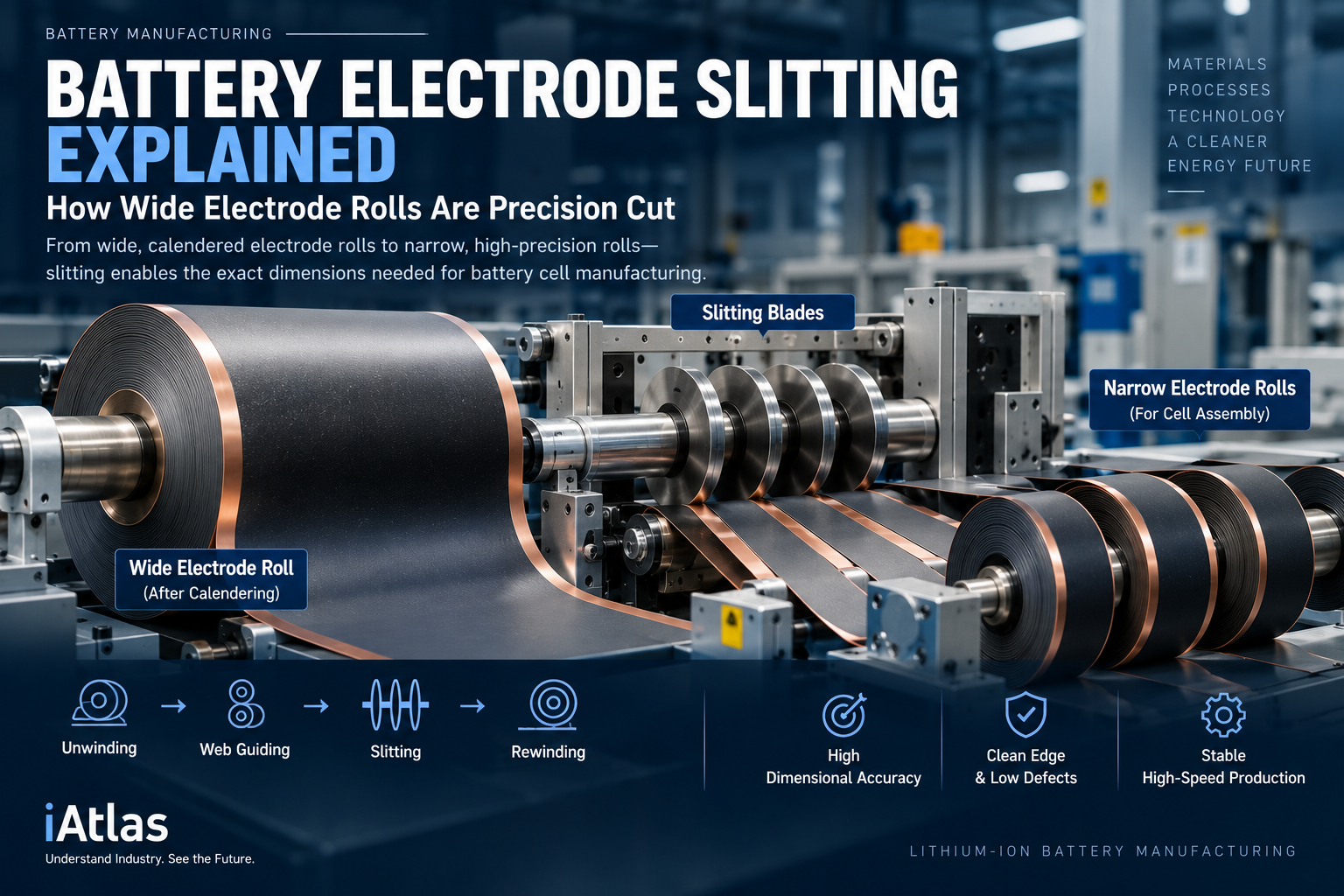
Battery Electrode Slitting Explained: How Wide Electrode Rolls Are Precision Cut
Understanding Slitting Blades, Electrode Width, Edge Quality, Burr Formation, and Contamination Control in Lithium-ion Battery Manufacturing
Category: Battery Technology
Content Type: Manufacturing
Learning Path: Battery Manufacturing
Related Industries: Electric Vehicles · Energy Storage Systems · Consumer Electronics
Last Updated: August 2026
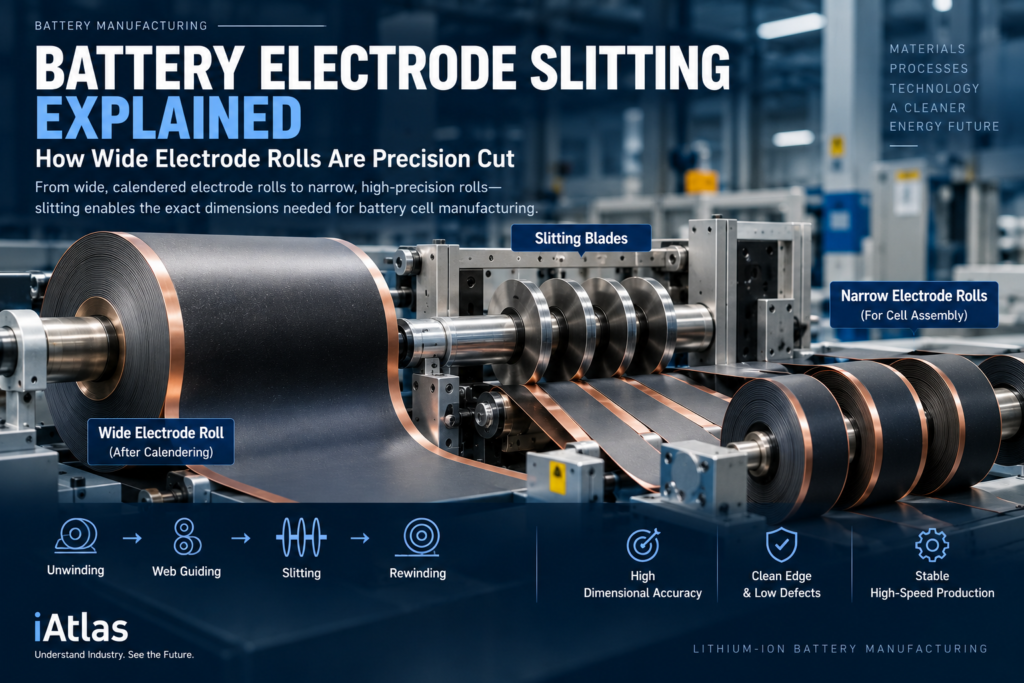
Industry Snapshot
Battery electrode slitting is the manufacturing process that cuts a wide, calendered electrode roll into narrower electrode rolls with precisely controlled widths.
The process typically follows calendering.
Electrode Coating
→ Electrode Drying
→ Calendering
→ Slitting
→ Cell Assembly
During coating and calendering, electrodes are generally processed as relatively wide continuous webs to achieve high manufacturing productivity.
However, battery cells require electrodes with specific dimensions.
Slitting converts the wide electrode web into narrower rolls suitable for downstream processes such as notching, winding, or stacking.
The cutting itself appears simple.
But poor slitting can generate burrs, particles, edge damage, dimensional variation, and mechanical defects that may propagate into later cell manufacturing.
For this reason, electrode slitting is fundamentally a precision converting process.
At a Glance
| Category | Description |
|---|---|
| Process | Electrode Slitting |
| Stage | Electrode Manufacturing |
| Input | Calendered Electrode Roll |
| Main Function | Longitudinal Precision Cutting |
| Output | Narrow Electrode Rolls |
| Key Parameters | Width · Blade Gap · Overlap · Tension · Speed |
| Key Risks | Burrs · Particles · Edge Damage · Width Variation |
| Previous Process | Calendering |
| Next Process | Cell Assembly / Notching |
What Is Battery Electrode Slitting?
Battery electrode slitting is the process of cutting a wide electrode sheet longitudinally into multiple narrower strips.
The basic flow is:
Wide Calendered Electrode Roll
↓
Unwinding
↓
Web Alignment
↓
Slitting Blades
↓
Separated Electrode Strips
↓
Rewinding
The resulting rolls have widths designed for specific battery cell dimensions.
Unlike cutting across the electrode, slitting continuously cuts along the direction of web travel.
This allows high-speed roll-to-roll processing.
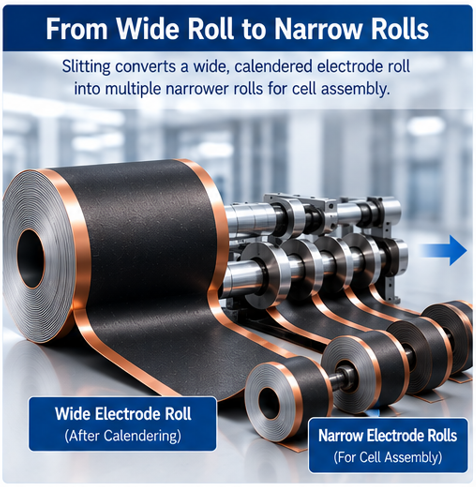
Why Are Electrodes Manufactured as Wide Rolls?
Battery electrodes are not normally coated individually at their final cell width.
Instead, manufacturers use wide rolls because continuous roll-to-roll production provides significant productivity advantages.
A simplified manufacturing flow is:
Wide Metal Foil
↓
Coating
↓
Drying
↓
Calendering
↓
Slitting
↓
Multiple Narrow Electrode Rolls
Processing wide webs enables larger quantities of electrode material to pass through coating, drying, and calendering equipment continuously.
Slitting then converts that production format into dimensions suitable for cell manufacturing.
How Battery Electrode Slitting Works
A typical slitting line contains several major functions.
Unwinding
The wide electrode roll is released into the slitting system.
Web Guiding
The electrode web is aligned so that it enters the cutting section at the correct position.
Slitting
Precision cutting tools divide the web longitudinally.
Separation
The resulting strips are separated to prevent interference between adjacent electrode rolls.
Rewinding
Each strip is wound into a new narrow electrode roll.
Throughout the process, the system must maintain stable:
- Web position
- Cutting accuracy
- Electrode tension
- Roll alignment
- Rewinding quality
Slitting Blades
The cutting system is the heart of the slitting process.
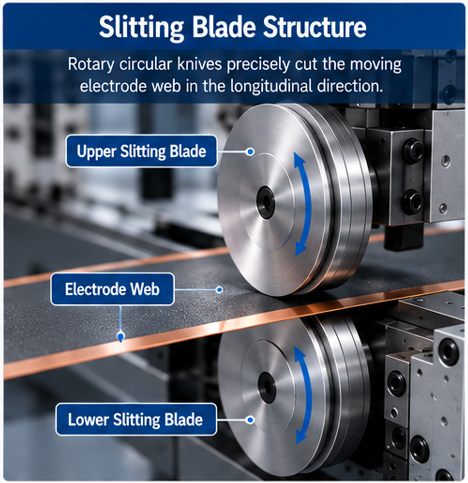
One common approach uses circular rotary knives.
Conceptually:
Upper Circular Blade
↓
Electrode Web
↑
Lower Circular Blade
As the electrode moves through the rotating blades, shear forces cut the material continuously.
Blade geometry and positioning must be carefully controlled because battery electrodes are complex layered materials.
The blade must cut through:
Electrode Coating
Metal Current Collector
without creating unacceptable edge damage.
Why Battery Electrodes Are Difficult to Cut
An electrode is not a simple metal sheet.
A cathode may consist of:
Active Material + Conductive Additive + Binder
↓
coated on
↓
Aluminum Current Collector
An anode may consist of:
Graphite / Silicon-Based Material + Binder + Conductive Additive
↓
coated on
↓
Copper Current Collector
The cutting tool therefore interacts simultaneously with a relatively brittle composite coating and a thin metallic foil.
This combination makes clean edge formation challenging.
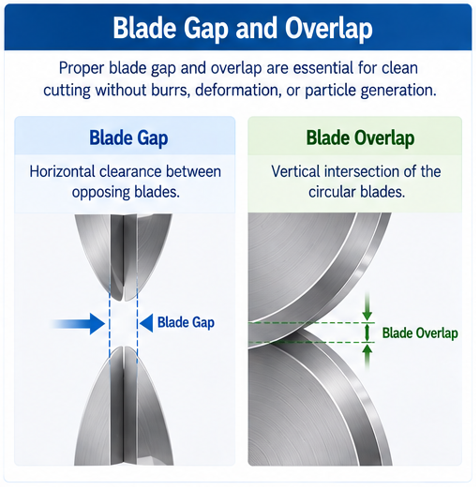
Blade Gap and Overlap
The relative position of the cutting blades strongly influences slitting quality.
Two important concepts are:
Blade Gap
The horizontal clearance between opposing cutting edges.
Blade Overlap
The degree to which the circular blades vertically intersect in the cutting zone.
If these settings are poorly optimized, the cut may produce:
- Excessive burrs
- Deformation
- Tearing
- Particle generation
- Accelerated blade wear
Optimal settings depend on electrode characteristics such as thickness, coating properties, and current collector material.
Electrode Width Accuracy
Each slit electrode must meet its specified width.
If the electrode is too wide or too narrow, it can create problems during downstream processes.
For example:
Incorrect Electrode Width
↓
Misalignment During Cell Assembly
↓
Electrode Overlap Problems
↓
Reduced Manufacturing Consistency
Precise dimensional control becomes particularly important when cathode and anode geometries are intentionally designed with different dimensions.
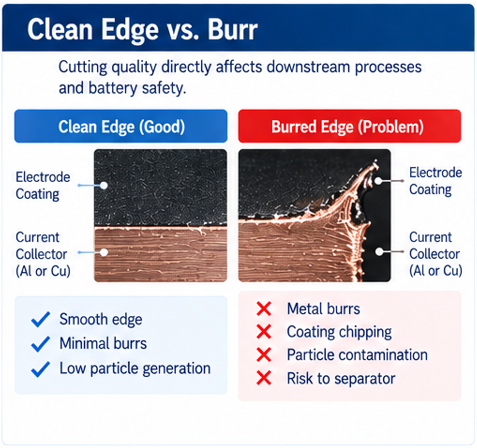
What Is a Slitting Burr?
A burr is a small protruding or deformed edge created during cutting.
When a thin metal current collector is cut, the edge may not separate perfectly.
Instead, a small metallic projection can remain.
Conceptually:
Clean Edge
────────
versus
Burred Edge
───────╱
The burr may be extremely small, but battery manufacturing operates at dimensions where microscopic defects can matter.
Why Burrs Matter in Battery Manufacturing
Battery cells contain positive and negative electrodes separated by a thin separator.
The separator is designed to prevent direct electrical contact while allowing ionic transport.
A sharp metallic burr can therefore become a serious concern.
Conceptually:
Electrode Edge Burr
↓
Mechanical Stress on Separator
↓
Potential Separator Damage
↓
Possible Internal Electrical Contact
For this reason, burr height and edge quality are important manufacturing quality characteristics.
Not every burr results in a failure, but controlling burr formation reduces downstream risk.
Particle Generation
Slitting can also generate particles.
During cutting, fragments may originate from:
- Electrode coating
- Active material
- Current collector
- Blade wear
- Edge fracture
These particles can contaminate the electrode surface or surrounding equipment.
Particle control is especially important because foreign material inside a battery cell can potentially affect:
- Separator integrity
- Local electrical behavior
- Cell consistency
- Long-term reliability
Edge Quality
A high-quality slit electrode should have a clean and consistent edge.
Important characteristics include:
- Minimal burr formation
- Minimal coating fracture
- Low particle generation
- Stable edge geometry
- Consistent width
- No significant delamination
Poor edge quality can also make later handling more difficult.
Electrode Delamination During Slitting
The mechanical forces generated during cutting can affect adhesion between the electrode coating and current collector.
If adhesion is insufficient, material near the cut edge may separate.
This can create:
Coating Delamination
→ Particle Generation
→ Edge Defects
→ Downstream Contamination
Slitting quality is therefore connected to earlier manufacturing processes.
For example, electrode adhesion can already be influenced by:
- Slurry formulation
- Coating
- Drying
- Calendering
This demonstrates how defects can propagate through the manufacturing chain.
Web Tension Control
Electrode tension must remain stable while the web moves through the slitting line.
If tension is too low:
- Web tracking can become unstable
- Wrinkles may form
- Cutting position may vary
If tension is too high:
- The electrode can stretch or deform
- Mechanical stress can increase
- Rewinding quality may deteriorate
The goal is controlled tension throughout:
Unwinding
→ Cutting
→ Separation
→ Rewinding
Web Alignment and Edge Guiding
Even perfectly positioned blades cannot maintain correct electrode width if the incoming web moves laterally.
Slitting equipment therefore often incorporates web guiding or edge-position control.
Sensors detect the web position.
The control system then corrects alignment before or during cutting.
This helps maintain consistent cut location across long electrode rolls.
Slitting Speed
Higher slitting speed can increase manufacturing throughput.
However, increasing speed can make it more difficult to maintain:
- Cutting stability
- Web tension
- Edge quality
- Particle control
- Rewinding accuracy
Therefore, production speed must be optimized together with blade condition and web-handling parameters.
Blade Wear
Slitting blades gradually wear during operation.
A sharp blade can produce a cleaner cut.
As wear progresses:
Blade Sharpness ↓
↓
Cutting Quality Can Deteriorate
↓
Burrs / Particles May Increase
Manufacturers therefore need blade inspection, maintenance, and replacement strategies.
Blade lifetime can depend on:
- Electrode chemistry
- Coating hardness
- Current collector
- Electrode thickness
- Slitting speed
- Blade material
Cathode vs Anode Slitting
Cathode and anode electrodes may behave differently during cutting.
Cathode
Typical current collector:
Aluminum Foil
Common active materials:
- NMC
- NCA
- LFP
Anode
Typical current collector:
Copper Foil
Common active materials:
- Graphite
- Silicon-Graphite
Differences in coating composition, mechanical properties, foil material, and electrode thickness can require different slitting conditions.
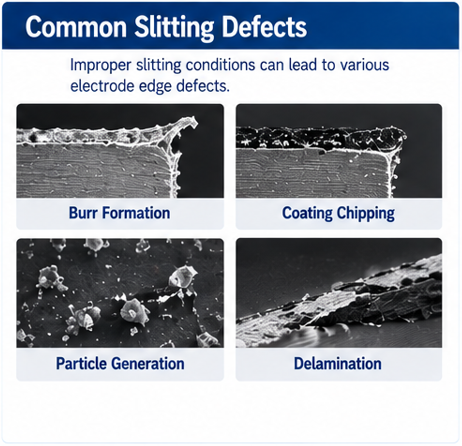
Common Electrode Slitting Defects
Poor slitting conditions can create several types of defects.
Metal Burrs
Small metallic projections remain along the cut edge.
Coating Chipping
Small fragments break away from the electrode coating.
Particle Contamination
Loose material is generated during cutting.
Delamination
The coating separates locally from the current collector.
Width Variation
The slit electrode does not maintain the target width.
Edge Waves
The electrode edge becomes mechanically distorted.
Wrinkles
Poor web handling creates deformation.
Poor Rewinding
The slit roll develops uneven or unstable winding geometry.
These defects may interfere with subsequent manufacturing.
Quality Control After Slitting
Manufacturers can inspect several characteristics after slitting.
Electrode Width
Confirms dimensional accuracy.
Burr Height
Measures protrusions at the cut edge.
Edge Condition
Detects chipping, cracking, or delamination.
Particle Contamination
Checks for material generated during cutting.
Surface Defects
Identifies scratches, wrinkles, or mechanical damage.
Roll Quality
Ensures stable and uniform rewinding.
Increasingly, optical inspection and automated measurement systems can support continuous monitoring.
Inline Inspection
High-volume battery manufacturing requires more than occasional manual inspection.
Machine vision systems can monitor electrode edges during production.
A simplified inspection concept is:
Slitting
↓
Camera / Optical Sensor
↓
Edge Detection
↓
Defect Analysis
↓
Process Feedback
Automated inspection can help identify deviations before large quantities of electrode material are processed.
Contamination Control
Slitting is a mechanical cutting process and therefore requires careful contamination management.
Production systems may incorporate:
- Particle extraction
- Vacuum collection
- Cleaning systems
- Controlled airflow
- Equipment cleaning procedures
The objective is to prevent cutting debris from remaining on the electrode or entering later cell manufacturing stages.
From Slitting to Cell Assembly
Slitting completes the main continuous electrode-manufacturing sequence.
The overall flow becomes:
Material Mixing
↓
Battery Slurry
↓
Electrode Coating
↓
Electrode Drying
↓
Calendering
↓
Slitting
↓
Cell Assembly
After slitting, the manufacturing route depends partly on cell design.
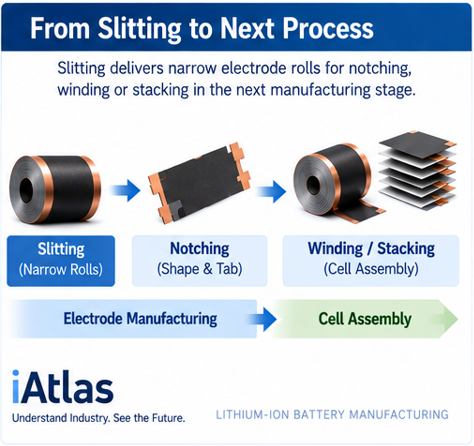
For many cell processes, the slit electrode can proceed to additional converting operations such as notching, followed by winding or stacking.
Slitting, Notching, Winding, and Stacking
These processes should not be confused.
Slitting
Cuts a wide continuous electrode roll into narrower rolls.
Notching
Cuts electrode material into the required geometry and can form features such as electrode tabs depending on the manufacturing approach.
Winding
Winds electrode and separator layers into a jelly-roll structure.
Stacking
Builds the cell by placing electrode and separator layers in sequence.
A simplified route can therefore be:
Slitting
→ Notching
→ Winding / Stacking
→ Cell Assembly
The exact sequence varies with cell architecture and manufacturing method.
Why Slitting Matters to Battery Safety
Slitting is a good example of how a seemingly simple mechanical process can influence battery safety.
The connection is:
Cutting Condition
↓
Electrode Edge Quality
↓
Burr / Particle Generation
↓
Interaction with Separator
↓
Cell Reliability & Safety
This does not mean that slitting alone determines battery safety.
Instead, it illustrates why battery manufacturing requires tight control at every stage.
Small defects introduced early can become more significant after the cell is assembled.
Emerging Electrode Slitting Technologies
Battery manufacturers continue to improve electrode converting technologies.
Advanced Machine Vision
Higher-resolution imaging can improve real-time edge inspection.
Automated Burr Detection
Inspection systems can detect increasingly small edge defects.
Predictive Blade Maintenance
Process data can help determine when blades should be replaced before quality deteriorates.
Laser Cutting
Laser-based electrode cutting is increasingly relevant in some battery manufacturing processes, particularly for precision cutting and notching applications.
Integrated Process Control
Slitting equipment can increasingly combine:
Web Position
Tension
Blade Condition
Inspection Data
to maintain more consistent manufacturing quality.
iAtlas Insight
Electrode manufacturing begins with chemistry, but eventually becomes an exercise in precision mechanical engineering.
Slitting makes this transition especially visible.
The electrode arriving at the slitting line already contains the result of several tightly controlled processes:
Mixing
determined material dispersion.
Coating
determined material loading.
Drying
formed the porous electrode structure.
Calendering
adjusted density and porosity.
Then slitting must cut that carefully engineered structure without damaging it.
The ideal slitting process therefore needs to achieve two objectives simultaneously:
High-Speed Precision Cutting
and
Minimal Electrode Damage
As battery factories move toward higher throughput, thinner current collectors, thicker active-material coatings, and increasingly demanding cell designs, edge quality and contamination control become even more important.
The final electrode may be measured in hundreds of millimeters.
But some of the defects that matter can exist at the micrometer scale.
Did You Know?
- Slitting cuts electrodes along the direction of web travel.
- Battery electrodes are usually coated and calendered as wider rolls before slitting.
- Cathodes commonly use aluminum current collectors, while anodes commonly use copper.
- Slitting must cut both the electrode coating and metallic current collector.
- Metallic burrs can create concerns because electrodes are separated by thin separator films inside the cell.
- Blade condition can influence burr and particle generation.
- Web tension and alignment are important for dimensional accuracy.
- Slitting and notching are different manufacturing processes.
FAQ
What is battery electrode slitting?
Battery electrode slitting is the process of longitudinally cutting a wide calendered electrode roll into narrower rolls with dimensions suitable for battery cell manufacturing.
When does electrode slitting occur?
It normally occurs after electrode calendering and before later cell-assembly or electrode-converting processes.
What is a slitting burr?
A slitting burr is a small protrusion or deformation that can form at the metal current collector edge during cutting.
Why are electrode burrs important?
Large or sharp burrs can create mechanical concerns near the separator and therefore need to be tightly controlled.
What causes particles during slitting?
Particles can originate from fractured electrode coating, current collector cutting, edge damage, or blade wear.
What parameters affect slitting quality?
Important factors include blade gap, blade overlap, blade condition, electrode tension, web alignment, material properties, and line speed.
Is slitting the same as notching?
No. Slitting divides a wide continuous electrode web into narrower rolls. Notching performs more detailed electrode shaping for subsequent cell assembly.
What happens after slitting?
Depending on the cell manufacturing process, electrodes may proceed to notching and then winding or stacking before later cell assembly stages.
Battery Manufacturing Learning Path
Overview
Electrode Manufacturing
- Material Mixing
- Battery Slurry
- Battery Electrode Coating
- Battery Electrode Drying
- Calendering
- Slitting (Current)
Cell Assembly
- Battery Cell Assembly
- Notching
- Winding
- Stacking
- Electrolyte Filling
- Cell Sealing
Cell Finishing
- Formation
- Aging
- Degassing
- Battery Cell Testing & Grading
System Assembly
- Battery Module Assembly
- Battery Pack Assembly
Explore More
Fundamentals
- Battery
- Lithium-ion Battery
- Battery Cell
- Battery Module
- Battery Pack
- Battery Management System(BMS)
- Battery Thermal Management System(BTMS)
- Battery Safety
Materials
Manufacturing
- Battery Manufacturing Process
- Material Mixing
- Battery Slurry
- Battery Electrode Coating
- Battery Electrode Drying
- Calendering
- Slitting (Current)
- Battery Cell Assembly
- Notching
Materials
- Cathode
- Anode
- Separator
- Electrolyte
References
Recommended primary research areas for this article:
- Journal of Power Sources
Computational and Experimental Studies of Laser Cutting of the Current Collectors for Lithium-ion Batteries - Journal of Materials Processing Technology
Characterization and Process Optimization of Remote Laser Cutting of Current Collectors for Battery Electrode Production - Journal of Power Sources
High Speed Remote Laser Cutting of Electrodes for Lithium-ion Batteries: Anode
About iAtlas
iAtlas is an independent publication covering batteries, semiconductors, OLED, advanced materials, AI, and global industrial trends.
We transform complex industrial developments into clear, reliable, and easy-to-understand insights.
Whether you’re following today’s industry news or building long-term expertise, iAtlas helps you understand not only what happened, but why it matters.
Technology creates change.
Insight creates opportunity.
— iAtlas