Battery Drying Equipment Explained: 7 Things Every Engineer Should Know
🔋 iAtlas Battery #20 | ⚙️ Equipment → 🌡️ Drying Equipment
After electrode slurry is coated onto copper or aluminum foil, the solvent must be removed before the electrode can move to calendaring and later cell assembly.
This may sound like a simple heating process, but electrode drying is one of the most sensitive steps in lithium-ion battery manufacturing. The drying conditions influence binder distribution, adhesion, porosity, coating strength, and overall electrode uniformity.
If drying is too fast, the surface may harden before solvent inside the coating can escape. If it is too slow, production speed falls and energy consumption increases. Battery manufacturers therefore use precisely controlled drying equipment to remove solvent without damaging the electrode structure.
This article explains how battery drying equipment works, the main components of a drying line, the key process variables, common defects, and the technologies shaping the future of electrode drying.
Table of Contents
- What Is Battery Drying Equipment?
- Why Electrode Drying Matters
- How a Battery Drying Line Works
- Main Drying Technologies
- Critical Drying Parameters
- Common Drying Defects
- Solvent Recovery and Energy Efficiency
- The Future of Battery Drying
- Frequently Asked Questions
- Key Takeaways
1. What Is Battery Drying Equipment?
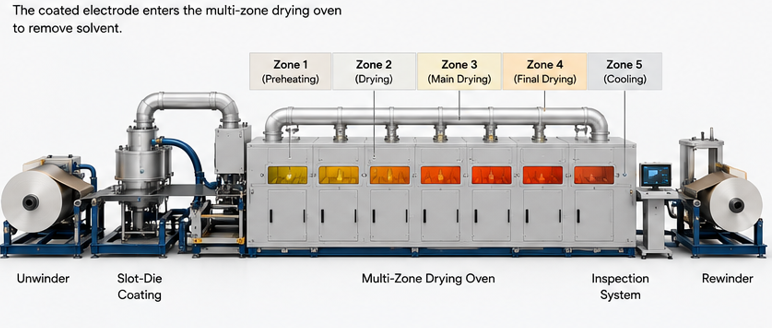
Battery drying equipment removes solvent from a freshly coated electrode.
A typical wet electrode coating contains:
- Active material
- Conductive additive
- Binder
- Solvent
- Current collector
The current collector is normally:
- Aluminum foil for the cathode
- Copper foil for the anode
The solvent depends on the electrode chemistry and binder system. Many cathode production processes use N-Methyl-2-pyrrolidone, commonly known as NMP, while graphite anodes are often manufactured with water-based slurry systems.
After coating, the wet electrode passes directly into a drying oven. Heated air, controlled airflow, and exhaust systems remove the solvent as the foil continuously travels through the production line.
The purpose of drying is not simply to make the electrode dry. The process must also preserve the coating’s internal structure and maintain uniform properties across the full width and length of the electrode roll.
2. Why Electrode Drying Matters
Drying has a direct influence on electrode quality.
Important properties affected by drying include:
- Adhesion to the current collector
- Electrode porosity
- Binder distribution
- Mechanical strength
- Electrical conductivity
- Electrolyte penetration
- Capacity consistency
- Cycle life
During drying, solvent moves from inside the wet coating toward the surface and evaporates into the surrounding air. At the same time, solid particles, binder, and conductive materials gradually form the final porous electrode structure.
If this process is not controlled properly, the electrode may develop defects that cannot be fully corrected later.
Binder Migration
Binder migration is one of the most important issues in electrode drying.
As solvent moves toward the electrode surface, it can carry binder with it. Excessive migration may leave too much binder near the top of the coating and too little near the current collector.
This can result in:
- Weak adhesion to the foil
- Uneven electrical conductivity
- Non-uniform mechanical strength
- Inconsistent electrochemical performance
A carefully designed drying profile helps reduce this movement.
Porosity and Electrolyte Penetration
Electrode porosity determines how easily electrolyte can penetrate the coating and how efficiently lithium ions can move through the electrode.
Drying conditions affect the size, distribution, and connectivity of pores. Very rapid drying may create an uneven structure, while controlled drying helps produce more consistent porosity.
The final pore structure is also influenced by the following calendaring process, but drying establishes the starting structure before compression.
Production Yield
Drying defects often appear later during calendaring, slitting, winding, or stacking.
For example, a poorly dried electrode may:
- Crack during roll pressing
- Separate from the current collector
- Curl during slitting
- Show uneven thickness
- Retain excessive solvent
Because these problems reduce production yield, drying quality is closely linked to manufacturing cost.
3. How a Battery Drying Line Works
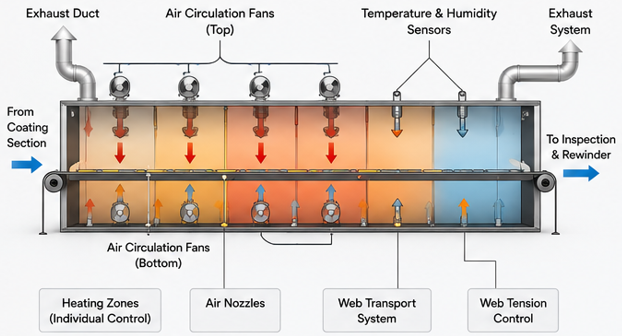
Modern battery drying systems are normally integrated directly with the coating line.
The coated foil enters the oven and moves through several individually controlled drying zones before reaching an inspection system and rewinder.
Multi-Zone Drying Oven
A battery drying oven is divided into multiple zones rather than using one uniform temperature.
Each zone can have different settings for:
- Temperature
- Air velocity
- Exhaust rate
- Humidity
- Solvent concentration
The first zone usually begins drying more gently to prevent rapid surface hardening. The middle zones remove most of the solvent, while later zones complete the process and stabilize the electrode.
This gradual approach provides better control than exposing the wet coating to maximum heat immediately.
Air Circulation and Nozzles
Heated air is delivered through specially designed nozzles positioned above, below, or on both sides of the moving foil.
The airflow must be uniform across the entire web width. Uneven air distribution can cause one area of the electrode to dry faster than another.
This may create differences in:
- Residual solvent
- Coating density
- Surface condition
- Adhesion
Dryer manufacturers therefore optimize nozzle geometry, circulation patterns, and exhaust locations to improve uniformity.
Web Transport System
The foil must travel through the oven at a stable speed and tension.
The transport system includes rollers, tension controllers, edge-position systems, and drive units. Its role is to prevent:
- Wrinkles
- Stretching
- Misalignment
- Contact damage
- Uneven movement
Stable web handling becomes increasingly important as current collectors become thinner and production lines operate at higher speeds.
Exhaust and Safety System
As solvent evaporates, its concentration inside the oven increases.
The exhaust system removes solvent vapor and introduces controlled amounts of fresh air. Sensors continuously monitor the oven atmosphere to keep solvent concentration within safe operating limits.
The system may include:
- Solvent concentration sensors
- Temperature sensors
- Pressure monitoring
- Airflow monitoring
- Automatic shutdown logic
- Fire and explosion protection
Process Monitoring
Modern equipment collects real-time data from each drying zone.
Operators can monitor:
- Zone temperature
- Web speed
- Web tension
- Air velocity
- Humidity
- Exhaust volume
- Solvent concentration
- Energy consumption
These measurements help maintain stable production and identify process deviations before they generate large quantities of defective electrodes.
4. Main Drying Technologies
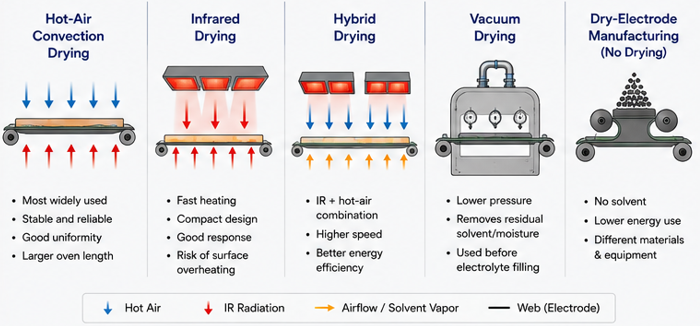
Several drying technologies can be used in battery manufacturing. Most high-volume lines rely on hot-air convection, although infrared and hybrid systems are increasingly considered for faster and more energy-efficient production.
Hot-Air Convection Drying
Hot-air convection is the most widely used technology for wet electrode manufacturing.
Heated air flows across the electrode surface, transfers thermal energy to the coating, and carries evaporated solvent into the exhaust system.
Its main advantages are:
- Proven industrial reliability
- Stable temperature control
- Good compatibility with continuous production
- Relatively uniform drying
- Flexible oven-zone design
The main drawback is the large oven length and high energy demand required for high-speed production.
Infrared Drying
Infrared systems transfer radiant energy directly to the electrode rather than relying only on heated air.
Infrared heating offers:
- Fast response
- Rapid surface heating
- Compact equipment design
- Potentially higher drying speed
However, excessive surface heating can create temperature gradients or encourage rapid skin formation. Infrared is therefore often used together with convection drying.
Hybrid Drying
Hybrid systems combine two or more drying methods.
A typical hybrid line may use infrared energy for rapid initial heating and hot-air convection for controlled solvent removal.
The goal is to improve:
- Production speed
- Energy efficiency
- Temperature response
- Drying uniformity
Hybrid equipment may become more important as manufacturers seek to shorten ovens without sacrificing electrode quality.
Vacuum Drying
Vacuum drying is generally used later in the production process rather than immediately after coating.
Lower pressure helps remove residual moisture and solvent from electrodes or assembled cells at relatively moderate temperatures.
It is especially important before electrolyte filling because moisture can negatively affect electrolyte stability and battery performance.
Dry-Electrode Manufacturing
Dry-electrode manufacturing avoids conventional slurry solvents altogether.
Instead of coating a liquid slurry and removing solvent, dry processes may use powder mixing, binder fibrillation, film formation, and lamination.
Potential advantages include:
- No large coating dryer
- Lower factory energy consumption
- Reduced solvent handling
- Smaller equipment footprint
- Shorter production flow
However, dry-electrode processing requires different material behavior, equipment design, and quality-control methods. It is therefore better understood as an alternative manufacturing route rather than simply another type of dryer.
5. Critical Drying Parameters
Battery drying quality depends on the interaction between several process variables. Changing one parameter may require adjustments to others.
Temperature Profile
A multi-zone temperature profile is normally used instead of one fixed temperature.
The entrance zone often applies moderate heat to avoid drying the surface too quickly. Higher thermal input can then be used in the middle of the oven, followed by final drying and stabilization near the exit.
The correct profile depends on:
- Electrode chemistry
- Coating thickness
- Solvent type
- Binder system
- Production speed
Airflow
Airflow provides heat transfer and removes solvent vapor from the coating surface.
Airflow that is too low reduces drying capacity. Airflow that is too strong may disturb the wet coating or increase uneven surface drying.
Uniform air distribution across the web is more important than simply maximizing air velocity.
Web Speed
Web speed determines how long the electrode remains inside the oven.
Faster speed improves production throughput but reduces drying time. Manufacturers must therefore balance line speed with oven length, temperature, airflow, and coating thickness.
Coating Thickness
A thick electrode contains more solvent and requires more drying capacity than a thin electrode.
High-loading electrodes developed for greater energy density can be more difficult to dry uniformly because solvent must travel a longer distance from the interior of the coating to the surface.
Humidity
Humidity control is particularly important for water-based electrode systems.
Changes in ambient or process-air humidity can influence evaporation rate and drying consistency. Stable dry-room conditions help reduce this variation.
Web Tension
The foil expands and contracts as it is heated and cooled. Proper tension control keeps the web stable throughout the oven.
Poor tension control can create wrinkles, curling, or alignment problems that affect later processing.

6. Common Drying Defects
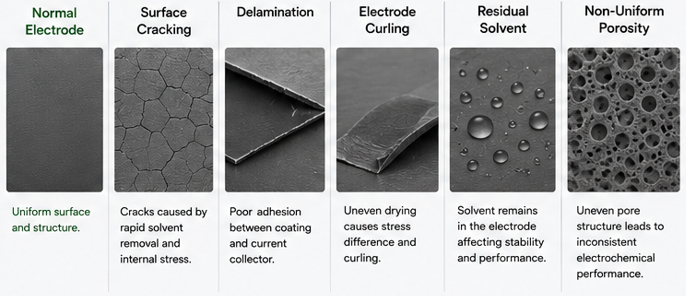
Surface Cracking
Rapid solvent evaporation can create internal stress in the coating. If the stress exceeds the mechanical strength of the wet electrode, surface cracks may form.
Cracking is more likely with thick or high-loading coatings.
Delamination
Delamination occurs when the electrode coating separates from the current collector.
Possible causes include:
- Binder migration
- Contaminated foil
- Poor surface preparation
- Excessively rapid drying
- Incorrect slurry formulation
Electrode Curling
The coated and uncoated surfaces of the foil may contract differently during drying. This difference can cause the electrode to curl.
Severe curling makes slitting, stacking, and winding more difficult.
Residual Solvent
If drying is incomplete, solvent may remain inside the electrode.
Residual solvent can affect downstream processing and cell stability. It may also indicate that the oven temperature, residence time, or exhaust conditions are insufficient.
Non-Uniform Porosity
Different drying rates across the coating can create variations in pore structure. This may lead to uneven electrolyte wetting and inconsistent ion transport.
Edge Defects
The coating edges may dry differently from the center because of local airflow patterns and heat transfer.
Dryer and nozzle designs must therefore control both cross-web and edge-zone uniformity.
7. Solvent Recovery and Energy Efficiency
Drying is one of the most energy-intensive stages of wet electrode production.
The process requires energy to:
- Heat process air
- Evaporate solvent
- Circulate large air volumes
- Operate exhaust systems
- Recover and purify solvent
Cathode production using NMP also requires a solvent recovery system.
Evaporated NMP is collected from the oven exhaust, cooled, condensed, and sent for purification or reuse. Recovery reduces solvent loss and limits emissions to the surrounding environment.
Modern factories improve efficiency through:
- Heat recovery from exhaust air
- Recirculation of conditioned air
- High-efficiency fans
- Better oven insulation
- Optimized nozzle design
- Automated control of exhaust volume
- Production-data analysis
The objective is to use only the airflow and thermal energy required for stable drying rather than operating every zone at maximum capacity.
8. The Future of Battery Drying
Future drying equipment will focus on higher productivity, lower energy use, and more precise process control.
Faster Production Lines
Battery manufacturers are increasing coating width and web speed to produce more electrode material from each line.
This requires improved heat transfer, better airflow design, and faster solvent removal without increasing defects.
Thicker Electrodes
Thicker electrodes can improve cell energy density by reducing the relative amount of inactive material.
However, they are more difficult to dry because solvent must travel farther through the coating. Advanced drying profiles and hybrid technologies may be needed to maintain uniformity.
Digital Process Control
Drying lines are increasingly connected to inspection systems and factory data platforms.
By combining dryer data with coating thickness, surface inspection, and downstream quality results, manufacturers can identify relationships between process conditions and defects.
AI and Digital Twins
AI-based control systems may help optimize zone temperatures, airflow, and line speed in real time.
Digital twins can simulate heat transfer and solvent movement before changes are applied to production equipment.
These technologies are intended to reduce trial-and-error testing and improve process consistency.
Expansion of Dry-Electrode Technology
Dry-electrode manufacturing could significantly reduce the need for conventional drying ovens.
Even so, wet electrode processes are expected to remain important because they are already established across global battery factories.
The industry may therefore develop in two directions:
- More efficient wet-coating and drying lines
- New solvent-free electrode production systems
9. Frequently Asked Questions
Why are battery drying ovens divided into several zones?
Multiple zones allow manufacturers to control solvent evaporation gradually. This helps reduce surface cracking, binder migration, and uneven drying.
What is the most common battery drying technology?
Hot-air convection drying is the most widely used technology in commercial lithium-ion battery electrode production.
Why is drying especially difficult for thick electrodes?
Thicker coatings contain more solvent, and the solvent inside the electrode must travel farther before reaching the surface.
Does the cathode use a different drying process from the anode?
Often, yes. Cathodes may use NMP-based slurry, while graphite anodes commonly use water-based slurry. The solvents require different drying and recovery conditions.
Is vacuum drying part of the coating line?
Usually not. Vacuum drying is more commonly used later to remove residual moisture or solvent before electrolyte filling.
10. Key Takeaways
- Battery drying equipment removes solvent from coated electrodes while preserving their internal structure.
- Drying conditions influence adhesion, binder distribution, porosity, conductivity, and production yield.
- Modern lines use multi-zone ovens with controlled temperature, airflow, exhaust, web speed, and tension.
- Hot-air convection remains the dominant technology, while infrared and hybrid systems can improve drying speed and efficiency.
- Common defects include cracking, delamination, curling, residual solvent, and non-uniform porosity.
- Solvent recovery and heat-management systems are essential for reducing emissions and operating costs.
- Future equipment will combine higher-speed production, digital monitoring, AI-based control, and potentially solvent-free electrode manufacturing.
📚 Key Terms
Binder Migration
The movement of binder within a wet electrode during solvent evaporation.
NMP
N-Methyl-2-pyrrolidone, a solvent commonly used in cathode slurry production.
Porosity
The proportion and structure of empty spaces within an electrode coating.
Residual Solvent
Solvent that remains inside the electrode after drying.
Web Speed
The speed at which coated foil travels through the production line.
Web Tension
The controlled pulling force applied to the moving electrode foil.
Solvent Recovery
The process of collecting, condensing, and recycling solvent vapor from the dryer exhaust.
🎓 Battery Learning Path
⚙️ Equipment
✅ #18 — Mixing Equipment
✅ #19 — Coating Equipment
📍 #20 — Drying Equipment
▶ #21 — Calendaring Equipment
▶ #22 — Slitting Equipment
▶ #23 — Stacking & Winding Equipment
📖 Continue Reading
⬅ Previous Article
🔋 iAtlas Battery #19 — Battery Coating Equipment Explained
Learn how electrode slurry is applied uniformly to copper and aluminum current collectors before entering the drying process.
➡ Next Article
🔋 iAtlas Battery #21 — Battery Calendaring Equipment Explained
Discover how roll pressing controls electrode thickness, density, porosity, and surface uniformity after drying.
References
- International Energy Agency (IEA)
- U.S. Department of Energy – Vehicle Technologies Office
- Battery University
- Nature Energy (Battery Manufacturing Research)
🔷 About iAtlas
iAtlas is an independent publication covering batteries, semiconductors, OLED, advanced materials, AI, and global industrial trends.
We transform complex industrial developments into clear, reliable, and easy-to-understand insights.
Whether you’re following today’s industry news or building long-term expertise, iAtlas helps you understand not only what happened, but why it matters.
Technology creates change.
Insight creates opportunity.
— iAtlas