
Battery Inspection Explained: 7 Essential Quality Control Tests Every Battery Must Pass
🔋 iAtlas Battery #17 | 🏭 Manufacturing → 🔍 Battery Inspection & Quality Control
Introduction

Battery inspection is the final checkpoint before a lithium-ion battery leaves the factory.
Throughout battery manufacturing, every process—from electrode production to formation—must meet strict quality standards. However, even a well-manufactured battery can contain hidden defects that affect safety, reliability, or long-term performance.
Modern battery inspection combines automated testing, AI-driven analysis, and precision measurement systems to identify defective cells before they reach customers.
By performing comprehensive quality control, manufacturers improve production yield, reduce warranty costs, and ensure consistent battery performance.
Table of Contents
- What Is Battery Inspection?
- Open-Circuit Voltage (OCV) Test
- Internal Resistance (IR) Test
- Capacity Test
- Leak & Appearance Inspection
- X-ray & Advanced Inspection
- Future Trends
- Frequently Asked Questions
What Is Battery Inspection?
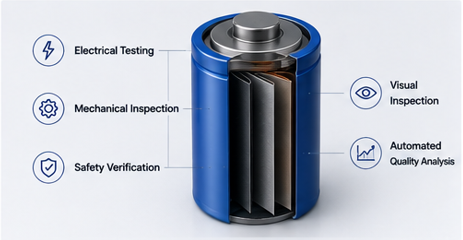
Battery inspection is the final quality control process performed before batteries are assembled into modules or packs.
Manufacturers verify that each battery cell satisfies electrical, mechanical, and safety requirements.
Typical inspection categories include:
- Electrical testing
- Mechanical inspection
- Safety verification
- Visual inspection
- Automated quality analysis
Only cells that meet every specification continue to the next stage.
Open-Circuit Voltage (OCV) Test
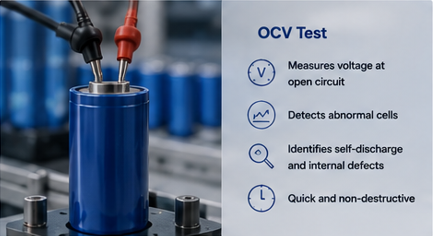
The Open-Circuit Voltage (OCV) test measures battery voltage after a stabilization period.
OCV testing helps detect:
- Internal defects
- Self-discharge abnormalities
- Improper formation
- Cell imbalance
Because OCV is quick and non-destructive, every battery cell is typically tested.
Internal Resistance (IR) Test
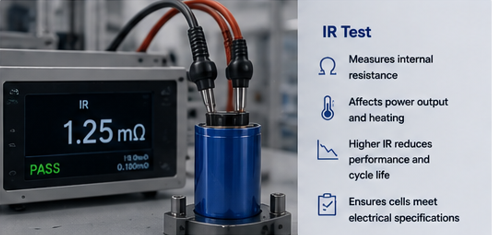
Internal resistance directly affects battery performance.
A higher resistance results in:
- Lower power output
- Increased heat generation
- Reduced fast-charging capability
- Shorter battery life
IR testing ensures every battery meets the manufacturer’s electrical specifications.
Capacity Test
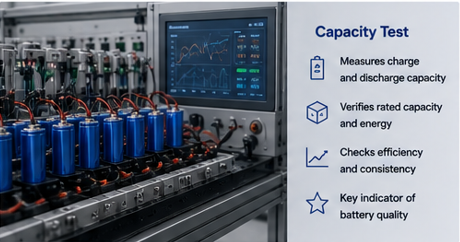
Capacity testing measures how much energy a battery can store.
Cells are charged and discharged under controlled conditions to verify:
- Rated capacity
- Energy efficiency
- Coulombic efficiency
- Consistency between cells
Capacity testing is one of the most important indicators of battery quality.
Leak & Appearance Inspection
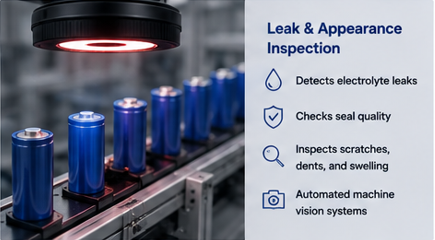
Battery manufacturers also inspect:
- Electrolyte leakage
- Seal quality
- Surface scratches
- Dents
- Swelling
Modern production lines often use machine vision systems to automate appearance inspection.
X-ray & Advanced Inspection
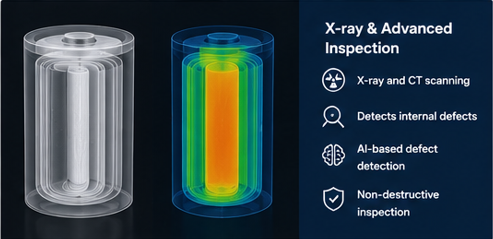
Advanced battery factories increasingly rely on non-destructive inspection technologies.
Examples include:
- X-ray inspection
- CT scanning
- AI-based defect detection
- Laser measurement
- Inline machine vision
These technologies identify hidden defects that cannot be detected visually.
Future Trends
Battery inspection continues evolving through smart manufacturing.
Current trends include:
- AI-powered defect detection
- Digital twin manufacturing
- Real-time inline inspection
- Automated traceability
- Predictive quality analytics
As battery production expands, inspection systems will become even faster, more accurate, and fully integrated into intelligent factories.
Frequently Asked Questions
What is battery inspection?
Battery inspection is the final quality control process that verifies battery safety, performance, and manufacturing quality before shipment.
Why is OCV testing important?
OCV testing identifies abnormal cells after formation and helps detect internal defects.
What does an internal resistance test measure?
It measures electrical resistance inside the battery, which influences power output, heat generation, and charging performance.
Why are X-ray inspections used?
X-ray inspection reveals hidden defects such as electrode misalignment, contamination, or internal structural damage without opening the battery.
Key Takeaways
- Battery inspection is the final quality control step in battery manufacturing.
- OCV, internal resistance, and capacity testing verify electrical performance.
- Leak testing and appearance inspection ensure mechanical quality.
- X-ray and AI inspection detect hidden defects.
- Smart inspection systems improve battery safety, consistency, and manufacturing efficiency.
🎓 Battery Learning Path
🏭 Manufacturing
✅ 🔋 iAtlas Battery #13 — Electrode Manufacturing
✅ 🔋 iAtlas Battery #14 — Cell Assembly
✅ 🔋 iAtlas Battery #15 — Electrolyte Filling
✅ 🔋 iAtlas Battery #16 — Formation & Aging
📍 🔋 iAtlas Battery #17 — Battery Inspection & Quality Control (Current)
🎉 Congratulations! You’ve completed the Manufacturing learning path.
Next Learning Path: ⚙️ Battery Equipment
📖 Continue Reading
⬅ Previous Article
🔋 iAtlas Battery #16
Battery Formation Explained: 5 Essential Steps That Determine Battery Life
Learn how formation creates the SEI layer, stabilizes battery performance, and determines long-term battery life.
➡ Next Learning Path
⚙️ Battery Equipment
🔋 iAtlas Battery #18
Battery Mixing Equipment Explained: How Slurry Mixers Ensure Consistent Battery Quality
Discover how industrial mixing systems produce uniform battery slurry and why precise mixing is the foundation of high-performance lithium-ion batteries.
References
- International Energy Agency (IEA)
- U.S. Department of Energy – Vehicle Technologies Office
- Battery University
- Nature Energy
About iAtlas
iAtlas is an independent publication covering batteries, semiconductors, OLED, advanced materials, AI, and global industrial trends.
We transform complex industrial developments into clear, reliable, and easy-to-understand insights.
Whether you’re following today’s industry news or building long-term expertise, iAtlas helps you understand not only what happened, but why it matters.
Technology creates change.
Insight creates opportunity.
— iAtlas