Battery Calendering Explained: How Electrode Density and Porosity Are Controlled
Understanding Electrode Compression, Thickness, Porosity, and Their Impact on Lithium-ion Battery Performance
Category: Battery Technology
Content Type: Manufacturing
Learning Path: Battery Manufacturing
Related Industries: Electric Vehicles · Energy Storage Systems · Consumer Electronics
Last Updated: August 2026
Industry Snapshot
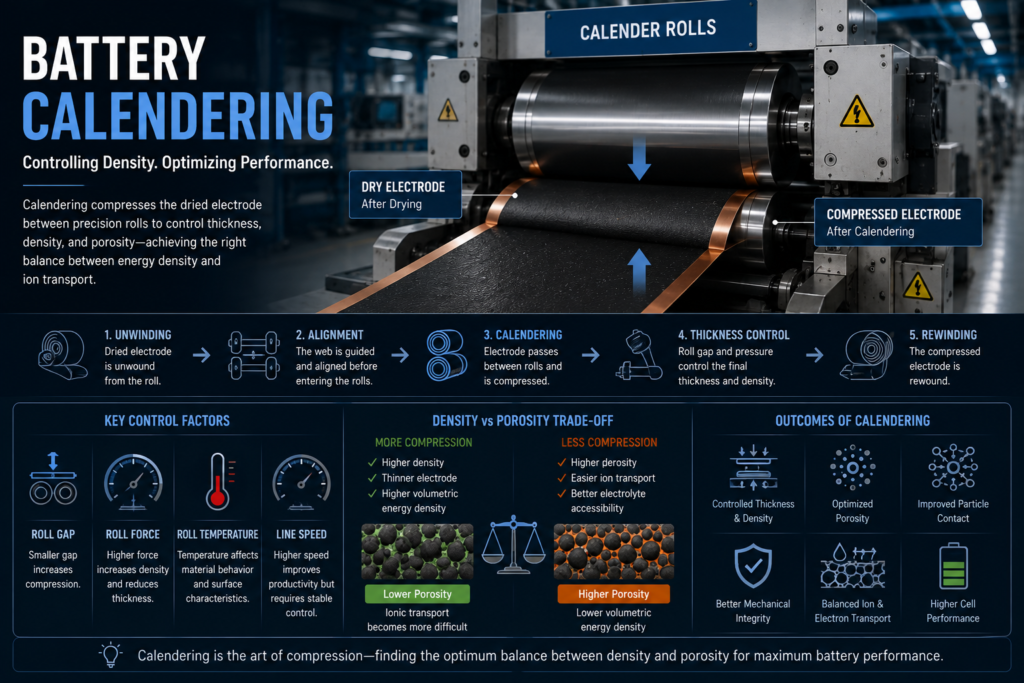
Battery calendering is an electrode manufacturing process in which a dried battery electrode is compressed between precision rollers to control its thickness, density, porosity, surface characteristics, and mechanical properties.
The process follows electrode drying.
Electrode Coating
→ Electrode Drying
→ Calendering
→ Slitting
After drying, the electrode contains active material particles, conductive additives, binder, and a network of pores.
Calendering rearranges and compresses this structure.
More compression can increase electrode density and improve particle contact. However, excessive compression can reduce pore volume and make ionic transport through the electrode more difficult.
The objective is therefore not simply to make the electrode as thin or dense as possible.
The real objective is to create the appropriate electrode structure for the intended battery performance.
At a Glance
| Category | Description |
|---|---|
| Process | Calendering |
| Stage | Electrode Manufacturing |
| Input | Dried Electrode |
| Main Function | Controlled Electrode Compression |
| Key Parameters | Thickness · Density · Porosity · Roll Gap · Pressure |
| Equipment | Precision Calender Rolls |
| Previous Process | Electrode Drying |
| Next Process | Slitting |
What Is Battery Calendering?
Battery calendering is the process of passing a dried electrode through rotating rollers that apply controlled compression.
Before calendering, the electrode coating typically has a relatively porous structure.
As the electrode passes between the rollers:
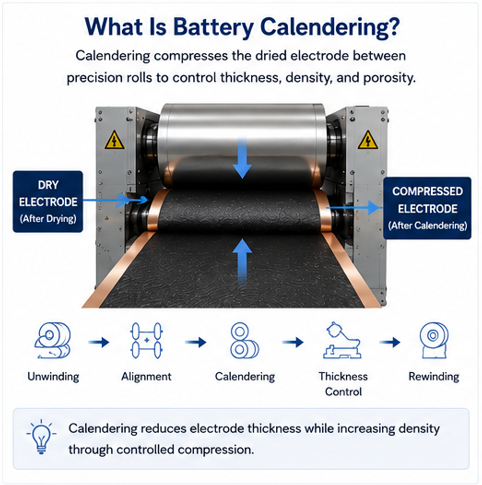
Dry Electrode
↓
Calender Rolls
↓
Controlled Compression
↓
Reduced Thickness
↓
Higher Electrode Density
The particles within the coating become more closely packed and the pore structure changes.
This affects not only the physical dimensions of the electrode but also its electrochemical behavior.
How Battery Calendering Works
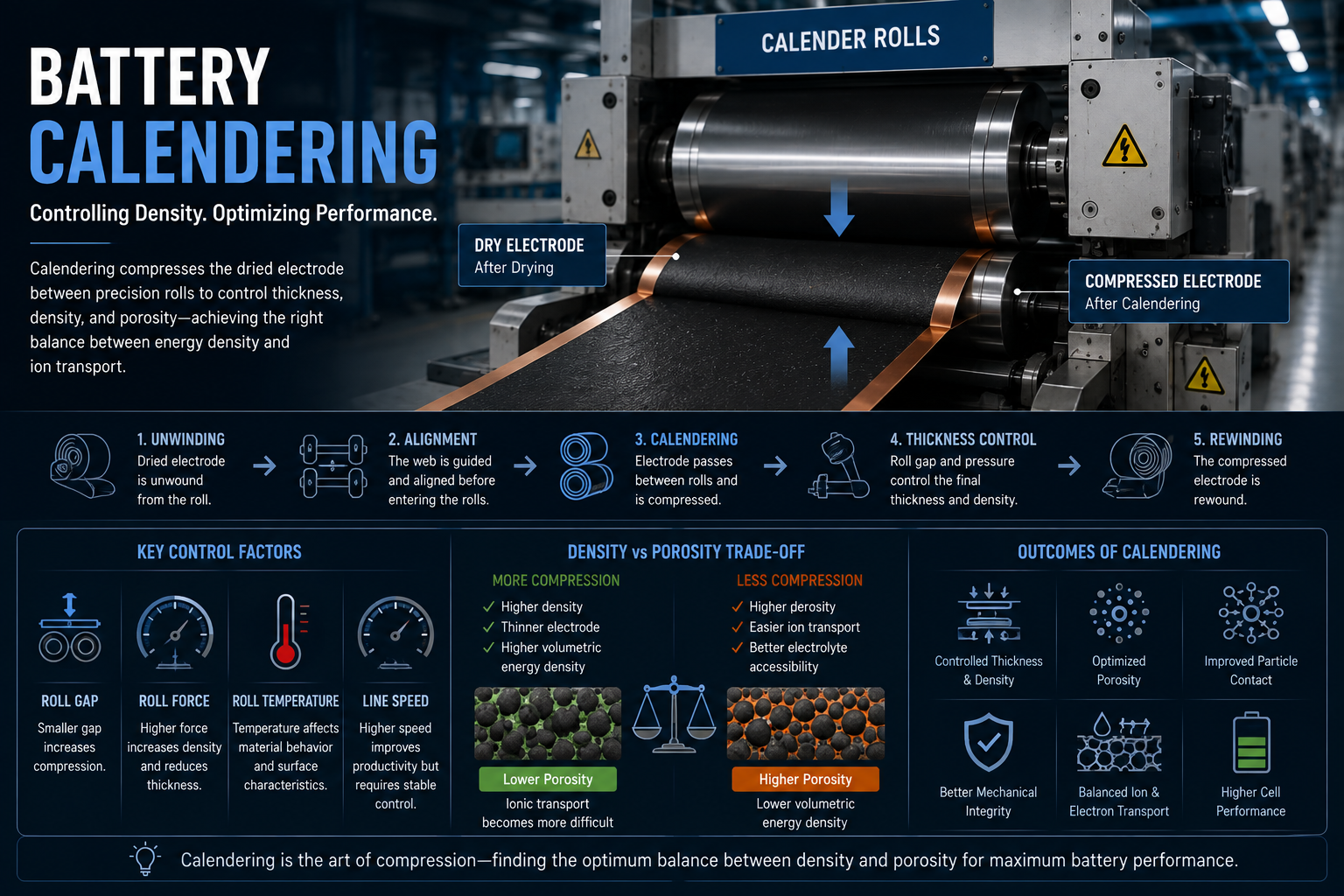
A simplified calendering system consists of two precision rolls separated by a controlled gap.
The electrode travels continuously between them.
Unwinding
→ Electrode Alignment
→ Calender Rolls
→ Thickness Control
→ Rewinding
The roll gap and applied force determine how strongly the electrode is compressed.
Industrial equipment must maintain consistent conditions across the width of the electrode and throughout long production rolls.
Even small variations can produce differences in electrode thickness or density.
What Changes During Calendering?
Calendering modifies several electrode properties simultaneously.
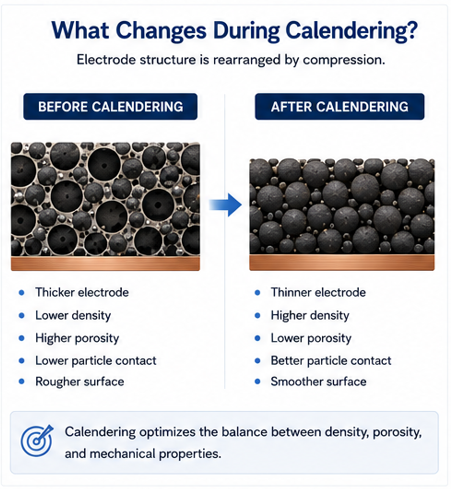
Thickness
The electrode becomes thinner.
Density
The amount of solid material within a given electrode volume increases.
Porosity
The volume occupied by pores generally decreases.
Particle Contact
Particles can become more closely connected.
Surface Characteristics
The electrode surface can become smoother and more uniform.
Mechanical Properties
Compression can affect electrode strength and adhesion.
These changes are interconnected.
That is why calendering conditions must be selected as part of the overall electrode design.
Electrode Density
Electrode density describes how much electrode material occupies a given volume.
Consider two electrodes containing similar amounts of active material.
One has a loose, highly porous structure.
The other has been compressed.
Low Density
Particles farther apart
More pore volume
Thicker electrode
versus
High Density
Particles closer together
Less pore volume
Thinner electrode
Increasing density can improve volumetric energy density, because more active material can be packed into a given cell volume.
However, density cannot be increased indefinitely.
What Is Electrode Porosity?
Porosity represents the fraction of the electrode volume occupied by pores rather than solid material.
Conceptually:
Electrode Volume
=
Solid Material + Pore Volume
The pores are extremely important.
After cell assembly and electrolyte filling, electrolyte must penetrate this porous network.
Lithium ions then move through the electrolyte-filled pores during charging and discharging.
Therefore:
Porosity is not empty, wasted space. It is part of the electrode’s ion-transport network.
How Calendering Changes Porosity
Before calendering:
Particles are relatively loosely packed
↓
Larger pore volume
After calendering:
Particles move closer together
↓
Pore volume decreases
↓
Electrode density increases
This produces one of the central engineering trade-offs in electrode manufacturing.
More Compression
Higher Density
→ Potentially better volumetric energy density
but
Lower Porosity
→ Potentially more difficult ionic transport
Calendering therefore requires optimization rather than maximum compression.
Density vs Porosity Trade-Off
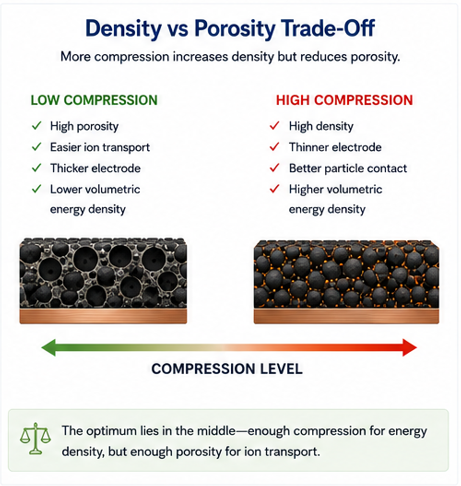
Imagine two extremes.
Very Low Compression
Advantages may include:
- High porosity
- Easier electrolyte penetration
- More open ionic pathways
Potential disadvantages include:
- Lower electrode density
- Greater thickness
- Lower volumetric energy density
- Weaker particle contact
Very High Compression
Advantages may include:
- Higher electrode density
- Reduced thickness
- Improved particle contact
- Potentially higher volumetric energy density
Potential disadvantages include:
- Reduced porosity
- More difficult electrolyte penetration
- Increased ionic transport resistance
- Possible mechanical damage
The optimum lies somewhere between these extremes.
Electronic Transport vs Ionic Transport
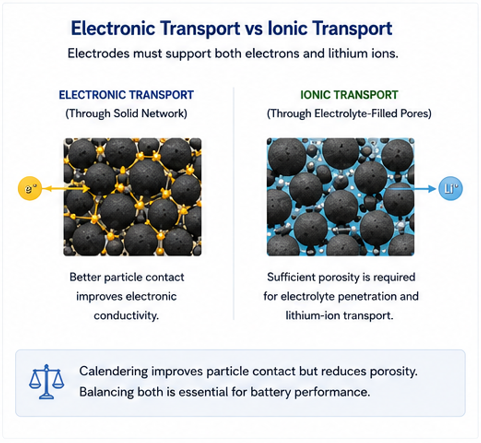
A battery electrode must support two different transport mechanisms.
Electrons
Electrons move through the solid conductive network.
Lithium Ions
Lithium ions move primarily through electrolyte-filled pores.
Calendering can improve solid-to-solid contact between particles, which may benefit electronic conduction.
But excessive compression can reduce the pore network required for ionic transport.
This creates another important relationship:
Particle Contact ↑
can improve
Electronic Transport
while
Porosity ↓
can make
Ionic Transport
more difficult.
A well-designed electrode must support both.
Calendering and Volumetric Energy Density
One reason calendering is important is its influence on volumetric energy density.
Battery cells have limited internal volume.
If the same amount of active material can occupy less space, more electrochemically active material may potentially be incorporated into a given cell volume.
This is particularly important for applications where space is limited, such as:
- Electric vehicles
- Consumer electronics
- High-energy battery packs
However, maximizing material packing alone is not enough.
The electrode must still maintain sufficient ion transport and electrolyte accessibility.
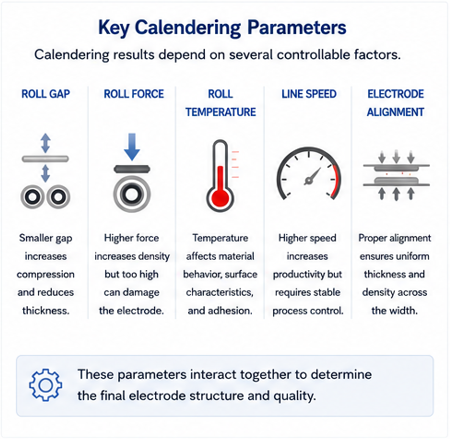
Roll Gap
The roll gap is the distance between the calender rolls.
It is one of the most intuitive calendering parameters.
A smaller gap generally creates stronger compression.
Conceptually:
Larger Roll Gap
→ Lower Compression
Smaller Roll Gap
→ Higher Compression
However, the resulting electrode structure also depends on other factors such as:
- Initial electrode thickness
- Material composition
- Electrode loading
- Roll force
- Roll temperature
- Line speed
Therefore, roll gap cannot be considered independently.
Calendering Pressure and Roll Force
The rolls must apply sufficient force to compress the electrode to its target condition.
If the force is too low, the desired thickness and density may not be achieved.
If it is too high, the electrode structure can be over-compressed or damaged.
Manufacturing systems therefore need precise and repeatable force control.
This becomes especially important as electrode widths increase for high-volume production.
Roll Temperature
Some calendering processes can use controlled roll temperature.
Heating can change the mechanical behavior of the electrode coating and binder system during compression.
Depending on electrode chemistry and manufacturing strategy, temperature control may help achieve the desired:
- Density
- Surface quality
- Adhesion
- Mechanical properties
This is often referred to as hot calendering when elevated roll temperatures are intentionally used.
Line Speed
As with coating and drying, production speed matters.
Higher line speed can increase throughput.
However, the electrode must still experience sufficiently stable and uniform compression.
The manufacturing challenge is therefore to maintain:
- High Throughput
- Precise Thickness
- Uniform Density
- Stable Electrode Quality
across long rolls of material.
Cathode vs Anode Calendering
Cathodes and anodes do not necessarily require identical calendering conditions.
Their materials have different:
- Particle structures
- Mechanical properties
- Binder systems
- Electrode loadings
- Target densities
- Porosity requirements
For example, a graphite anode behaves differently under compression from an NMC or LFP cathode.
Therefore, manufacturers optimize calendering conditions separately for each electrode design.
Calendering High-Loading Electrodes
High-loading electrodes contain more active material per unit area.
They are attractive because they can potentially increase energy density while reducing the relative amount of inactive components.
However, thicker electrodes make transport more challenging.
After calendering, excessive densification can further restrict ionic pathways.
This means high-loading electrode development requires careful coordination between:
Slurry Formulation
→ Coating
→ Drying
→ Calendering
A change in one process can influence the optimum conditions of the next.
Electrode Tortuosity
Porosity alone does not completely describe how easily ions can move through an electrode.
Another important concept is tortuosity.
A perfectly straight pore would provide a direct transport path.
Real battery electrodes contain complex pathways around particles.
Conceptually:
Low Tortuosity
→ More direct ionic pathway
High Tortuosity
→ Longer, more complex pathway
Calendering changes particle arrangement and pore geometry, which can influence tortuosity.
This is why two electrodes with similar overall porosity may still exhibit different transport behavior.
Calendering and Electrode Adhesion
Calendering also affects mechanical contact within the electrode.
Controlled compression can improve contact:
- Between active material particles
- Between conductive additives
- Within the binder network
- Between the coating and current collector
However, excessive mechanical stress may also damage the electrode or weaken interfaces.
Again, the target is controlled optimization.
Common Calendering Problems
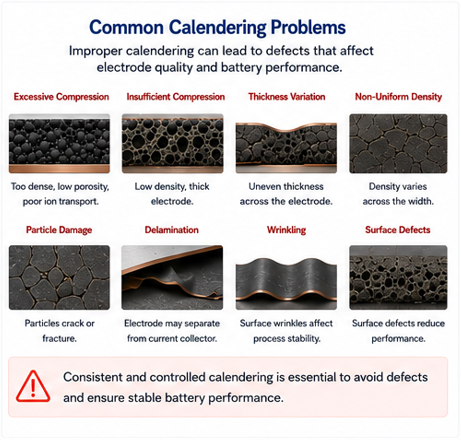
Poorly controlled calendering can create several manufacturing issues.
Excessive Compression
The electrode becomes too dense and pore volume is significantly reduced.
Insufficient Compression
Target thickness or density is not achieved.
Thickness Variation
Different regions of the electrode have different final thicknesses.
Non-Uniform Density
Compression varies across the electrode width.
Particle Damage
Excessive mechanical stress can damage certain electrode materials.
Delamination
The electrode coating can separate from the current collector under unfavorable conditions.
Wrinkling
Improper web handling or mechanical conditions can deform the electrode sheet.
These defects can affect downstream manufacturing and cell performance.
Quality Control After Calendering
Manufacturers can monitor characteristics including:
- Electrode thickness
- Density
- Porosity
- Surface roughness
- Electrode width
- Adhesion
- Roll uniformity
- Defects
Thickness measurement is especially important because calendering directly determines the final electrode dimension before later converting processes.
Increasingly, inline measurement systems can monitor these characteristics continuously during roll-to-roll manufacturing.
From Calendering to Slitting
After calendering, the electrode has reached its target thickness and density but is still manufactured as a wide roll.
The next step is slitting.
Wide Electrode Roll
↓
Slitting Blades
↓
Narrow Electrode Rolls
The electrode is cut longitudinally into widths appropriate for subsequent cell manufacturing.
This means calendering must produce a mechanically stable electrode capable of surviving further web handling and cutting.
Why Calendering Matters to Battery Performance
The manufacturing chain can be summarized as:
Slurry
determines material dispersion
↓
Coating
determines material deposition
↓
Drying
establishes the solid porous structure
↓
Calendering
adjusts density and porosity
↓
Final Electrode Structure
↓
Battery Performance
Calendering therefore acts as one of the final opportunities to engineer electrode structure before the electrode is cut and assembled into a cell.
Emerging Calendering Technologies
Battery manufacturing research continues to improve calendering control.
Advanced Inline Measurement
Real-time thickness and density measurements can support tighter process control.
Model-Based Process Optimization
Digital models can help predict how roll pressure and material properties affect electrode structure.
High-Loading Electrode Calendering
New electrode architectures require optimization for thicker coatings and higher active-material loading.
Structured Electrodes
Future electrodes may intentionally use engineered pore structures rather than relying solely on conventional uniform compression.
Dry Electrode Processing
Dry electrode manufacturing may introduce different mechanical processing requirements compared with conventional slurry-based electrodes.
These developments could change how calendering is integrated into future electrode production lines.
iAtlas Insight
Battery calendering demonstrates why higher density does not automatically mean a better electrode.
From a manufacturing perspective, compression is attractive:
Thickness ↓
Density ↑
Volumetric Energy Density Potential ↑
But electrochemistry imposes another requirement:
Lithium ions still need pathways through the electrode.
If compression becomes excessive:
Porosity ↓
↓
Electrolyte Accessibility ↓
↓
Ion Transport Becomes More Difficult
The ideal electrode therefore needs a carefully engineered balance between solid material and pore space.
This is particularly important as the industry pursues thicker, higher-loading electrodes for greater energy density.
Future improvements in calendering will increasingly depend on understanding not only electrode thickness, but also three-dimensional pore structure, tortuosity, material mechanics, and transport behavior.
Calendering may look like a simple pair of rollers.
In reality, it is one of the processes that determines the internal architecture of a battery electrode.
Did You Know?
- Calendering occurs after electrode drying and before slitting.
- The process reduces electrode thickness while generally increasing density.
- Higher compression typically reduces electrode porosity.
- Electrode pores are necessary for electrolyte penetration and lithium-ion transport.
- Cathodes and anodes can require different calendering conditions.
- Roll gap, force, temperature, and line speed can influence the final electrode.
- Porosity and tortuosity are both important for understanding ion transport.
- Maximum electrode density is not necessarily the optimum battery design.
FAQ
What is battery calendering?
Battery calendering compresses a dried electrode between precision rollers to control its thickness, density, porosity, and mechanical characteristics.
When does calendering occur?
It normally occurs after electrode drying and before electrode slitting.
Why are battery electrodes calendered?
Calendering helps achieve the desired electrode thickness and density while improving particle contact and controlling the electrode pore structure.
Does calendering reduce porosity?
Generally, increased compression reduces pore volume and therefore decreases porosity.
Is lower porosity always better?
No. Lower porosity can increase electrode density, but sufficient pores are required for electrolyte penetration and lithium-ion transport.
What is electrode tortuosity?
Tortuosity describes how complex the transport pathways through an electrode are compared with a direct path.
What happens if an electrode is over-calendered?
Excessive compression can reduce pore volume, hinder ion transport, alter electrode structure, and potentially cause mechanical problems.
What happens after calendering?
The electrode typically proceeds to slitting, where the wide electrode roll is cut into narrower rolls for subsequent cell manufacturing.
Battery Manufacturing Learning Path
Overview
Electrode Manufacturing
- Material Mixing
- Battery Slurry
- Battery Electrode Coating
- Battery Electrode Drying
- Calendering (Current)
- Slitting
Cell Assembly
- Battery Cell Assembly
- Notching
- Winding
- Stacking
- Electrolyte Filling
- Cell Sealing
Cell Finishing
- Formation
- Aging
- Degassing
- Battery Cell Testing & Grading
System Assembly
- Battery Module Assembly
- Battery Pack Assembly
Explore More
Fundamentals
- Battery
- Lithium-ion Battery
- Battery Cell
- Battery Module
- Battery Pack
- Battery Management System(BMS)
- Battery Thermal Management System(BTMS)
- Battery Safety
Materials
Manufacturing
- Battery Manufacturing Process
- Material Mixing
- Battery Slurry
- Battery Electrode Coating
- Battery Electrode Drying
- Calendering (Current)
- Slitting
- Battery Cell Assembly
- Notching
Technologies
- High-Loading Electrodes
- Dry Electrode Technology
- Silicon Anode
References
Recommended primary research areas:
- Advanced Energy Materials — Insights into Influencing Electrode Calendering on the Battery Performance
- Journal of Materials Processing Technology — Characterization of the Calendering Process for Compaction of Electrodes for Lithium-Ion Batteries
- Cell Reports Physical Science — Microstructural Evolution of Battery Electrodes During Calendering
- Journal of Power Sources — Elucidating the Effect of Electrode Calendering on Electrochemical Performance Using 3D Image-Based Modelling
- Journal of Energy Storage — Modelling of Lithium-Ion Battery Electrode Calendering: A Critical Review
About iAtlas
iAtlas is an independent publication covering batteries, semiconductors, OLED, advanced materials, AI, and global industrial trends.
We transform complex industrial developments into clear, reliable, and easy-to-understand insights.
Whether you’re following today’s industry news or building long-term expertise, iAtlas helps you understand not only what happened, but why it matters.
Technology creates change.
Insight creates opportunity.
— iAtlas