Battery Thermal Management System (BTMS)
How Batteries Stay Safe, Efficient, and Long-Lasting
Category: Battery Technology
Content Type: Fundamentals
Related Industries: Electric Vehicles · Energy Storage Systems · Consumer Electronics
Last Updated: July 2026
Industry Snapshot
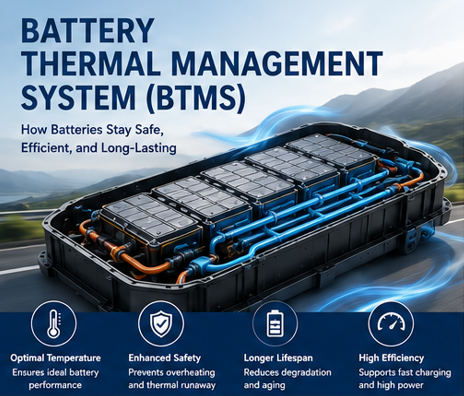
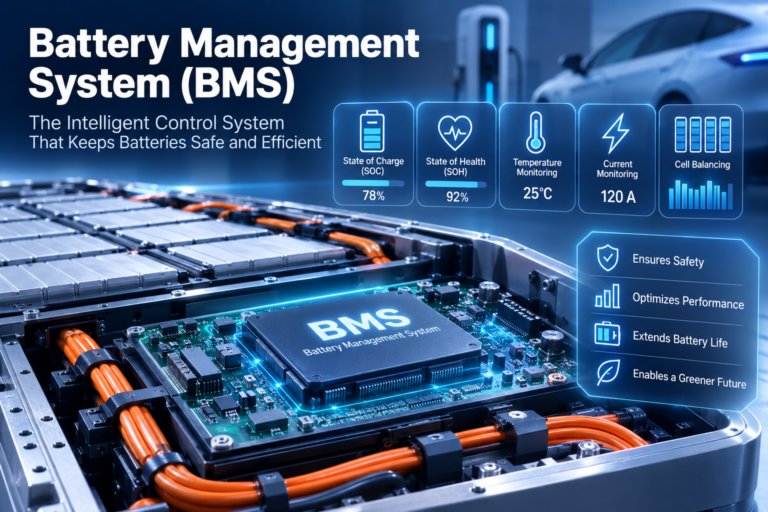
A Battery Thermal Management System (BTMS) is designed to maintain batteries within their optimal operating temperature range. While a Battery Management System (BMS) monitors battery conditions and controls charging and discharging, the BTMS manages heat generation and dissipation to ensure safe and efficient operation.
Lithium-ion batteries perform best within a relatively narrow temperature range. Excessive heat accelerates battery degradation and increases the risk of thermal runaway, while low temperatures reduce charging efficiency and available power. As battery capacities continue to grow in electric vehicles (EVs) and energy storage systems (ESS), thermal management has become a critical aspect of battery design.
At a Glance
| Category | Description |
|---|---|
| Definition | System that regulates battery temperature |
| Main Purpose | Improve safety, performance, and lifespan |
| Controls | Heating, cooling, and temperature distribution |
| Typical Location | Integrated within the battery pack |
| Major Applications | EVs, ESS, Commercial Vehicles |
Overview
Every lithium-ion battery generates heat during charging and discharging. Without effective thermal management, uneven temperature distribution can cause cell imbalance, reduced efficiency, accelerated aging, and safety issues.
A Battery Thermal Management System continuously removes or redistributes heat to maintain a consistent temperature across all battery cells. This improves charging performance, extends battery life, and enhances overall system reliability.
Battery Thermal Management System Architecture
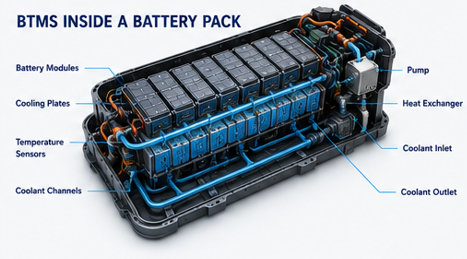
A typical BTMS consists of several integrated components.
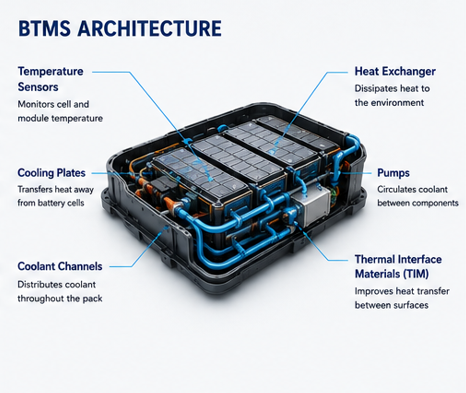
Cooling Plates
Transfer heat away from battery cells.
Coolant Channels
Circulate coolant throughout the battery pack.
Pumps
Move coolant between the battery and heat exchanger.
Heat Exchanger
Dissipates heat to the surrounding environment.
Temperature Sensors
Continuously monitor cell and module temperatures.
Thermal Interface Materials (TIM)
Improve heat transfer between cells and cooling components.
Types of Battery Thermal Management Systems
Several cooling methods are used depending on battery size and application.
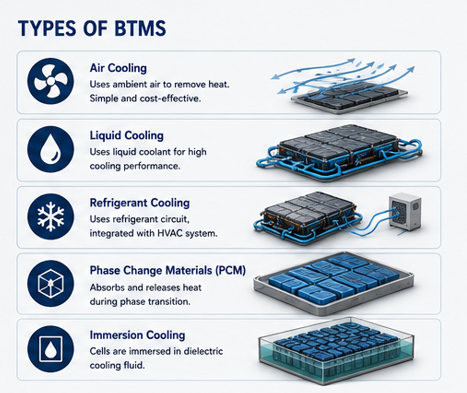
| Type | Characteristics |
|---|---|
| Air Cooling | Simple and inexpensive but lower cooling performance |
| Liquid Cooling | High efficiency and widely used in EVs |
| Refrigerant Cooling | Direct cooling using HVAC systems |
| Phase Change Materials (PCM) | Absorb heat during phase transition |
| Immersion Cooling | Cells are immersed in dielectric cooling fluid |
How a BTMS Works
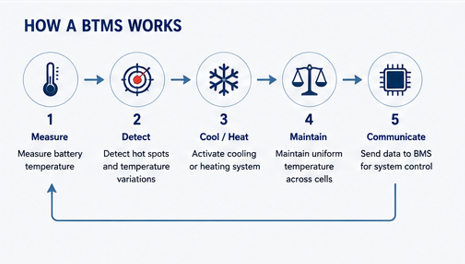
The BTMS continuously performs the following cycle:
- Measure battery temperature.
- Detect hot spots.
- Activate cooling or heating.
- Maintain uniform cell temperature.
- Communicate temperature data with the BMS.
By keeping temperature variations small, the BTMS helps maintain balanced battery performance and extends service life.
Key Performance Factors
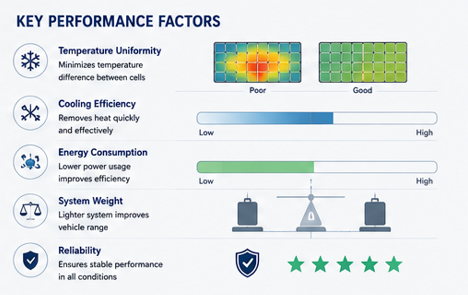
| Parameter | Importance |
|---|---|
| Temperature Uniformity | Prevents cell imbalance |
| Cooling Efficiency | Improves charging and discharging performance |
| Energy Consumption | Reduces auxiliary power usage |
| System Weight | Influences vehicle efficiency |
| Reliability | Ensures long-term operation |
Applications
Battery Thermal Management Systems are widely used in:
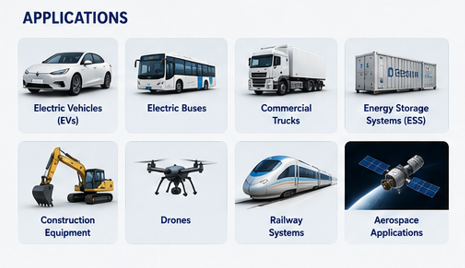
- Electric Vehicles (EVs)
- Hybrid Vehicles (HEVs & PHEVs)
- Energy Storage Systems (ESS)
- Electric Buses
- Commercial Trucks
- Aerospace Applications
- High-performance Battery Systems
Industry Ecosystem
The BTMS supply chain includes:
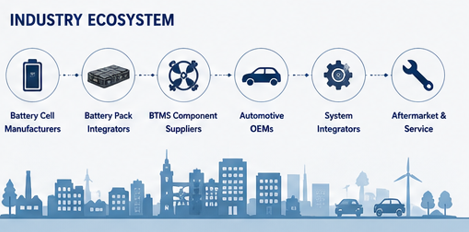
- Battery Cell Manufacturers
- Battery Pack Integrators
- Cooling System Suppliers
- Thermal Interface Material Manufacturers
- Automotive OEMs
- Heat Exchanger Manufacturers
- Pump Suppliers
- Semiconductor Sensor Companies
Atlas Insight
Thermal management is becoming a major competitive factor in next-generation battery systems.
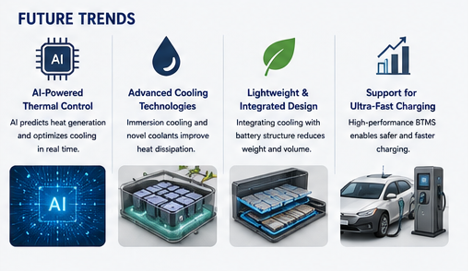
Modern EV manufacturers increasingly adopt advanced liquid cooling, immersion cooling, and AI-assisted thermal control to support ultra-fast charging and improve battery longevity. Future structural battery packs are expected to integrate thermal management more closely with the battery enclosure, reducing weight while improving cooling efficiency.
Did You Know?
- A temperature difference of only a few degrees between cells can accelerate battery aging.
- Most premium EVs use liquid cooling instead of air cooling.
- Fast charging generates significantly more heat than normal charging.
- Thermal management is one of the key technologies enabling ultra-fast charging.
FAQ
What is a Battery Thermal Management System (BTMS)?
A BTMS regulates battery temperature to improve safety, efficiency, and battery lifespan.
Why is thermal management important?
Maintaining the correct temperature prevents overheating, improves charging performance, and extends battery life.
What is the difference between BMS and BTMS?
A BMS monitors and controls battery operation, while a BTMS specifically manages battery temperature.
Which cooling method is most common?
Liquid cooling is currently the most widely used solution for modern electric vehicles.
Can poor thermal management reduce battery life?
Yes. Excessive heat accelerates battery degradation and increases safety risks.
Explore More
Fundamentals
- Battery
- Lithium-ion Battery
- Battery Cell
- Battery Module
- Battery Pack
- Battery Management System(BMS)
- Battery Thermal Management System(BTMS)
- Battery Safety
Materials
- Cathode
- Anode
- Electrolyte
- Separator
Manufacturing
- Cell Assembly
- Module Assembly
- Pack Assembly
Technologies
- Cell-to-Pack (CTP)
- Cell-to-Chassis (CTC)
- Wireless BMS
- Thermal Runaway
- Fast Charging
References
- International Energy Agency (IEA) – Global EV Outlook 2025
- U.S. Department of Energy – Vehicle Technologies Office
- Texas Instruments – Battery Management Solutions
- Analog Devices – Battery Management Systems
- LG Energy Solution – Battery Technology
About iAtlas
iAtlas is an independent publication covering batteries, semiconductors, OLED, advanced materials, AI, and global industrial trends.
We transform complex industrial developments into clear, reliable, and easy-to-understand insights.
Whether you’re following today’s industry news or building long-term expertise, iAtlas helps you understand not only what happened, but why it matters.
Technology creates change.
Insight creates opportunity.
— iAtlas