Battery Pack
The Complete Energy Storage System for Electric Vehicles and Beyond
Category: Battery Technology
Content Type: Fundamentals
Related Industries: Electric Vehicles · Energy Storage Systems · Consumer Electronics
Last Updated: July 2026
Industry Snapshot
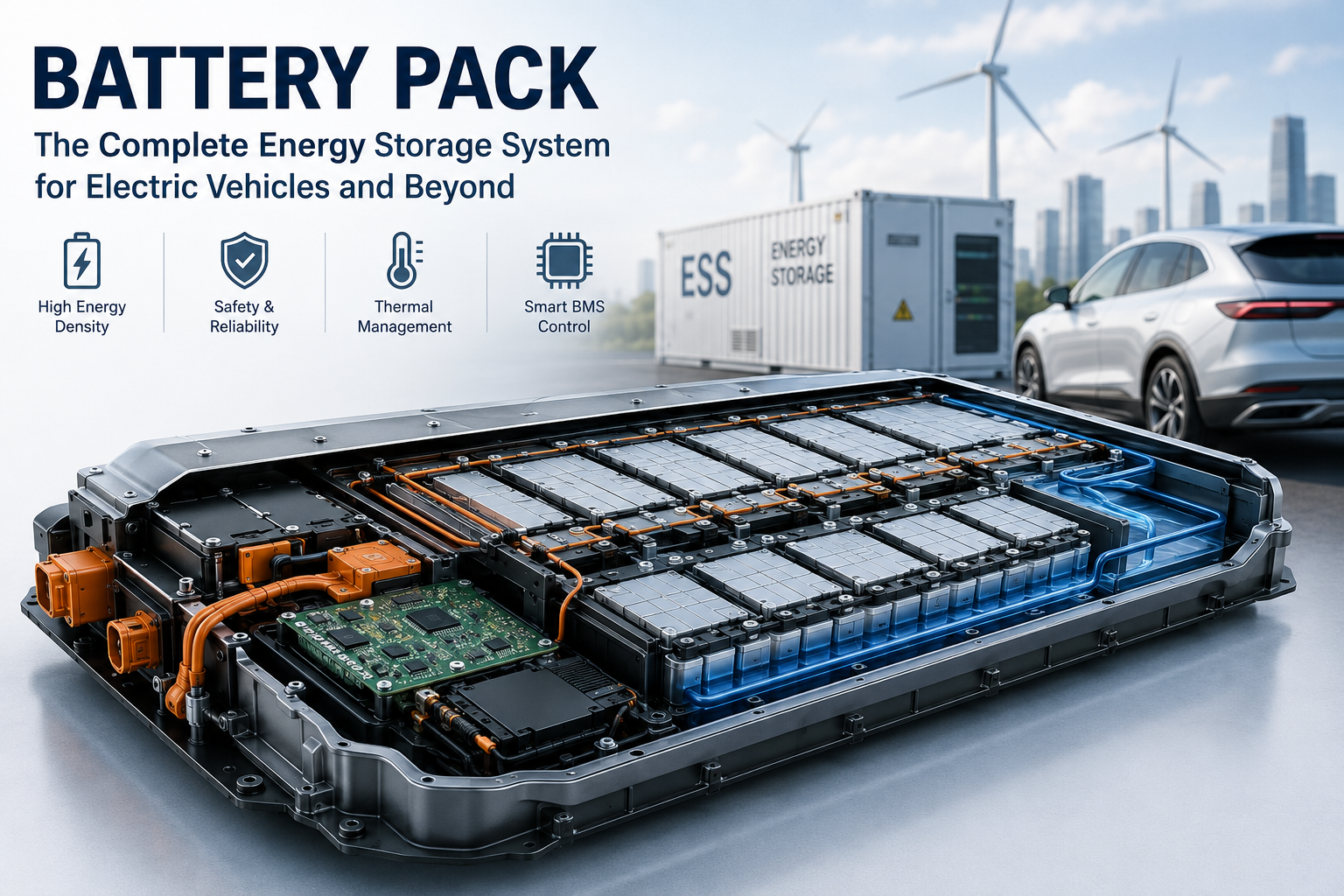
A battery pack is the complete energy storage system that powers electric vehicles (EVs), energy storage systems (ESS), and many industrial applications. While a battery cell stores electrical energy individually and a battery module groups multiple cells together, the battery pack integrates modules, battery management electronics, cooling systems, safety devices, and structural components into one fully functional unit.
Modern battery packs are engineered not only to maximize energy density but also to ensure safety, durability, and efficient thermal management. As demand for longer driving range and faster charging continues to grow, battery pack technology has become one of the most important competitive factors in the global battery industry.
At a Glance
| Category | Description |
|---|---|
| Definition | Complete battery system containing modules and supporting components |
| Main Purpose | Store and deliver electrical energy safely |
| Typical Components | Battery Modules, BMS, Cooling System, Housing, HV Wiring |
| Position | Highest level of battery assembly |
| Major Applications | EVs, ESS, Industrial Equipment |
Overview
A battery pack is the highest level of battery assembly.
Instead of operating individual cells independently, manufacturers combine multiple battery modules into a battery pack. The pack also includes electrical protection systems, thermal management, communication electronics, and mechanical structures that allow the battery to operate safely under various conditions.
Battery packs are designed according to the voltage, capacity, power output, and safety requirements of their intended applications.
Battery Pack Structure
A battery pack consists of several major components working together.
Battery Modules
Groups of battery cells connected to provide the required voltage and capacity.
Battery Management System (BMS)
Monitors voltage, current, temperature, and state of charge while protecting the battery from abnormal conditions.
Cooling System
Maintains the battery within its optimal operating temperature using air or liquid cooling.
Housing
Provides mechanical protection against vibration, impact, dust, and moisture.
High-Voltage Components
Includes busbars, contactors, fuses, relays, and wiring required for power distribution.
Battery Pack Design Considerations
Serviceability
Safety
Thermal Management
Structural Strength
Energy Density
Battery System Hierarchy
Battery systems are assembled in multiple stages.
Battery Cell -> Battery Module -> Battery Pack -> Electric Vehicle / Energy Storage System
This hierarchical design enables manufacturers to build scalable battery systems for different vehicle sizes and energy storage capacities.
Battery Pack Manufacturing Process
Typical manufacturing steps include:
- Module Installation
- High-Voltage Wiring
- Cooling System Assembly
- BMS Installation
- Housing Assembly
- Leak Testing
- Electrical Testing
- Final Inspection
Every battery pack undergoes rigorous electrical, mechanical, and safety testing before delivery.
Key Performance Factors
Several factors determine battery pack performance.
| Parameter | Importance |
|---|---|
| Energy Density | Determines driving range |
| Thermal Management | Maintains battery health |
| Safety | Prevents thermal runaway |
| Structural Strength | Protects against impact |
| Battery Management | Maximizes lifespan |
Applications
Battery packs are widely used in:
- Electric Vehicles (EVs)
- Hybrid Electric Vehicles (HEVs)
- Plug-in Hybrid Vehicles (PHEVs)
- Energy Storage Systems (ESS)
- Marine Power Systems
- Aerospace Applications
- Industrial Equipment
Industry Ecosystem
Battery pack manufacturing involves collaboration across the battery supply chain.
- Battery Cell Manufacturers
- Battery Module Manufacturers
- Battery Pack Integrators
- BMS Suppliers
- Thermal Management Suppliers
- Automotive OEMs
- ESS Integrators
- Battery Recycling Companies
Atlas Insight
Battery pack design is rapidly evolving beyond traditional module-based architectures.
Technologies such as Cell-to-Pack (CTP) and Cell-to-Chassis (CTC) reduce the number of structural components, improving energy density while lowering manufacturing costs. At the same time, advanced battery management systems and liquid cooling technologies continue to enhance safety and battery lifespan.
Did You Know?
- A modern EV battery pack may contain hundreds to thousands of individual battery cells.
- The battery pack is often the heaviest single component in an electric vehicle.
- Battery packs are designed to withstand vibration, water, dust, and collisions.
- Some next-generation EV platforms eliminate battery modules entirely through Cell-to-Pack technology.
FAQ
What is a battery pack?
A battery pack is the complete battery system that combines battery modules, electronics, cooling systems, and protective structures into one integrated unit.
What is the difference between a battery module and a battery pack?
A battery module contains multiple battery cells, while a battery pack integrates multiple modules with control and safety systems.
What is inside a battery pack?
A battery pack typically contains battery modules, a battery management system (BMS), cooling systems, housing, high-voltage wiring, and safety devices.
Why is thermal management important?
Maintaining the correct operating temperature improves battery performance, lifespan, and safety.
Do all EVs use battery modules?
No. Some modern EVs use Cell-to-Pack (CTP) technology, which removes traditional battery modules to improve efficiency.
Explore More
Fundamentals
- Battery
- Lithium-ion Battery
- Battery Cell
- Battery Module
- Battery Pack
- Battery Management System(BMS)
- Battery Thermal Management System(BTMS)
- Battery Safety
Materials
- Cathode
- Anode
- Electrolyte
- Separator
Manufacturing
- Cell Assembly
- Module Assembly
- Pack Assembly
Technologies
- Cell-to-Pack (CTP)
- Cell-to-Chassis (CTC)
- Wireless BMS
- Thermal Runaway
- Fast Charging
References
- International Energy Agency (IEA) – Global EV Outlook 2025
- U.S. Department of Energy – Vehicle Technologies Office
- Nature Energy
- Journal of Power Sources
- LG Energy Solution – Battery Technology
About iAtlas
iAtlas is an independent publication covering batteries, semiconductors, OLED, advanced materials, AI, and global industrial trends.
We transform complex industrial developments into clear, reliable, and easy-to-understand insights.
Whether you’re following today’s industry news or building long-term expertise, iAtlas helps you understand not only what happened, but why it matters.
Technology creates change.
Insight creates opportunity.
— iAtlas