Battery Cell
The Fundamental Building Block of Every Rechargeable Battery
Category: Battery Technology
Content Type: Fundamentals
Related Industries: Electric Vehicles · Energy Storage Systems · Consumer Electronics
Last Updated: July 2026
Industry Snapshot
A battery cell is the smallest electrochemical unit capable of storing and delivering electrical energy. Every rechargeable battery—from smartphones and laptops to electric vehicles (EVs) and grid-scale energy storage systems (ESS)—is built from one or more battery cells.
Modern lithium-ion battery cells combine carefully engineered materials and precision manufacturing processes to achieve high energy density, long cycle life, and reliable safety. Although a battery pack may appear as a single component, its performance ultimately depends on the quality and consistency of each individual cell.
As demand for EVs and renewable energy storage continues to grow, battery cell technology has become one of the most competitive areas in the global battery industry.
At a Glance
| Category | Description |
|---|---|
| Definition | The smallest rechargeable electrochemical unit |
| Main Components | Cathode, Anode, Electrolyte, Separator, Current Collectors |
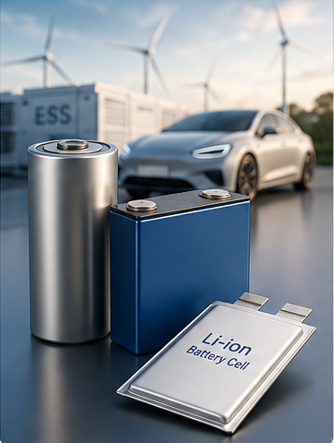
| Major Formats | Cylindrical, Prismatic, Pouch |
| Applications | EVs, Consumer Electronics, ESS, Power Tools |
| Key Performance | Energy Density, Cycle Life, Power Output, Safety |
Overview
A battery cell converts chemical energy into electrical energy through electrochemical reactions. During discharge, lithium ions move from the anode to the cathode through the electrolyte, while electrons travel through the external circuit to power a device. During charging, this process is reversed.
Individual cells are connected together to create larger battery systems.
- Battery Cell → basic energy storage unit
- Battery Module → group of connected cells
- Battery Pack → multiple modules with cooling, protection, and control systems
This modular architecture allows manufacturers to scale battery capacity for applications ranging from wearable electronics to electric buses.
Cell Anatomy
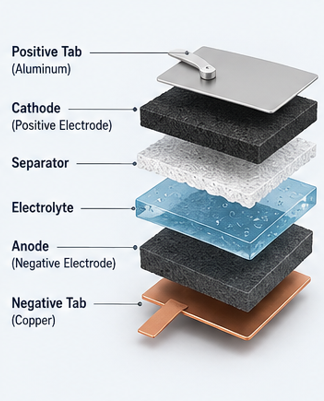
Every battery cell contains five essential components.
Cathode
The cathode is the positive electrode and largely determines the battery’s voltage, capacity, and energy density. Common cathode chemistries include LFP, NMC, and NCA.
Anode
The anode stores lithium ions during charging. Most commercial cells use graphite, while next-generation batteries increasingly incorporate silicon to increase energy density.
Electrolyte
The electrolyte transports lithium ions between the electrodes while remaining electrically insulating.
Separator
The separator prevents direct contact between the cathode and anode while allowing lithium ions to pass safely through microscopic pores.
Current Collectors
Copper and aluminum foils collect and transfer electrical current from the electrodes to the external circuit.
Types of Battery Cells

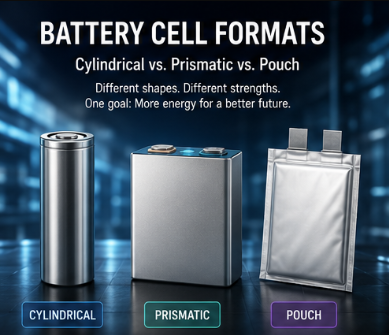
Battery manufacturers choose different cell formats depending on application requirements.
| Cell Type | Advantages | Typical Applications |
|---|---|---|
| Cylindrical | Excellent durability, mature manufacturing | Tesla, Power Tools |
| Prismatic | High space efficiency | Electric Vehicles |
| Pouch | Lightweight, flexible design | EVs, Consumer Electronics |
Each format offers different trade-offs between cost, packaging efficiency, thermal management, and mechanical strength.
How a Battery Cell Works
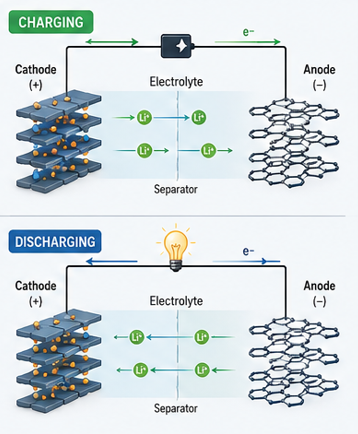
During charging:
- External power supplies electrical energy.
- Lithium ions move toward the anode.
- Electrons travel through the charging circuit.
- Energy is stored chemically.
During discharge:
- Lithium ions move back to the cathode.
- Electrons flow through the external circuit.
- Electrical energy powers the connected device.
This reversible process enables thousands of charging cycles throughout the battery’s service life.
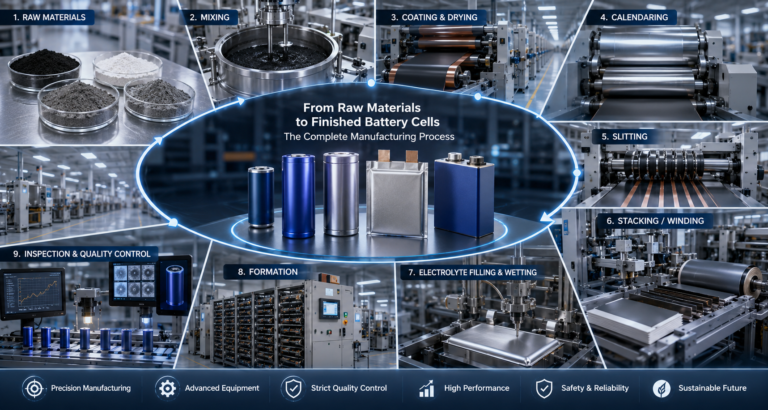
Battery Cell Manufacturing
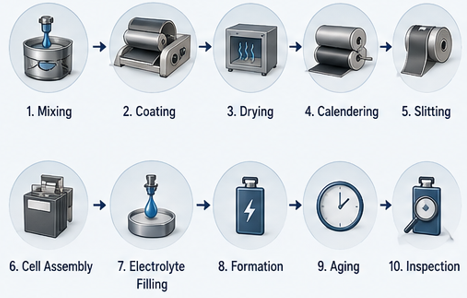
Producing high-quality battery cells requires extremely precise manufacturing.
Typical production steps include:
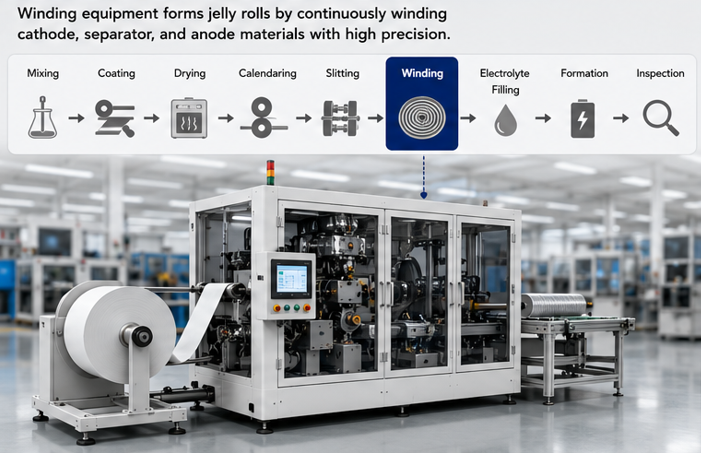
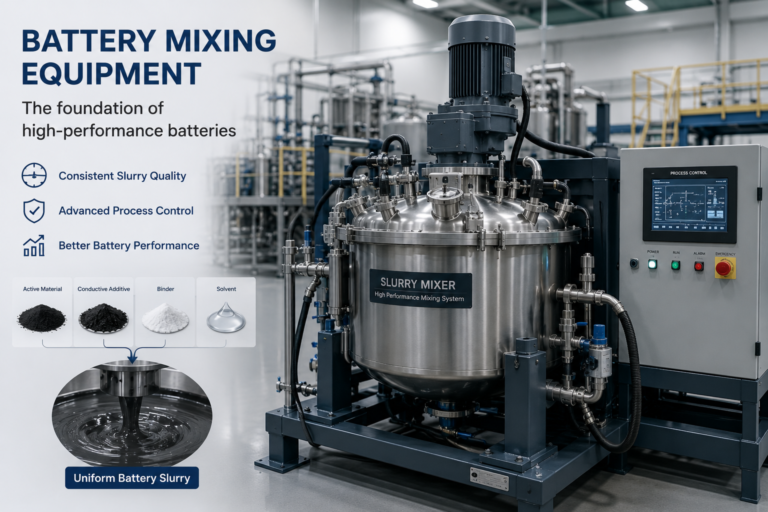
- Material Mixing
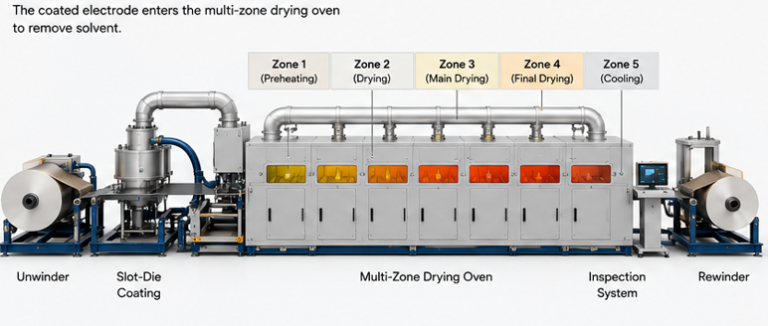
- Electrode Coating
- Drying
- Calendering
- Electrode Slitting
- Cell Assembly
- Electrolyte Filling
- Formation
- Aging
- Final Inspection
Even minor variations during these processes can significantly affect battery performance, lifetime, and safety.
Key Performance Indicators
Battery manufacturers evaluate cells using several critical performance metrics.
| Parameter | Importance |
|---|---|
| Energy Density | Determines driving range and operating time |
| Power Density | Indicates charging and discharge capability |
| Cycle Life | Number of charge-discharge cycles before degradation |
| Safety | Resistance to overheating and thermal runaway |
| Fast Charging | Ability to recharge rapidly |
| Cost | Manufacturing competitiveness |
Balancing these characteristics remains one of the biggest challenges in battery development.

Applications
Battery cells are used across a wide range of industries.
- Electric Vehicles (EVs)
- Hybrid Electric Vehicles (HEVs)
- Consumer Electronics
- Energy Storage Systems (ESS)
- Medical Devices
- Aerospace
- Robotics
- Industrial Equipment
As electrification expands, battery cells are becoming a foundational technology across multiple sectors.
Industry Ecosystem
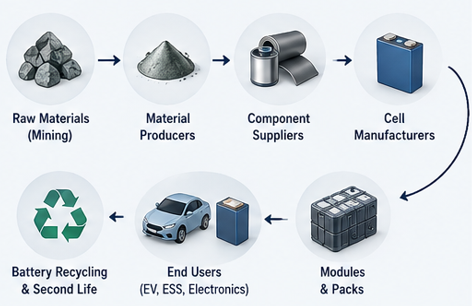
The battery cell industry depends on collaboration across the entire value chain.
- Raw Material Suppliers
- Cathode & Anode Material Producers
- Separator Manufacturers
- Electrolyte Suppliers
- Cell Manufacturers
- Module & Pack Integrators
- Automotive OEMs
- Battery Recycling Companies
Continuous innovation across this ecosystem is driving improvements in cost, sustainability, and performance.
Atlas Insight
Although battery packs receive most public attention, the true source of battery performance lies within the individual cell.
Small improvements in electrode materials, electrolyte formulation, separator technology, or manufacturing precision can significantly increase energy density, extend battery life, and improve safety. As a result, battery cell technology has become one of the most strategically important areas of investment for automakers, material suppliers, and battery manufacturers worldwide.
Did You Know?
- A typical electric vehicle battery pack contains hundreds to thousands of individual battery cells.
- Formation is one of the most time-consuming manufacturing processes because it creates the battery’s protective SEI layer.
- Even cells produced on the same manufacturing line are carefully matched before being assembled into modules and packs.
- Battery cell quality directly influences the performance, reliability, and lifespan of the final battery pack.
FAQ
What is a battery cell?
A battery cell is the smallest electrochemical unit capable of storing and supplying electrical energy.
What is the difference between a cell, module, and pack?
A cell is the basic energy storage unit. Multiple cells form a module, and multiple modules combined with control and cooling systems create a battery pack.
Which battery cell format is most common?
Cylindrical, prismatic, and pouch cells are the three dominant formats used today.
Why is cell manufacturing so important?
High manufacturing precision ensures consistent capacity, long cycle life, improved safety, and reliable battery performance.
What industries use battery cells?
Battery cells are widely used in electric vehicles, consumer electronics, renewable energy storage systems, robotics, aerospace, and medical equipment.
Explore More
Fundamentals
- Battery
- Lithium-ion Battery
- Battery Cell
- Battery Module
- Battery Pack
- Battery Management System(BMS)
- Battery Thermal Management System(BTMS)
- Battery Safety
Materials
- Cathode
- Anode
- Electrolyte
- Separator
Manufacturing
- Cell Assembly
- Module Assembly
- Pack Assembly
Technologies
- Cell-to-Pack (CTP)
- Cell-to-Chassis (CTC)
- Wireless BMS
- Thermal Runaway
- Fast Charging
References
- International Energy Agency (IEA) – Global EV Outlook 2025
- U.S. Department of Energy – Vehicle Technologies Office
- Nature Energy
- Journal of Power Sources
- LG Energy Solution – Battery Technology
About iAtlas
iAtlas is an independent publication covering batteries, semiconductors, OLED, advanced materials, AI, and global industrial trends.
We transform complex industrial developments into clear, reliable, and easy-to-understand insights.
Whether you’re following today’s industry news or building long-term expertise, iAtlas helps you understand not only what happened, but why it matters.
Technology creates change.
Insight creates opportunity.
— iAtlas