Electrode Coating Explained: How Battery Slurry Becomes an Electrode
Understanding Slot-Die Coating, Current Collectors, Coating Uniformity, and Defect Control in Lithium-ion Battery Manufacturing
Category: Battery Technology
Content Type: Manufacturing
Learning Path: Battery Manufacturing
Related Industries: Electric Vehicles · Energy Storage Systems · Consumer Electronics
Last Updated: August 2026
Industry Snapshot
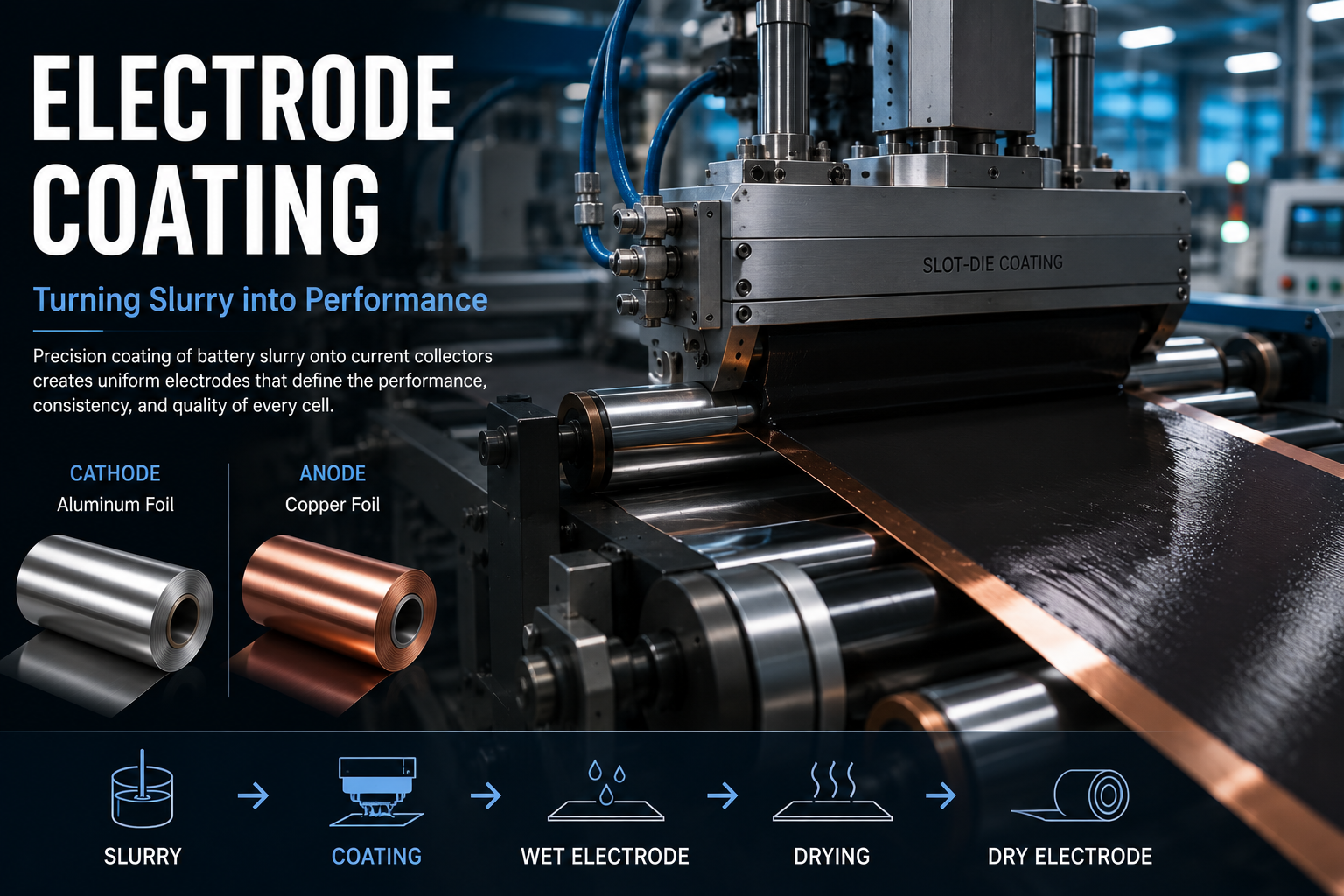
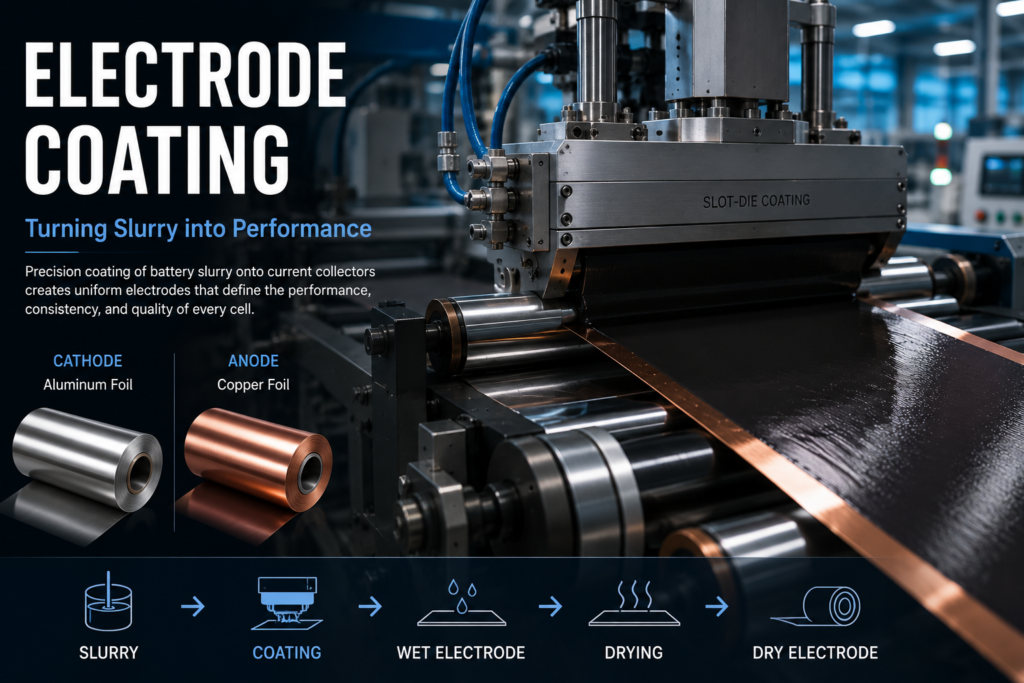
Battery electrode coating is a critical step in lithium-ion battery manufacturing where prepared cathode and anode slurry is applied onto thin metallic current collectors.
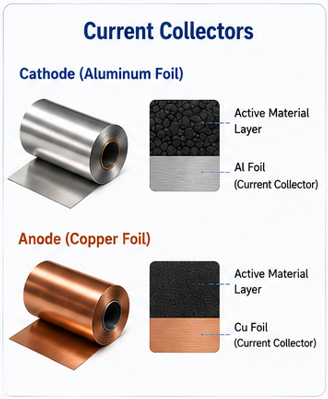
For conventional lithium-ion cells, cathode slurry is typically coated onto aluminum foil, while anode slurry is typically coated onto copper foil.
The objective may sound straightforward: spread slurry onto foil.
In industrial production, however, the coating must maintain tightly controlled thickness, width, loading, edge quality, and uniformity across long rolls of electrode material.
Small variations during coating can affect electrode capacity, cell balance, energy density, and manufacturing consistency.
Electrode coating therefore serves as the point where a battery material formulation begins to take the physical form of an electrode.
At a Glance
| Category | Description |
|---|---|
| Process | Electrode Coating |
| Stage | Electrode Manufacturing |
| Input | Cathode or Anode Slurry |
| Substrate | Aluminum Foil · Copper Foil |
| Common Technology | Slot-Die Coating |
| Key Controls | Loading · Thickness · Width · Uniformity · Line Speed |
| Previous Process | Battery Slurry |
| Next Process | Electrode Drying |
What Is Electrode Coating?
Electrode coating is the process of applying battery slurry onto a metallic current collector to create a continuous wet electrode layer.
The basic process is:
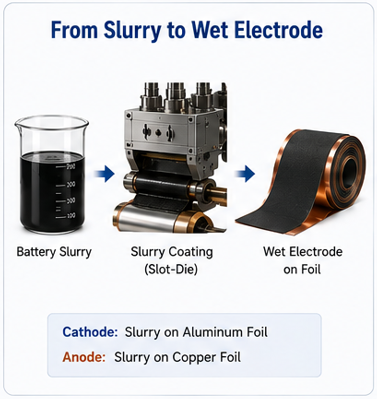
Battery Slurry
↓
Slurry Delivery
↓
Coating Head
↓
Current Collector Foil
↓
Wet Electrode
↓
Drying
The cathode and anode are produced separately.
Cathode
Cathode Slurry → Aluminum Foil
Anode
Anode Slurry → Copper Foil
After coating, the wet electrode immediately proceeds toward drying, where most of the liquid medium is removed.
Why Are Current Collectors Needed?
Active battery materials do not operate independently.
Electrons must be transported between the electrode material and the external electrical circuit.
This is the role of the current collector.
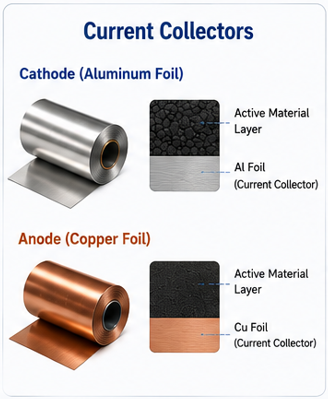
Cathode Current Collector
Cathodes commonly use aluminum foil.
Anode Current Collector
Graphite-based anodes commonly use copper foil.
The foil must be thin enough to minimize inactive material while maintaining sufficient:
- Electrical conductivity
- Mechanical strength
- Processability
- Adhesion to the electrode coating
Current collector thickness therefore also influences cell weight and energy density.
How Electrode Coating Works
In a continuous production line, battery electrode coating applies a controlled slurry layer onto metal foil as the current collector moves through the coating system.
Slurry is delivered from a storage or supply system to the coating head.
The coating system then deposits a controlled layer onto the moving foil.
A simplified flow is:
Unwinding
→ Foil Transport
→ Slurry Delivery
→ Coating
→ Wet Electrode
→ Drying Oven
→ Rewinding
This is commonly known as a roll-to-roll process.
Continuous roll-to-roll manufacturing allows very long electrode sheets to be produced at industrial scale.
Slot-Die Coating
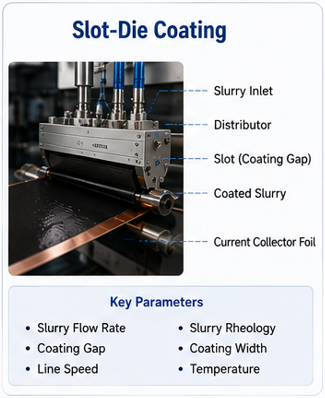
One of the important technologies used in battery electrode production is slot-die coating.
Slurry enters the coating head and is distributed across its width before exiting through a narrow slot.
The slurry is then deposited onto the moving current collector.
The coating result depends on several interacting variables, including:
- Slurry flow rate
- Foil speed
- Coating gap
- Slurry rheology
- Coating width
- Equipment precision
The objective is to maintain a stable coating condition across both the width and length of the electrode.
Slurry Rheology Meets Coating
This is where the slurry properties discussed in the previous Library article become especially important.
Battery slurry is often a complex non-Newtonian material.
As it travels through:
Tank → Pump → Filter → Pipe → Coating Head
it experiences different flow and shear conditions.
If slurry properties are inconsistent, the coating process can become unstable.
This is why slurry engineering and coating engineering cannot be treated as completely separate processes.
Good coating begins with well-controlled slurry.
Coating Thickness and Loading
Two important coating characteristics are thickness and loading.
Coating Thickness
This describes the physical thickness of the applied electrode layer.
Electrode Loading
Loading describes the amount of electrode material applied over a given area.
These parameters influence the amount of active material contained within the electrode.
Higher loading can potentially increase the amount of energy stored per unit electrode area.
However, simply making an electrode thicker does not automatically produce a better battery.
Very thick electrodes can create challenges related to:
- Ion transport
- Drying
- Mechanical stability
- Electrolyte penetration
- Fast-charging performance
Electrode design therefore requires a balance between energy density and electrochemical performance.
Coating Uniformity
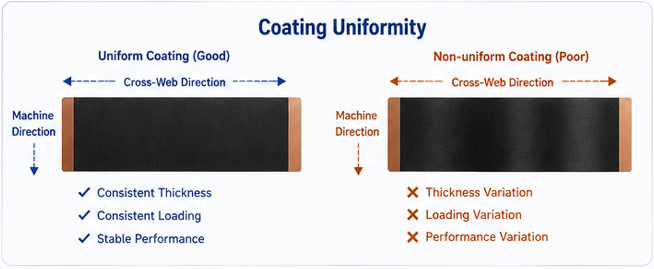
Uniformity is one of the most important coating objectives.
Ideally, the electrode should maintain consistent properties:
Across the Width
← Cross-Web Direction →
and
Along the Roll
→ Machine Direction →
Variation in coating thickness or loading can produce differences in local electrode capacity.
This may eventually contribute to cell-to-cell variation.
Manufacturers therefore monitor coating uniformity continuously during production.
Single-Side and Double-Side Coating
Battery electrodes generally require active material on both sides of the current collector.
This can be achieved through different production configurations.
Single-Side Coating
One side is coated and processed before the opposite side is coated.
Double-Side Coating
Production systems can be designed to coat both sides as part of a more integrated process.
The appropriate configuration depends on equipment design, electrode requirements, line speed, and production strategy.
Coating Width and Edge Control
The slurry is not necessarily applied across the entire width of the foil.
Specific uncoated regions may be required for:
- Electrode tabs
- Electrical connection
- Downstream cutting
- Cell design requirements
This means the coating system must control not only thickness but also coating width and edge position.
Poor edge control can create dimensional problems during later processes such as slitting and notching.
Intermittent Coating
Some battery electrode designs use intermittent coating rather than one continuous coated area.
The production line repeatedly switches between:
Coated Area → Uncoated Area → Coated Area
The uncoated regions can support downstream electrode design or tab requirements.
Accurate start and stop control becomes important in these applications.
Common Electrode Coating Defects
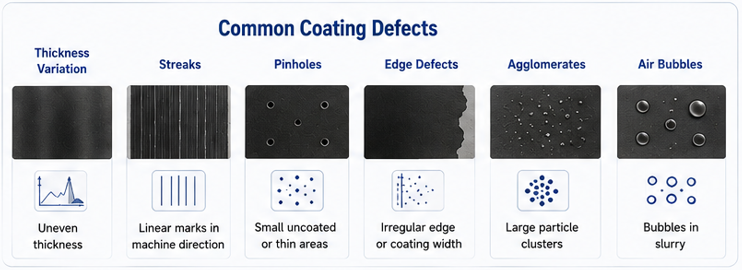
Coating defects can originate from slurry properties, contamination, equipment conditions, or process instability.
Typical problems can include:
Thickness Variation
The coating is not uniform across the electrode.
Streaks
Linear defects appear in the machine direction.
Pinholes
Small uncoated or defective regions form within the coating.
Edge Defects
The coating edge becomes irregular or unstable.
Agglomerate-Related Defects
Poorly dispersed particles interfere with the coating surface.
Air-Bubble Defects
Entrapped gas in the slurry can create local coating imperfections.
Because downstream processes cannot always remove these defects, early detection is important.
Inline Inspection
Modern battery manufacturing lines increasingly inspect electrodes during production.
Inspection systems can monitor parameters such as:
- Coating width
- Thickness
- Surface defects
- Edge position
- Material loading
- Dimensional consistency
Machine vision, laser measurement, X-ray or other sensor technologies may be used depending on the manufacturing system.
Inline inspection allows abnormal conditions to be detected before large quantities of defective electrode material are produced.
From Wet Coating to Dry Electrode

Immediately after slurry is deposited, the electrode remains wet.
It must therefore proceed into a controlled drying process.
Wet Electrode -> Drying Oven -> Solvent Removal -> Dry Electrode
The drying process does more than remove liquid.
Drying conditions can influence the internal distribution of binder and other components within the electrode.
For this reason, coating and drying are closely connected manufacturing processes.
Why Coating Speed Matters
Increasing line speed can improve manufacturing throughput.
However, faster coating can also make process control more challenging.
Higher speed affects:
- Slurry delivery
- Coating stability
- Drying requirement
- Web handling
- Inspection response time
Manufacturers therefore seek to increase productivity without sacrificing electrode uniformity or quality.
This trade-off becomes increasingly important in high-volume battery factories.
Coating and Battery Performance
Coating quality can influence the finished battery through several pathways.
Coating Uniformity -> Electrode Uniformity -> Capacity Consistency ->
Cell Balance -> Battery Performance
Likewise, defects or local variations can create regions with different electrochemical characteristics.
Electrode coating is therefore not simply a mechanical production process—it is part of battery performance engineering.
Emerging Electrode Coating Technologies
Battery manufacturers and researchers continue to improve electrode production.
Higher-Loading Electrodes
Thicker electrodes may help increase energy density but require improved transport and drying control.
High-Speed Coating
Increasing production speed can reduce manufacturing cost if quality can be maintained.
Advanced Inline Inspection
Real-time process measurement enables faster detection and correction of coating variation.
Water-Based Electrode Processing
Water-based formulations can reduce dependence on certain organic solvents.
Dry Electrode Technology
Dry electrode manufacturing seeks to reduce or eliminate the traditional slurry coating and solvent-drying process.
If commercialized at large scale, this could significantly change conventional electrode manufacturing.
iAtlas Insight
Electrode coating is where battery chemistry meets precision manufacturing.
A high-performance active material provides little value if it cannot be distributed consistently across industrial-scale electrodes.
As manufacturers pursue higher energy density and faster production, coating systems must handle increasingly demanding combinations of:
- Higher material loading
- More complex slurry rheology
- Thinner current collectors
- Faster line speeds
- Tighter quality tolerances
At the same time, coating is closely tied to one of the most energy-intensive steps in conventional electrode production: drying.
This is why innovations such as high-solid slurry, water-based processing, faster drying, and dry electrode manufacturing are attracting attention.
Improving electrode coating can therefore affect not only battery performance but also factory productivity, energy consumption, yield, and manufacturing cost.
Did You Know?
- Cathode and anode electrodes are manufactured on different metallic current collectors.
- Cathodes commonly use aluminum foil, while graphite anodes commonly use copper foil.
- Battery electrodes are typically produced through continuous roll-to-roll manufacturing.
- Slurry rheology directly affects coating behavior.
- Electrode loading influences how much active material is contained per unit area.
- Small coating defects can affect later battery manufacturing processes.
- Dry electrode technology could fundamentally change conventional slurry coating.
FAQ
What is electrode coating in battery manufacturing?
Electrode coating is the process of applying cathode or anode slurry onto a metallic current collector to create a wet battery electrode.
What is battery slurry coated onto?
Cathode slurry is commonly coated onto aluminum foil, while graphite anode slurry is commonly coated onto copper foil.
What is slot-die coating?
Slot-die coating uses a precision coating head to distribute slurry through a narrow opening and deposit it onto a moving substrate.
Why is coating uniformity important?
Uneven thickness or material loading can create differences in electrode capacity and electrochemical behavior.
What is electrode loading?
Electrode loading describes how much electrode material is applied over a given area.
What happens after electrode coating?
The wet electrode proceeds to electrode drying, where most of the liquid medium is removed.
Is dry electrode manufacturing the same as conventional coating?
No. Dry electrode technology seeks to reduce or eliminate the conventional liquid slurry and solvent-drying steps.
Battery Manufacturing Learning Path
Overview
Electrode Manufacturing
- Material Mixing
- Battery Slurry
- Electrode Coating (Current)
- Electrode Drying
- Calendering
- Slitting
Cell Assembly
- Battery Cell Assembly
- Notching
- Winding
- Stacking
- Electrolyte Filling
- Cell Sealing
Cell Finishing
- Formation
- Aging
- Degassing
- Battery Cell Testing & Grading
System Assembly
- Battery Module Assembly
- Battery Pack Assembly
Explore More
Fundamentals
- Battery
- Lithium-ion Battery
- Battery Cell
- Battery Module
- Battery Pack
- Battery Management System(BMS)
- Battery Thermal Management System(BTMS)
- Battery Safety
Materials
Manufacturing
- Battery Manufacturing Process
- Material Mixing
- Battery Slurry
- Electrode Coating (Current)
- Electrode Drying
- Calendering
- Slitting
- Battery Cell Assembly
Technologies
- Dry Electrode Technology
- Fast Charging
- Silicon Anode
References
Recommended source categories for this article:
- Chemical Engineering and Processing — Slot-die processing of lithium-ion battery electrodes: Coating window characterization
- Journal of Energy Storage — Electrode manufacturing for lithium-ion batteries: Analysis of current and next generation processing
- Materials & Design — A review of metrology in lithium-ion electrode coating processes
- Electrochemistry Communications — Electrode fabrication process and its influence in lithium-ion battery performance
About iAtlas
iAtlas is an independent publication covering batteries, semiconductors, OLED, advanced materials, AI, and global industrial trends.
We transform complex industrial developments into clear, reliable, and easy-to-understand insights.
Whether you’re following today’s industry news or building long-term expertise, iAtlas helps you understand not only what happened, but why it matters.
Technology creates change.
Insight creates opportunity.
— iAtlas