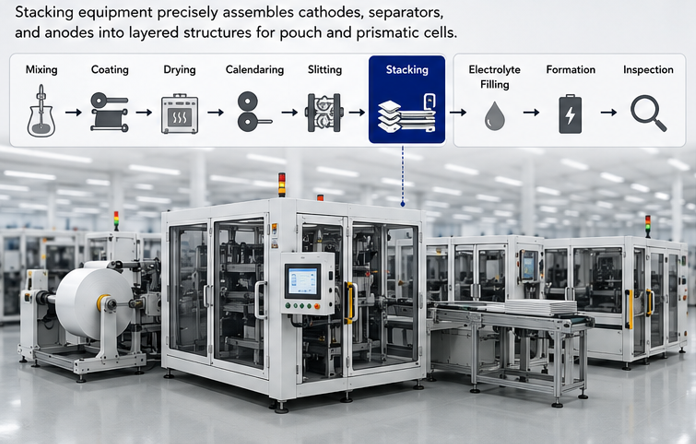

Lithium-ion Battery
The Rechargeable Battery Technology Powering Modern Electrification

Category: Battery Technology
Content Type: Technology
Related Industries: Electric Vehicles · Energy Storage Systems · Consumer Electronics
Last Updated: July 2026
Industry Snapshot

| Item | Details |
|---|---|
| Category | Rechargeable Battery |
| Industry | Battery |
| First Commercialized | 1991 |
| Commercialized By | Sony Corporation |
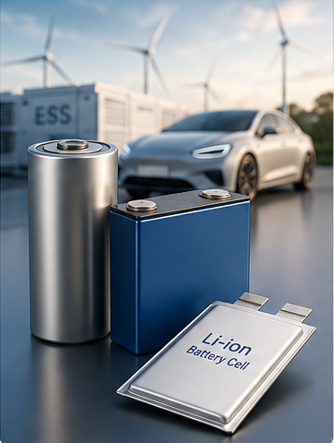
| Primary Applications | Electric Vehicles (EV), Energy Storage Systems (ESS), Consumer Electronics |
| Key Materials | Lithium, Nickel, Cobalt, Manganese, Graphite |
| Leading Companies | CATL, BYD, LG Energy Solution, Panasonic, Samsung SDI, SK On |
| Typical Cycle Life | 500–5,000+ cycles (depending on chemistry) |
| Major Strength | High Energy Density & Rechargeability |
Why It Matters
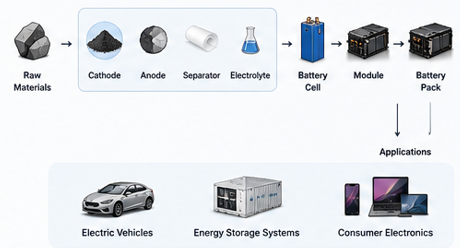
A lithium-ion battery is the world’s most widely used rechargeable battery technology, powering electric vehicles, energy storage systems, consumer electronics, and countless industrial applications.
They power smartphones, laptops, electric vehicles, industrial robots, drones, medical devices, and renewable energy storage systems. As the global economy moves toward electrification and carbon neutrality, lithium-ion batteries have evolved from a consumer electronics component into critical industrial infrastructure.
Today, battery manufacturing is no longer just about producing better batteries. It is also about securing raw materials, improving manufacturing efficiency, reducing costs, and building resilient supply chains. Governments and companies around the world are investing billions of dollars to strengthen their battery industries, making lithium-ion batteries one of the world’s most strategically important technologies.
At a Glance
Overview
A lithium-ion battery is a rechargeable battery that stores and releases electrical energy by moving lithium ions between two electrodes.
Unlike primary batteries, lithium-ion batteries can be charged hundreds or even thousands of times. During charging, lithium ions move from the cathode to the anode, where they are stored. During discharge, the ions return to the cathode, generating the electrical current that powers connected devices.
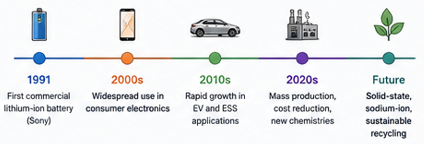
Since its commercialization in 1991, continuous improvements in battery chemistry, manufacturing technology, and production scale have significantly increased energy density while reducing cost. Today, lithium-ion batteries dominate the global rechargeable battery market and serve as the foundation of electric mobility, renewable energy storage, and portable electronics.
How It Works
A lithium-ion battery operates through the movement of lithium ions between two electrodes.
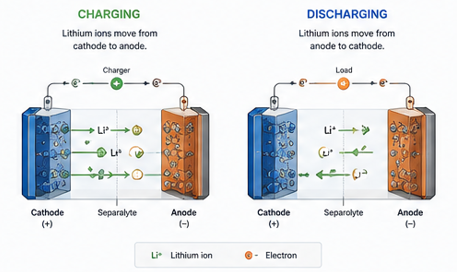
Charging
- Lithium ions move from the cathode to the anode.
- Electrical energy is stored inside the battery.
- Electrons flow through the external charging circuit.
Discharging
- Lithium ions return to the cathode.
- Electrons flow through the external circuit.
- Electrical energy is supplied to the connected device.
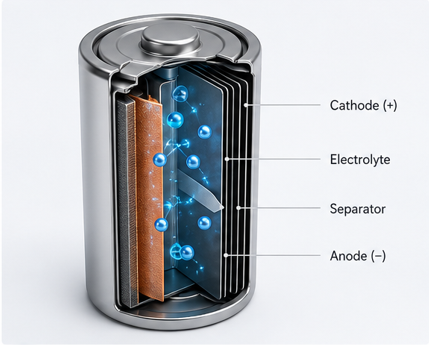
Future infographic: Cross-sectional diagram showing lithium-ion movement during charging and discharging.
Key Components
| Component | Role |
|---|---|
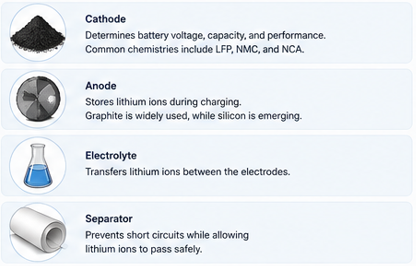
| Cathode | Determines battery voltage, capacity, and overall performance. Common chemistries include LFP, NMC, and NCA. |
| Anode | Stores lithium ions during charging. Graphite is widely used, while silicon is emerging for higher energy density. |
| Electrolyte | Transfers lithium ions between the electrodes. |
| Separator | Prevents short circuits while allowing lithium ions to pass safely. |
Explore More
- Cathode
- Anode
- Electrolyte
- Separator
- Graphite
- Silicon Anode
Applications
| Industry | Examples |
|---|---|
| Electric Vehicles | Passenger EVs, Commercial Vehicles, Electric Buses |
| Energy Storage | Grid ESS, Renewable Energy Storage |
| Consumer Electronics | Smartphones, Tablets, Laptops, Wearables |
| Industrial Equipment | AGVs, Drones, Robotics |
| Medical Devices | Portable Monitoring Equipment |
| Aerospace | Satellites and Emerging Electric Aircraft |
Industry Ecosystem
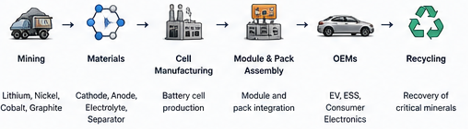
The lithium-ion battery industry spans a complex global supply chain.
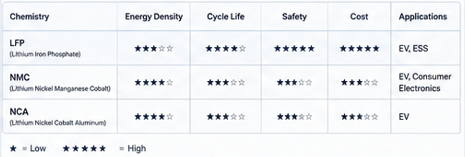
Battery Chemistry Comparison
| Chemistry | Best For |
|---|---|
| LFP | Safety |
| NMC | Balance |
| NCA | High Energy |
Battery Timeline
Leading Companies
| Company | Overview |
|---|---|
| CATL | World’s largest EV battery manufacturer |
| BYD | Vertically integrated EV and battery producer |
| LG Energy Solution | Global leader in pouch and cylindrical batteries |
| Panasonic | Pioneer in cylindrical battery technology |
| Samsung SDI | Premium battery technologies for EV and ESS |
| SK On | High-performance batteries for next-generation EVs |
Market Trends
The lithium-ion battery industry continues to evolve rapidly.
- Silicon-rich anodes for higher energy density
- Commercialization of sodium-ion batteries
- Development of solid-state batteries
- Expansion of battery recycling
- Construction of global gigafactories
- Localization of battery supply chains
Atlas Insight
Lithium-ion batteries will remain the dominant rechargeable battery technology throughout this decade. However, future industry leadership will depend not only on battery chemistry but also on manufacturing efficiency, production scale, supply chain resilience, and cost competitiveness.
As electrification accelerates worldwide, companies that successfully integrate material sourcing, advanced manufacturing, and recycling capabilities will be best positioned to lead the next generation of the battery industry.
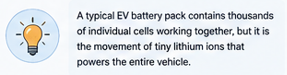
Did you know?
Frequently Asked Questions
What is a lithium-ion battery?
A rechargeable battery that stores and releases electrical energy through the movement of lithium ions.
Why are lithium-ion batteries widely used?
They offer high energy density, long cycle life, high efficiency, and relatively low self-discharge.
What is the difference between LFP and NMC batteries?
LFP batteries emphasize safety and longevity, while NMC batteries provide higher energy density and longer driving range.
Can lithium-ion batteries be recycled?
Yes. Valuable materials such as lithium, nickel, cobalt, copper, and graphite can be recovered through advanced recycling technologies.
Will lithium-ion batteries be replaced?
Although technologies such as solid-state and sodium-ion batteries are advancing, lithium-ion batteries are expected to remain the dominant commercial battery technology for many years.
Explore More in Atlas Library
Fundamentals
- Battery
- Lithium-ion Battery
- Battery Cell
- Battery Module
- Battery Pack
- Battery Management System(BMS)
- Battery Thermal Management System(BTMS)
- Battery Safety
Materials
- Cathode
- Anode
- Electrolyte
- Separator
Manufacturing
- Cell Assembly
- Module Assembly
- Pack Assembly
Technologies
- Cell-to-Pack (CTP)
- Cell-to-Chassis (CTC)
- Wireless BMS
- Thermal Runaway
- Fast Charging
References
- International Energy Agency (IEA)
- U.S. Department of Energy (DOE)
- Argonne National Laboratory
- Nature Energy
- Journal of Power Sources
- LG Energy Solution Technical Resources
- CATL Technical Resources
About iAtlas
iAtlas is an independent publication covering batteries, semiconductors, OLED, advanced materials, AI, and global industrial trends.
We transform complex industrial developments into clear, reliable, and easy-to-understand insights.
Whether you’re following today’s industry news or building long-term expertise, iAtlas helps you understand not only what happened, but why it matters.
Technology creates change.
Insight creates opportunity.
— iAtlas