Battery Management System (BMS)
The Intelligent Control System That Keeps Batteries Safe and Efficient
Category: Battery Technology
Content Type: Fundamentals
Related Industries: Electric Vehicles · Energy Storage Systems · Consumer Electronics
Last Updated: July 2026
Industry Snapshot
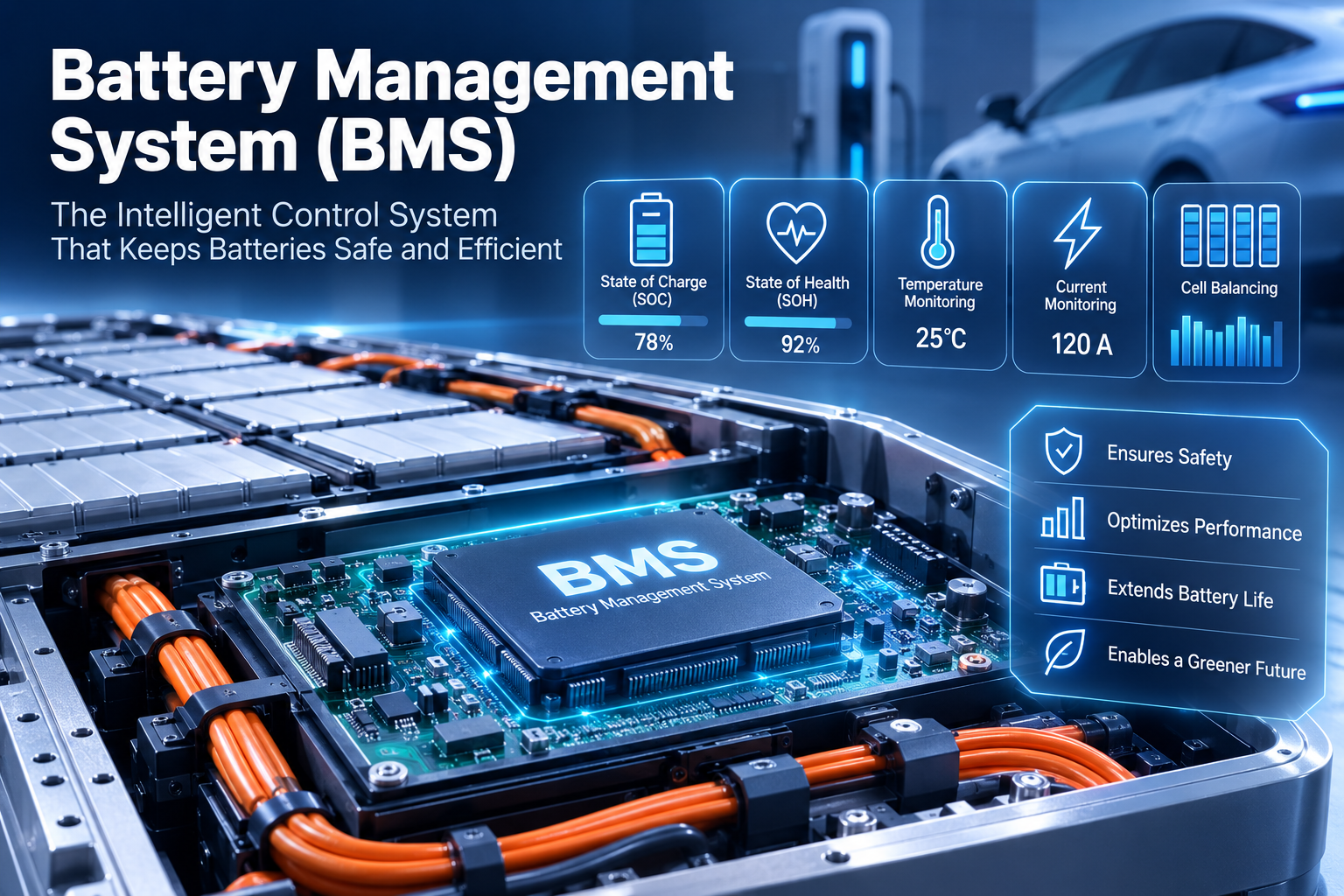
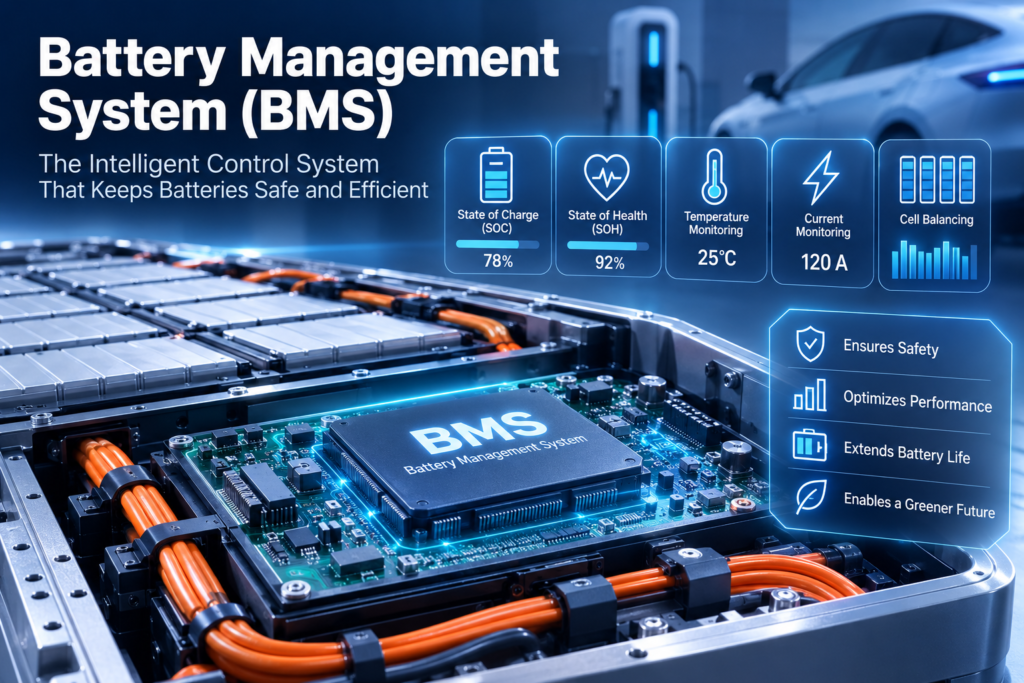
A Battery Management System (BMS) is the electronic control system responsible for monitoring, protecting, and optimizing rechargeable batteries. While battery cells, modules, and packs store electrical energy, the BMS acts as the “brain” of the battery system, ensuring that every cell operates safely and efficiently.
Modern electric vehicles and energy storage systems rely heavily on advanced BMS technologies to maximize battery performance, extend service life, and prevent hazardous conditions such as overcharging, deep discharge, overheating, and thermal runaway.
Without a Battery Management System, today’s high-capacity lithium-ion batteries could not be operated safely or reliably.
At a Glance
| Category | Description |
|---|---|
| Definition | Electronic system that monitors and controls battery operation |
| Main Purpose | Safety, performance optimization, and battery protection |
| Monitors | Voltage, Current, Temperature, State of Charge (SOC), State of Health (SOH) |
| Typical Location | Inside a battery pack |
| Major Applications | EVs, ESS, Consumer Electronics, Industrial Batteries |
Overview
A Battery Management System continuously collects data from battery cells and makes real-time decisions to ensure safe operation.
Instead of allowing every battery cell to operate independently, the BMS monitors electrical and thermal conditions, balances cell voltages, estimates the remaining battery capacity, and communicates with external systems.
As battery capacity increases, BMS technology becomes increasingly important because even small differences between cells can reduce performance or create safety risks.
Battery Management System Architecture
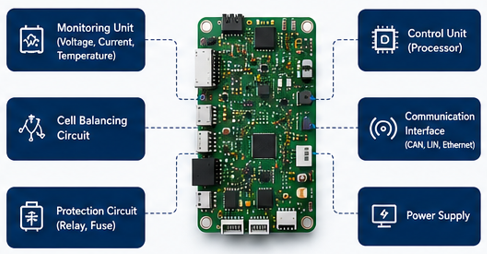
A typical Battery Management System consists of several functional blocks.
Battery Monitoring Unit
Measures cell voltage, pack voltage, current, and temperature.
Battery Control Unit
Processes sensor data and determines charging, discharging, and protection actions.
Cell Balancing Circuit
Maintains similar voltage levels across all battery cells.
Communication Interface
Exchanges information with the vehicle controller, charger, or energy management system through protocols such as CAN, LIN, or Ethernet.
Protection Circuit
Disconnects the battery when abnormal conditions are detected.
Key Functions of a Battery Management System
The Battery Management System performs multiple critical functions.
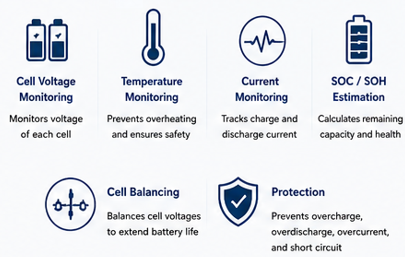
Cell Voltage Monitoring
Continuously measures individual cell voltages to detect abnormal conditions.
Temperature Monitoring
Protects batteries from overheating or operation outside the recommended temperature range.
Current Monitoring
Measures charging and discharging current to prevent excessive load.
State of Charge (SOC) Estimation
Calculates the remaining battery capacity available for use.
State of Health (SOH) Estimation
Evaluates battery aging and long-term performance degradation.
Cell Balancing
Ensures all battery cells maintain similar voltages, improving battery lifespan and usable capacity.
Types of Battery Management Systems
Different battery systems require different BMS architectures.
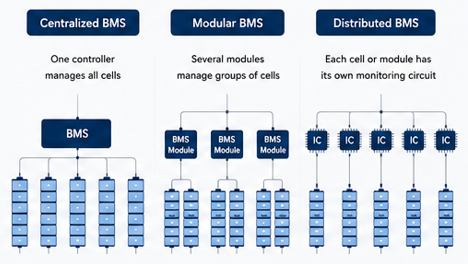
| Type | Characteristics |
|---|---|
| Centralized BMS | One controller manages all cells. Simple and cost-effective. |
| Modular BMS | Several control modules manage groups of cells. |
| Distributed BMS | Each cell or module has its own monitoring circuit, improving scalability and reliability. |
Battery Management System Workflow
A Battery Management System operates continuously in a closed-loop process.
- Measure battery voltage, current, and temperature.
- Calculate SOC and SOH.
- Detect abnormal operating conditions.
- Balance cell voltages if necessary.
- Control charging and discharging.
- Communicate battery status to external systems.
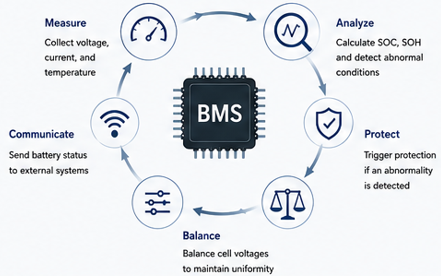
This continuous monitoring allows the battery to operate safely throughout its lifetime.
Key Performance Factors
Several factors determine the effectiveness of a Battery Management System.
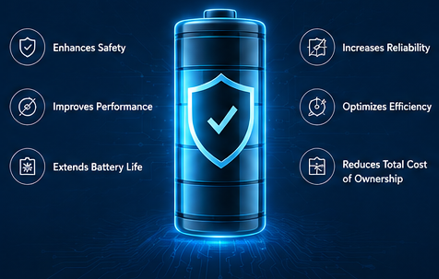
| Parameter | Importance |
|---|---|
| Measurement Accuracy | Improves battery estimation precision |
| Cell Balancing Efficiency | Extends battery lifespan |
| Communication Speed | Enables real-time system control |
| Functional Safety | Prevents hazardous failures |
| Power Consumption | Reduces energy loss during operation |
Applications
Battery Management Systems are widely used in:
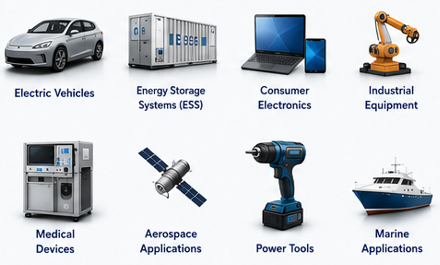
- Electric Vehicles (EVs)
- Hybrid Electric Vehicles (HEVs)
- Plug-in Hybrid Vehicles (PHEVs)
- Energy Storage Systems (ESS)
- Consumer Electronics
- Medical Devices
- Aerospace Applications
- Industrial Equipment
Industry Ecosystem
The Battery Management System market involves multiple technology providers.
- Battery Manufacturers
- BMS Semiconductor Companies
- Automotive OEMs
- Battery Pack Integrators
- Sensor Manufacturers
- Embedded Software Developers
- Energy Storage Solution Providers
Atlas Insight
Future Battery Management Systems are becoming more intelligent through artificial intelligence and cloud connectivity.
AI-based algorithms can predict battery degradation more accurately, while cloud-connected BMS platforms enable remote diagnostics, predictive maintenance, and fleet-wide battery optimization. Wireless Battery Management Systems (wBMS) are also reducing wiring complexity, lowering weight, and improving manufacturing flexibility for next-generation electric vehicles.
Did You Know?
- A modern EV Battery Management System can monitor hundreds or even thousands of individual battery cells.
- Cell balancing can significantly extend battery lifespan by minimizing voltage differences between cells.
- Some premium electric vehicles now use wireless Battery Management Systems to reduce cable weight and simplify assembly.
- BMS software is updated regularly to improve battery performance and charging strategies.
FAQ
What is a Battery Management System (BMS)?
A Battery Management System is an electronic control system that monitors, protects, and optimizes rechargeable batteries.
Why is a Battery Management System important?
It prevents unsafe operating conditions, improves battery performance, and extends battery lifespan.
What does a BMS monitor?
A BMS monitors voltage, current, temperature, State of Charge (SOC), and State of Health (SOH).
What is cell balancing?
Cell balancing equalizes the voltage of individual battery cells, ensuring better performance and longer battery life.
Can a battery operate without a BMS?
Small batteries may operate without one, but modern lithium-ion battery packs used in EVs and ESS require a Battery Management System for safe and reliable operation.
Explore More
Fundamentals
- Battery
- Lithium-ion Battery
- Battery Cell
- Battery Module
- Battery Pack
- Battery Management System(BMS)
- Battery Thermal Management System(BTMS)
- Battery Safety
Materials
- Cathode
- Anode
- Electrolyte
- Separator
Manufacturing
- Cell Assembly
- Module Assembly
- Pack Assembly
Technologies
- Cell-to-Pack (CTP)
- Cell-to-Chassis (CTC)
- Wireless BMS
- Thermal Runaway
- Fast Charging
References
- International Energy Agency (IEA) – Global EV Outlook 2025
- U.S. Department of Energy – Vehicle Technologies Office
- Texas Instruments – Battery Management Solutions
- Analog Devices – Battery Management Systems
- LG Energy Solution – Battery Technology
About iAtlas
iAtlas is an independent publication covering batteries, semiconductors, OLED, advanced materials, AI, and global industrial trends.
We transform complex industrial developments into clear, reliable, and easy-to-understand insights.
Whether you’re following today’s industry news or building long-term expertise, iAtlas helps you understand not only what happened, but why it matters.
Technology creates change.
Insight creates opportunity.
— iAtlas