AI Infrastructure Investment Could Reach $31.6 Trillion by 2050
The AI Boom Is Expanding from GPUs into Data Centers, Power, Cooling, Storage and the Physical Infrastructure Behind Computing
🌐 iAtlas Daily #53 | AI Infrastructure & Data Centers | September 2026
The AI Infrastructure Investment boom is becoming much larger than the semiconductor industry.
The first phase of the AI investment cycle focused heavily on GPUs.
Then attention expanded toward HBM, advanced packaging, enterprise SSDs and networking.
Now the investment wave is moving further into the physical economy.
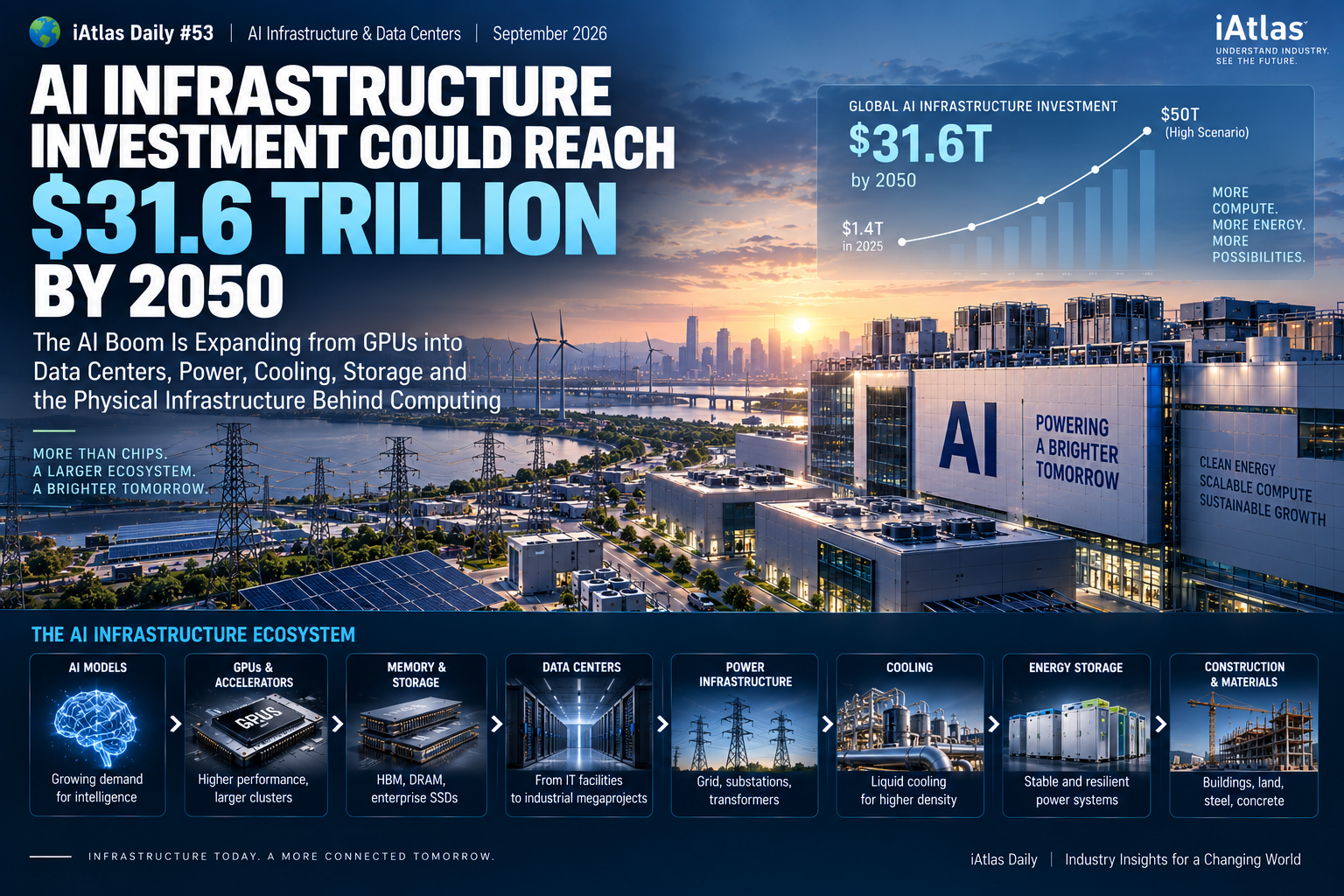
According to a new analysis from PwC, global capital expenditure required to build AI computing infrastructure could reach approximately:
$31.6 Trillion
through 2050.
That is not simply spending on computers.
It represents a much broader industrial system:
AI Models
↓
GPUs & Accelerators
↓
Memory & Storage
↓
Servers
↓
Data Centers
↓
Power Infrastructure
↓
Cooling
↓
Energy Storage
↓
Construction & Materials
AI is becoming a physical infrastructure industry.
The biggest AI investment opportunity may eventually extend far beyond the companies designing AI chips.
🌐 The Big Story
AI models require enormous amounts of computing power.
But computing power cannot exist independently.
Every GPU requires:
- memory
- storage
- networking
- electricity
- cooling
- buildings
- backup power
- grid connections
As AI models become larger and inference expands across the economy, all of those supporting systems must scale.
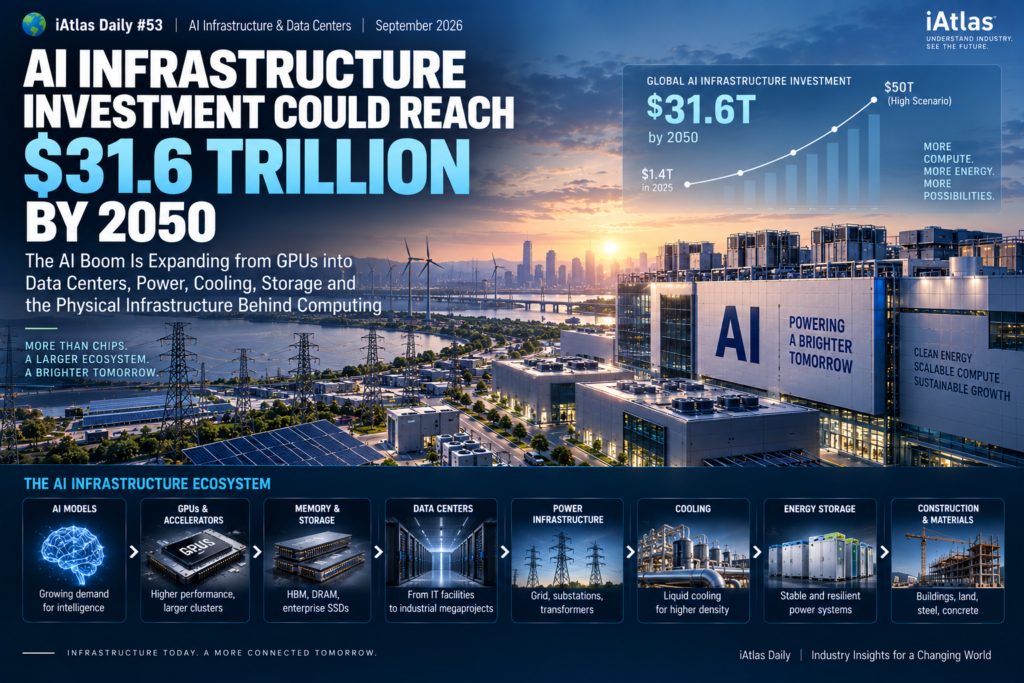
PwC estimates that approximately $31.6 trillion of global capital investment could be required through 2050 to build the necessary AI infrastructure.
Under a higher-growth scenario, the requirement could climb toward $50 trillion.
The AI investment story is therefore changing from:
Who makes the best AI chip?
to:
Who can build the industrial infrastructure required to operate millions of them?
💰 1. $31.6 Trillion Is an Enormous Industrial Investment Cycle
To understand the scale, it helps to look beyond technology.
PwC’s estimate suggests AI infrastructure could become one of the largest capital-investment cycles associated with a transformative technology.
The base-case regional investment estimates through 2050 include approximately:
🇺🇸 United States
$15.1 trillion
🌏 Asia-Pacific
$8.2 trillion
🇪🇺 Europe
$5.6 trillion
with additional investment across the Middle East, Africa and other regions.
The United States remains the center of the AI infrastructure boom.
But the buildout is becoming global.
🏢 2. AI Data Centers Are Becoming Industrial Megaprojects
Traditional data centers were largely IT facilities.
AI data centers are beginning to resemble heavy industrial projects.
A modern AI campus can require:
Hundreds of Megawatts
or eventually:
Gigawatts of Power
That changes everything about project development.
The facility needs more than servers.
It needs:
Land
Substations
Transformers
Transmission
Cooling
Water Infrastructure
Backup Power
Energy Storage
Network Connectivity
The data center becomes an industrial complex.
⚡ 3. Electricity May Become the Most Important Constraint
GPUs can be manufactured relatively quickly compared with new power infrastructure.
A large transformer can take months or years to procure.
Transmission projects can take even longer.
Power plants require permitting, construction and grid integration.
That creates a fundamental mismatch:
AI Compute Demand
↑ Rapid
while
Power Infrastructure
↑ Slow
PwC identifies power availability as one of the major constraints capable of reducing the speed of AI infrastructure deployment.
This is why electricity is increasingly becoming part of the AI technology race.
🔌 4. The Data Center Power Architecture Is Changing
Traditional data centers could rely on relatively predictable electricity demand.
AI workloads behave differently.
Large clusters containing tens or hundreds of thousands of accelerators can create extremely high-density power requirements.
The power chain becomes:
Utility Grid
↓
Substation
↓
Transformer
↓
Switchgear
↓
UPS
↓
Power Distribution
↓
Server Rack
↓
GPU
Every stage must scale.
A shortage in any one component can delay the entire data center.
That creates opportunities across electrical equipment industries that historically received far less attention from technology investors.
🔋 5. Batteries Are Entering the AI Infrastructure Chain
Energy storage is also becoming increasingly important.
AI data centers need reliable power.
Even short interruptions can affect expensive computing infrastructure.
Battery systems can support:
- backup power
- UPS functions
- grid stabilization
- renewable integration
- peak-power management
This creates a new industrial connection:
AI
↓
Data Centers
↓
Power Demand
↓
Grid Constraints
↓
Battery Energy Storage
↓
Battery Manufacturing
The semiconductor and battery industries are therefore beginning to connect through AI infrastructure.
🌬️ 6. Cooling Is Becoming Strategic Infrastructure
Electricity entering an AI processor eventually becomes heat.
And AI chips are becoming extremely power dense.
Traditional air cooling becomes increasingly difficult as rack power density rises.
The industry is therefore moving toward technologies such as:
Direct-to-Chip Liquid Cooling
Cold Plates
Coolant Distribution Units
Rear-Door Heat Exchangers
and potentially:
Immersion Cooling
The thermal chain looks like this:
Electricity
↓
GPU Compute
↓
Heat
↓
Liquid Cooling
↓
Heat Rejection
↓
Cooling Infrastructure
The more compute installed, the larger this industrial cooling market becomes.
💾 7. Storage Is Another Hidden AI Infrastructure Layer
AI does not operate only on GPUs.
Models require enormous datasets.
Inference produces additional data.
AI agents and enterprise applications require rapid access to stored information.
This is why enterprise SSDs are becoming an increasingly important part of AI infrastructure.
The architecture becomes:
GPU
↕
HBM
↕
DRAM
↕
Enterprise SSD
↕
Data Storage
AI therefore drives demand across multiple layers of the memory hierarchy.
This is one reason NAND Flash and enterprise SSDs have recently become much more important parts of the AI investment story.
🌐 8. Networking Must Scale with Compute
Thousands of GPUs are useful only if they can communicate efficiently.
Large AI clusters therefore require extremely high-speed networking.
That creates demand for:
- switches
- optical transceivers
- silicon photonics
- fiber
- advanced network processors
The relationship becomes:
More GPUs
↓
More Data Movement
↓
Higher Network Bandwidth
↓
More Optical Connectivity
↓
More Photonics Infrastructure
This is beginning to benefit semiconductor-material suppliers as well.
Recent market developments show strong AI-related demand for photonics-oriented semiconductor substrates, demonstrating how the AI infrastructure cycle is spreading into previously specialized materials markets.
🧱 9. AI Is Creating Demand for Ordinary Industrial Materials
The further the AI supply chain expands, the less it looks like a pure technology industry.
Building thousands of data centers requires enormous amounts of:
Copper
Steel
Concrete
Aluminum
Fiber Optics
Electrical Cable
Transformers
Cooling Equipment
Power Electronics
PwC’s analysis specifically points to commodity and infrastructure suppliers as potential beneficiaries of the buildout.
AI therefore creates a multiplier effect.
One AI chip creates demand for the industrial infrastructure surrounding it.
🔄 10. AI Hardware Has an Unusual Replacement Cycle
There is another reason the investment requirement becomes so large.
Railways can remain useful for decades.
Power transmission assets can operate for many decades.
AI hardware ages much faster.
GPUs and accelerators can become technologically outdated within only a few years as new architectures deliver significantly better performance.
PwC’s analysis assumes relatively frequent computing-hardware replacement compared with conventional infrastructure.
That means AI infrastructure combines:
Long-Life Assets
Buildings
Substations
Transmission
Cooling infrastructure
with:
Short-Life Assets
GPUs
Accelerators
Servers
Networking hardware
This creates a recurring capital-investment cycle.
🏭 11. The Data Center Supply Chain Is Becoming Longer
The original AI supply chain looked relatively simple:
NVIDIA
↓
GPU
↓
AI
Today it increasingly looks like:
Semiconductor Equipment
↓
Advanced Chips
↓
HBM
↓
Advanced Packaging
↓
Enterprise SSD
↓
Networking
↓
Servers
↓
Data Center
↓
Power
↓
Cooling
↓
ESS
↓
Grid Infrastructure
Every layer creates another industrial market.
And each layer can potentially become a bottleneck.
🌎 12. Countries Are Competing to Host AI Infrastructure
AI data centers are also becoming geopolitical assets.
Countries increasingly want domestic compute capacity because it can support:
- AI companies
- national research
- cloud infrastructure
- defense
- industrial AI
- digital sovereignty
This has triggered data-center investment across the U.S., Europe, the Middle East and Asia.
The Financial Times recently noted that national AI data-center projects are spreading globally even as the U.S. and China retain overwhelming positions in frontier compute and AI ecosystems.
AI infrastructure is therefore becoming part of national industrial strategy.
🇰🇷 13. Korea Has an Interesting Position in This Supply Chain
Korea does not currently dominate hyperscale cloud computing.
But it occupies several important layers of the physical AI supply chain.
Memory
SK hynix
Samsung Electronics
SSD / NAND
Samsung Electronics
SK hynix / Solidigm
Batteries
LG Energy Solution
Samsung SDI
SK On
Electrical Equipment
HD Hyundai Electric
LS ELECTRIC
Hyosung Heavy Industries
Data Centers & Telecom
SK Telecom
KT
NAVER
This creates an interesting strategic opportunity.
Korea does not necessarily need to dominate every layer of AI.
It can participate in the industrial infrastructure surrounding AI.
🏗️ 14. AI Investment Is Moving Downstream
The investment cycle is following a recognizable pattern.
Phase 1
AI Models
OpenAI / Anthropic / Google
↓
Phase 2
AI Chips
NVIDIA / AMD
↓
Phase 3
Memory & Packaging
HBM / CoWoS / Advanced Packaging
↓
Phase 4
Data Centers
Servers / Networking / Storage
↓
Phase 5
Physical Infrastructure
Power / Cooling / ESS / Grid
This progression is one of the most important structural changes occurring across the technology industry.
⚠️ 15. The $31.6 Trillion Forecast Is Not Guaranteed
Large long-term forecasts require caution.
AI adoption could accelerate faster than expected.
But it could also slow.
Potential constraints include:
Power Availability
Semiconductor Supply
Capital Costs
Regulation
Data Sovereignty
Community Opposition
Grid Capacity
PwC estimates these constraints could materially reduce the amount of infrastructure ultimately built.
There is also increasing scrutiny over whether AI infrastructure investment can generate sufficient economic returns.
The scale is enormous.
So are the risks.
🧩 Why This Matters
The AI Infrastructure Investment cycle is changing the industrial economy in four important ways.
AI investment is moving beyond semiconductors.
Power, cooling, storage and construction are becoming part of the technology supply chain.
Data centers are becoming industrial facilities.
Gigawatt-scale campuses increasingly resemble manufacturing complexes.
Electricity is becoming a technology constraint.
Compute capacity can grow only as fast as the infrastructure supplying it.
AI connects previously separate industries.
Semiconductors, batteries, electrical equipment and utilities are increasingly participating in the same investment cycle.
🔭 What to Watch
Data Center Power
The availability of grid connections may increasingly determine where AI infrastructure gets built.
Transformers
Long lead times could make transformers and switchgear critical bottlenecks.
Liquid Cooling
Higher rack densities should continue accelerating the transition away from conventional air cooling.
ESS
Battery storage could become an increasingly important part of data-center power architecture.
Enterprise SSD
AI inference and storage demand may continue strengthening NAND demand.
AI Infrastructure Financing
As projects become larger, financing structures will become increasingly important.
Korea
Watch whether Korea can translate its strength in memory, batteries and electrical equipment into a larger role in global AI infrastructure.
🧭 iAtlas Insight
The AI boom began as a software story.
Then it became a semiconductor story.
Now it is becoming an infrastructure story.
The progression is:
AI Model
↓
AI Chip
↓
Memory
↓
Storage
↓
Data Center
↓
Power
↓
Cooling
↓
Energy Storage
↓
Industrial Infrastructure
Each step moves AI further into the physical economy.
That may ultimately be the most important consequence of the current AI cycle.
AI does not run in the cloud. It runs inside factories of computing filled with chips, cables, cooling systems and enormous amounts of electrical infrastructure.
The next phase of AI competition may therefore depend not only on who develops the best model or processor.
It may depend on:
Who can build the physical infrastructure required to operate AI at scale.
📚 Related Articles
📰 iAtlas Daily #38: AI Data Centers Are Creating a New Industrial Equipment Boom
How AI data centers are expanding demand for power, cooling and industrial equipment.
📰 iAtlas Daily #10: TSMC Advanced Packaging Expansion Signals the Next AI Boom
Why AI compute demand is driving another manufacturing bottleneck upstream.
🔗 References
PwC — Global Investment in AI Infrastructure
Financial Times — National Data Centre Projects and the Global AI Race
About iAtlas
iAtlas is an independent publication covering batteries, semiconductors, OLED, advanced materials, AI, and global industrial trends.
We transform complex industrial developments into clear, reliable, and easy-to-understand insights.
Whether you’re following today’s industry news or building long-term expertise, iAtlas helps you understand not only what happened, but why it matters.
Technology creates change.
Insight creates opportunity.
— iAtlas