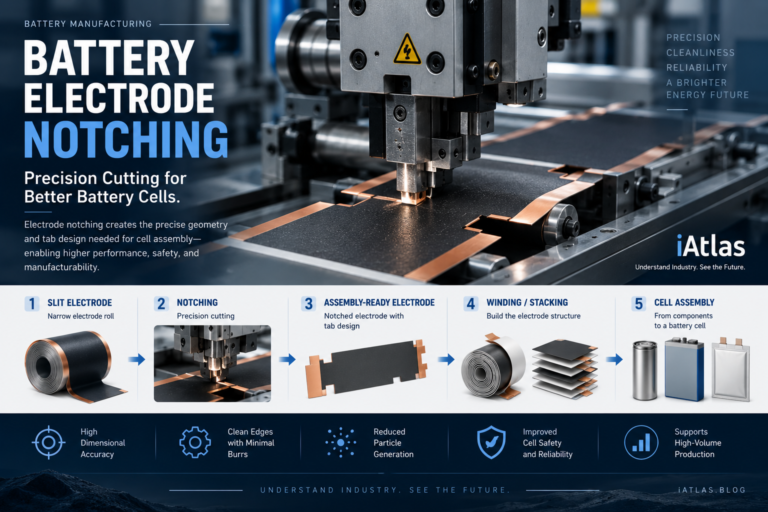

Formation & Aging Explained: 5 Essential Steps That Determine Battery Life
🔋 iAtlas Battery #16 | 🏭 Manufacturing → ⚡ Formation & Aging
Introduction

Battery formation is one of the most critical processes in lithium-ion battery manufacturing.
After electrolyte filling, a battery cell cannot be shipped immediately. Instead, it must undergo a carefully controlled battery formation process, followed by aging.
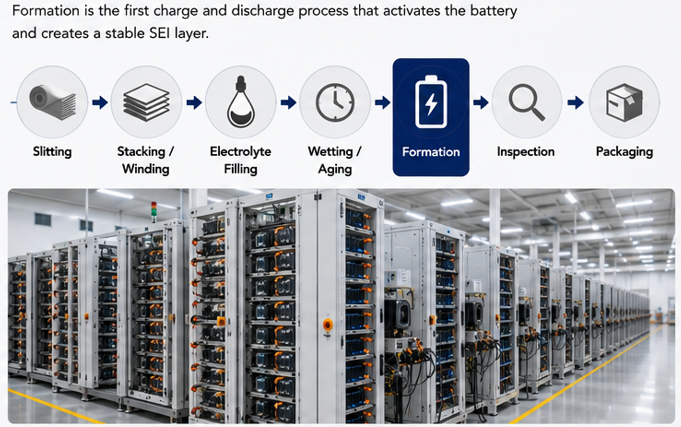
During formation, the battery is charged and discharged under tightly controlled conditions to create a stable Solid Electrolyte Interphase (SEI) layer on the anode surface. This protective layer is essential for long battery life, stable performance, and safe operation.
Without proper battery formation, even perfectly manufactured battery cells can suffer from rapid capacity loss and reduced safety.
Table of Contents
- What Is Battery Formation?
- Why the SEI Layer Is Important
- Formation and Aging Process
- Quality Inspection During Aging
- Future Trends
- Frequently Asked Questions
What Is Battery Formation?
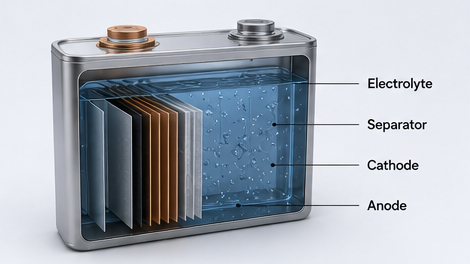
Battery formation is the first controlled charging process performed after electrolyte filling.
Its primary purpose is to activate the battery and create a stable SEI layer between the electrolyte and the anode.
Unlike normal charging, formation is intentionally slow and precisely controlled.
Typical objectives include:
- SEI formation
- Cell activation
- Capacity stabilization
- Internal resistance optimization
Why the SEI Layer Is Important
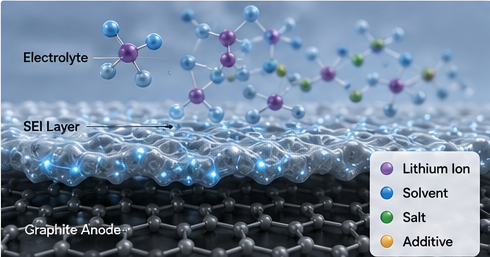
The Solid Electrolyte Interphase (SEI) is a thin protective film that naturally forms during the first charge.
Although only a few nanometers thick, it plays a vital role by:
- Preventing continuous electrolyte decomposition
- Allowing lithium ions to pass
- Blocking electrons
- Improving battery lifespan
- Enhancing safety
A high-quality SEI layer is one of the biggest factors influencing long-term battery performance.
Formation and Aging Process
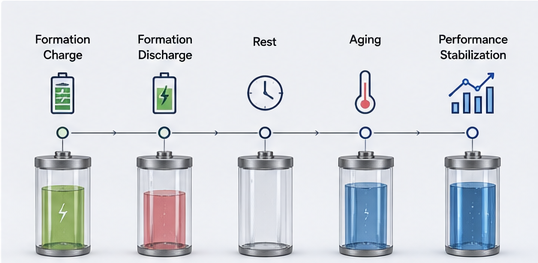
Following formation, battery cells enter an aging period.
During aging:
- Electrolyte becomes fully stabilized.
- The SEI layer matures.
- Internal pressure stabilizes.
- Initial defects become detectable.
Manufacturers monitor temperature, voltage, and internal resistance throughout this stage.
Because formation and aging require time, they are among the longest processes in battery manufacturing.
Quality Inspection During Aging
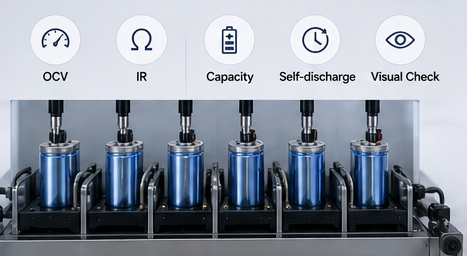
Battery cells are inspected before leaving the aging room.
Typical inspections include:
- Open-circuit voltage (OCV)
- Internal resistance (IR)
- Capacity testing
- Self-discharge evaluation
- Visual inspection
Cells that fail to meet specifications are removed before final assembly.
Future Trends
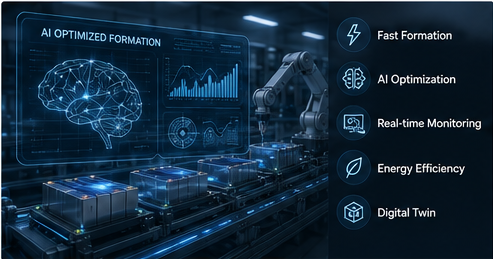
Modern battery factories continue improving battery formation technology.
Recent trends include:
- Fast formation protocols
- AI-driven formation optimization
- Digital twin manufacturing
- Real-time cell monitoring
- Energy-efficient formation systems
These innovations reduce production time while maintaining battery quality.
Frequently Asked Questions
What is battery formation?
Battery formation is the first controlled charging process that activates a lithium-ion battery and creates the protective SEI layer.
Why is the SEI layer important?
The SEI layer protects the anode, improves battery lifespan, and enables stable lithium-ion transport.
Why do batteries need aging?
Aging allows battery performance to stabilize while revealing manufacturing defects before shipment.
Can formation affect battery lifespan?
Yes. Proper battery formation significantly influences cycle life, safety, and long-term performance.
Key Takeaways
- Battery formation activates lithium-ion battery cells.
- Formation creates the protective SEI layer.
- Aging stabilizes battery performance before shipment.
- Formation is one of the longest and most critical manufacturing processes.
- AI and advanced monitoring are improving formation efficiency.
🎓 Battery Learning Path
🏭 Manufacturing
✅🔋 iAtlas Battery #13 — Electrode Manufacturing
✅🔋 iAtlas Battery #14 — Cell Assembly
✅🔋 iAtlas Battery #15 — Electrolyte Filling
📍 🔋 iAtlas Battery #16 — Formation & Aging (Current)
▶ 🔋 iAtlas Battery #17 — Battery Inspection & Quality Control
Continue exploring how lithium-ion batteries are activated, stabilized, and prepared for reliable long-term performance.
📖 Continue Reading
⬅ Previous Article
🔋 iAtlas Battery #15
Electrolyte Filling Explained: 6 Critical Steps for Lithium-Ion Battery Performance
Learn why electrolyte filling, vacuum injection, and moisture control are essential for battery safety and performance.
➡ Next Article
🔋 iAtlas Battery #17
Battery Inspection & Quality Control Explained: Ensuring Every Cell Meets the Standard
Discover how battery manufacturers inspect capacity, internal resistance, appearance, and safety before cells leave the factory.
References
- International Energy Agency (IEA)
- U.S. Department of Energy – Vehicle Technologies Office
- Battery University
- Nature Energy
About iAtlas
iAtlas is an independent publication covering batteries, semiconductors, OLED, advanced materials, AI, and global industrial trends.
We transform complex industrial developments into clear, reliable, and easy-to-understand insights.
Whether you’re following today’s industry news or building long-term expertise, iAtlas helps you understand not only what happened, but why it matters.
Technology creates change.
Insight creates opportunity.
— iAtlas