GM and LG Energy Solution Are Turning One Battery Factory into a Multi-Chemistry Hub
Ultium Cells Will Add LMR Prismatic Cells to a Tennessee Plant Already Producing High-Nickel and LFP Batteries
🔋 iAtlas Daily #73 | Battery Manufacturing & Technology | October 2026
For years, the battery industry pursued a relatively simple objective:
Build More Gigafactories
More electric vehicles would require more batteries.
More batteries would require more factories.
But the next phase of battery manufacturing may be more complicated.
The question is no longer simply:
How much battery capacity can a factory produce?
Increasingly, manufacturers also need to ask:
How many different battery technologies can the factory support?
General Motors and LG Energy Solution are now providing an important example.
Their joint venture, Ultium Cells, will upgrade its Spring Hill, Tennessee battery factory to produce:
Lithium Manganese-Rich — LMR
prismatic battery cells for future GM electric vehicles.
Facility modifications are scheduled to begin later in 2026 and are expected to be completed in 2028. Ultium Cell
But the most interesting part of the announcement is not simply LMR.
The same manufacturing site is evolving toward supporting:
High-Nickel
LFP
LMR
across:
Pouch
Prismatic
cell formats. Ultium Cell
That represents a larger change in battery manufacturing.
The competitive advantage of a battery factory may increasingly depend not only on scale, but on flexibility.
🌍 The Big Story
Ultium Cells announced on September 28 that its Spring Hill facility will be upgraded for LMR prismatic battery production.
The plant is expected to become the world’s first facility to mass-produce prismatic LMR battery cells, according to Ultium Cells and the Tennessee government. Ultium Cell
The technology is particularly interesting because GM and LG Energy Solution are positioning LMR between two established battery strategies.
On one side:
LFP
Low cost.
Strong safety characteristics.
Increasingly important for affordable EVs and ESS.
On the other:
High-Nickel
High energy density.
Long driving range.
But generally greater material cost.
LMR attempts to create another option.
According to GM and Ultium Cells, the new cells are designed to provide approximately:
33% Higher Energy Density than LFP
while targeting:
Comparable Cost.
If the technology reaches those targets at commercial scale, it could occupy an important middle ground in the battery market.
1. What Is LMR?
LMR stands for:
Lithium Manganese-Rich
The basic idea is reflected in the name.
The cathode uses a relatively high proportion of:
Manganese
while reducing dependence on more expensive materials such as cobalt and nickel.
Manganese is already used in several lithium-ion battery chemistries.
But LMR attempts to increase its role significantly.
The objective is to combine:
Lower Material Cost
with:
Higher Energy Density
than conventional low-cost battery chemistries.
2. Why Does Manganese Matter?
Battery chemistry is partly a materials-economics problem.
Different cathode materials provide different combinations of:
Energy Density
Cost
Safety
Cycle Life
and:
Raw-Material Exposure
High-nickel batteries can deliver excellent energy density.
But nickel and cobalt can increase cost and supply-chain complexity.
LFP removes nickel and cobalt from the cathode.
That helps reduce cost.
But LFP generally provides lower energy density than high-nickel chemistries.
LMR attempts to create another balance:
More Manganese
↓
Less Dependence on Expensive Metals
↓
Competitive Cost
while maintaining:
Higher Energy Density
3. GM Has Been Working on LMR for More Than a Decade
This is not a sudden battery experiment.
GM says it began researching manganese-rich lithium-ion cells in:
2015
The company subsequently developed the technology with LG Energy Solution across areas including:
Cathode Materials
Electrolytes
Additives
Cell Formats
and:
Manufacturing Processes. Ultium Cell
That is important because LMR has historically faced technical challenges.
Promising chemistry does not automatically become a commercial battery.
The real challenge is turning materials science into:
Reliable Mass Production
4. LMR Has Had Technical Problems
Manganese-rich cathodes have attracted attention for years.
But commercialization has been difficult.
Challenges can include:
Voltage Fade
Capacity Retention
Cycle Life
and:
Charging Performance
These issues help explain why LMR has not already become a mainstream EV chemistry.
GM and LG Energy Solution say their development work has addressed historical performance and durability barriers. Ultium Cell
The next test will be industrial.
Can those improvements survive:
Millions of Cells
rather than laboratory samples?
5. The Cell Format Is Changing Too
The new battery is not only a new chemistry.
It also represents a different:
Form Factor
GM’s earlier Ultium strategy was strongly associated with:
Large Pouch Cells
The new LMR batteries will use:
Prismatic Cells
This means the Spring Hill transition involves two variables at once:
Chemistry Change
Form-Factor Change
That makes the manufacturing transition particularly significant.
6. What Is a Prismatic Cell?
A prismatic cell places battery components inside a:
Rigid Rectangular Housing
Conceptually:
Electrodes
↓
Cell Stack
↓
Rigid Prismatic Case
Compared with pouch cells, the rigid structure can simplify certain aspects of pack integration and mechanical design.
Prismatic cells are already widely used across the global EV industry.
For GM, adding prismatic production broadens the manufacturing architecture available for future vehicles.
7. Why Not Use One Battery Chemistry Everywhere?
Because different vehicles need different batteries.
A large electric pickup may prioritize:
Range
Power
and:
Energy Density
An affordable compact EV may prioritize:
Cost
An ESS installation may prioritize:
Cycle Life
Safety
and:
Cost per kWh
There is no single chemistry that perfectly optimizes all of them.
That is why GM increasingly describes its strategy as matching:
The Right Battery to the Right Application
8. High-Nickel Still Has a Role
The move toward LMR does not mean high-nickel batteries are disappearing.
GM says high-nickel batteries will continue to provide the highest-range solutions within its portfolio. Ultium Cell
That distinction matters.
The industry is not necessarily moving:
High-Nickel → LFP → LMR
as a simple replacement sequence.
Instead, the structure is becoming:
High-Nickel
↕️
LMR
↕️
LFP
with each chemistry serving different applications.
9. And LFP Is Already Being Produced at Spring Hill
This is where the factory story becomes particularly interesting.
Spring Hill began producing LFP battery cells for:
Energy Storage Systems
in June 2026.
Those cells are intended for LG Energy Solution Vertech customers. Ultium Cell
So within a relatively short period, the plant’s role has expanded from its original EV focus toward:
ESS
and now:
Next-Generation EV Batteries
The factory itself is becoming diversified.
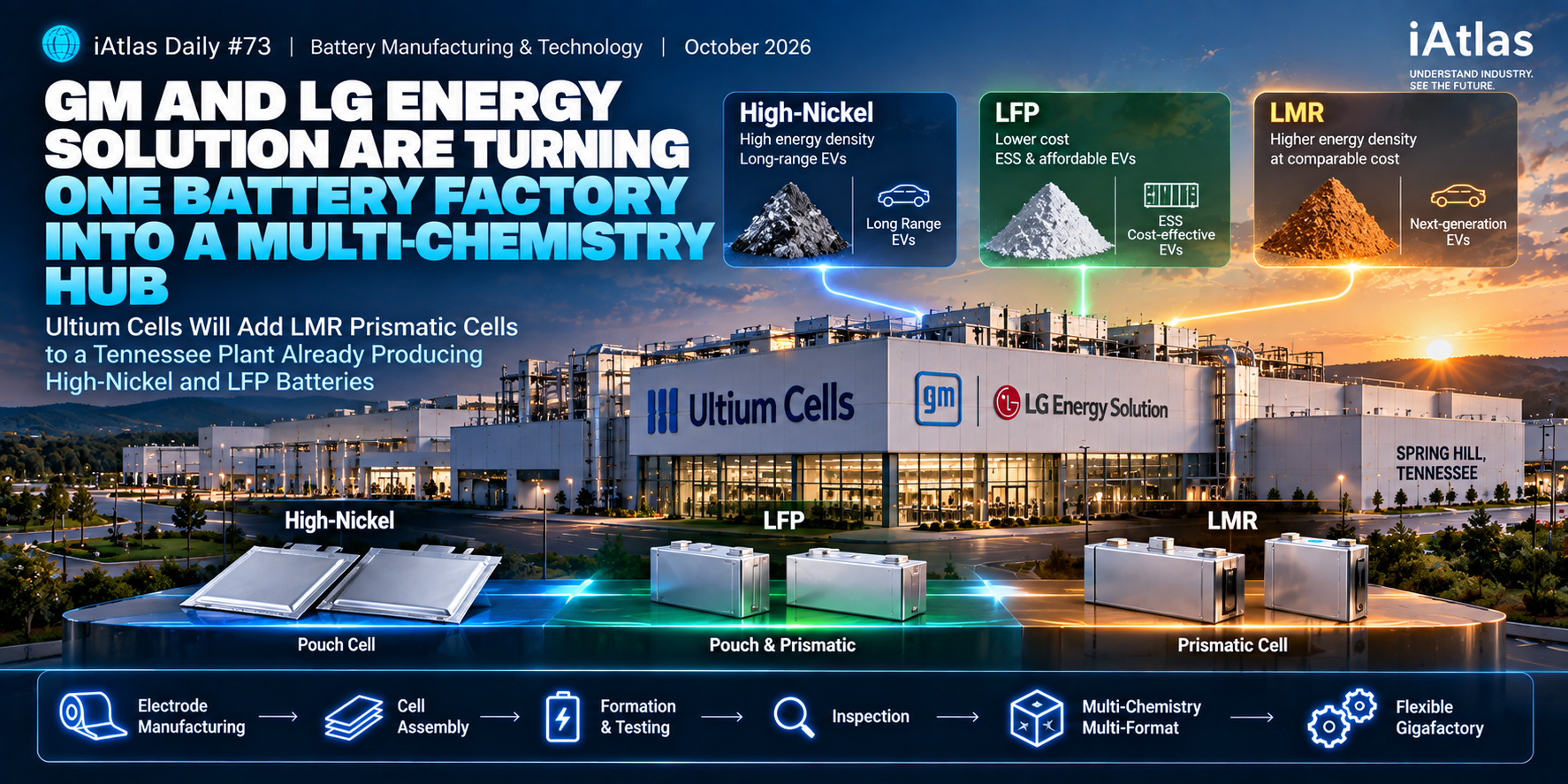
10. One Factory, Three Chemistries
Once the new production system is established, Spring Hill is expected to support:
High-Nickel
For high-performance and long-range applications.
LFP
For stationary energy storage.
LMR
For future GM electric vehicles.
That creates a manufacturing portfolio of:
Three Different Chemistry Platforms
under one industrial site. Ultium Cell
This may be more important than any individual chemistry.
11. It Will Also Support Multiple Cell Formats
The diversification does not stop there.
Ultium Cells says Spring Hill will support both:
Pouch
and:
Prismatic
cells. Ultium Cell
So the manufacturing structure becomes:
Multiple Chemistries
×
Multiple Form Factors
×
Multiple Applications
That is a very different factory strategy from building a highly optimized line around one cell design.
12. Battery Factories Are Becoming Platforms
The first generation of gigafactory thinking emphasized:
Scale
Large factories.
Large capacity.
High utilization.
Lower unit cost.
Those principles still matter.
But rapidly changing battery markets create another requirement:
Adaptability
A factory optimized for one product can become vulnerable if demand changes.
A more flexible factory may be able to respond by shifting:
Chemistry
Cell Format
or:
End Market
13. The ESS Pivot Already Demonstrated This
Spring Hill provides a real example.
The facility was originally developed primarily around EV battery manufacturing.
But slower EV growth and rapidly increasing energy-storage demand created another opportunity.
Ultium Cells invested approximately:
$70 Million
to retool part of the facility for LFP ESS batteries.
That production began in 2026. Ultium Cell
This is an important industrial lesson.
Existing battery assets can sometimes be:
Repurposed
rather than abandoned.
14. Now Another Retooling Cycle Is Beginning
The next stage is much larger.
The Tennessee government says Ultium Cells will invest:
$1 Billion
in Spring Hill as it retools and diversifies the operation. TNECD
Ultium Cells describes the combined investment in its LFP and LMR programs and related facility improvements as reaching $1 billion by 2030. Ultium Cell
Facility modifications for LMR are expected to begin later this year.
Completion is targeted for:
2028
The expansion is also projected to create approximately:
500 New Jobs
in addition to the site’s current workforce of roughly 1,200. Ultium Cell
15. Retooling Is Becoming a Strategic Capability
This deserves more attention.
Battery manufacturing is extremely capital intensive.
Factories contain expensive:
Coating Equipment
Drying Systems
Calendaring Equipment
Slitting Equipment
Cell Assembly Systems
Electrolyte Filling
Formation Equipment
and:
Inspection Systems
If battery technology changes, replacing the entire factory would be enormously expensive.
Manufacturers therefore have strong incentives to design production systems that can be:
Modified
rather than completely rebuilt.
16. But Retooling Is Not Simple
A chemistry change can affect more than the cathode material.
Different cells may require changes in:
Electrode Formulation
Coating Conditions
Drying
Electrode Loading
Cell Assembly
Electrolyte
Formation Protocols
and:
Quality Control
Changing the form factor from pouch to prismatic introduces additional manufacturing differences.
So:
Flexible Manufacturing
does not mean:
Easy Manufacturing
It means designing factories and equipment with future conversion in mind.
17. This Could Change Battery Equipment Demand
That creates an important implication for equipment suppliers.
Historically, equipment orders often followed:
New Factory Construction
But if manufacturers increasingly reconfigure existing plants, another market grows:
Factory Retooling
Equipment companies may increasingly need to provide:
Line Modification
Process Integration
Automation Upgrades
Inspection Upgrades
and:
New Chemistry Compatibility
not only greenfield production lines.
18. Brownfield Investment Could Become More Important
Battery investment can broadly be divided into:
Greenfield
Building an entirely new factory.
Brownfield
Upgrading or expanding an existing facility.
During periods of explosive demand growth, greenfield projects dominate attention.
But when demand becomes less predictable:
Brownfield Flexibility Becomes More Attractive
Companies can reuse:
Buildings
Utilities
Infrastructure
Workforce
and parts of:
Existing Equipment
That can reduce both investment risk and implementation time.
19. This Is Especially Relevant After the EV Slowdown
The global battery industry built enormous capacity based on expectations of rapid EV growth.
EV demand continues to expand over the long term.
But the pace has not always matched earlier projections.
That has created:
Idle Capacity
Delayed Projects
Factory Reassessment
and:
Investment Discipline
At the same time, ESS demand is accelerating.
The result is not simply:
Less Battery Demand
It is:
Different Battery Demand
20. Factories Need to Follow Demand
This creates a new manufacturing equation:
EV Demand Changes
↓
ESS Demand Grows
↓
Chemistry Requirements Change
↓
Factory Configuration Changes
Spring Hill illustrates this clearly.
The site can increasingly respond to different markets rather than depending on one product trajectory.
21. Chemistry Is Becoming Market Segmentation
Battery chemistry used to sound like a laboratory decision.
Increasingly, it is also a:
Market Strategy
High-nickel can target premium performance.
LFP can target cost-sensitive and stationary applications.
LMR could potentially occupy the space between them.
The battery portfolio begins to resemble:
Premium
Mid-Market
Value
product segmentation in other industries.
22. LMR Could Fill an Important Gap
Consider the basic trade-off.
High-Nickel
Higher Energy Density
but generally:
Higher Cost
LFP
Lower Cost
but:
Lower Energy Density
LMR aims for:
LFP-Like Cost + Higher Energy Density
According to GM, the technology is designed to provide approximately 33% greater energy density than LFP at comparable cost. GM
If commercial production confirms that combination, LMR could become particularly attractive for:
Electric Trucks
and:
Large SUVs
where battery size and driving range are critical.
23. Pack-Level Economics Matter Too
Battery cost is not determined only by:
$/kWh at the Cell Level
Higher energy density can potentially reduce the number or volume of cells required for a given driving range.
That can affect:
Pack Size
Vehicle Weight
Structural Materials
Cooling
and:
Packaging
GM previously said it expects LMR and prismatic architecture to deliver significant pack-cost savings compared with its current high-nickel packs. Ultium Cell
So the economic argument extends beyond cathode material cost.
24. More Chemistry Options Also Reduce Strategic Risk
Battery manufacturers face uncertainty across:
Raw Materials
Trade Policy
Customer Demand
Technology
and:
Regional Supply Chains
Depending entirely on one chemistry creates exposure.
A broader portfolio creates options.
If nickel prices rise:
another chemistry may become more attractive.
If ESS demand accelerates:
LFP capacity can become more valuable.
If consumers demand long-range but lower-cost EVs:
LMR may offer another solution.
This is essentially:
Manufacturing Optionality
25. Korea’s Battery Strategy Is Moving in the Same Direction
This also connects directly with Daily #70.
There we examined how Korea’s battery-material industry is expanding beyond its traditional strength in:
High-Nickel NCM
toward:
LFP
Mid-Nickel
LMR
and:
LMFP
Now the same diversification is appearing downstream in cell manufacturing.
The pattern is becoming clear:
Materials Diversification
↓
Chemistry Diversification
↓
Cell-Format Diversification
↓
Manufacturing Diversification
26. The Industry Is Moving Beyond One Winning Chemistry
For years, battery discussions often asked:
Which chemistry will win?
NCM?
LFP?
Sodium-ion?
LMR?
But the better question may be:
Which chemistry will win each application?
The battery market is becoming too large and diverse for one chemistry to dominate every use case.
27. That Changes the Meaning of Scale
Traditional manufacturing scale means:
Produce More of the Same Thing
Future battery scale may increasingly mean:
Produce Different Things Efficiently
That requires a different industrial capability.
Factories need:
Modular Equipment
Flexible Automation
Recipe Control
Advanced Inspection
and:
Process Knowledge
across multiple chemistries.
28. The Factory Becomes a Competitive Asset
This changes how we should evaluate battery companies.
It is not enough to ask:
How many GWh of capacity do they have?
We may increasingly need to ask:
What chemistries can that capacity produce?
What formats can it handle?
How quickly can it be converted?
How much does conversion cost?
and:
What markets can it serve?
Nominal capacity alone tells only part of the story.
29. Flexibility Has a Cost
There is an important counterargument.
A factory optimized around one product can potentially achieve:
Higher Throughput
Lower Complexity
Simpler Quality Control
and:
Lower Unit Cost
A highly flexible factory may sacrifice some optimization.
So manufacturers face another trade-off:
Efficiency vs. Flexibility
The correct balance will depend on how predictable battery demand becomes.
30. Spring Hill Will Be an Important Test
By 2028, the Tennessee facility could become an unusually diversified battery manufacturing hub.
If Ultium Cells executes its plan successfully, Spring Hill will demonstrate whether a large battery factory can economically support:
High-Nickel
LFP
LMR
Pouch Cells
Prismatic Cells
EV Applications
and:
ESS Applications
within one manufacturing ecosystem. Ultium Cell
That makes Spring Hill more than another gigafactory.
It becomes a test of:
The Flexible Gigafactory
🧩 Why This Matters
GM and LG Energy Solution are moving LMR toward industrialization.
The Spring Hill facility is expected to become the first plant to mass-produce prismatic LMR battery cells. Ultium Cell
LMR targets the gap between LFP and high-nickel.
GM says the technology is designed to provide around 33% higher energy density than LFP at comparable cost. GM
The factory is becoming multi-chemistry.
Spring Hill is evolving toward high-nickel, LFP and LMR production rather than depending on a single chemistry. Ultium Cell
It is becoming multi-format too.
The facility is expected to support both pouch and prismatic cells. Ultium Cell
Retooling is becoming an industrial strategy.
Existing battery factories may increasingly be modified for new chemistries and applications instead of being replaced by entirely new plants.
Battery capacity needs a new definition.
Future competitiveness may depend less on headline GWh alone and more on how flexibly that capacity can respond to changing markets.
🔭 What to Watch
LMR Manufacturing Yield
Laboratory performance is not enough. The critical question will be whether LMR can achieve competitive yield, consistency and durability at mass-production scale.
2028 Commercialization
Spring Hill modifications are scheduled for completion in 2028. Watch whether GM and LG Energy Solution remain on schedule as the technology moves toward commercial deployment. Ultium Cell
LMR vs. LFP
If LMR delivers substantially higher energy density at comparable cost, it could become an important alternative for larger EVs where LFP’s lower energy density creates packaging challenges.
Factory Retooling
Watch whether other battery manufacturers increasingly convert existing EV lines toward ESS, new chemistries or new cell formats rather than announcing entirely new gigafactories.
Battery Equipment
Multi-chemistry manufacturing could increase demand for flexible coating, assembly, formation, inspection and automation systems capable of supporting multiple production recipes.
Chemistry Diversification
The broader trend to watch is not which single chemistry wins, but how manufacturers divide different chemistries across EV, ESS and other applications.
🧭 iAtlas Insight
The first phase of the battery manufacturing race was about:
Capacity
Who could build the largest factories?
Who could reach the most GWh?
Who could scale fastest?
The next phase may be about something different:
Optionality
Can the factory move from EV to ESS?
Can it support more than one chemistry?
Can it change cell format?
Can existing equipment be reconfigured instead of replaced?
Can production follow the market?
Spring Hill provides an unusually clear example.
Its evolution can be summarized as:
High-Nickel EV Batteries
↓
LFP for ESS
↓
LMR for Future EVs
while its manufacturing architecture expands from:
Pouch
to:
Pouch + Prismatic
That is not simply a battery-chemistry story.
It is a factory-design story.
The most valuable gigafactory of the future may not be the one that produces the most of one battery. It may be the one that can adapt fastest when the battery market changes.
And in an industry where chemistry, demand and policy are all evolving simultaneously, that flexibility could become a major competitive advantage.
📚 Related Articles
📰 iAtlas Daily #70: Korea Is Building an LFP Supply Chain of Its Own
📰 iAtlas Daily #65: LG Energy Solution Is Building an ESS Manufacturing Network Across North America
🔗 References
- Ultium Cells — Spring Hill Operations to Produce LMR Prismatic Battery Cells
- General Motors — Ultium Cells to Bring LMR Production to Tennessee
- Tennessee Department of Economic & Community Development — $1 Billion Spring Hill Investment
- Ultium Cells — GM and LG Energy Solution to Pioneer LMR Battery Cell Technology
- Reuters — GM, LG to Make Lower-Cost EV Battery Cells in Tennessee
ℹ️ About iAtlas
iAtlas is an independent publication covering batteries, semiconductors, OLED, advanced materials, AI, and global industrial trends.
We transform complex industrial developments into clear, reliable, and easy-to-understand insights.
Whether you’re following today’s industry news or building long-term expertise, iAtlas helps you understand not only what happened, but why it matters.
Technology creates change.
Insight creates opportunity.
— iAtlas