SK Telecom Builds a New AI Data Center Platform with SK Horizon
A KRW 3.08 Trillion Investment Shows How AI Competition Is Moving from Chips to Physical Infrastructure
🌐 iAtlas Daily #46 | AI Infrastructure & Data Centers | August 2026
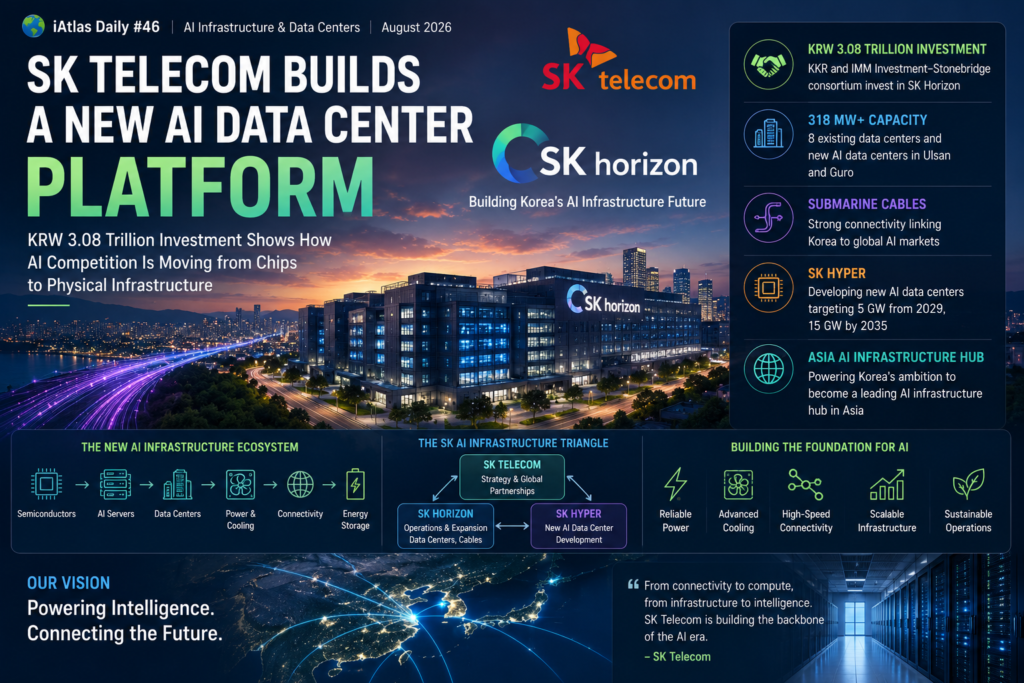
The SK Horizon AI Data Center strategy marks a major expansion of South Korea’s AI infrastructure ambitions.
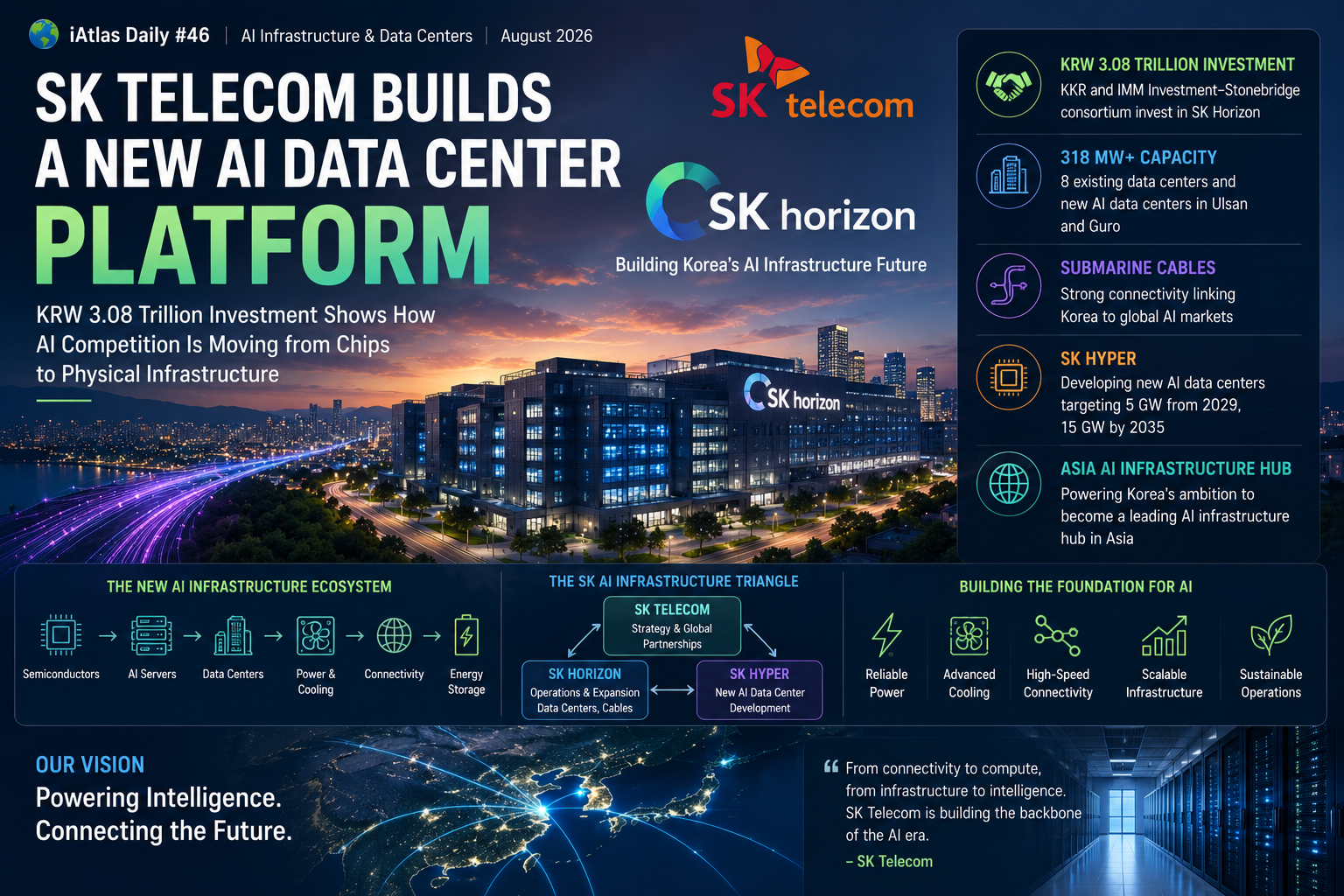
SK Telecom announced that it will establish SK Horizon, a dedicated AI data center infrastructure company created through the planned spin-off of SK Broadband’s data center and submarine cable businesses. At the same time, funds managed by KKR and the IMM Investment-Stonebridge consortium will invest a combined KRW 3.08 trillion in the new company.
The move reflects a broader shift in the AI industry.
AI competition is no longer only about developing better models or manufacturing faster processors.
It is increasingly about building the enormous physical infrastructure required to operate them.
AI is becoming an infrastructure industry — and data centers are becoming one of its most important industrial assets.
🌐 The Big Story
SK Telecom is restructuring its AI data center business around three distinct roles.
The company plans to divide SK Broadband into the surviving telecommunications and media company and a newly established infrastructure company, SK Horizon.
SK Horizon will inherit and expand the data center and submarine cable businesses.
SK Telecom will remain responsible for overall AI data center strategy and partnerships with global technology companies.
A separate company established in July, SK Hyper, will focus on developing new large-scale AI data center projects.
The structure looks like this:
SK Telecom
Strategy / Global Partnerships
↓
SK Horizon
Existing Data Centers / Operations / Expansion / Submarine Cables
↓
SK Hyper
New GW-Scale AI Data Center Development
This is much more than a corporate restructuring.
SK Telecom is effectively creating a dedicated industrial platform for AI infrastructure.
🏢 1. SK Horizon Starts with an Existing Data Center Network
SK Horizon will not start from zero.
According to SK Telecom, the company will encompass eight existing data centers:
- Seocho
- Ilsan (two locations)
- Bundang
- Gasan
- Centum
- Yangju
- Pangyo
It will also incorporate new AI data centers under development, including facilities in Ulsan and Guro.
SK Telecom says this infrastructure is expected to reach a combined capacity of approximately:
318 MW
That gives SK Horizon something particularly valuable in the AI infrastructure market:
Operating experience + Existing facilities + Expansion projects + Capital
AI data centers require large amounts of capital and specialized operational capabilities.
Starting with an existing infrastructure base can therefore provide an advantage over building a completely new platform.
💰 2. KRW 3.08 Trillion Shows How Capital-Intensive AI Infrastructure Is Becoming
The financial structure is another important part of the announcement.
KKR and the IMM Investment-Stonebridge consortium will provide a combined KRW 3.08 trillion in equity investment to SK Horizon.
The investment illustrates one of the defining characteristics of the AI infrastructure boom:
AI requires enormous amounts of capital.
Building an AI data center requires far more than servers.
The infrastructure stack includes:
Land -> Power Connection -> Substation & Electrical Equipment ->
Cooling Infrastructure -> Data Center Building -> GPU / AI Servers ->
Networking -> Storage -> Operations
And each layer can require substantial investment.
As AI clusters move toward hundreds of megawatts and eventually gigawatt-scale projects, infrastructure financing becomes a strategic capability of its own.
This explains why global infrastructure investors are increasingly participating in the AI data center market.
⚡ 3. AI Data Centers Are Becoming Power Infrastructure
Traditional data centers already consume significant electricity.
AI data centers can push those requirements much higher.
Large GPU clusters require enormous amounts of power not only for computing, but also for:
- cooling
- power conversion
- networking
- storage
- backup systems
As a result, AI data center development increasingly depends on access to the electricity grid.
A simplified infrastructure chain looks like this:
Power Generation -> Transmission -> Substation -> Transformer / Switchgear ->
UPS & Energy Storage -> Cooling -> AI Servers
This creates opportunities far beyond semiconductor companies.
Electrical-equipment manufacturers, cooling companies, construction firms, energy companies and battery suppliers can all become part of the AI infrastructure ecosystem.
🌊 4. Why Submarine Cables Matter
One particularly interesting part of SK Horizon is the inclusion of SK Broadband’s submarine cable business.
At first glance, data centers and submarine cables may appear to be separate industries.
In reality, they are deeply connected.
AI infrastructure needs enormous amounts of data to move between:
Countries -> Data Centers -> Cloud Regions -> AI Training Clusters -> Users
Submarine fiber-optic cables form the backbone of international internet traffic.
That means a large AI infrastructure platform increasingly needs not only computing capacity, but also connectivity.
SK Horizon therefore combines:
- Compute Infrastructure
- Data Center Operations
- Network Connectivity
This combination could become particularly important if South Korea aims to serve AI workloads across Asia.
🏗️ 5. SK Hyper Is Targeting a Much Larger Scale
SK Horizon handles infrastructure operations and expansion.
SK Hyper has a different role.
Established in July, SK Hyper is dedicated to developing new AI data center projects.
SK Telecom says SK Hyper is targeting the phased opening of 5 GW of capacity beginning in 2029, with an eventual ambition to expand toward 15 GW by 2035.
The numbers illustrate just how dramatically the data center industry could change.
For comparison:
SK Horizon existing + planned infrastructure
≈ 318 MW
SK Hyper 2029 target
→ 5 GW
Long-term ambition
→ 15 GW
The scale difference is enormous.
It suggests that SK Telecom is not treating AI data centers as a small extension of its telecommunications business.
It is positioning them as a major new infrastructure industry.
🧠 6. AI Infrastructure Connects Multiple SK Group Businesses
There is another strategic advantage behind SK Telecom’s approach.
The broader SK Group operates across several industries that are directly relevant to AI infrastructure.
Memory Semiconductors
SK hynix supplies HBM, DRAM, NAND and enterprise storage technologies.
Telecommunications
SK Telecom provides network infrastructure and connectivity.
Data Centers
SK Telecom and SK Broadband have experience operating large-scale facilities.
Energy
SK Group companies participate across energy and power-related businesses.
Construction & Infrastructure
Large data center projects require extensive engineering and construction capabilities.
This creates the potential for a vertically connected AI ecosystem.
A simplified version looks like:
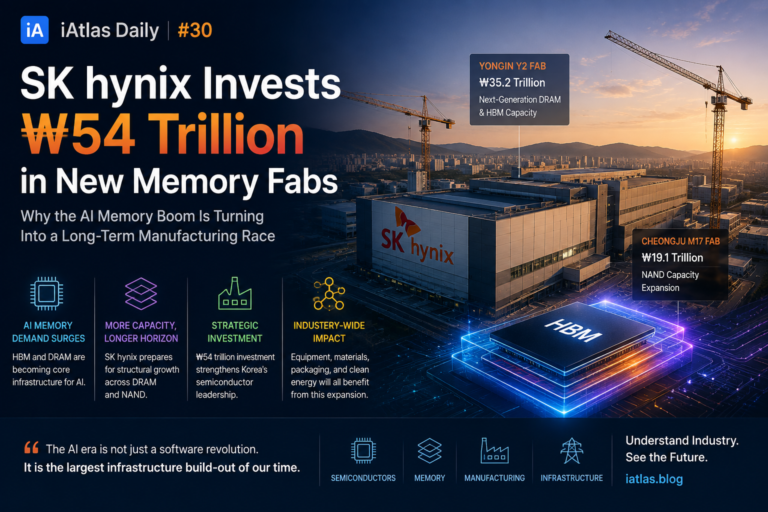
SK hynix
HBM / DRAM / NAND / eSSD
↓
AI Servers
↓
SK Telecom
AI Infrastructure Strategy
↓
SK Horizon
Data Center Operations
↓
SK Hyper
New AI Data Center Development
↓
Submarine Cables
Regional Connectivity
SK Telecom itself describes its strategy as bringing together SK Group capabilities spanning telecommunications, semiconductors, energy solutions and data center construction and operation.
🌏 7. South Korea Wants to Become an AI Infrastructure Hub
SK Telecom’s ambition extends beyond the domestic market.
The company has described its goal as helping establish Korea as an:
“Asia AI Infrastructure Hub”
The logic is straightforward.
South Korea already has several important industrial advantages:
Advanced Semiconductor Manufacturing
Samsung Electronics / SK hynix
Memory Technology
HBM / DRAM / NAND
Telecommunications Infrastructure
High-speed networks
Manufacturing Ecosystem
Equipment / Materials / Engineering
Strategic Geography
Connectivity to major Asian markets
But having semiconductor manufacturing alone does not automatically create an AI infrastructure hub.
Korea also needs:
- AI computing capacity
- reliable electricity
- advanced cooling
- network connectivity
- large-scale data centers
- investment capital
SK Horizon and SK Hyper are intended to help build that missing physical layer.
🏭 8. AI Is Becoming an Industrial Equipment Story
For iAtlas, this is perhaps the most important part of the development.
A massive AI data center requires physical equipment.
That means the AI investment cycle increasingly reaches companies producing:
Electrical Equipment
Transformers
Switchgear
UPS systems
Power distribution equipment
Thermal Management
Chillers
Liquid cooling systems
Pumps
Heat exchangers
Semiconductor Infrastructure
GPUs
HBM
DRAM
Enterprise SSDs
Networking chips
Energy Infrastructure
Grid connections
Renewable energy
ESS
Backup power
Construction
Steel
Cables
Piping
Mechanical systems
The AI boom therefore increasingly resembles an industrial capital-expenditure cycle.
Software demand ultimately becomes demand for physical factories, power systems and equipment.
🔋 9. Batteries Could Become Part of the AI Infrastructure Opportunity
This also creates an interesting connection with the battery industry.
Data centers require stable electricity.
As renewable energy penetration grows, electricity supply can become more variable.
Energy storage can help provide:
- grid stabilization
- renewable energy integration
- peak-load management
- backup power
- power-quality support
This creates another emerging chain:
AI Data Center Growth -> Electricity Demand -> Grid Investment ->
Renewable Energy -> Energy Storage -> Battery Demand
The semiconductor, energy and battery industries are therefore becoming increasingly connected through AI infrastructure.
This is one reason ESS has become strategically important beyond the traditional renewable-energy market.
🧩 Why This Matters
The creation of SK Horizon highlights several structural changes.
AI competition is moving into infrastructure.
Models and chips remain critical, but data centers determine how much AI computing capacity can actually be deployed.
Capital is becoming a competitive advantage.
The KRW 3.08 trillion investment demonstrates how financing capability matters as projects grow.
Power is becoming a bottleneck.
AI data centers increasingly depend on access to large-scale electricity infrastructure.
Connectivity matters.
Submarine cables connect AI computing clusters with regional and global markets.
AI is connecting industries.
Semiconductors, power equipment, cooling, construction, telecommunications and batteries are increasingly part of the same ecosystem.
🔭 What to Watch
Several developments will determine whether SK Telecom can turn its strategy into a major AI infrastructure platform.
1. SK Horizon Formation
The corporate spin-off process is expected to be completed after the necessary approvals.
2. Ulsan AI Data Center
The project will be an important test of SK Telecom’s ability to operate large-scale AI infrastructure.
3. 318 MW Expansion
Watch how quickly SK Horizon can expand its existing and planned portfolio.
4. SK Hyper
The 5 GW target beginning in 2029 represents a dramatic increase in scale.
5. Power Availability
Securing electricity could become one of the biggest constraints on expansion.
6. Global Partnerships
Partnerships with hyperscalers and AI technology companies will be crucial.
7. Submarine Cable Expansion
Connectivity could become an important differentiator for Korea’s ambition to serve as an Asian AI infrastructure hub.
🧭 iAtlas Insight
The AI industry is entering a new phase.
The first phase was dominated by:
AI Models
Then attention shifted toward:
GPUs
Then:
HBM
Now the industry is moving further downstream:
Data Centers → Power → Cooling → Networking → Storage → Energy
SK Horizon illustrates that transition.
A telecommunications company is effectively transforming part of its infrastructure portfolio into a dedicated platform for the AI economy.
The next bottleneck in AI may not be the model or even the chip. It may be the physical infrastructure required to power, cool, connect and operate millions of AI processors.
If that happens, AI data centers could become one of the largest industrial investment cycles of the next decade.
📚 Related Articles
📊 iAtlas Weekly #8: AI Infrastructure Is Reshaping the Industrial Supply Chain
How AI investment is spreading from semiconductors into memory, storage, packaging, power and industrial infrastructure.
📊 iAtlas Daily #45: Korea’s Semiconductor Exports Ride the AI Memory Boom
How AI demand for HBM and memory is translating into semiconductor manufacturing and Korean exports.
📊 iAtlas Daily #42: SK hynix Expands AI Memory Beyond HBM
How the AI memory opportunity is expanding into DRAM, enterprise SSDs and computational storage.
🔗 Sources
Official Sources
- SK Telecom — SK Horizon Launch and KRW 3.08 Trillion Investment
- SK Telecom Newsroom — SK Horizon Announcement
- SK Telecom — Asia AI Infrastructure Hub Strategy
Industry Reporting
About iAtlas
iAtlas is an independent publication covering batteries, semiconductors, OLED, advanced materials, AI, and global industrial trends.
We transform complex industrial developments into clear, reliable, and easy-to-understand insights.
Whether you’re following today’s industry news or building long-term expertise, iAtlas helps you understand not only what happened, but why it matters.
Technology creates change.
Insight creates opportunity.
— iAtlas