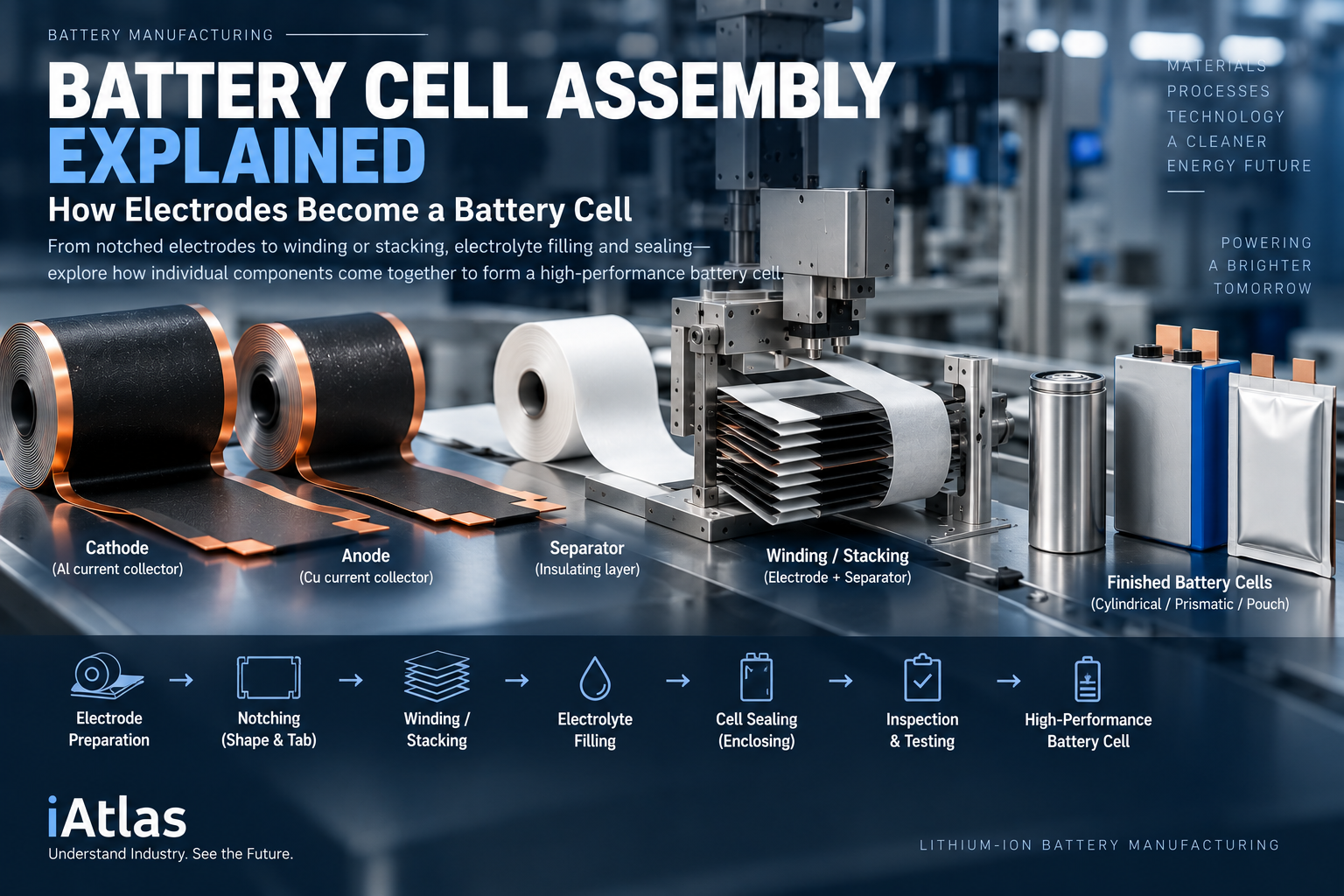
Battery Cell Assembly Explained: How Electrodes Become a Battery Cell
Understanding Notching, Winding, Stacking, Tab Joining, Electrolyte Filling, and Cell Sealing in Lithium-ion Battery Manufacturing
Category: Battery Technology
Content Type: Manufacturing
Learning Path: Battery Manufacturing
Related Industries: Electric Vehicles · Energy Storage Systems · Consumer Electronics
Last Updated: August 2026
Industry Snapshot
Battery cell assembly is the manufacturing stage in which prepared cathodes, anodes, separators, and other components are transformed into the physical structure of a lithium-ion battery cell.
Before this stage, manufacturing is largely focused on producing high-quality electrodes:
Material Mixing
→ Coating
→ Drying
→ Calendering
→ Slitting
Cell assembly changes the nature of the process.
The cathode and anode must now be arranged with separators, electrically connected, inserted into the cell housing, filled with electrolyte, and sealed.
A simplified sequence is:
Prepared Electrodes
→ Notching
→ Winding / Stacking
→ Tab Joining
→ Cell Housing
→ Electrolyte Filling
→ Cell Sealing
→ Formation
At this stage, alignment, contamination, moisture, particles, mechanical damage, and dimensional accuracy become especially important because many defects can become permanently enclosed inside the finished cell.
At a Glance
| Category | Description |
|---|---|
| Process | Battery Cell Assembly |
| Stage | Cell Manufacturing |
| Main Inputs | Cathode · Anode · Separator · Cell Housing |
| Main Function | Build the Physical Battery Cell |
| Key Processes | Notching · Winding/Stacking · Joining · Filling · Sealing |
| Key Controls | Alignment · Tension · Cleanliness · Moisture · Dimensions |
| Previous Stage | Electrode Manufacturing |
| Next Stage | Cell Finishing |
What Is Battery Cell Assembly?
Battery cell assembly is the manufacturing stage where individual battery materials and prepared electrodes are physically integrated into a cell.
At the simplest level, a lithium-ion battery requires:
Cathode
│
Separator
│
Anode
These layers must be arranged so that the cathode and anode remain electrically isolated while lithium ions can move between them through the electrolyte.
But industrial battery manufacturing is considerably more complex.
The layers must be:
- Cut to precise dimensions
- Accurately aligned
- Mechanically assembled
- Electrically connected
- Placed inside a housing
- Filled with electrolyte
- Sealed from the external environment
Only after these operations does the product begin to resemble a complete battery cell.
From Electrode Manufacturing to Cell Assembly
Before cell assembly begins, the electrode has already passed through several manufacturing stages.
Material Mixing
Active materials, binders, conductive additives, and processing liquids are mixed.
Electrode Coating
Slurry is deposited onto metal current collectors.
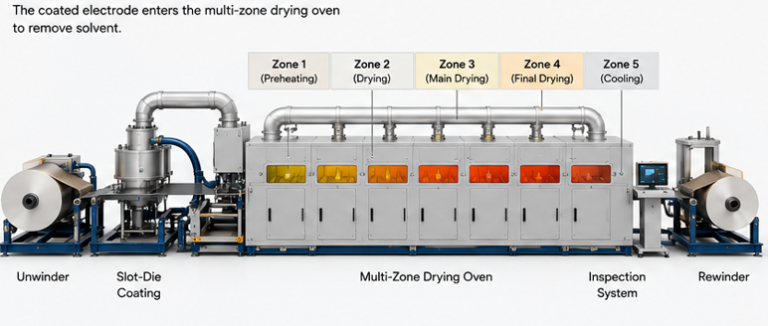
Electrode Drying
Processing liquids are removed and the porous electrode structure develops.
Calendering
The electrode is compressed to control thickness, density, and porosity.
Slitting
Wide electrode rolls are cut into narrower rolls.
The result is a prepared electrode ready for converting and assembly.
This transition is important:
Electrode manufacturing creates the functional electrode. Cell assembly creates the physical battery cell.
Main Components Entering Cell Assembly
Several critical components come together during battery cell assembly.
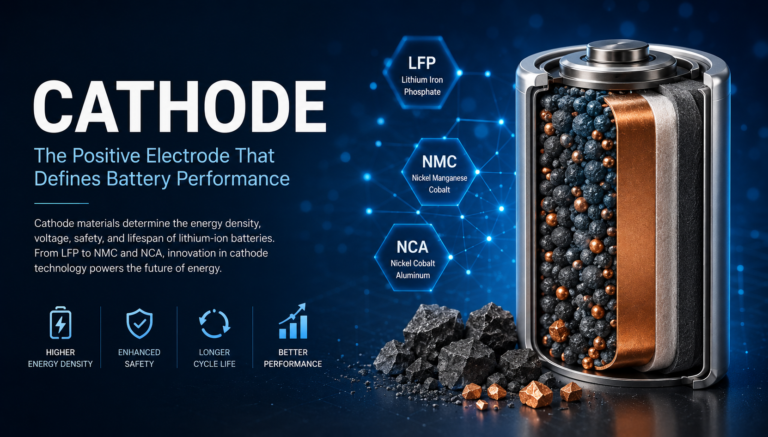
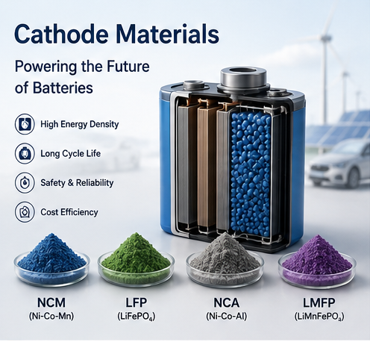
Cathode
The positive electrode typically uses an aluminum current collector coated with cathode active material.
Examples include:
- NMC
- NCA
- LFP
Anode
The negative electrode commonly uses a copper current collector coated with materials such as:
- Graphite
- Silicon-Graphite
Separator
A thin porous polymer membrane physically separates the cathode and anode.
Cell Housing
The assembled electrode structure is eventually placed inside a housing.
Depending on cell format, this may be:
- Cylindrical can
- Prismatic case
- Pouch film
Electrolyte
Liquid electrolyte is introduced later so lithium ions can move between the electrodes during operation.
Notching
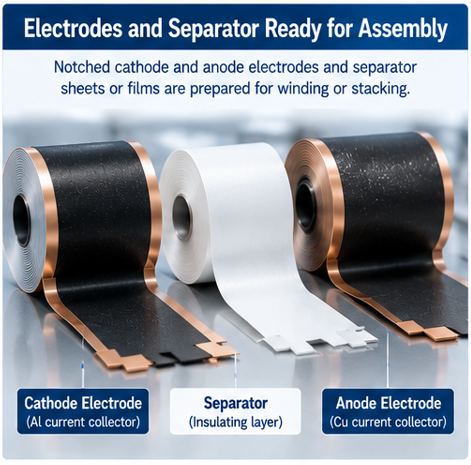
After slitting, electrodes often require further cutting to create the geometry needed for cell assembly.
This process is known as notching.
A simplified sequence is:
Slit Electrode Roll
→ Precision Cutting
→ Electrode Geometry / Tab Region
Notching can define electrode dimensions and tab-related geometry depending on the manufacturing design.
Cutting quality is important because poor notching can generate:
- Burrs
- Particles
- Edge damage
- Dimensional variation
These issues can affect later assembly and battery reliability.
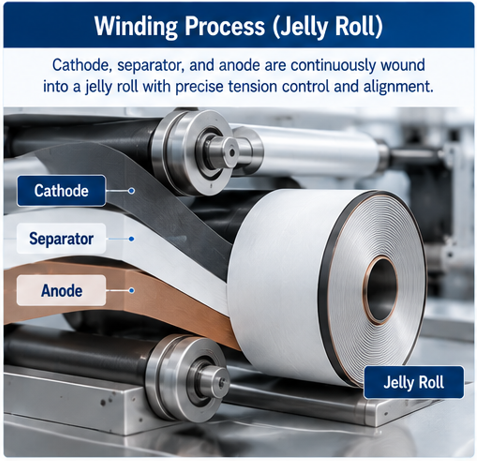
Winding
One major method for assembling electrodes is winding.
Cathode, separator, and anode layers are continuously wound together.
Conceptually:
Cathode + Separator + Anode + Separator
↓
Continuous Winding
↓
Jelly Roll
The resulting structure is commonly called a jelly roll.
Winding is widely associated with cylindrical cells and is also used in certain prismatic cell designs.
Stacking
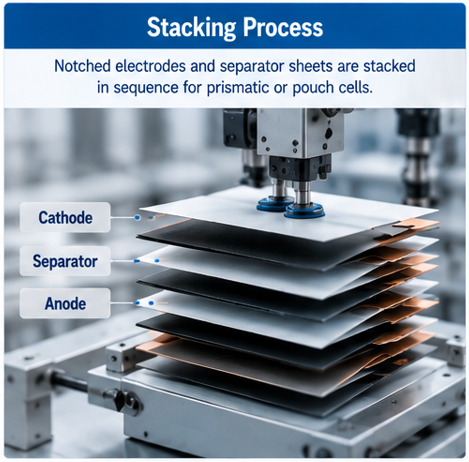
Another major assembly method is stacking.
Instead of winding continuous layers, electrode sheets and separators are arranged sequentially.
Conceptually:
Cathode
↓
Separator
↓
Anode
↓
Separator
↓
Repeat
This creates a layered electrode stack.
Stacking is widely used in pouch and some prismatic cell manufacturing processes.
Winding vs Stacking
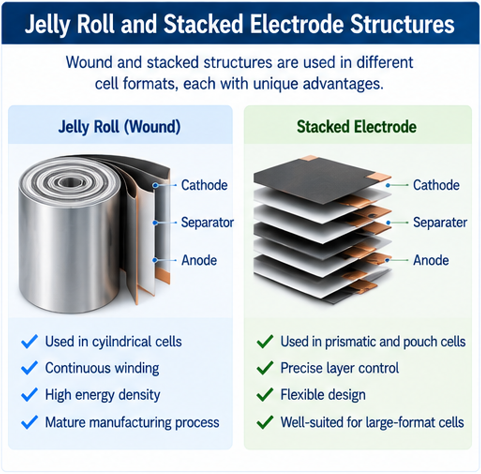
Both methods create alternating cathode, separator, and anode layers, but their mechanical structures differ.
| Characteristic | Winding | Stacking |
|---|---|---|
| Structure | Continuous wound layers | Layered sheets |
| Typical Product | Jelly Roll | Electrode Stack |
| Process | Continuous winding | Repeated placement |
| Major Challenge | Tension & winding alignment | Placement & layer alignment |
| Common Applications | Cylindrical, some prismatic | Pouch, prismatic |
The appropriate method depends on cell format, design, manufacturing strategy, and production requirements.
Why Electrode Alignment Matters
Cathodes and anodes must be positioned accurately relative to each other.
The separator must also maintain sufficient coverage between opposing electrodes.
Poor alignment can create regions where electrode geometry deviates from the intended design.
A simplified relationship is:
Electrode Misalignment
↓
Incorrect Layer Overlap
↓
Localized Electrochemical / Safety Risk
Modern battery assembly equipment therefore requires highly precise position control.
Separator Placement
The separator has a critical safety function.
It must physically prevent direct contact between cathode and anode while remaining porous enough for ion transport.
During assembly, separator handling must avoid:
- Wrinkles
- Folding
- Tearing
- Misalignment
- Particle contamination
- Mechanical damage
A very small separator defect can become significant once the cell is filled, sealed, and cycled.
Tension Control During Winding
In winding processes, material tension must remain stable.
If tension is too high:
- Separator deformation can occur
- Electrode layers may experience excessive mechanical stress
- Winding geometry may change
If tension is too low:
- Wrinkles may form
- Layers may shift
- Winding consistency may deteriorate
The manufacturing objective is:
Stable Tension
Accurate Alignment
Consistent Winding Geometry
Tab Formation and Electrical Connection
Battery electrodes require electrical pathways connecting the active electrode structure to the external cell terminals.
The current collectors therefore include regions that can be connected electrically.
Depending on the cell design and manufacturing process, these regions may be created or prepared during electrode converting.
During assembly, electrical joining technologies can include methods such as:
- Ultrasonic welding
- Laser welding
- Other precision joining processes
The exact architecture varies considerably between cylindrical, prismatic, and pouch cells.
Why Tab Connections Matter
A battery cell may carry substantial electrical current.
Poor electrical connections can create increased resistance.
Conceptually:
Poor Joint
↓
Electrical Resistance ↑
↓
Localized Heating ↑
↓
Efficiency & Reliability ↓
Electrical joining quality is therefore an important part of cell manufacturing.
Cell Housing
Once the electrode assembly has been created, it must be incorporated into the cell housing.
The housing depends on battery format.
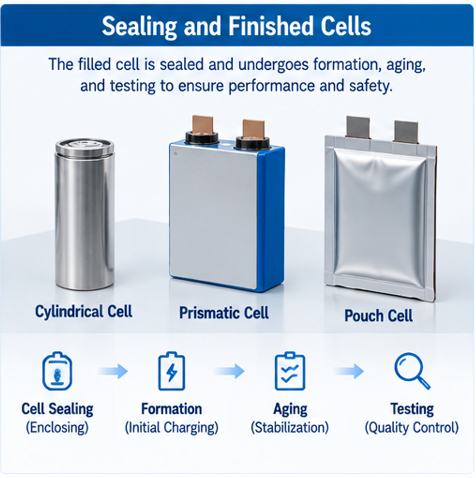
Cylindrical Cell
The jelly roll is inserted into a cylindrical metal can.
Prismatic Cell
The electrode assembly is placed inside a rigid rectangular case.
Pouch Cell
The electrode stack or wound structure is enclosed in a flexible multilayer pouch.
Each format creates different manufacturing requirements for insertion, joining, filling, and sealing.
Cylindrical Cell Assembly
A simplified cylindrical-cell sequence can look like:
Electrode Preparation
↓
Winding
↓
Jelly Roll
↓
Can Insertion
↓
Electrical Connections
↓
Electrolyte Filling
↓
Closing / Sealing
Modern cylindrical cells can use increasingly sophisticated current-collector and tab architectures, so actual production sequences vary by cell design.
Prismatic Cell Assembly
A simplified prismatic route may involve:
Electrode Preparation
↓
Winding or Stacking
↓
Electrode Assembly
↓
Case Insertion
↓
Electrical Joining
↓
Electrolyte Filling
↓
Sealing
Rigid housings can provide structural advantages but require precise integration of internal components.
Pouch Cell Assembly
A simplified pouch-cell sequence may involve:
Electrode Preparation
↓
Stacking / Winding
↓
Electrode Assembly
↓
Tab Joining
↓
Pouch Packaging
↓
Electrolyte Filling
↓
Vacuum Sealing
Pouch cells use flexible packaging rather than a rigid metal can.
This creates different requirements for handling, sealing, and later degassing operations.
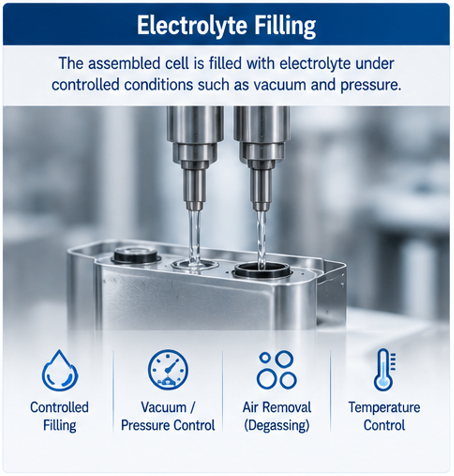
Electrolyte Filling
After the electrode assembly is placed into its housing, electrolyte must be introduced.
The electrolyte must penetrate the separator and porous electrode structure.
This process is more complex than simply adding liquid.
The electrolyte must wet:
- Separator pores
- Cathode pores
- Anode pores
The internal pore structure created during earlier processes such as drying and calendering therefore affects electrolyte filling.
This is an important example of how upstream electrode manufacturing influences downstream cell assembly.
Electrolyte Wetting
After filling, electrolyte needs time to penetrate the internal porous structure.
Conceptually:
Electrolyte Filling
↓
Capillary Penetration
↓
Separator Wetting
↓
Electrode Pore Wetting
↓
More Uniform Electrolyte Distribution
Incomplete wetting can negatively affect cell consistency and electrochemical performance.
Manufacturers therefore carefully control filling and wetting conditions.
Why Moisture Control Is Critical
Lithium-ion battery cell assembly is highly sensitive to moisture.
Many electrolyte systems use lithium salts such as LiPF₆.
Unwanted water can react with electrolyte components and create undesirable reaction products, including corrosive species.
Therefore, sensitive cell-assembly operations are commonly performed in low-humidity dry-room environments.
Moisture control is especially important around:
- Prepared electrodes
- Separators
- Electrolyte
- Open cells before sealing
Dry Rooms in Battery Manufacturing
A dry room is an industrial environment designed to maintain extremely low humidity.
Unlike a conventional cleanroom, where airborne particle concentration is usually the primary environmental metric, battery dry rooms place particular emphasis on moisture control.
Battery cell manufacturing may therefore require simultaneous control of:
Particles
Temperature
Humidity / Dew Point
Contamination
Dry-room infrastructure can represent a significant portion of battery factory energy consumption.
Contamination Control
Particles inside a battery cell can create serious quality concerns.
Possible contamination sources include:
- Electrode cutting
- Equipment wear
- Metallic particles
- Coating fragments
- Dust
- Handling operations
Once the cell is sealed, contaminants cannot easily be removed.
Therefore, contamination prevention must continue throughout the entire assembly process.
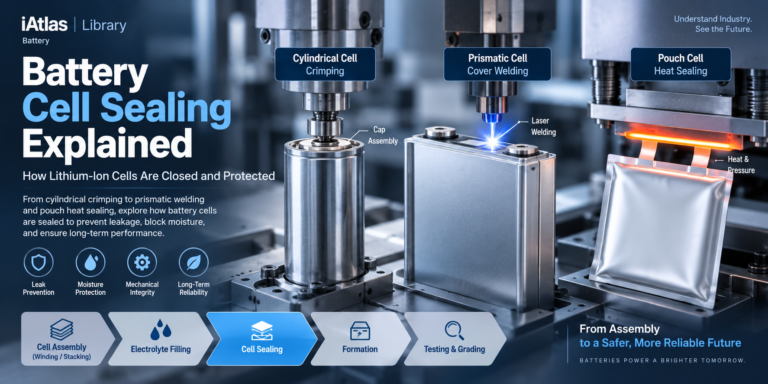
Cell Sealing
After electrolyte filling and required assembly operations, the cell must be closed.
The sealing method depends on cell format.
Cylindrical
Mechanical and/or welded closure systems can be used.
Prismatic
Rigid case components are joined and sealed.
Pouch
The multilayer pouch film is heat-sealed around the cell.
The objective is to create a controlled internal environment while preventing unwanted exchange with the outside atmosphere.
Why Cell Sealing Matters
A lithium-ion battery relies on a stable internal chemical environment.
Poor sealing can allow:
Moisture Ingress
or
Electrolyte Leakage
which can compromise cell performance, reliability, and safety.
Seal integrity is therefore a critical quality-control parameter.
Common Cell Assembly Defects
Battery cell assembly can introduce several types of defects.
Electrode Misalignment
Cathode and anode layers are not positioned correctly.
Separator Wrinkles
The separator folds or deforms during assembly.
Electrode Edge Damage
Cutting or handling damages electrode edges.
Particle Contamination
Foreign material enters the electrode assembly.
Poor Welding
Electrical connections have insufficient or inconsistent joint quality.
Incomplete Electrolyte Wetting
Electrolyte does not uniformly penetrate the electrode structure.
Seal Defects
The cell housing does not achieve sufficient integrity.
Moisture Contamination
Water enters sensitive cell materials before sealing.
Each defect can influence downstream cell performance.
Quality Control During Cell Assembly
Manufacturers can use multiple inspection methods throughout assembly.
Examples include:
- Machine vision
- Dimensional inspection
- Electrode alignment measurement
- Burr inspection
- Particle monitoring
- Weld inspection
- Leak testing
- Weight measurement
- Electrolyte fill verification
The increasing scale of gigafactory production is driving greater use of automated inline inspection.
From Cell Assembly to Formation
After assembly and sealing, the battery may physically resemble a finished cell.
But electrochemically, it is not yet a finished commercial battery.
The next major stage is formation.
Assembled Cell
↓
Formation Charging
↓
Initial Electrochemical Reactions
↓
Interphase Development
↓
Functional Battery Cell
Formation is one of the most important finishing processes because the battery experiences its first controlled electrochemical cycles.
Why Battery Cell Assembly Matters
Cell assembly sits at the intersection of several engineering disciplines.
Materials Engineering
Electrodes and separators must retain their intended properties.
Mechanical Engineering
Layers must be cut, handled, wound, stacked, and packaged precisely.
Electrical Engineering
Current collectors and terminals must be reliably connected.
Chemical Engineering
Electrolyte filling and wetting must be controlled.
Environmental Engineering
Moisture and contamination must be tightly managed.
The result is a manufacturing stage where micrometer-scale precision meets high-volume industrial production.
Emerging Cell Assembly Technologies
Battery factories are increasingly adopting advanced automation.
High-Speed Stacking
Faster stacking equipment aims to increase pouch and prismatic cell productivity.
Advanced Machine Vision
Cameras and AI-based inspection can detect alignment and material defects.
Laser Processing
Laser cutting and welding can enable highly controlled manufacturing operations.
Digital Process Monitoring
Equipment data can be used to identify process drift before defects increase.
Advanced Tab Designs
New current-collector architectures can reduce electrical resistance and improve high-current performance.
Factory Automation
Material handling, inspection, traceability, and process control are increasingly integrated across the production line.
iAtlas Insight
Cell assembly marks one of the most important transitions in battery manufacturing.
Before assembly, many defects remain visible and potentially detectable on an open electrode roll.
After assembly:
Electrode
Separator
Electrical Connections
Electrolyte
are enclosed inside the cell.
This changes the economics of quality control.
A defect discovered during electrode manufacturing may require scrapping electrode material.
A defect discovered after full assembly, filling, formation, and testing carries significantly more accumulated manufacturing cost.
Therefore:
The further a defect travels through battery manufacturing, the more expensive it can become.
This is why battery factories increasingly emphasize inline inspection, traceability, contamination control, and early defect detection.
Cell assembly is not simply where battery components are put together.
It is where previously separate materials become a single electrochemical system.
Did You Know?
- Cell assembly begins after the main electrode-manufacturing processes are completed.
- Winding and stacking are two major methods of arranging electrodes and separators.
- Cylindrical cells are strongly associated with wound jelly-roll structures.
- Pouch cells commonly use stacked or wound electrode assemblies depending on design.
- Electrode alignment can influence both performance and safety.
- Lithium-ion battery assembly requires stringent moisture control.
- Electrolyte must penetrate both separator and electrode pores.
- A cell is not electrochemically finished immediately after sealing; formation still has to occur.
FAQ
What is battery cell assembly?
Battery cell assembly is the manufacturing stage in which cathodes, anodes, separators, electrical connections, electrolyte, and packaging are integrated into a physical battery cell.
What happens before cell assembly?
Electrodes typically undergo mixing, coating, drying, calendering, and slitting before assembly.
What is the difference between winding and stacking?
Winding creates a continuous wound electrode-separator structure, while stacking builds the cell from sequentially arranged electrode and separator layers.
Why is electrode alignment important?
Proper alignment helps maintain the intended electrode overlap and separator coverage throughout the cell.
Why are battery cells assembled in dry rooms?
Low humidity helps prevent unwanted reactions between moisture and moisture-sensitive battery materials and electrolyte components.
When is electrolyte added?
Electrolyte is generally introduced after the electrode assembly has been incorporated into the cell packaging or housing, with the exact sequence depending on cell design.
Is a sealed battery cell ready to use?
Not yet. Newly assembled cells normally undergo subsequent processes including formation, aging, and testing.
What comes after battery cell assembly?
The major downstream stage is cell finishing, beginning with processes such as formation.
Battery Manufacturing Learning Path
Overview
Electrode Manufacturing
Cell Assembly
- Battery Cell Assembly (Current)
- Notching
- Winding
- Stacking
- Electrolyte Filling
- Cell Sealing
Cell Finishing
- Formation
- Aging
- Degassing
- Battery Cell Testing & Grading
System Assembly
- Battery Module Assembly
- Battery Pack Assembly
Explore More
Fundamentals
- Battery
- Lithium-ion Battery
- Battery Cell
- Battery Module
- Battery Pack
- Battery Management System(BMS)
- Battery Thermal Management System(BTMS)
- Battery Safety
Materials
Manufacturing
- Battery Manufacturing Process
- Material Mixing
- Battery Slurry
- Battery Electrode Coating
- Battery Electrode Drying
- Calendering
- Slitting
- Battery Cell Assembly (Current)
- Notching
Technologies
- High-Loading Electrodes
- Dry Electrode Technology
- Silicon Anode
References
Recommended primary-source areas for this article:
- Journal of Energy Storage
Electrode Manufacturing for Lithium-ion Batteries—Analysis of Current and Next Generation Processing - Procedia CIRP
Simulation of the Stacking Process in Battery Cell Manufacturing - Batteries
A Systematic Literature Analysis on Electrolyte Filling and Wetting in Lithium-Ion Battery Production - Energy Technology
Quality Assurance for Flexible Stack Assembly of Lithium-Ion Cells
About iAtlas
iAtlas is an independent publication covering batteries, semiconductors, OLED, advanced materials, AI, and global industrial trends.
We transform complex industrial developments into clear, reliable, and easy-to-understand insights.
Whether you’re following today’s industry news or building long-term expertise, iAtlas helps you understand not only what happened, but why it matters.
Technology creates change.
Insight creates opportunity.
— iAtlas