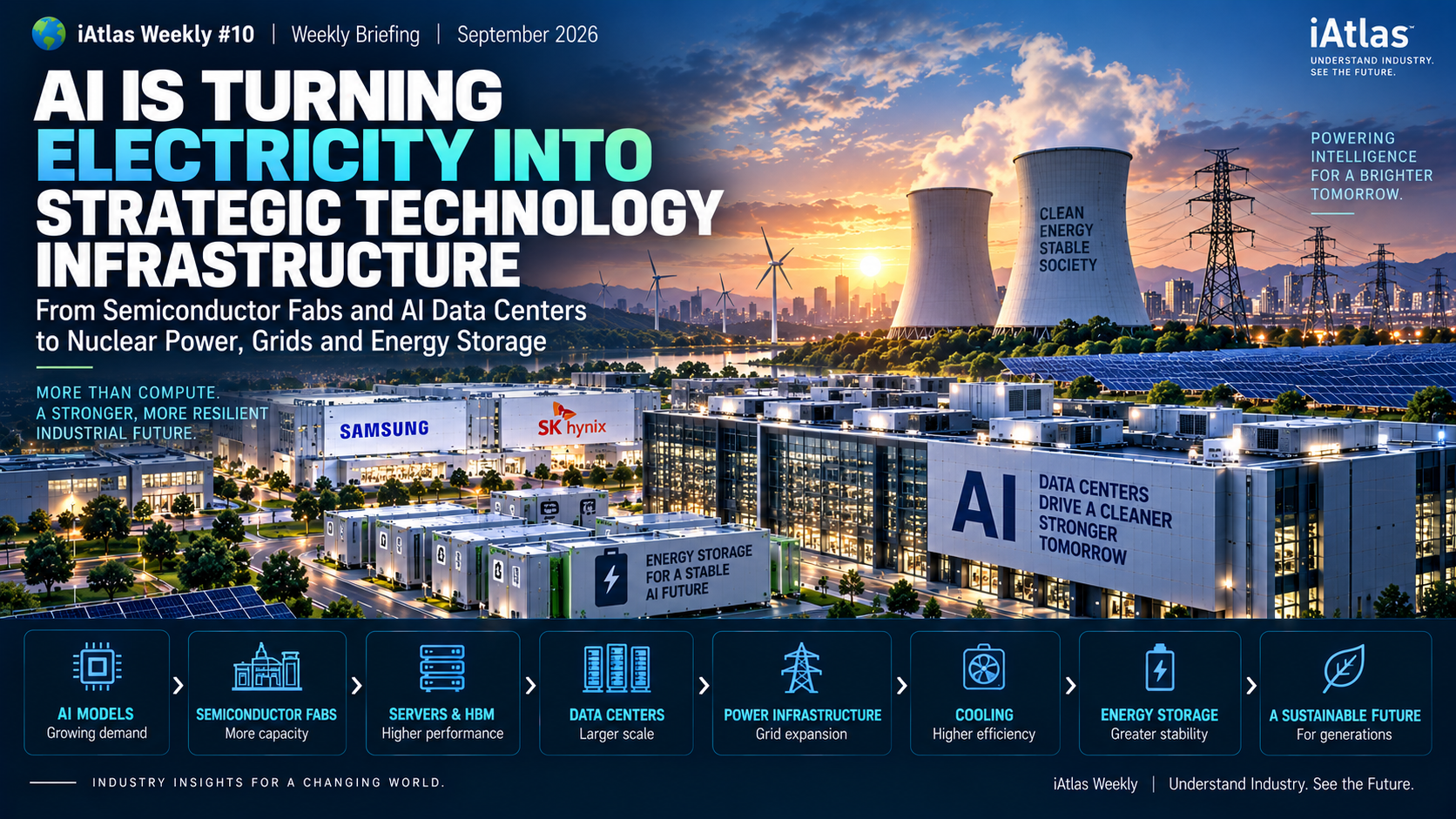
AI Is Turning Electricity into Strategic Technology Infrastructure
From Semiconductor Fabs and AI Data Centers to Nuclear Power, Grids and Energy Storage
📊 iAtlas Weekly #10 | Weekly Briefing | September 2026
Artificial intelligence began as a software story.
Then it became a semiconductor story.
Now it is becoming an energy story.
The enormous investment flowing into AI chips, memory, advanced packaging and data centers is creating a new industrial constraint:
Electricity
South Korea offers one of the clearest examples.
The country’s Energy Ministry estimates that semiconductor expansion and new AI data centers could add approximately 25–30 gigawatts of electricity demand — comparable to the output of roughly 20 nuclear reactors.
At the same time, similar pressures are emerging across the United States and other major AI markets.
The industrial chain is therefore expanding again:
AI Models
↓
AI Chips
↓
HBM & Storage
↓
Data Centers
↓
Electricity
↓
Power Plants
↓
Grid Infrastructure
↓
Energy Storage
The AI race is no longer only about computing capacity.
The next generation of AI infrastructure will be constrained by how quickly the physical energy system can expand around it.
🌐 1. The Big Picture
Over the past several years, each stage of the AI boom has revealed another bottleneck.
First:
GPUs
Then:
HBM
Then:
Advanced Packaging
Then:
Data Center Capacity
And increasingly:
Power
This progression is important because each new bottleneck moves AI further away from the traditional technology industry.
Building more GPUs requires semiconductor fabs.
Building more fabs requires electricity.
Operating GPUs requires data centers.
Operating data centers requires even more electricity.
The resulting industrial loop looks like this:
More AI
→ More Chips
→ More Fabs
→ More Data Centers
→ More Electricity
→ More Power Infrastructure
AI is therefore becoming deeply connected to industries that previously sat far outside the center of the technology investment cycle.
🇰🇷 2. Korea Shows How Large the Power Problem Could Become
South Korea is particularly exposed to this transition because it combines several electricity-intensive industries.
The country is simultaneously expanding:
- advanced semiconductor manufacturing
- HBM production
- AI data centers
- electrification
- battery manufacturing
- digital infrastructure
Samsung Electronics and SK hynix are also developing enormous semiconductor manufacturing clusters.
According to Energy Minister Kim Sung-whan, planned semiconductor facilities and AI data centers could eventually add approximately:
25–30 GW
to Korea’s electricity demand.
For perspective, that is comparable to the output of around:
20 nuclear reactors
The number illustrates an important point.
A semiconductor investment announcement is not simply a semiconductor investment.
It creates another investment requirement somewhere else.
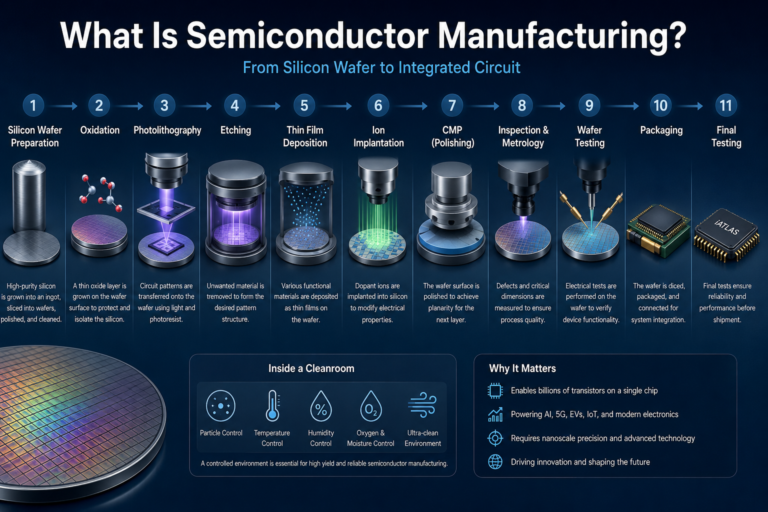
🏭 3. Semiconductor Fabs Are Becoming Energy Infrastructure Projects
Modern semiconductor fabs consume enormous amounts of electricity.
The equipment inside them includes:
- EUV lithography
- deposition
- etching
- ion implantation
- cleaning
- vacuum systems
- abatement
- HVAC
- ultrapure water systems
- process cooling
Advanced semiconductor manufacturing therefore depends on far more than lithography equipment.
The infrastructure chain is:
Electricity
↓
Substation
↓
Fab Utilities
↓
Semiconductor Equipment
↓
Wafer Processing
↓
AI Chips
As semiconductor production expands, electrical infrastructure must expand with it.
This is particularly important for Korea because Samsung Electronics and SK hynix form the backbone of the country’s AI-memory strategy.
🧠 4. AI Is Also Changing the Semiconductor Factory Itself
The connection between AI and semiconductor manufacturing is moving in both directions.
AI needs semiconductor fabs.
But semiconductor fabs are also beginning to use more AI.
This week, Samsung Electronics announced a strategic partnership with Mistral AI to introduce customized on-premises AI technologies across its semiconductor operations.
The collaboration will apply AI to semiconductor engineering and manufacturing, with Samsung also making a lead investment in Mistral AI’s funding round.
This creates another cycle:
Semiconductor Manufacturing
↓
AI Chips
↓
AI Models
↓
AI-Assisted Manufacturing
↓
More Advanced Semiconductors
AI is becoming both a product of the semiconductor industry and a manufacturing tool inside it.
🏢 5. Data Centers Add Another Massive Source of Demand
Semiconductor fabs are only half the story.
Once AI chips are manufactured, they must operate somewhere.
That means data centers.
Traditional cloud facilities already consumed significant electricity.
AI changes the equation because accelerator density is dramatically higher.
A single AI campus can eventually require hundreds of megawatts or even gigawatts of electricity.
The infrastructure chain becomes:
AI Accelerator
↓
AI Server
↓
AI Rack
↓
Data Hall
↓
Data Center
↓
Substation
↓
Grid
↓
Power Generation
At large enough scale, building AI compute starts to resemble building an industrial complex.
💰 6. AI Infrastructure Is Becoming One of the World’s Largest CapEx Cycles
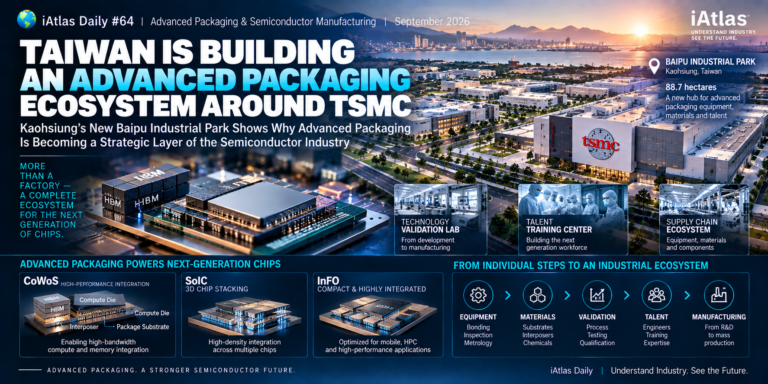
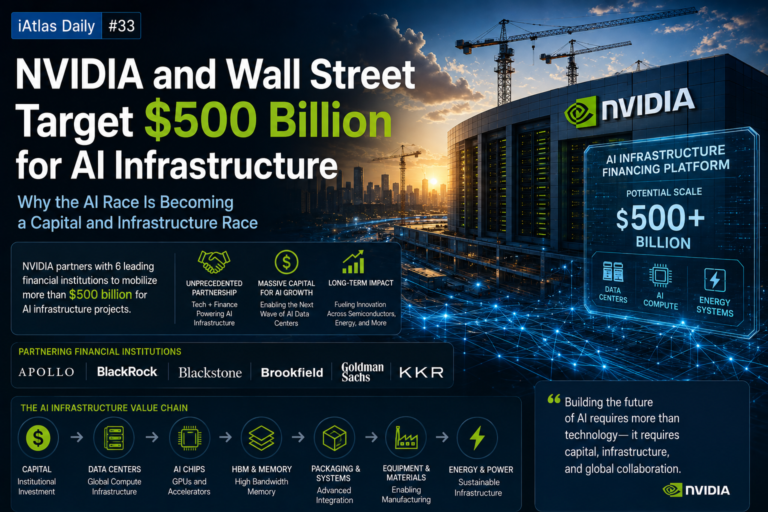
This is the same structural shift highlighted in iAtlas Daily #53.
PwC estimates that cumulative global investment in AI infrastructure could reach approximately:
$31.6 trillion by 2050
under its base scenario.
The important point is not simply the headline number.
The money increasingly flows beyond processors.
AI infrastructure requires:
Compute
Memory
Storage
Networking
Data Centers
Electricity
Cooling
Construction
This is why companies that historically had little direct connection to artificial intelligence are increasingly entering the AI investment story.
⚡ 7. Power Generation Is Becoming Part of the AI Race
This week’s Korean energy debate illustrates the next stage.
South Korea currently operates 26 nuclear reactors, which provide roughly one-third of national electricity.
The government is now reassessing its long-term energy roadmap as AI and semiconductor electricity demand rises.
The options include combinations of:
Nuclear
Renewables
Natural Gas
Grid Expansion
Energy Storage
The policy question is no longer simply:
What electricity mix should Korea use?
It increasingly becomes:
What electricity system can support Korea’s future semiconductor and AI industries?
That is a very different industrial-policy question.
⚛️ 8. Nuclear Power Is Returning to the Technology Conversation
AI has unexpectedly brought nuclear power back into the center of technology strategy.
The reason is straightforward.
AI data centers need electricity that is:
Large Scale
Reliable
Available 24/7
Predictable
Renewable energy can play an important role, but variable generation creates additional balancing requirements.
Nuclear provides large amounts of relatively stable baseload electricity.
Korea’s government is therefore considering whether additional nuclear capacity should form part of its updated long-term energy strategy.
This does not mean nuclear alone will solve the AI power problem.
But it shows how dramatically the AI supply chain has expanded.
AI → GPU → Data Center → Nuclear Power
would have looked like an unusual technology-investment chain only a few years ago.
Today it is becoming increasingly logical.
🇺🇸 9. The Same Connection Is Appearing in U.S. Investment
The relationship is also becoming geopolitical.
Reports this week suggested that South Korea and the United States are discussing large-scale Korean investment in American energy infrastructure associated with AI demand.
Potential projects reportedly include nuclear reactors and natural-gas generation, although Seoul has stressed that the specific projects, amounts and timing have not yet been finalized.
That distinction is important.
These should not yet be treated as confirmed investments.
But the discussions themselves reveal a larger structural change:
Trade Policy
↓
Industrial Investment
↓
Energy Infrastructure
↓
AI Data Centers
Energy policy, technology policy and trade policy are beginning to converge.
🔌 10. The Grid Could Become More Important Than the Power Plant
Generating electricity is only one part of the problem.
Electricity must also reach the facility.
That requires:
Transmission Lines
↓
Substations
↓
Transformers
↓
Switchgear
↓
Power Distribution
↓
Data Center / Semiconductor Fab
This creates another bottleneck.
A country may theoretically possess enough electricity generation while still lacking sufficient grid capacity in the locations where semiconductor fabs or data centers are being built.
The next AI infrastructure constraint may therefore not always be:
Can we generate enough electricity?
It may be:
Can we deliver enough electricity to the right place?
⚙️ 11. Transformers Are Becoming Technology Infrastructure
This brings industrial electrical equipment into the AI supply chain.
AI infrastructure requires enormous amounts of:
- transformers
- switchgear
- power distribution systems
- substations
- cables
- power electronics
- backup systems
These are not traditional “AI products.”
But without them, AI infrastructure cannot operate.
The new supply chain therefore looks increasingly like:
NVIDIA / AI Chips
↓
Server Manufacturers
↓
Data Center Developers
↓
Utilities
↓
Transformer Manufacturers
↓
Electrical Equipment Suppliers
This is one reason AI demand can create opportunities far beyond semiconductor companies.
🔋 12. ESS Becomes the Bridge Between Batteries and AI
Energy storage adds another layer.
AI data centers require highly reliable electricity.
Battery systems can support:
- UPS
- backup power
- renewable integration
- peak shaving
- grid stabilization
- demand management
That connects two industries iAtlas has been following separately:
AI Infrastructure
and
Battery Manufacturing
The connection becomes:
AI
↓
Data Center
↓
Electricity Demand
↓
Grid Constraint
↓
ESS
↓
Battery Demand
This helps explain why the recent shift by Korean battery manufacturers from EV-only strategies toward ESS is strategically important.
Battery companies are gaining exposure to another structural growth market.
🔄 13. Korean Battery Factories Are Becoming More Flexible
Recent developments at LG Energy Solution, Samsung SDI and SK On show how battery manufacturing strategies are changing.
Factories originally designed primarily around EV demand are increasingly being adapted toward:
EV
ESS
UPS / Backup Power
potentially other industrial applications.
That manufacturing flexibility matters because AI infrastructure could create another large source of stationary battery demand.
The battery factory is gradually becoming less tied to one end market.
Instead:
The factory itself becomes a flexible industrial platform.
This is an important long-term change.
🌡️ 14. Electricity Entering a Data Center Eventually Becomes Heat
There is another physical constraint that follows power.
Cooling.
Almost all electricity consumed by AI processors eventually becomes heat.
As GPU density increases:
More Compute
↓
More Electricity
↓
More Heat
↓
More Cooling
This is accelerating the transition toward:
- direct-to-chip liquid cooling
- cold plates
- coolant distribution units
- advanced heat exchangers
- immersion cooling
The AI infrastructure chain therefore continues expanding.
Power Infrastructure
↓
Cooling Infrastructure
↓
Water / Thermal Systems
A power constraint can quickly become a thermal-management constraint.
💾 15. AI Demand Is Expanding Across the Entire Computing Stack
This week’s semiconductor developments reinforce another point.
AI infrastructure is not becoming dependent on one chip company or one type of processor.
On September 8, Qualcomm announced a major long-term agreement with Amazon covering AI data-center chips and related products.
The arrangement could potentially generate up to $60 billion in product purchases, while the companies will also collaborate on high-speed optical connectivity.
Two days later, AI-chip startup d-Matrix announced that its inference processors would use NVIDIA’s NVLink Fusion technology to integrate into NVIDIA-oriented data-center systems.
This signals another shift.
The AI infrastructure market is broadening from:
GPU-centric computing
toward:
GPU + Custom Accelerator + Inference Chip + Memory + Networking + Storage
The infrastructure underneath all of them still requires electricity.
🤖 16. AI Is Moving from the Cloud into the Physical World
Another development this week points even further ahead.
Analog Devices announced a $1.35 billion acquisition of Alif Semiconductor, combining ADI’s sensing, signal-processing and power-management technologies with Alif’s AI processors.
The objective is to expand AI capabilities into physical systems capable of sensing, analyzing and responding in real time.
This points toward:
Cloud AI
↓
Edge AI
↓
Industrial AI
↓
Robotics
↓
Autonomous Systems
AI infrastructure therefore may not remain concentrated inside data centers forever.
Compute is spreading outward into machines.
That creates another industrial layer beyond today’s AI cloud.
🧩 17. What Changed This Week?
Several apparently separate developments tell the same story.
🇰🇷 Korea warned of a 25–30 GW increase in electricity demand.
AI data centers and semiconductor fabs are becoming national energy-planning issues.
🧠 Samsung partnered with Mistral AI.
AI is entering semiconductor manufacturing itself.
☁️ Amazon signed a major AI-chip agreement with Qualcomm.
AI compute architecture is becoming more diverse.
🔗 d-Matrix joined NVIDIA’s AI infrastructure ecosystem.
Inference is creating another specialized accelerator market.
🤖 Analog Devices moved deeper into physical AI.
AI is beginning to spread from data centers into industrial systems.
These are not isolated stories.
Together they show the next expansion of the AI economy.
🗺️ 18. The AI Industrial Map Is Getting Larger
The AI ecosystem can now be mapped across several layers.
Layer 1 — Intelligence
AI Models
Software
Applications
↓
Layer 2 — Compute
GPU
ASIC
Inference Accelerator
↓
Layer 3 — Semiconductor Infrastructure
HBM
DRAM
NAND
Advanced Packaging
Optical Connectivity
↓
Layer 4 — Digital Infrastructure
Servers
Networking
Storage
Data Centers
↓
Layer 5 — Physical Infrastructure
Electricity
Transformers
Cooling
Grid
ESS
↓
Layer 6 — Industrial Infrastructure
Power Plants
Semiconductor Fabs
Battery Factories
Construction
Raw Materials
This is why AI is becoming much larger than an IT cycle.
It is becoming an industrial investment cycle.
🔭 What to Watch Next
⚡ Korea’s New Energy Roadmap
The most important question is how Korea plans to supply an additional 25–30 GW of potential demand.
⚛️ Nuclear Expansion
Watch whether additional nuclear reactors are included in Korea’s future power plan.
🔌 Grid Investment
Transmission, substations and transformers could become major bottlenecks.
🔋 Data Center ESS
Battery manufacturers may increasingly target AI data centers and grid infrastructure.
🌡️ Liquid Cooling
Higher GPU power density should continue accelerating cooling investment.
🧠 AI Semiconductor Diversification
NVIDIA will remain central, but custom accelerators and inference processors are becoming increasingly important.
🏭 AI in Manufacturing
Samsung–Mistral provides an early example of AI moving directly into semiconductor manufacturing.
🧭 iAtlas Insight
The most important AI development this week may not be a new model or processor.
It may be the realization that compute has become an energy problem.
The industrial chain has expanded rapidly:
AI
↓
Semiconductors
↓
Memory
↓
Advanced Packaging
↓
Data Centers
↓
Power
↓
Grid
↓
Energy Storage
Each new layer increases the amount of physical infrastructure required to support the digital economy.
And that changes which companies, industries and countries can participate in the AI boom.
A transformer manufacturer can now be part of the AI supply chain.
A battery factory can be part of the AI supply chain.
A nuclear reactor can be part of the AI supply chain.
A cooling-equipment supplier can be part of the AI supply chain.
The AI race is becoming a race to build physical infrastructure.
The winners may therefore not be determined only by who has the best AI model or the fastest processor.
They may also be determined by:
Who can supply the power required to run them.
📚 Related Articles
🔗 References
Reuters — South Korea’s Power Demand Set to Soar on AI Boom
Samsung Semiconductor — Samsung and Mistral AI Strategic Partnership
Reuters — Qualcomm and Amazon Develop AI Data Center Chips
Reuters — d-Matrix Adopts NVIDIA NVLink Fusion
Reuters — Analog Devices to Acquire Alif Semiconductor
About iAtlas
iAtlas is an independent publication covering batteries, semiconductors, OLED, advanced materials, AI, and global industrial trends.
We transform complex industrial developments into clear, reliable, and easy-to-understand insights.
Whether you’re following today’s industry news or building long-term expertise, iAtlas helps you understand not only what happened, but why it matters.
Technology creates change.
Insight creates opportunity.
— iAtlas