Korean Battery Factories Are Pivoting from EVs to ESS
Slower EV Growth and Surging AI Power Demand Are Reshaping Battery Manufacturing
🔋 iAtlas Daily #48 | Battery Manufacturing & ESS | August 2026
The EV Battery to ESS Conversion trend is accelerating across the Korean battery industry.
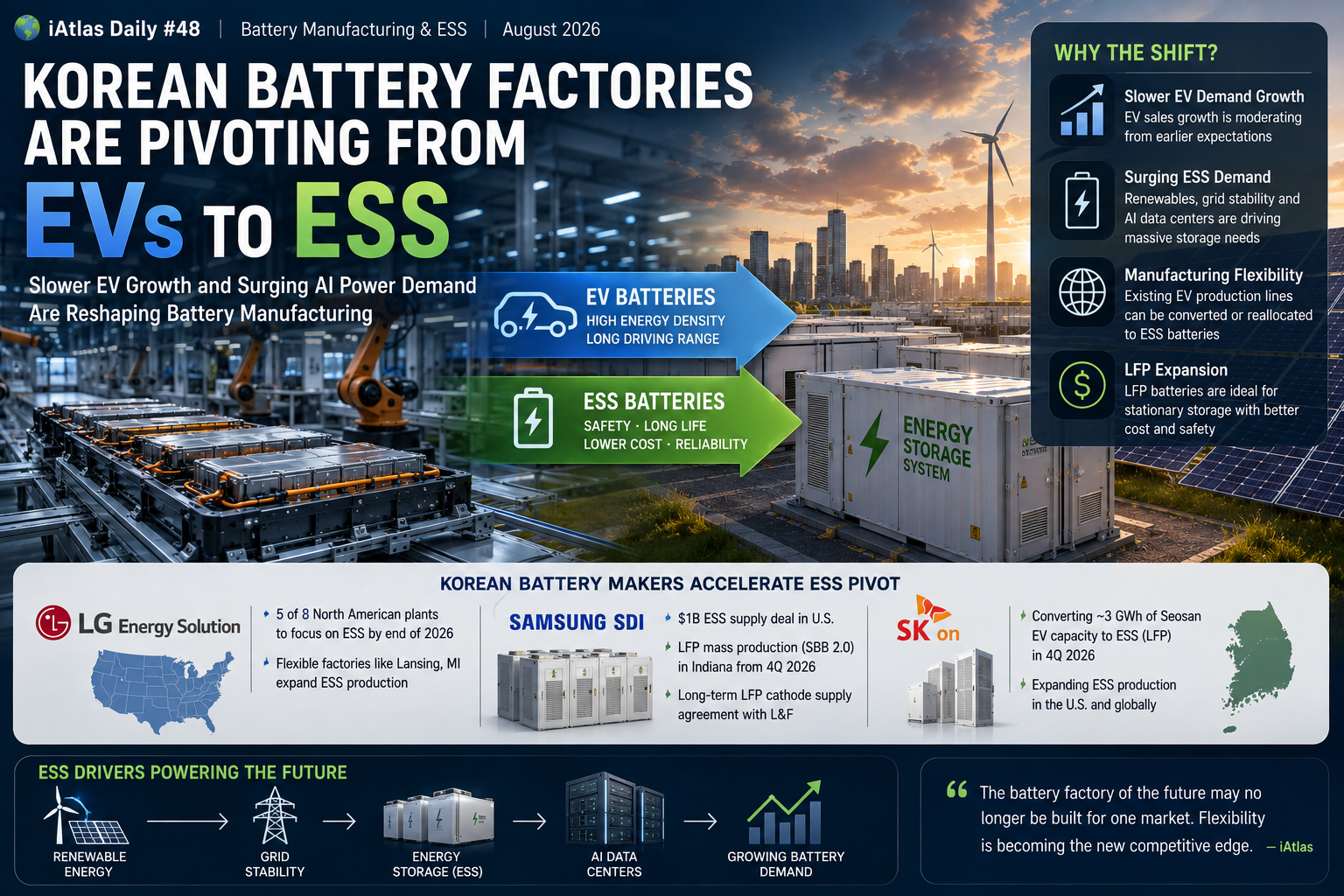
LG Energy Solution, Samsung SDI and SK On originally built much of their global manufacturing networks around rapid electric-vehicle growth. But as EV demand has become less predictable and demand for energy storage systems rises, those factories are gaining a second role.
Battery manufacturers are converting or reallocating portions of existing EV production capacity toward ESS batteries, particularly LFP products designed for stationary energy storage.
This is more than a temporary response to slower EV sales.
AI data centers, renewable energy and grid investment are creating another potentially enormous battery market.
The battery factory of the future may no longer be designed for one end market. Manufacturing flexibility itself is becoming a competitive advantage.
🏭 The Big Story
For much of the last decade, battery investment followed a relatively simple chain:
EV Demand -> Battery Orders -> Gigafactory Construction -> EV Battery Production
But the market is changing.
The EV industry continues to grow globally, yet demand has not always matched the aggressive capacity expansion planned several years ago.
At the same time, another market is accelerating:
Energy Storage Systems.
ESS demand is being supported by several structural trends:
Renewable Energy -> Grid Volatility -> Energy Storage
and increasingly:
AI Data Centers -> Electricity Demand -> Grid Infrastructure -> Energy Storage
That creates a new option for battery manufacturers.
Instead of leaving EV manufacturing capacity underutilized, some production lines can be converted or reallocated toward ESS.
Korean battery makers are already moving in that direction.
🔋 1. Why ESS Is Becoming So Important
EVs and ESS use batteries for very different purposes.
An EV battery must optimize several factors simultaneously:
- energy density
- vehicle weight
- charging performance
- driving range
- cycle life
- safety
Stationary ESS has different priorities.
Weight is much less important.
Instead, the focus shifts toward:
- cost
- safety
- cycle life
- reliability
- thermal stability
- long operating life
This difference is one reason LFP — lithium iron phosphate — batteries have become so important in stationary storage.
LFP generally offers lower energy density than nickel-rich chemistries, but its cost structure, cycle life and thermal characteristics make it highly attractive for ESS applications.
The manufacturing shift is therefore happening in two dimensions:
EV → ESS
and
High-Nickel → LFP
🟢 2. LG Energy Solution Is Making the Largest Pivot
LG Energy Solution provides perhaps the clearest example.
Reuters reported on August 19 that the company is redirecting much of its North American manufacturing strategy toward ESS as EV demand grows more slowly than previously expected.
By the end of 2026, five of LG Energy Solution’s eight North American facilities are expected to prioritize ESS production.
That is a significant strategic change.
LG Energy Solution’s North American footprint was built largely around expectations of rapid EV adoption.
Now those assets are being used more flexibly.
One important example is the company’s Lansing, Michigan facility.
The plant can support batteries for different applications, including stationary storage and EV customers, demonstrating how manufacturing assets can increasingly serve multiple markets.
The strategic logic is straightforward:
Existing Factory
Available Capacity
Growing ESS Demand
=
Faster Market Entry
Building a new gigafactory can take years.
Converting existing production infrastructure can be much faster.
3. North America Is at the Center of the Shift
The U.S. market is particularly important.
Korean manufacturers already invested heavily in American battery capacity because of expected EV growth and industrial-policy incentives.
That means they now possess something valuable:
Local battery manufacturing infrastructure.
At the same time, U.S. demand for grid storage and AI-related power infrastructure is increasing.
This creates an opportunity to redirect some existing capacity.
Industry reporting indicates LG Energy Solution, Samsung SDI and SK On are all expanding U.S. ESS production by converting or reallocating EV battery lines.
The strategy also fits broader efforts to reduce dependence on Chinese battery supply chains.
China currently dominates global LFP battery manufacturing.
Local production therefore becomes strategically valuable for U.S. customers seeking alternative supply.
🔵 4. Samsung SDI Is Building an ESS Portfolio Around Both NCA and LFP
Samsung SDI is following a somewhat different path.
The company already has a strong position in prismatic ESS batteries and has continued to secure large U.S. supply agreements.
In March, Samsung SDI announced a KRW 1.5 trillion ESS battery supply contract with a U.S. energy company.
Initial supply will use NCA batteries, while future deliveries are expected to expand toward LFP products manufactured at the StarPlus Energy facility in Indiana.
Its strategy therefore combines:
Existing NCA Technology -> Prismatic ESS Batteries -> U.S. Production ->
LFP Expansion
Samsung SDI expects U.S. mass production of its SBB 2.0 prismatic LFP ESS battery in the fourth quarter of 2026.
The company is also expanding production for UPS and BBU applications, another area benefiting from AI infrastructure growth.
🧪 5. ESS Conversion Is Also Reshaping the Materials Supply Chain
Changing a factory from one battery application to another does not affect only the cell production line.
It can change the entire materials ecosystem.
For example, shifting toward LFP requires a different cathode supply chain from conventional nickel-rich batteries.
Samsung SDI has already signed a long-term agreement with Korean materials company L&F.
Under the agreement, Samsung SDI will purchase approximately KRW 1.6 trillion of LFP cathode materials over three years beginning in 2027, with the materials intended for ESS batteries manufactured at StarPlus Energy.
This illustrates a broader chain:
ESS Demand -> LFP Cell Production -> LFP Cathode Materials ->
Domestic Material Suppliers -> Localized Battery Supply Chain
Factory conversion can therefore create new opportunities upstream.
🟠 6. SK On Is Converting EV Capacity Too
SK On is also moving toward ESS.
The company built much of its manufacturing network around electric vehicles, making the current transition particularly significant.
In Korea, SK On is converting part of its Seosan EV battery manufacturing capacity into ESS-oriented LFP production.
Industry reporting indicates the company plans to complete conversion of approximately 3 GWh of capacity during the fourth quarter of 2026 and begin trial operations.
SK On is also converting production capacity in the United States as it pursues global ESS orders. Industry estimates earlier this summer pointed to an ambition to secure more than 20 GWh of global ESS orders.
For SK On, ESS provides an opportunity to diversify a manufacturing network that has historically been highly dependent on EV demand.
⚙️ 7. Converting an EV Battery Line Is Not as Simple as Changing the Product
A battery factory cannot simply switch from EV batteries to ESS batteries overnight.
Several production parameters may need to change.
Depending on the chemistry and cell format, manufacturers may need to modify:
Materials Handling
Cathode materials
Anode materials
Electrolyte formulations
Electrode Manufacturing
Mixing
Coating
Drying
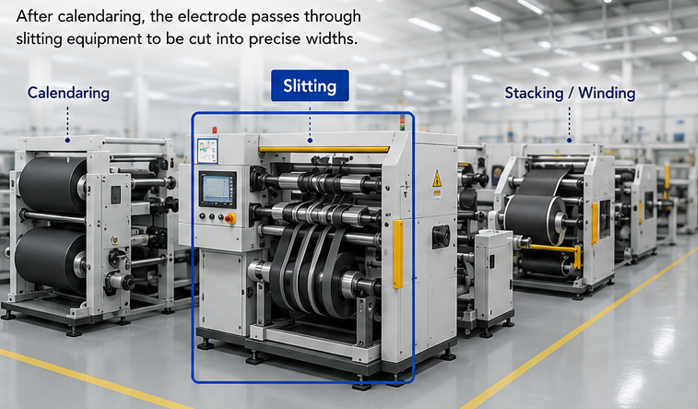
Calendaring
Cell Assembly
Electrode dimensions
Stacking or winding parameters
Cell architecture
Formation
Charging protocols
Formation conditions
Aging procedures
Testing
Safety requirements
Cycle-life testing
Performance criteria
Pack Integration
ESS modules and racks require completely different mechanical architectures from EV battery packs.
The conversion therefore affects not only the cell factory.
It also creates demand for:
Battery Equipment
Automation
Inspection Systems
Material Handling
Pack Assembly
Thermal Management
Safety Systems
This makes ESS conversion an important manufacturing-equipment story as well.
🤖 8. AI Data Centers Are Adding a New Demand Engine
The connection between ESS and AI is becoming increasingly important.
AI data centers consume enormous amounts of electricity.
But computing equipment requires highly reliable power.
Even short interruptions can create serious operational problems.
This creates demand across multiple energy systems:
Grid -> Substation -> UPS -> BBU -> ESS -> AI Servers
Samsung SDI, for example, explicitly identifies AI-driven UPS and BBU demand as an important growth opportunity.
The broader Korean battery industry has also increasingly positioned ESS and AI infrastructure as new growth markets beyond EVs.
This means AI investment is beginning to influence another industrial supply chain.
Previously:
AI → GPU → HBM
Now:
AI → Data Center → Power → ESS → Battery
⚡ 9. ESS Connects Batteries with the Power Grid
The AI connection is only one part of the opportunity.
Renewable energy creates another.
Solar and wind generation are variable.
Electricity production does not always match electricity demand.
ESS can store excess energy and release it when needed.
That creates the basic chain:
Solar / Wind -> Electricity Generation -> Battery ESS -> Grid Stabilization ->
Electricity Demand
As renewable generation expands, storage can become increasingly important to maintaining grid reliability.
Recent energy-market disruption has also encouraged countries to accelerate renewable-energy investment and strengthen energy security.
Battery manufacturers therefore gain exposure to another enormous infrastructure market beyond transportation.
📈 10. Manufacturing Flexibility Could Become a Competitive Advantage
This may be the most important long-term implication.
Gigafactories require enormous investment.
A factory optimized for only one market carries risk if demand changes unexpectedly.
The next generation of battery manufacturing strategy may therefore emphasize:
Flexible Capacity
Factories capable of supporting different:
- chemistries
- cell formats
- customers
- applications
could adapt more quickly to market changes.
The model could evolve from:
EV Factory
to:
Battery Manufacturing Platform
capable of serving:
EV
ESS
UPS
BBU
Robotics
Industrial Applications
That would fundamentally change how battery companies think about manufacturing assets.
🧩 Why This Matters
The EV Battery to ESS Conversion trend reveals several structural changes in the battery industry.
EV demand is no longer the only growth engine.
Stationary storage is becoming a major second market.
LFP is becoming strategically important.
Korean companies are expanding into a chemistry historically dominated by Chinese manufacturers.
Existing factories are gaining new value.
Underutilized EV capacity can potentially be redirected toward ESS.
AI is creating battery demand indirectly.
AI data centers require power infrastructure, and energy storage is increasingly part of that ecosystem.
The supply chain changes with the factory.
Cathode materials, equipment, automation and pack systems all need to adapt.
🔭 What to Watch
1. LG Energy Solution’s North American Conversion
Watch how quickly its ESS-focused facilities ramp production.
2. Samsung SDI SBB 2.0
U.S. mass production of the LFP ESS platform is planned for Q4 2026.
3. SK On’s Seosan Conversion
Approximately 3 GWh of EV capacity is being converted toward ESS LFP production.
4. AI Data Center Demand
Continued data-center construction could strengthen demand for UPS, BBU and grid-scale ESS.
5. Korean LFP Supply Chains
Cathode and other materials localization will become increasingly important.
6. Manufacturing Equipment
Line conversions could generate additional demand for battery production and inspection equipment.
🧭 iAtlas Insight
For years, the battery industry’s central question was:
How many EV batteries can a company manufacture?
The question is changing.
The more important question may become:
How quickly can a battery manufacturer redirect its factories toward the applications where demand is strongest?
The industrial chain is expanding:
EV
Renewable Energy
AI Data Centers
↓
Battery Demand
↓
Flexible Gigafactories
↓
EV + ESS + UPS + BBU
That changes the meaning of battery manufacturing capacity.
A factory is no longer valuable only because of how many gigawatt-hours it can produce.
Its value increasingly depends on how flexibly those gigawatt-hours can be deployed.
The next battery manufacturing advantage may be flexibility — not simply scale.
📚 Related Articles
For this article, I would connect it to the existing battery/AI cluster rather than another Korea ESS procurement story.
📊 iAtlas Daily #44: Korea’s Battery Giants Prepare for the Next ESS Battle
The domestic-market side of the ESS transition: LG Energy Solution, Samsung SDI and SK On competing for large-scale Korean storage projects.
📊 iAtlas Daily #46: SK Telecom Builds a New AI Data Center Platform with SK Horizon
Explains the AI data-center infrastructure that is becoming one of the new drivers of electricity and storage demand.
🔋 Battery Manufacturing Process: How Lithium-Ion Batteries Are Manufactured
The technical foundation for understanding why converting battery production between chemistries and applications requires changes across multiple manufacturing stages.
🔗 References
- Reuters — LG Energy Solution pivots toward ESS production
- Samsung SDI — $1 Billion U.S. ESS Supply Deal
- Samsung SDI — LFP Cathode Material Agreement with L&F
- Samsung SDI — Q2 2026 Results and ESS Strategy
- The Korea Times — Korean Battery Makers Convert EV Capacity for ESS
- Electronic Times — ESS Production Conversion and Equipment Demand
About iAtlas
iAtlas is an independent publication covering batteries, semiconductors, OLED, advanced materials, AI, and global industrial trends.
We transform complex industrial developments into clear, reliable, and easy-to-understand insights.
Whether you’re following today’s industry news or building long-term expertise, iAtlas helps you understand not only what happened, but why it matters.
Technology creates change.
Insight creates opportunity.
— iAtlas