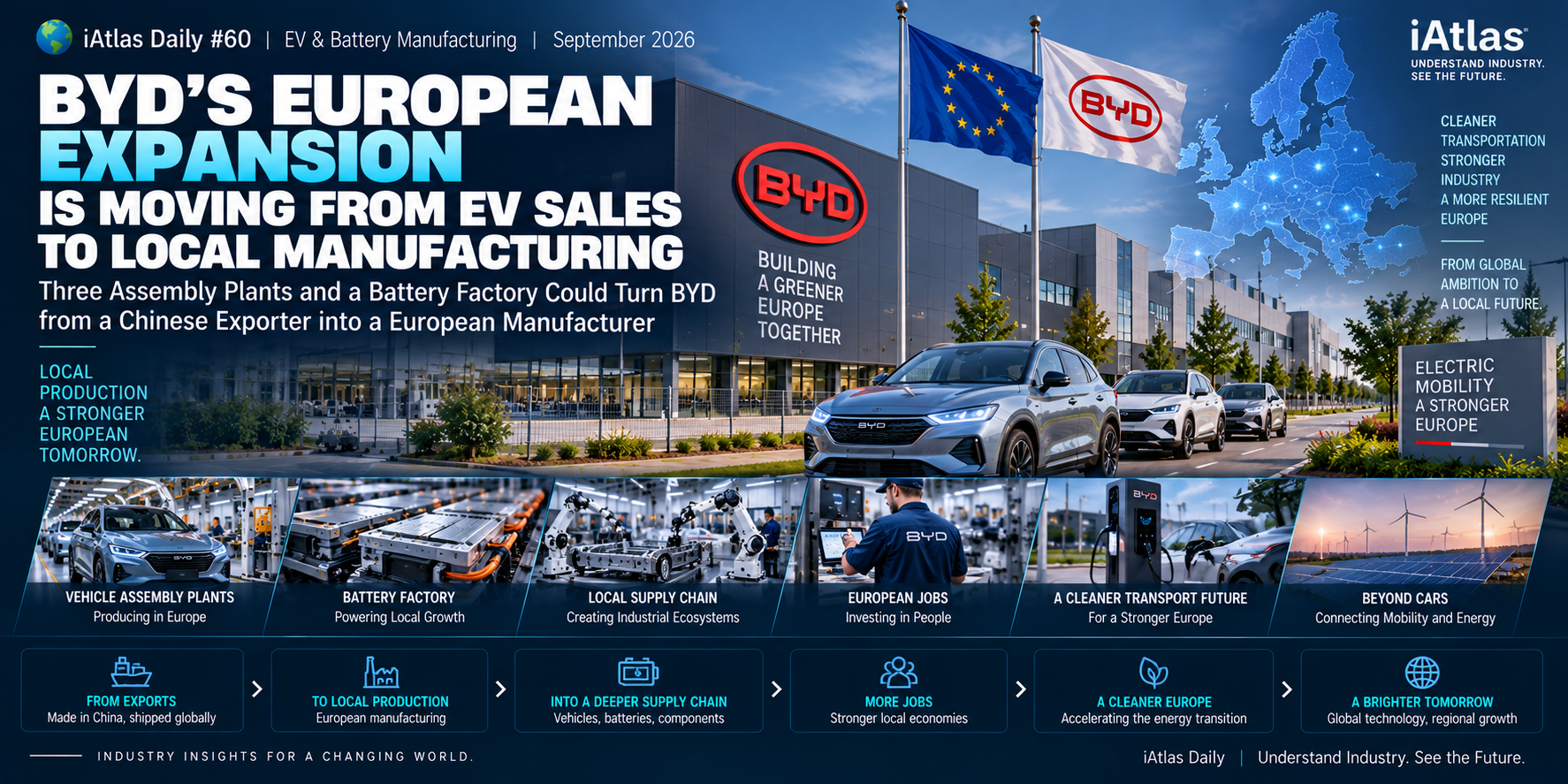
BYD’s European Expansion Is Moving from EV Sales to Local Manufacturing
Three Assembly Plants and a Battery Factory Could Turn BYD from a Chinese Exporter into a European Manufacturer
📰 iAtlas Daily #60 | EV & Battery Manufacturing | September 2026
BYD’s expansion in Europe is entering a new phase.
The first phase was about selling Chinese-made electric vehicles in European markets.
The next phase is increasingly about:
Making them in Europe.
BYD expects that its long-term European footprint could require:
3 Vehicle Assembly Plants
1 Battery Factory
according to Alfredo Altavilla, special adviser to BYD for Europe.
The shift represents something much larger than additional factory capacity.
BYD is gradually moving from:
Chinese Production
↓
Vehicle Exports
↓
European Sales
toward:
European Manufacturing
↓
Local Components
↓
Local Batteries
↓
Regional Supply Chain
This is the next stage of globalization for Chinese EV manufacturers.
The question is no longer whether Chinese EV companies can sell cars in Europe. It is whether they can build a manufacturing ecosystem inside Europe.
🌍 The Big Story
BYD is rapidly internationalizing.
In August 2026, the company sold 440,293 vehicles globally, while overseas shipments reached 189,466 vehicles, up 134.5% year over year. International markets generated more revenue than China for the first time in the first half of 2026.
Europe is becoming one of the most important parts of that strategy.
BYD has begun production in Hungary and plans to choose a second European manufacturing location by the end of 2026.
Spain and France are among the leading possibilities, and the company is considering acquiring and refurbishing an existing automotive factory rather than constructing every facility from scratch.
But BYD’s longer-term plan goes deeper.
Altavilla says the company will eventually require:
Three vehicle assembly plants
and:
One battery factory
in Europe.
That changes the story from vehicle exports to industrial localization.
🚗 1. BYD’s First Global Model Was Export
The simplest way to enter a foreign automotive market is:
Manufacture in China
↓
Ship Overseas
↓
Sell Locally
This allows a manufacturer to use its existing factories and supply chain.
And China has an enormous EV manufacturing ecosystem.
BYD can draw on:
Battery Manufacturing
Vehicle Assembly
Power Electronics
Semiconductors
Motors
Components
Suppliers
That ecosystem helped Chinese manufacturers achieve enormous scale.
But exports also have limitations.
🛃 2. Tariffs Change the Economics
Europe has become increasingly concerned about competition from Chinese EV manufacturers.
Imported vehicles can face additional trade barriers.
This changes the calculation.
Imagine:
China Factory
↓
Vehicle Production
↓
International Shipping
↓
Import Tariff
↓
European Customer
As tariffs and localization requirements increase, local production becomes more attractive.
The alternative is:
European Factory
↓
European Production
↓
European Customer
BYD’s strategy is increasingly moving toward the second model.
🏭 3. The First Step Is Vehicle Assembly
Vehicle assembly is the most visible layer.
BYD’s first European passenger-vehicle manufacturing base is in Szeged, Hungary.
The company is also considering additional manufacturing capacity elsewhere in Europe.
But BYD does not necessarily want to build every plant from zero.
Its European adviser says acquiring existing automotive plants could accelerate expansion.
Spain and France are particularly attractive because underutilized facilities may be available and easier to acquire.
This matters because Europe already has something BYD needs:
Automotive Infrastructure
Factories.
Workers.
Suppliers.
Logistics.
Engineering expertise.
BYD can potentially plug into an existing industrial ecosystem rather than recreating one entirely.
🏗️ 4. Existing Factories Can Accelerate Localization
Building a greenfield automotive factory takes time.
A manufacturer needs:
Land
↓
Permits
↓
Construction
↓
Utilities
↓
Equipment
↓
Workers
↓
Production
Buying an existing facility changes the sequence.
Existing Factory
↓
Refurbishment
↓
New Equipment
↓
Production
This could allow Chinese manufacturers to establish European manufacturing capacity more quickly.
And BYD is not alone.
Reuters reports that Chinese automakers including Leapmotor, Dongfeng, Geely and Chery have also explored partnerships or existing production assets in Europe.
Europe’s underutilized automotive infrastructure could therefore become part of China’s international expansion.
🔋 5. But Vehicle Assembly Is Only the Beginning
This is where BYD’s battery-factory plan becomes strategically important.
An EV is not simply a vehicle.
Its largest strategic component is the battery.
A simplified value chain looks like:
Battery Materials
↓
Battery Cell
↓
Battery Pack
↓
EV Assembly
↓
Vehicle
If BYD only assembles vehicles in Europe while importing batteries from China, a large portion of the manufacturing value chain remains outside Europe.
Adding a battery factory changes that.
🔋 6. Battery Localization Moves BYD Deeper into Europe
The progression becomes:
Stage 1
Imported BYD Vehicle
Stage 2
European-Assembled BYD Vehicle
Stage 3
European Vehicle + European Battery
Stage 4
Potentially:
More Local Components & Materials
This is how localization deepens.
The vehicle factory creates demand for components.
The battery factory creates demand for:
Cathode Materials
Anode Materials
Electrolyte
Separator
Copper Foil
Aluminum Foil
Battery Equipment
Recycling
The industrial impact becomes much larger.
🧱 7. BYD Is Different Because It Is Highly Vertically Integrated
BYD has an unusual industrial structure.
It does not simply assemble cars.
Its operations extend across multiple technologies, including batteries and automotive semiconductors.
BYD says it covers the full automotive-chip development chain from product definition and circuit design through wafer manufacturing, packaging and testing, while its Chengdu operation includes a 12-inch automotive semiconductor fab.
This creates a much deeper stack than a conventional automaker.
A simplified BYD ecosystem looks like:
Battery
Semiconductor
Power Electronics
Motor
Vehicle
This vertical integration helped BYD scale rapidly in China.
The question is how much of that model can eventually be replicated internationally.
🌍 8. Europe Is Becoming More Than an Export Market
This distinction is important.
A market is where products are sold.
An industrial base is where products are made.
BYD is trying to transform Europe from:
Sales Market
into:
Manufacturing Region
That creates a different relationship with Europe.
Instead of only:
Dealer
Customer
Importer
BYD increasingly needs:
Workers
Suppliers
Factories
Energy
Logistics
Governments
Local Communities
The company becomes more embedded in the regional economy.
🇪🇺 9. Regulation Is Accelerating the Transition
European industrial policy is also pushing companies in this direction.
Reuters reports that Chinese automakers are looking for European production assets ahead of expected EU rules requiring a minimum share of EV components to be produced within the bloc.
This changes what localization means.
Simply assembling imported kits may eventually be insufficient.
Manufacturers may need deeper local content.
That creates pressure to localize:
Battery
Components
Electronics
Supplier Networks
The regulatory direction therefore encourages the same industrial movement that BYD is already pursuing.
🧩 10. Local Content Can Pull the Supply Chain Behind It
Once an automaker commits to local production, suppliers have an incentive to follow.
Consider a large BYD factory.
It needs:
Seats
Glass
Tires
Body Components
Electronics
Motors
Battery Systems
Thermal Management
Charging Components
At first, some parts may be imported.
But as production volume increases, local sourcing becomes more economical.
The sequence can become:
Vehicle Factory
↓
Tier 1 Suppliers
↓
Component Suppliers
↓
Battery Factory
↓
Material Suppliers
↓
Regional EV Cluster
This is similar to the semiconductor ecosystem discussed in Daily #59.
Different industry.
Same industrial logic.
🔄 11. BYD Could Become a European Manufacturer
This is perhaps the most interesting long-term possibility.
BYD is currently widely perceived in Europe as:
A Chinese Automaker
But local production can gradually change that identity.
The progression might look like:
Chinese Brand
↓
Chinese Exporter
↓
European Manufacturer
↓
European Employer
↓
European Supply-Chain Customer
BYD executives are already using similar language in other vehicle segments.
At the IAA Transportation show, Executive Vice President Stella Li said BYD wanted to become a “European company” as it prepares local truck manufacturing.
Localization therefore has a strategic branding dimension as well as an economic one.
🚚 12. The Strategy Is Expanding Beyond Passenger Cars
BYD’s European ambitions are not limited to passenger EVs.
The company also plans to introduce its first heavy-duty truck in Europe next year and subsequently manufacture trucks locally.
This creates another possible ecosystem:
Passenger Cars
Commercial Vehicles
Batteries
Charging
Energy Solutions
BYD’s European footprint could therefore become broader than a conventional automotive assembly network.
⚡ 13. Batteries Connect Cars to Energy Infrastructure
BYD’s battery expertise creates another strategic advantage.
A battery is not useful only inside a vehicle.
Battery technology also connects to:
Energy Storage
Charging Infrastructure
Renewable Energy
Grid Systems
This creates potential overlap between:
EV Manufacturing
and:
Energy Infrastructure
The company therefore has the ability to participate in multiple electrification markets.
Europe’s energy transition makes that particularly relevant.
♻️ 14. Battery Localization Eventually Raises the Recycling Question
Once batteries are manufactured and sold locally, another industry eventually emerges:
Battery Recycling
The battery lifecycle becomes:
Materials
↓
Cell
↓
Vehicle
↓
Used Battery
↓
Recycling
↓
Recovered Materials
BYD already operates battery-recycling and reuse systems in China and says it works with overseas recycling companies for retired batteries outside China.
A larger European battery footprint could therefore eventually create incentives for more localized circular supply chains.
📈 15. Overseas Growth Is Becoming More Important to BYD
The localization strategy is occurring as international markets become increasingly important to BYD.
August 2026 overseas shipments reached 189,466 vehicles, more than doubling from a year earlier.
BYD’s own figures also show the scale of the shift.
The company said overseas passenger-car and pickup sales reached 789,367 units in the first half of 2026, up 68% year over year.
The business is therefore moving from:
China Growth
toward:
China + Global Growth
That makes overseas manufacturing increasingly important.
🏁 16. European Automakers Now Face a Different Competitor
European automakers previously competed with Chinese EV companies primarily through imported vehicles.
Local manufacturing changes the competitive structure.
The comparison becomes less:
European Manufacturer
vs.
Chinese Import
and increasingly:
European Manufacturer
vs.
Chinese-Owned European Manufacturer
This removes some of the structural differences between competitors.
Both may eventually:
- employ European workers
- operate European factories
- source European components
- pay European taxes
- use European logistics networks
Competition shifts back toward:
Cost
Technology
Product
Manufacturing Efficiency
Brand
📊 17. Chinese Brands Are Already Gaining Share
The pressure is not theoretical.
Chinese brands accounted for roughly 9% of EU car sales in the first half of 2026, according to Reuters Breakingviews, with projections suggesting the share could reach 16% by 2030.
If that market share increasingly comes from locally manufactured vehicles, the European automotive landscape could change substantially.
Chinese brands would no longer sit outside the European manufacturing system.
They would become part of it.
🌐 18. This Is a New Form of Globalization
The previous globalization model often looked like:
Manufacture in China
↓
Export to World
The emerging model increasingly looks like:
Chinese Technology
↓
Regional Factory
↓
Regional Suppliers
↓
Regional Market
This is a very different structure.
China’s manufacturing capabilities do not necessarily remain geographically inside China.
Companies can carry:
Technology
Capital
Production Know-how
Supply-Chain Management
into overseas manufacturing hubs.
That may become one of the defining trends of the next industrial cycle.
🗺️ 19. The Global Manufacturing Map Is Being Redrawn
Daily #59 examined India.
India is trying to pull semiconductor manufacturing into the country.
Daily #60 shows the opposite direction.
A Chinese industrial company is pushing manufacturing capabilities outward into Europe.
Put them together:
India
Global Semiconductor Companies → India
BYD
Chinese EV Manufacturing → Europe
The global manufacturing map is becoming more distributed.
But globalization is not disappearing.
It is changing form.
🧭 20. Localization Does Not Necessarily Mean De-Globalization
This is an important distinction.
More local factories do not necessarily mean the end of globalization.
A BYD factory in Europe can still depend on:
Chinese Technology
European Workers
Global Materials
Regional Suppliers
International Capital
The resulting supply chain may actually become more complex.
The emerging model could be described as:
Global Technology + Regional Manufacturing
Companies remain global.
But production moves closer to major markets.
🧩 Why This Matters
BYD’s European expansion highlights several important industrial changes.
Exports are evolving into local manufacturing.
BYD’s European strategy is moving beyond selling imported vehicles.
Battery localization is the deeper step.
A European battery factory would move much more of the EV value chain into the region.
Regulation can reshape supply chains.
Tariffs and local-content rules make regional manufacturing more attractive.
Suppliers can follow factories.
Vehicle production can create broader component and battery ecosystems.
Chinese manufacturing capabilities are becoming global.
The next phase of China’s industrial expansion may occur increasingly through overseas factories rather than exports alone.
🔭 What to Watch
Second European Factory
BYD expects to choose another European manufacturing location by the end of 2026, with Spain and France among the leading candidates.
Third Assembly Plant
Watch when the longer-term three-factory strategy becomes concrete.
European Battery Factory
This will be the most important indicator that BYD is moving beyond vehicle assembly toward deeper localization.
Local Content
Watch how future EU rules define what qualifies as a locally manufactured EV.
European Suppliers
Supplier localization will reveal how deeply BYD becomes integrated into Europe’s industrial ecosystem.
Commercial Vehicles
Local truck manufacturing could expand BYD’s European industrial footprint beyond passenger cars.
European Automakers
The key question will be how Volkswagen, Stellantis, Renault and other incumbents respond as Chinese competitors increasingly manufacture inside Europe.
🧭 iAtlas Insight
BYD’s European expansion represents something larger than another overseas factory.
It shows how globalization itself is changing.
The first stage of China’s EV rise was:
Made in China
↓
Sold to the World
The next stage may increasingly become:
Chinese Technology
↓
Made Around the World
BYD’s potential European industrial chain could eventually look like:
Battery
↓
Components
↓
Vehicle Assembly
↓
European Suppliers
↓
European Customers
That would make BYD more than a Chinese exporter.
It would make BYD part of Europe’s manufacturing system.
And this leads to a much larger question:
When a Chinese company builds the factory, employs local workers, sources local components and manufactures for local customers — where does the Chinese supply chain end and the European supply chain begin?
That boundary may become increasingly difficult to define.
📚 Related Articles
📰 iAtlas Daily #59: India Is Building More Than Semiconductor Fabs
📰 iAtlas Weekly #11: Industrial Competition Is Moving Deeper into the Supply Chain
🔗 References
Reuters — BYD Will Eventually Need Three Assembly Plants and One Battery Factory in Europe
Reuters — Chinese Automakers Search Europe for Factories Ahead of Local-Content Rules
Reuters — BYD to Produce Trucks in Europe
ℹ️ About iAtlas
iAtlas is an independent publication covering batteries, semiconductors, OLED, advanced materials, AI, and global industrial trends.
We transform complex industrial developments into clear, reliable, and easy-to-understand insights.
Whether you’re following today’s industry news or building long-term expertise, iAtlas helps you understand not only what happened, but why it matters.
Technology creates change.
Insight creates opportunity.
— iAtlas