Korea Is Betting ₩1.2 Trillion on Silicon Anodes
HS Hyosung’s Ulsan Investment Shows How Next-Generation Battery Materials Are Moving from R&D Toward Industrial-Scale Production
🔋 iAtlas Daily #62 | Battery Materials & Manufacturing | September 2026
For years, silicon anodes have been discussed as one of the most promising technologies for next-generation lithium-ion batteries.
The reason is straightforward.
Silicon can help batteries achieve:
Higher Energy Density
Faster Charging
and potentially:
Longer EV Driving Range
But promising laboratory performance does not automatically create a commercially viable battery material.
The harder challenge is:
Industrialization
That is why a new investment in Ulsan, South Korea, matters.
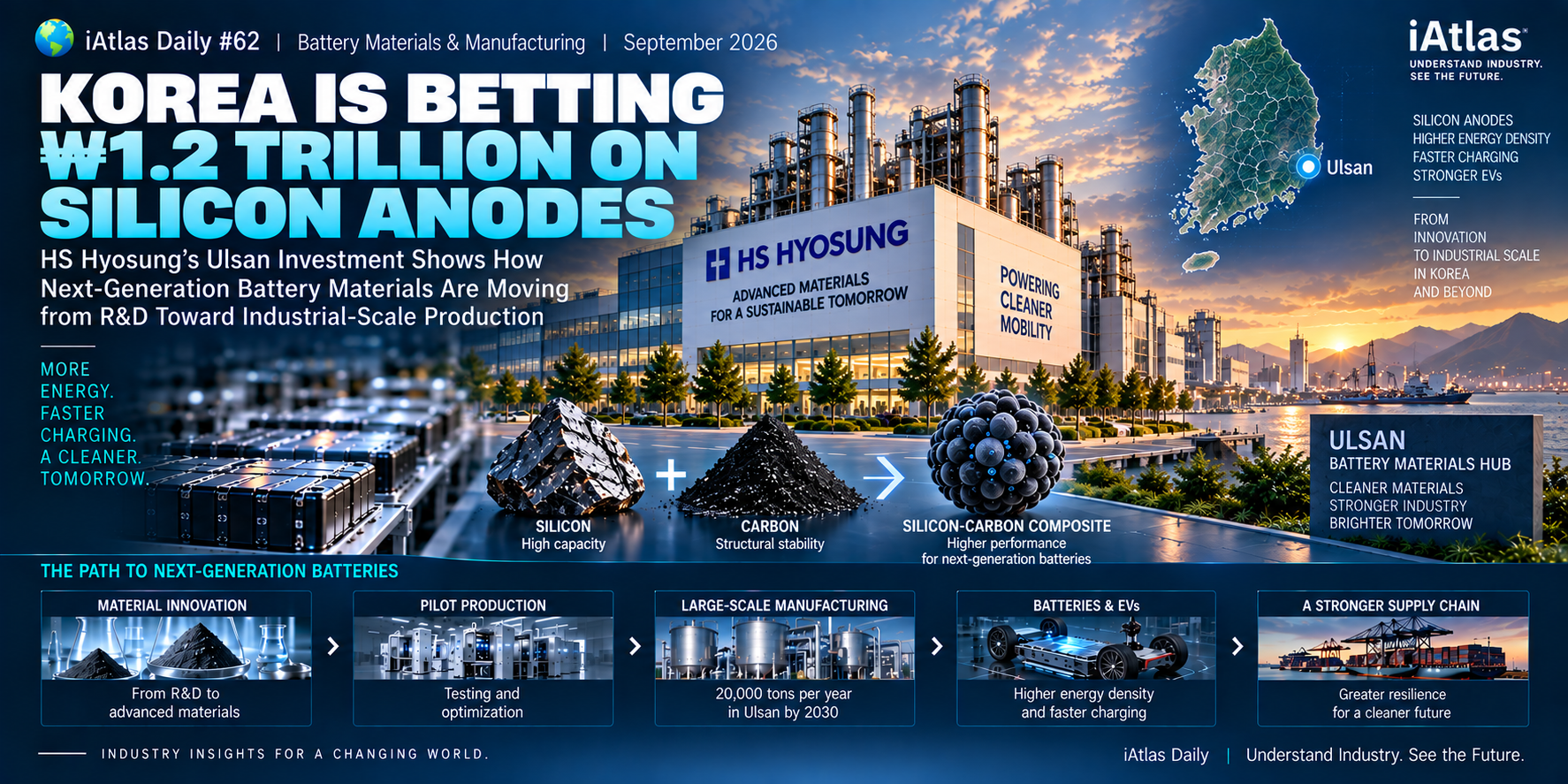
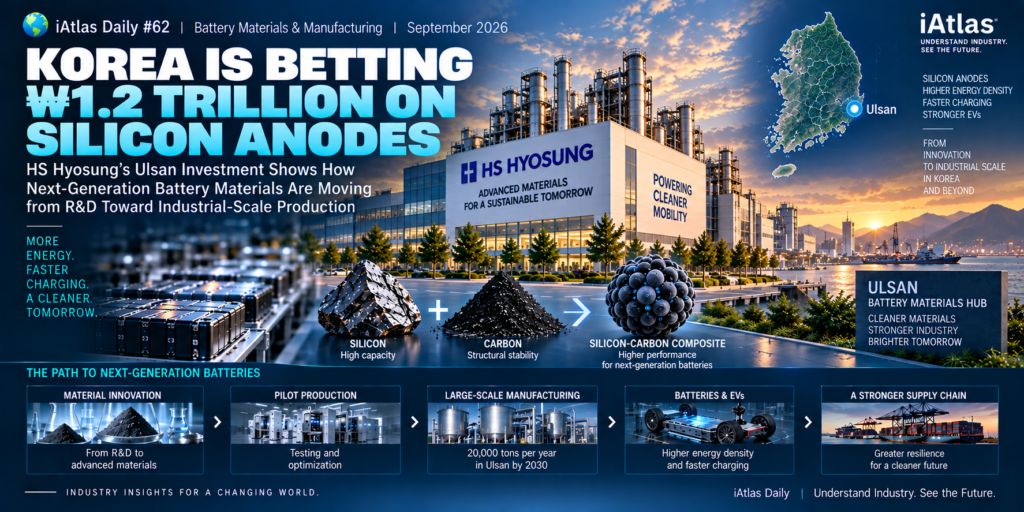
HS Hyosung Energy Solution Korea plans to invest ₩1.2 trillion ($860 million) through 2030 to establish large-scale silicon-anode-material production in the Ulsan-Mipo National Industrial Complex.
The investment will be developed in three stages and is ultimately expected to reach:
20,000 tons per year
of production capacity.
The project represents something larger than another battery-material factory.
It illustrates the transition:
Battery Research
↓
Material Development
↓
Pilot Production
↓
Customer Qualification
↓
Mass Production
↓
Industrial Scale
The next battery breakthrough will not be determined only by which material performs best in the laboratory. It will be determined by which material can be manufactured reliably, economically and at scale.
🌍 The Big Story
HS Hyosung Energy Solution Korea has signed an investment agreement with Ulsan to establish a silicon-anode-material manufacturing base.
The plan is substantial.
Phase 1
₩300 billion
→ 5,000 tons/year
→ Target completion: Q1 2028
Phase 2
₩300 billion
→ Additional 5,000 tons/year
Phase 3
₩600 billion
→ Additional 10,000 tons/year
By 2030, total capacity is expected to reach:
20,000 tons/year
with total investment of:
₩1.2 trillion.
The project also connects Korean manufacturing capabilities with European materials technology.
HS Hyosung previously partnered with Belgium-based Umicore to industrialize silicon-carbon composite anode materials developed through more than a decade of R&D.
This creates an interesting industrial combination:
European Materials Technology
Korean Manufacturing Investment
↓
Next-Generation Battery Materials
🔋 1. Why Does the Battery Need a Better Anode?
A lithium-ion battery consists of several major components:
Cathode
Anode
Electrolyte
Separator
During charging, lithium ions move toward the anode and are stored there.
Most commercial lithium-ion batteries today rely heavily on:
Graphite
Graphite works extremely well.
It is mature.
Stable.
Manufacturable.
And supported by a massive global supply chain.
But it also has physical limitations.
As battery manufacturers pursue:
More Energy
Less Weight
Faster Charging
they need ways to store more lithium inside the anode.
This is where silicon becomes attractive.
🧪 2. Silicon Can Store Much More Lithium
Silicon has attracted enormous attention because of its high theoretical lithium-storage capacity compared with graphite.
In simplified terms:
Graphite
→ Mature and stable
→ Lower capacity
Silicon
→ Much higher theoretical capacity
→ Greater technical challenges
That higher capacity creates the possibility of increasing the amount of energy stored in a battery without simply making the battery larger.
For an EV, that could eventually contribute to:
Higher Energy Density
↓
More Energy in the Same Space
↓
Longer Driving Range
Umicore says its silicon-anode technology is designed to support higher energy density and faster charging for EV batteries.
So why hasn’t silicon already replaced graphite?
Because silicon has a major problem.
📈 3. Silicon Expands Dramatically During Charging
When silicon absorbs lithium, its volume changes significantly.
That creates mechanical stress inside the electrode.
Repeated charging and discharging can lead to:
Expansion
↓
Contraction
↓
Material Damage
↓
Loss of Electrical Contact
↓
Capacity Degradation
This is one of the fundamental challenges of silicon-anode technology.
A material can have exceptional theoretical capacity and still perform poorly as a commercial battery if it cannot survive hundreds or thousands of charge cycles.
The real engineering problem is therefore not simply:
How much lithium can silicon store?
It is:
How can we use silicon while controlling its physical behavior?
🧱 4. The Practical Answer Is Often Silicon-Carbon Composite
This is why the industry’s near-term direction is not necessarily:
Graphite → 100% Silicon
Instead, manufacturers are developing combinations that capture some of silicon’s benefits while controlling its weaknesses.
One important approach is:
Silicon-Carbon Composite
Umicore describes its technology specifically as a silicon-carbon composite anode material.
The basic idea is to combine the advantages of:
Silicon
→ High capacity
with:
Carbon-Based Structures
→ Better structural and electrochemical stability
The goal is balance.
Not maximum theoretical performance.
But commercially useful performance.
⚖️ 5. Battery Materials Are Always a Trade-Off
This is one of the most important principles in battery technology.
There is rarely one material that maximizes everything simultaneously.
Battery designers must balance:
Energy Density
Power
Charging Speed
Cycle Life
Safety
Cost
Manufacturability
A silicon anode that delivers exceptional initial capacity but degrades rapidly has limited commercial value.
Likewise, a material that performs perfectly but costs too much to manufacture may never reach mass-market EVs.
The actual target is:
Performance × Cost × Manufacturability
That is why industrial-scale investment matters.
🏭 6. Industrialization Is the Hard Part
Developing a material in a laboratory is one challenge.
Producing thousands of tons of it consistently is another.
A commercial battery-material plant needs to control:
Raw Materials
↓
Particle Characteristics
↓
Composition
↓
Purity
↓
Processing
↓
Quality
↓
Batch Consistency
Battery-cell manufacturers need predictable materials.
A small variation in material properties can affect:
Electrode Processing
Cell Performance
Yield
Lifetime
and:
Safety
Scaling therefore requires much more than simply making larger quantities.
It requires manufacturing control.
🇧🇪 7. Umicore Brings More Than a Decade of Development
This is where the HS Hyosung–Umicore relationship becomes important.
Umicore says it spent more than a decade developing its anode technology at its Olen facility in Belgium before moving toward industrial-scale production.
The partnership announced in November 2025 was designed to:
Industrialize
Commercialize
and:
Further Develop
the silicon-carbon composite technology.
Umicore also says the technology is protected by more than 30 patent families and is undergoing qualification at multiple major battery-cell manufacturers.
That tells us something important.
The project did not begin with the Ulsan factory.
The factory is one later stage in a much longer technology-development process.
🔬 8. Belgium Provides the Bridge to Mass Production
Before the Korean production expansion, the technology is also being scaled in Belgium.
The partners planned to expand Umicore’s existing line in Olen into an:
Industrial Demonstration Plant
by the end of 2026.
That creates a logical industrial pathway:
Laboratory R&D
↓
Pilot / Demonstration
↓
Customer Qualification
↓
Commercial Plant
↓
Large-Scale Production
This is how many advanced materials move from scientific development into industry.
And it helps explain why mass-production announcements are important milestones.
🇰🇷 9. Ulsan Becomes the Scale-Up Location
The Korean project moves the strategy toward much larger capacity.
Ulsan is already one of South Korea’s most important industrial regions.
It has deep capabilities across:
Petrochemicals
Automotive
Shipbuilding
Materials
Energy
and:
Manufacturing
That existing industrial base matters.
Advanced materials plants need:
Utilities
Chemical Handling
Logistics
Engineering Talent
Industrial Infrastructure
Choosing an established industrial cluster can therefore reduce the friction involved in scaling a new technology.
HS Hyosung itself describes the planned Ulsan facility as part of its next-generation battery-material strategy.
🏗️ 10. Why Build the Plant in Three Stages?
The three-stage structure is notable.
Instead of immediately constructing 20,000 tons of annual capacity, the plan progresses:
5,000 tons
↓
10,000 tons cumulative
↓
20,000 tons cumulative
This can reduce scale-up risk.
A new material business needs to synchronize:
Technology
Customer Qualification
Demand
and:
Manufacturing Capacity
Building capacity incrementally can allow the company to learn from earlier production stages before committing the entire planned scale.
This is particularly important for emerging battery materials.
🚗 11. Customer Qualification Is Critical
A battery-cell manufacturer does not simply buy a new material because its specifications look better.
It must test it.
The process can involve:
Material Evaluation
↓
Electrode Testing
↓
Cell Testing
↓
Cycle Testing
↓
Safety Testing
↓
Process Optimization
↓
Qualification
↓
Commercial Supply
That process can be long.
Battery manufacturers need confidence that a material will perform consistently across millions of cells.
Umicore says its silicon-anode materials are already undergoing qualification with multiple leading battery-cell manufacturers.
This may ultimately be more important than the announced factory capacity itself.
⚡ 12. Fast Charging Is Another Important Opportunity
Silicon-anode technology is often discussed mainly through energy density.
But charging performance is another potential advantage.
Consumers want:
Longer Range
and:
Shorter Charging Time
Those two requirements place enormous pressure on battery design.
Umicore positions its silicon-anode technology around both higher energy density and faster charging.
If silicon-carbon composites can improve both while maintaining acceptable:
Cycle Life
Safety
and:
Cost
they become much more commercially attractive.
🚘 13. EV Range Is Still a Powerful Driver
Battery technology ultimately competes through the vehicle.
A higher-energy-density cell can potentially allow automakers to choose between:
Option A
Same battery size
→ Longer range
Option B
Smaller battery
→ Similar range
→ Lower weight
Option C
Performance optimization
→ Balance range, weight and charging
This is why seemingly small improvements in electrode materials can influence the entire EV architecture.
The anode may be one component.
But its performance propagates through the system.
💰 14. Cost Will Determine How Far Silicon Can Spread
Technical performance alone will not determine adoption.
Silicon materials must compete against graphite, which already benefits from:
Large Production Scale
Established Suppliers
Mature Processing
Known Performance
Existing Cell Designs
That means silicon must deliver enough additional value to justify its cost.
HS Hyosung describes its strategy around silicon-carbon composite materials that balance high energy capacity, long cycle life and cost competitiveness, with an emphasis on value per kWh.
This is the commercialization challenge.
The best material is not necessarily the one with the highest laboratory capacity.
It is the one that creates the best system-level economics.
🌏 15. Supply Security Also Matters
Battery supply chains remain highly concentrated.
Graphite is a particularly important example.
China occupies a dominant position in the global graphite-anode supply chain.
Alternative anode technologies therefore have another strategic dimension:
Supply-Chain Diversification
Silicon will not immediately eliminate graphite dependence.
But the development of new anode-material supply chains in regions such as Korea and Europe could gradually broaden the industrial base supporting battery production.
Umicore specifically identifies supply security as one of the potential benefits of its silicon-anode strategy.
🔋 16. Korea Already Has a Powerful Battery Ecosystem
South Korea starts from a strong position.
Its battery industry includes major cell manufacturers such as:
LG Energy Solution
Samsung SDI
SK On
along with extensive networks of:
Cathode Suppliers
Anode Suppliers
Separator Companies
Electrolyte Companies
Equipment Manufacturers
Recycling Companies
Adding industrial-scale silicon-anode production expands another layer of this ecosystem.
The structure becomes:
Battery R&D
↓
Advanced Materials
↓
Cell Manufacturing
↓
EV / ESS
↓
Recycling
This is precisely how industrial clusters deepen.
🧪 17. The Anode Market Could Become More Diverse
Today’s anode market is heavily associated with graphite.
The future could become more segmented.
Potential structures include:
Natural Graphite
Synthetic Graphite
Silicon-Graphite
Silicon-Carbon Composite
and eventually potentially:
Higher-Silicon Anodes
Different battery applications may use different combinations.
High-performance EVs may prioritize energy density.
Mass-market vehicles may prioritize cost.
Fast-charging applications may require another balance.
There may therefore be no single universal anode solution.
🏁 18. This Is a Commercialization Race
Many companies around the world are developing silicon-anode technologies.
The key competition is increasingly moving from:
Who has the best laboratory result?
toward:
Who can commercialize first at scale?
That requires four capabilities simultaneously:
Technology
Manufacturing
Customer Qualification
Cost
This is why a 20,000-ton production roadmap deserves attention.
It represents an attempt to bridge all four.
🗺️ 19. Battery Innovation Is Becoming Geographic
Daily #59 looked at semiconductor manufacturing moving into India.
Daily #60 examined BYD building manufacturing capacity in Europe.
Daily #61 looked at China’s expanding memory industry.
Now Daily #62 adds another piece:
Next-Generation Battery Materials in Korea
The pattern is becoming clear.
Technology competition increasingly has a geographic dimension.
Countries are not simply competing to invent technologies.
They want to manufacture them.
🔄 20. The Next Battery Cycle Is About Manufacturing Innovation
The first generation of lithium-ion innovation focused heavily on improving chemistry.
The next phase increasingly requires:
Chemistry
Materials Engineering
Manufacturing
Scale
A promising material must survive the transition from:
Gram
to:
Kilogram
to:
Ton
to:
Tens of Thousands of Tons
That transition is where many technologies fail.
And it is precisely where the HS Hyosung–Umicore project is now heading.
🧩 Why This Matters
The Ulsan investment highlights several larger trends.
Silicon anodes are moving toward industrialization.
The story is no longer confined to laboratory research.
Scale is becoming the next test.
The project targets 20,000 tons of annual capacity by 2030.
Technology and manufacturing are becoming geographically connected.
Belgian R&D is being combined with Korean industrial-scale manufacturing.
Customer qualification remains critical.
Capacity matters only if battery manufacturers adopt the material.
Korea is expanding its battery-material ecosystem.
Silicon anodes add another strategic layer beyond conventional battery materials.
🔭 What to Watch Next
MPK-1
The first 5,000-ton-per-year plant is scheduled for completion in Q1 2028.
Customer Qualification
Watch for announcements identifying battery manufacturers that qualify the material for commercial cells.
EV Applications
The first major production programs using the material will be particularly important.
Silicon Content
Watch how much silicon can practically be incorporated while maintaining cycle life and manufacturability.
Cost
Silicon needs to demonstrate competitive value at the cell and pack level.
Scale-Up
The progression from 5,000 → 10,000 → 20,000 tons will show whether demand develops alongside capacity.
Competing Technologies
Watch other silicon-anode developers and alternative anode technologies as commercialization accelerates.
🧭 iAtlas Insight
Silicon has been a promising battery material for a long time.
That is no longer the most interesting question.
The important question now is:
Can silicon become an industrial material?
That requires a very different set of capabilities.
A laboratory proves:
It works.
A pilot plant proves:
It can be produced.
Customer qualification proves:
It can work inside a commercial battery.
A large factory must prove:
It can work economically at scale.
The HS Hyosung–Umicore project is moving into that final territory.
And that may be where the next phase of battery competition is decided.
Not only in:
Chemistry
but in:
Manufacturing
Cost
Quality
and:
Scale
The next battery breakthrough may not be the material with the highest theoretical capacity. It may be the advanced material that industry finally learns how to manufacture by the thousand-ton.
📚 Related Articles
📰 iAtlas Daily #8: Why Silicon Anodes Are the Future of Lithium-Ion Batteries
📰 iAtlas Daily #60: BYD’s European Expansion Is Moving from EV Sales to Local Manufacturing
📰 iAtlas Weekly #11: Industrial Competition Is Moving Deeper into the Supply Chain
🔗 References
Umicore — HS Hyosung Partnership for Silicon-Anode Materials
Yonhap — Ulsan Silicon Anode Plant Investment
ℹ️ About iAtlas
iAtlas is an independent publication covering batteries, semiconductors, OLED, advanced materials, AI, and global industrial trends.
We transform complex industrial developments into clear, reliable, and easy-to-understand insights.
Whether you’re following today’s industry news or building long-term expertise, iAtlas helps you understand not only what happened, but why it matters.
Technology creates change.
Insight creates opportunity.
— iAtlas