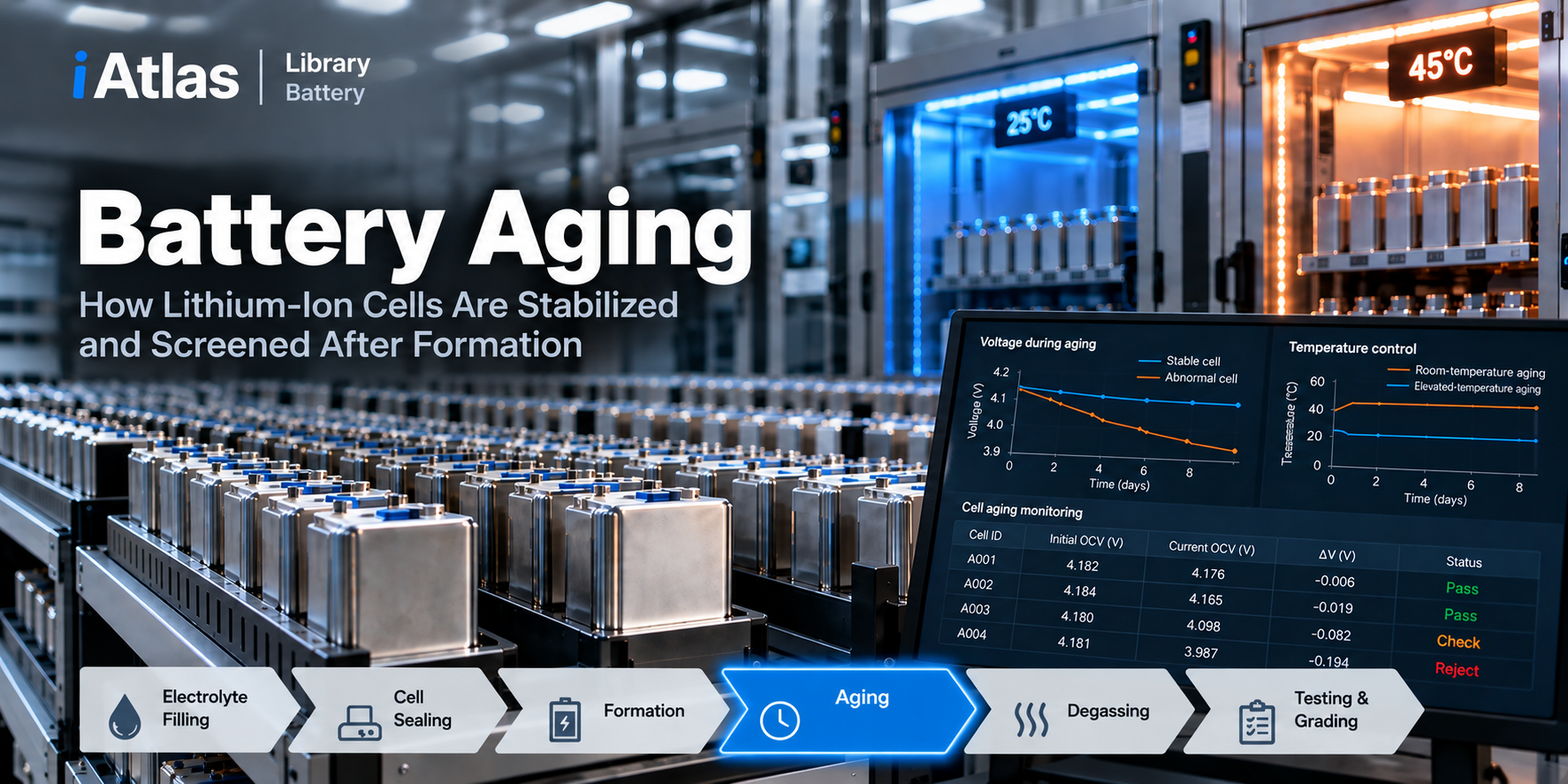
Battery Aging Explained: How Lithium-Ion Cells Are Stabilized and Screened After Formation
Understanding Post-Formation Storage, Voltage Relaxation, Self-Discharge, Temperature Control, Defect Detection, and Quality Assurance in Lithium-Ion Battery Manufacturing
Topic: Processes
Process Stage: Cell Finishing
Content Type: Manufacturing
Learning Path: Battery Manufacturing
Related Industries: Electric Vehicles · Energy Storage Systems · Consumer Electronics
Last Updated: October 2026
Industry Snapshot
Battery aging is a post-formation manufacturing stage in which newly formed lithium-ion cells are stored under controlled conditions to observe their electrochemical stability and identify potential quality defects.
After formation, the cell has undergone its first controlled electrochemical charging process. Important interfacial reactions have occurred, including the development of the solid electrolyte interphase (SEI) on the anode.
However, completing formation does not automatically guarantee that every cell will behave consistently during subsequent storage and operation.
Some defects become apparent only after time has passed.
Battery aging provides an opportunity to observe these changes before cells proceed to later manufacturing and quality-control stages.
A simplified process sequence is:
Electrolyte Filling → Cell Sealing → Formation → Aging → Quality Evaluation
Depending on the cell format and manufacturing architecture, degassing and final sealing operations may occur at different points in this sequence.
The key purpose of aging is to determine whether a cell remains sufficiently stable after its initial electrochemical activation.
Battery aging is not simply waiting. It is a controlled observation period that helps manufacturers distinguish stable cells from potentially defective ones.
At a Glance
| Category | Description |
|---|---|
| Process | Battery Aging |
| Manufacturing Stage | Cell Finishing |
| Previous Main Process | Formation |
| Main Function | Post-formation stabilization and defect screening |
| Key Mechanisms | Voltage relaxation, self-discharge, continued interfacial reactions |
| Key Variables | Temperature, time, state of charge, storage conditions |
| Major Measurements | Open-circuit voltage, voltage decay, temperature |
| Main Quality Risks | Abnormal self-discharge, internal leakage, unstable electrochemical behavior |
| Common Approaches | Controlled storage, room-temperature aging, elevated-temperature aging |
| Next Learning Path Process | Degassing |
What Is Battery Aging?
Battery aging in manufacturing refers to a controlled storage and monitoring process performed after initial formation.
The cell is maintained under specified conditions while manufacturers evaluate whether its electrical and electrochemical behavior remains within acceptable limits.
A simplified process is:
Formed Battery Cell
↓
Controlled Storage Conditions
↓
Voltage Relaxation and Monitoring
↓
Self-Discharge Evaluation
↓
Quality Screening
↓
Accepted Cell / Further Evaluation / Rejected Cell
Aging may involve passive storage, periodic measurements, or additional electrical conditioning depending on the manufacturing process.
It is important to distinguish this manufacturing stage from the broader concept of battery aging during use.
Manufacturing Aging focuses on post-production stabilization and quality screening.
Lifetime Aging refers to gradual battery degradation during storage and repeated operation over months or years.
Both involve electrochemical changes, but their purposes and timescales differ.
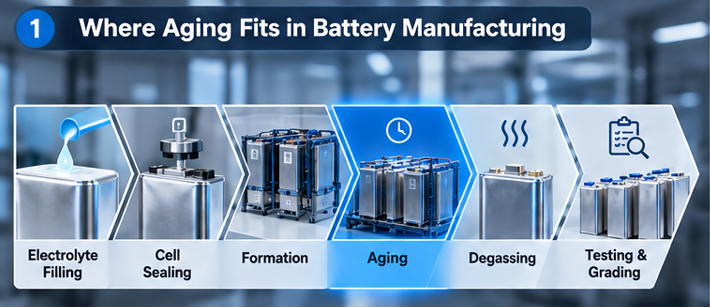
Where Aging Fits in Battery Manufacturing
Electrode Manufacturing
Material Mixing → Battery Slurry → Electrode Coating → Electrode Drying → Calendering → Slitting
Cell Assembly
Notching → Winding / Stacking → Electrolyte Filling → Cell Sealing
Cell Finishing
Formation → Aging (Current) → Degassing → Battery Cell Testing & Grading
System Assembly
Battery Module Assembly → Battery Pack Assembly
This is the sequence used in the iAtlas Battery Manufacturing Learning Path.
Actual production sequences vary. For example, pouch-cell degassing can be performed after initial formation and before or between subsequent aging and testing operations.
Why Battery Aging Is Necessary
Formation creates important electrochemical interfaces, but it does not eliminate every possible manufacturing defect.
A cell may initially show acceptable voltage and capacity yet experience abnormal voltage loss during storage.
Potential causes include:
- Internal leakage pathways
- Microshorts
- Contamination
- Unwanted side reactions
- Abnormal self-discharge
- Defective or unstable internal interfaces
Aging allows time-dependent abnormalities to become measurable.
This is particularly important because some defects cannot be identified reliably through visual inspection or a single electrical measurement.
Voltage Relaxation After Formation
Immediately after charging or discharging, a battery’s terminal voltage may not equal its equilibrium open-circuit voltage.
During rest, the measured voltage changes as internal electrochemical gradients relax.
These changes can involve:
- Lithium concentration redistribution
- Electrochemical polarization relaxation
- Interfacial processes
- Temperature equilibration
The voltage may therefore change even in a healthy cell.
This is known as voltage relaxation.
Conceptually:
End of Formation Charge
↓
Cell Rest
↓
Voltage Relaxation
↓
More Stable Open-Circuit Voltage
The distinction matters because voltage relaxation is not automatically evidence of a defective cell.
Manufacturers must separate expected relaxation behavior from abnormal long-term voltage loss.
What Is Open-Circuit Voltage?
Open-circuit voltage (OCV) is the voltage measured across a battery’s terminals when no external current is flowing.
OCV depends on factors including:
- State of charge
- Electrode chemistry
- Temperature
- Electrochemical equilibrium conditions
During aging, OCV measurements can provide information about the cell’s condition.
However, voltage alone does not reveal every internal defect.
Its interpretation depends on the measurement conditions and the battery chemistry.
What Is Battery Self-Discharge?
Self-discharge is the gradual loss of stored charge while a battery is not supplying an external load.
Even a healthy lithium-ion cell can experience some self-discharge because of internal parasitic reactions.
The important distinction is between:
Normal Self-Discharge
and
Abnormal Self-Discharge
A cell with unusually high self-discharge may indicate an internal quality problem.
During manufacturing aging, this behavior can help identify cells that require additional inspection or rejection.

How Self-Discharge Is Evaluated
A simplified measurement approach is:
Initial OCV Measurement
↓
Controlled Storage Period
↓
Second OCV Measurement
↓
Voltage Change Evaluation
One basic parameter is:
\[ \Delta V = V_{\text{initial}} – V_{\text{final}} \]
where:
- \(V_{\text{initial}}\) is the voltage at the initial measurement.
- \(V_{\text{final}}\) is the voltage after the defined storage interval.
A simplified voltage-change rate is:
\[ \frac{\Delta V}{\Delta t} \]
However, voltage decay is not identical to a direct measurement of self-discharge current or lost capacity.
Because the relationship between OCV and SOC is nonlinear and chemistry-dependent, manufacturers must account for relaxation, temperature, and measurement conditions when interpreting voltage changes.
This distinction is especially important for chemistries with relatively flat OCV–SOC curves, such as LFP over parts of their operating range.
Normal vs Abnormal Voltage Decay
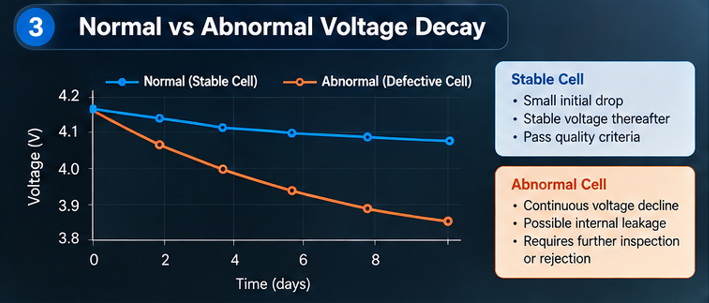
Consider two cells stored under identical conditions.
Cell A exhibits an initial relaxation followed by relatively stable voltage.
Cell B exhibits a much larger continuing voltage decline.
Under comparable test conditions, Cell B may require further investigation.
The graph is illustrative rather than an actual industrial acceptance specification.
Room-Temperature Aging
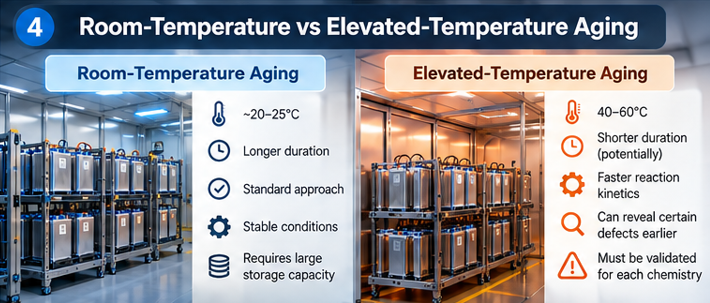
Room-temperature aging stores cells under controlled ambient conditions.
The objective is to observe voltage behavior and other quality indicators over time.
Important conditions include:
- Stable ambient temperature
- Defined storage duration
- Controlled initial state of charge
- Consistent measurement intervals
- Reliable voltage measurement
This approach is relatively straightforward but may require considerable storage capacity when production volumes are high.
Elevated-Temperature Aging
Some manufacturers use elevated-temperature storage as part of their screening or conditioning strategy.
Temperature can accelerate certain electrochemical reactions, potentially making some abnormal behaviors observable over shorter periods.
Conceptually:
Higher Temperature
↓
Faster Reaction Kinetics
↓
Potentially Faster Detection of Certain Instabilities
However, elevated-temperature aging is not universally superior.
Higher temperatures can also accelerate undesirable degradation.
Therefore, temperature and duration must be validated for the particular cell chemistry and manufacturing objective.
Aging temperature should not be increased arbitrarily simply to shorten production time.
How Long Does Battery Aging Take?
There is no single universal aging duration for lithium-ion battery manufacturing.
The required time depends on:
- Cell chemistry
- Cell size and design
- Initial state of charge
- Aging temperature
- Defect-screening requirements
- Measurement precision
- Manufacturing strategy
Some industrial approaches use storage periods lasting days, while alternative protocols and accelerated screening methods aim to reduce this duration.
The key objective is not to maximize aging time.
It is to provide enough reliable information to identify unacceptable cells without unnecessarily extending production.
Aging Equipment and Production Infrastructure
Battery aging requires controlled storage infrastructure and reliable measurement systems.
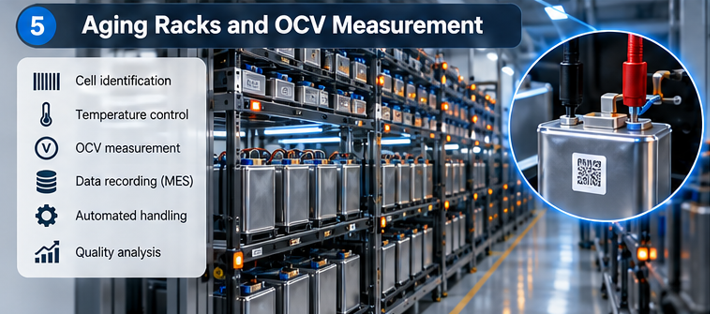
Industrial equipment can include:
- Aging racks and storage towers
- Automated cell handling and conveyors
- Temperature-controlled storage areas
- OCV measurement stations
- Barcode or cell identification systems
- Manufacturing execution systems (MES)
- Data logging and quality-analysis software
VDMA and PEM RWTH Aachen’s 2026 production guide identifies high-temperature aging, room-temperature aging, and OCV measurements as major parts of industrial aging operations. It describes manufacturer-dependent aging durations of up to three weeks.

vdma.eu
Aging Racks and Storage Towers
Aging racks hold large numbers of cells during their defined storage period.
An industrial aging system must support:
Cell Identification
↓
Controlled Storage Location
↓
Scheduled Measurements
↓
Data Recording
↓
Quality Decision
Each cell must remain traceable to its manufacturing history.
This allows manufacturers to associate abnormal aging behavior with upstream processes such as electrode cutting, cell assembly, electrolyte filling, and formation.
How Aging Can Detect Manufacturing Defects
One of the most important applications of aging is identifying cells affected by unwanted internal electrical leakage.
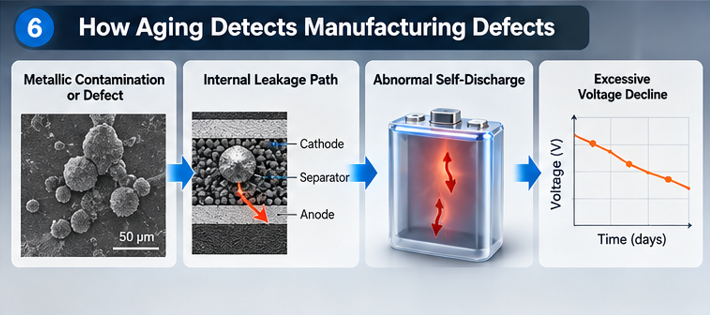
For example, a metallic particle introduced during manufacturing may create or contribute to an internal short-circuit pathway.
The defect may not immediately produce an obvious external symptom.
However, abnormal voltage decay during storage can help identify the affected cell.
A 2025 study in the Journal of Energy Storage investigated voltage-drop screening for detecting defective cells associated with foreign metallic contaminants.
ScienceDirect
Conceptually:
Metallic Contamination
↓
Potential Internal Leakage Path
↓
Abnormal Self-Discharge
↓
Excessive Voltage Decline
↓
Cell Flagged for Investigation
This does not mean every abnormal voltage drop is caused by metallic contamination. It is one possible failure mechanism.
Measurement Accuracy and Repeatability
Reliable aging analysis depends on measurement quality.
If voltage changes are small, measurement errors can make normal cells appear defective or defective cells appear acceptable.
Important factors include:
- Voltage measurement accuracy
- Instrument calibration
- Stable contact resistance
- Consistent measurement timing
- Temperature compensation
- Reproducible initial SOC
- Reliable cell identification
Aging is therefore not just a storage process. It is also a precision metrology and quality-control process.
Aging and Manufacturing Throughput
Aging can become a significant production bottleneck.
Unlike electrode coating or slitting, where materials move continuously through equipment, aging requires cells to occupy storage positions for an extended period.
The basic capacity relationship is:
N = Q x t
where:
- N = average number of cells in aging storage
- Q = cell production throughput per day
- t = average aging duration in days
For example, consider a hypothetical production line manufacturing 50,000 cells per day.
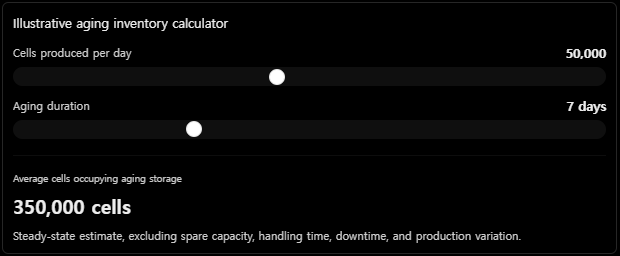
Reducing the aging duration can significantly reduce the number of storage positions required, but only if defect-screening performance is maintained.
Why Faster Aging Is Difficult
Aging duration cannot simply be reduced without consequences.
If cells are evaluated too early, certain time-dependent defects may not yet be detectable.
This creates a trade-off:
Shorter Aging
→ Higher throughput and lower inventory
Longer Aging
→ More observation time for slow-developing abnormalities
The challenge is to identify the shortest validated screening protocol that meets the required quality standard.
Advanced Aging and Early Defect Detection
Research and industrial development are exploring ways to improve aging efficiency.
High-Precision Voltage Monitoring
More accurate voltage measurements can improve detection of subtle abnormalities.
Temperature-Controlled Screening
Carefully designed temperature profiles can support specific accelerated screening methods.
Data-Driven Defect Detection
Statistical models can compare voltage behavior across large cell populations.
Early Quality Prediction
Manufacturers may combine formation and aging measurements to identify cells likely to exhibit abnormal later behavior.
Automated Cell Traceability
Each cell’s aging data can be linked to its complete manufacturing history.
These approaches aim to reduce unnecessary storage time while improving defect-detection reliability.
iAtlas Insight
Battery aging illustrates a fundamental principle of high-volume battery manufacturing:
Manufacturing quality cannot always be determined immediately after production.
A cell may pass mechanical inspection, electrolyte filling, sealing, and initial formation but still contain a defect that becomes observable only during storage.
This makes aging an important bridge between manufacturing and quality assurance.
The relationship extends across the entire production chain:
Electrode Manufacturing
↓
Particle and Structural Quality
↓
Cell Assembly
↓
Formation
↓
Aging
↓
Defect Detection
The industrial challenge is that every additional day of aging increases the number of cells occupying factory storage space.
Therefore, the next generation of aging systems must address two objectives simultaneously:
Higher Defect-Detection Confidence
+
Shorter Validated Screening Time
The long-term opportunity lies in combining precise voltage measurements, controlled storage, cell-level traceability, and predictive analytics.
In this context, battery aging is not merely the final waiting period before shipment.
It is a valuable source of information about the quality of the entire manufacturing process.
Did You Know?
- Battery manufacturing aging differs from battery degradation over years of use.
- Healthy cells can exhibit voltage relaxation immediately after charging.
- Abnormal voltage decay can indicate internal leakage or other defects.
- Aging can be performed at room temperature or under elevated-temperature conditions.
- Aging time depends on chemistry, manufacturing design, and screening requirements.
- Some industrial aging protocols can extend to several weeks.
- Small voltage changes require precise and repeatable measurement.
- Aging inventory grows approximately in proportion to production throughput and storage duration.
- Aging data can be combined with formation data to improve quality screening.
FAQ
What is battery aging in manufacturing?
Battery aging is a controlled storage and monitoring stage after initial formation, used to evaluate cell stability and detect potential manufacturing defects.
Is battery aging the same as battery degradation?
No. Manufacturing aging is a quality-control stage, whereas lifetime aging refers to gradual degradation during storage and use.
Why are batteries stored after formation?
Storage allows manufacturers to observe voltage relaxation, self-discharge behavior, and time-dependent abnormalities.
What is the difference between voltage relaxation and self-discharge?
Voltage relaxation results from internal electrochemical equilibration after charging or discharging. Self-discharge involves loss of stored charge through internal reactions or leakage pathways.
How long does battery aging take?
It varies by cell chemistry and manufacturer. Some industrial protocols extend to several weeks, while others use shorter validated procedures.
Why is OCV measured during aging?
Open-circuit voltage measurements help track cell stability and identify abnormal voltage changes.
Can aging detect internal short circuits?
Abnormal voltage decay can indicate internal leakage or short-circuit-related defects, although further analysis may be needed to determine the cause.
What comes after battery aging?
In the iAtlas Battery Manufacturing Learning Path, the next article is Battery Degassing. Actual industrial process order can vary by cell design.
Battery Manufacturing Learning Path
Overview
– Battery Manufacturing Process
Electrode Manufacturing
Cell Assembly
- Battery Cell Assembly
- Battery Electrode Notching
- Battery Electrode Winding
- Battery Electrode Stacking
- Battery Electrolyte Filling
- Battery Cell Sealing
Cell Finishing
- Battery Formation
- Battery Aging (Current)
- Battery Degassing
- Battery Cell Testing & Grading
System Assembly
- Battery Module Assembly
- Battery Pack Assembly
Explore More
Cell Finishing
- Battery Formation
- Battery Aging (Current)
- Battery Degassing
- Battery Cell Testing & Grading
Cell Assembly
- Battery Electrolyte Filling
- Battery Cell Sealing
Related Concepts
- Battery Self-Discharge
- Open-Circuit Voltage (OCV)
- State of Charge (SOC)
- Internal Short Circuit
- Battery Quality Control
References
VDMA / PEM RWTH Aachen — Production Process of a Lithium-Ion Battery Cell, 5th Edition (2026)
Industrial production reference covering room-temperature aging, high-temperature aging, OCV measurements, storage duration, and quality screening.
vdma.eu
Royal Society of Chemistry — Lithium-ion battery cell formation: status and future directions towards a knowledge-based process design
Energy & Environmental Science, 2024
Scientific review covering formation, post-formation aging, self-discharge testing, and manufacturing quality assessment.
pubs.rsc.org
Lee et al. — Voltage drop screening for defective cells during the battery formation process
Journal of Energy Storage, 2025, Volume 131, Part B, Article 117579
Research on voltage-drop screening, metallic contamination, internal short-circuit risks, and manufacturing defect detection.
DOI: 10.1016/j.est.2025.117579
ScienceDirect
About iAtlas
iAtlas is an independent publication covering batteries, semiconductors, OLED, advanced materials, AI, and global industrial trends.
We transform complex industrial developments into clear, reliable, and easy-to-understand insights.
Whether you’re following today’s industry news or building long-term expertise, iAtlas helps you understand not only what happened, but why it matters.
Technology creates change.
Insight creates opportunity.
— iAtlas