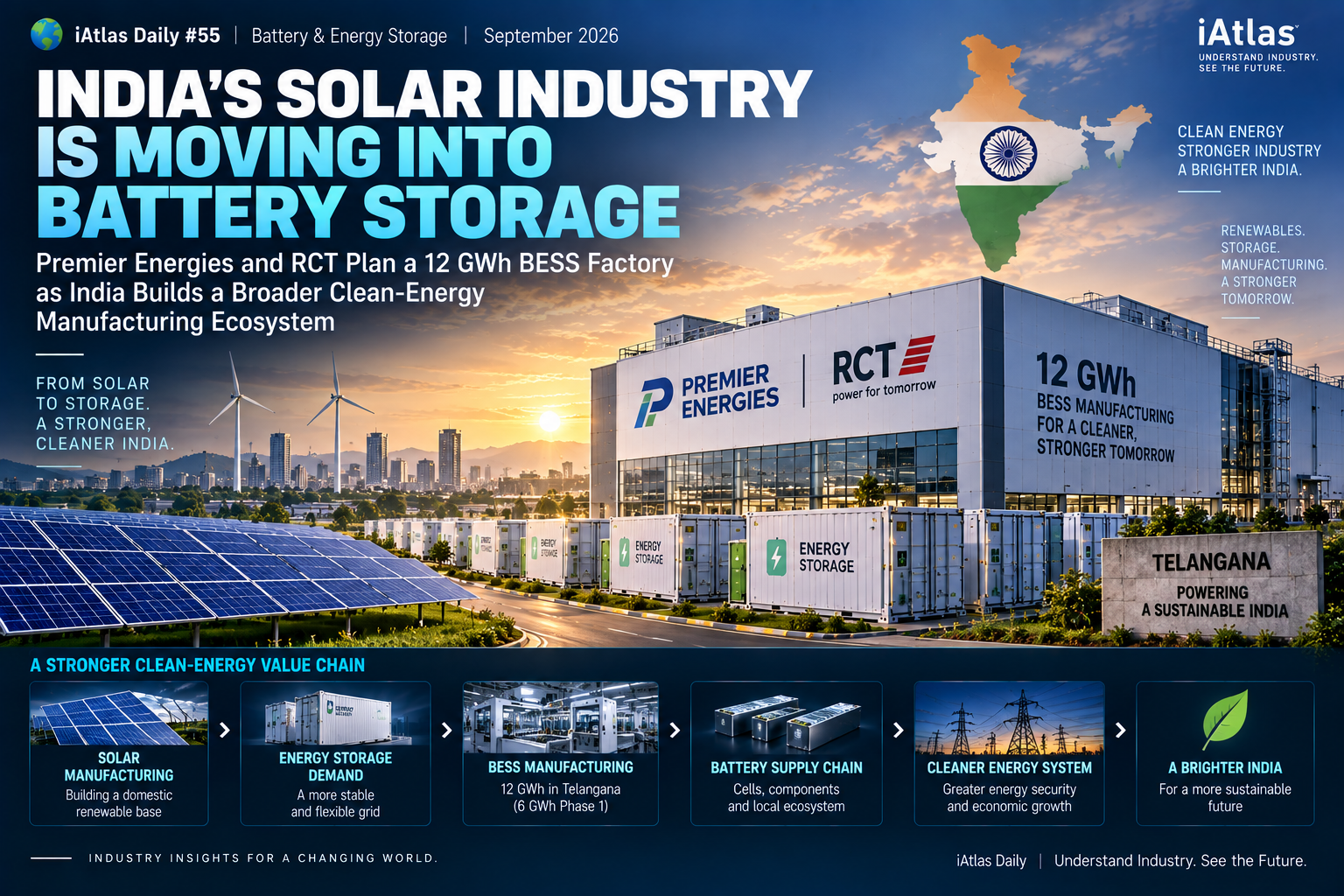
India’s Solar Industry Is Moving into Battery Storage
Premier Energies and RCT Plan a 12 GWh BESS Factory as India Builds a Broader Clean-Energy Manufacturing Ecosystem
🔋 iAtlas Daily #55 | Battery & Energy Storage | September 2026
India’s Battery Energy Storage Manufacturing industry is beginning to take shape alongside its rapidly expanding solar sector.
On September 10, Indian solar manufacturer Premier Energies announced a binding term sheet with RCT Energy India, part of Germany’s RCT Group, to establish a joint venture targeting 12 GWh of battery energy storage system manufacturing capacity in Telangana.
The project is significant not simply because of its size.
Premier Energies is primarily known as a solar cell and module manufacturer.
Its expansion into battery storage illustrates a broader transformation taking place across India’s clean-energy industry:
Solar Manufacturing
↓
Renewable Deployment
↓
Energy Storage Demand
↓
BESS Manufacturing
↓
Integrated Clean-Energy Industry
India is no longer building only renewable generation capacity.
It is beginning to build more of the industrial infrastructure required to store and manage that electricity.
The next phase of India’s renewable-energy expansion may increasingly be a manufacturing story.
🔋 The Big Story
Premier Energies’ wholly owned subsidiary, Premier Battery Technologies, has entered into a binding term sheet with RCT Energy India to establish a new joint venture called Premier Energies Storage Solutions.
The proposed facility will be located in Seetharampur, Telangana.
The plan calls for:
12 GWh
of total BESS manufacturing capacity.
The first phase is expected to provide:
6 GWh
with implementation targeted for FY2027–28.
The planned facility will target:
- utility-scale energy storage
- commercial applications
- industrial applications
- international markets
The partners also envision the project as an export-oriented manufacturing platform.
That last point matters.
The ambition is not simply to manufacture batteries for India’s domestic grid.
It is to develop India as a potential manufacturing base for global energy-storage markets.
☀️ 1. Why Is a Solar Company Moving into Batteries?
The logic begins with a fundamental limitation of renewable energy.
Solar generation is variable.
Electricity production rises during daylight hours and disappears at night.
As solar capacity grows, the grid increasingly needs ways to move electricity across time.
Without storage:
Solar Generation
☀️
↓
Electricity Produced Now
↓
Must Be Used Now
With storage:
Solar Generation
↓
Battery Storage
↓
Electricity Available Later
This changes the economics of renewable power.
The more solar and wind a grid installs, the more valuable flexible energy storage can become.
For a solar manufacturer such as Premier Energies, moving into BESS therefore expands the company from one part of the clean-energy system into another.
🇮🇳 2. India’s Solar Industry Has Already Reached Industrial Scale
India has spent years building domestic solar manufacturing.
That strategy is beginning to produce substantial capacity.
Industry estimates cited in recent Indian market analysis put solar manufacturing capacity in operation or development at roughly 135 GW, while the country is targeting 500 GW of non-fossil-fuel generation capacity by 2030.
This creates an increasingly important question:
What happens when enormous amounts of renewable electricity enter the grid?
Generation capacity alone is not enough.
The system also requires:
Transmission
Grid Management
Power Electronics
Energy Storage
Backup Capacity
The renewable-energy industry therefore naturally expands into infrastructure.
🔄 3. The Industrial Chain Is Expanding
The traditional solar manufacturing chain looks roughly like this:
Polysilicon
↓
Wafer
↓
Solar Cell
↓
Module
↓
Solar Farm
But the energy system does not end there.
As renewable penetration rises:
Solar Farm
↓
Grid
↓
Variable Electricity
↓
Storage Requirement
↓
BESS
The complete industrial chain becomes:
Solar Manufacturing + Battery Storage + Grid Infrastructure
Premier Energies’ move illustrates this transition.
🏭 4. The First Phase Alone Is 6 GWh
The proposed factory will not immediately start at the full 12 GWh target.
The first phase is planned at:
6 GWh
with the overall project ultimately targeting:
12 GWh
of manufacturing capacity.
A phased strategy makes industrial sense.
Battery-storage manufacturing requires more than building a factory.
Companies need to establish:
- suppliers
- engineering processes
- quality systems
- customer qualification
- project pipelines
- service networks
Starting with 6 GWh allows the manufacturing platform to scale alongside demand.
🤝 5. The Partnership Combines Indian Manufacturing and German Technology
The joint venture also illustrates another common pattern in emerging manufacturing ecosystems.
Premier Energies contributes its Indian manufacturing base and market presence.
RCT contributes engineering expertise, technology and international supply-chain experience.
The proposed initial ownership structure is approximately:
Premier Battery Technologies — 85%
RCT India — 15%
with RCT having an option to increase its stake to 20%, according to the company’s filing information.
The industrial model becomes:
Local Manufacturing
International Technology
Domestic Demand
Export Market
This approach can accelerate the development of industries where domestic demand exists but technology and supply chains are still maturing.
⚡ 6. BESS Is More Than a Battery
One important distinction is often overlooked.
A Battery Energy Storage System is not simply a large battery pack.
A BESS typically combines:
Battery Cells
↓
Battery Modules / Racks
↓
Battery Management System
↓
Power Conversion System
↓
Thermal Management
↓
Fire Safety
↓
Energy Management System
↓
Grid Connection
This creates a much broader manufacturing opportunity than cell production alone.
It involves:
- batteries
- power electronics
- electrical equipment
- software
- cooling
- safety systems
- containers
- grid engineering
That makes energy storage an industrial ecosystem.
🧩 7. India Does Not Need to Replicate China’s Battery Industry Exactly
China dominates much of the global lithium-ion battery supply chain.
India is starting from a different position.
Instead of immediately competing across every part of:
Critical Minerals
↓
Cathode Materials
↓
Anode Materials
↓
Cell Manufacturing
↓
Battery Pack
India may build substantial demand first through its power system.
The pathway can look like:
Renewable Energy
↓
Solar Deployment
↓
Grid Storage Demand
↓
BESS Manufacturing
↓
Battery Supply Chain Development
This is strategically different from building a battery industry primarily around electric vehicles.
🔋 8. Korea and India Are Entering ESS from Different Directions
This creates an interesting comparison with Korea.
Korean battery manufacturers developed enormous manufacturing capacity primarily around:
Electric Vehicles
Companies such as LG Energy Solution, Samsung SDI and SK On are now expanding more aggressively into ESS as EV growth moderates in some markets.
The Korean transition looks like:
EV Battery
↓
Manufacturing Capacity
↓
ESS
India is approaching from another direction:
Solar
↓
Renewable Generation
↓
Grid Storage
↓
BESS Manufacturing
So both markets are moving toward ESS, but from different industrial starting points.
🌍 9. ESS Is Becoming a Global Manufacturing Market
Energy storage demand is no longer concentrated in a small number of countries.
Large markets are emerging across:
United States
China
Europe
India
Middle East
Australia
and other regions with rapidly growing renewable-energy capacity.
This creates an opportunity for manufacturing platforms that can serve both domestic and export markets.
Premier Energies and RCT explicitly plan for the Telangana operation to supply India as well as international markets.
That changes the project’s strategic significance.
It becomes:
Made in India
↓
Used in India
Exported Globally
🏗️ 10. Battery Manufacturing Is Following Solar Manufacturing
India’s experience with solar provides a potential template.
Initially, much of the country’s renewable-energy expansion depended heavily on imported equipment.
Industrial policy increasingly shifted toward domestic manufacturing.
The progression became:
Solar Demand
↓
Module Manufacturing
↓
Cell Manufacturing
↓
Upstream Localization
Battery storage may follow a similar path.
BESS Demand
↓
System Assembly
↓
Battery Manufacturing
↓
Components
↓
Materials
Localization tends to move upstream over time.
That connects directly with the broader industrial pattern iAtlas examined in Daily #54.
🧪 11. The Next Question Is Cell Localization
There is an important limitation.
Building BESS manufacturing capacity does not automatically mean every battery component will be manufactured domestically.
A storage system can be assembled locally while cells remain imported.
The deeper industrial question therefore becomes:
BESS Assembly
↓
Where do the cells come from?
↓
Where do the cathode materials come from?
↓
Where does the lithium come from?
This is where India’s battery strategy becomes particularly important.
The true depth of localization will depend on how much of the upstream battery supply chain eventually develops domestically.
💰 12. Storage Can Become the Next Clean-Energy CapEx Cycle
Solar investment creates generating assets.
But large renewable systems increasingly create secondary investment requirements.
For example:
Solar
→ Transmission
→ Grid Modernization
→ Storage
→ Power Electronics
→ Digital Energy Management
One investment cycle creates another.
This is why BESS is becoming one of the most important adjacent industries to renewable energy.
The value increasingly moves from:
How much renewable capacity can we build?
toward:
How effectively can the power system use it?
Storage is one answer.
🏭 13. Telangana Is Becoming an Energy-Manufacturing Location
The planned BESS factory will be developed at Seetharampur in Telangana.
This is notable because industrial clusters can create cumulative advantages.
Once a region develops:
Manufacturing
↓
Suppliers
↓
Engineering Talent
↓
Logistics
↓
Customers
↓
Additional Investment
future projects become easier to attract.
This is how industrial ecosystems deepen over time.
A battery-storage factory is therefore not simply production capacity.
It can become an anchor for additional suppliers.
♻️ 14. Recycling Will Eventually Follow Manufacturing
There is another layer further downstream.
As India’s battery-storage fleet expands, those systems will eventually reach the end of their operating lives.
That creates:
BESS Manufacturing
↓
Deployment
↓
Operation
↓
Retirement
↓
Battery Recycling
↓
Recovered Materials
This is the same circular supply-chain transition occurring in the United States and Europe.
Manufacturing capacity today eventually creates recycling feedstock tomorrow.
Battery recycling should therefore be viewed as part of the long-term ESS industrial ecosystem.
🧱 15. The Battery Industry Is Becoming More Than EVs
For much of the last decade:
Battery Industry ≈ EV Industry
was a reasonable shorthand.
That is becoming increasingly inaccurate.
Battery demand is spreading across:
EV
ESS
UPS
Data Centers
Commercial & Industrial Power
Residential Storage
Robotics
The result is a more diversified battery market.
This diversification can also change how factories are designed.
Manufacturing flexibility becomes more valuable when cells can serve multiple end markets.
🧩 Why This Matters
India’s Battery Energy Storage Manufacturing expansion reveals several important industrial trends.
Solar is creating another manufacturing industry.
Renewable generation increasingly requires storage.
India is moving deeper into clean-energy manufacturing.
The country is expanding beyond solar modules toward integrated energy infrastructure.
ESS is becoming a global battery growth market.
EVs are no longer the only major source of battery demand.
Localization occurs in stages.
BESS manufacturing may come first, followed by deeper cell, component and material localization.
Industrial ecosystems build on themselves.
Solar manufacturing can become the foundation for storage, grid equipment and broader energy manufacturing.
🔭 What to Watch
12 GWh Expansion
The first phase is 6 GWh. Watch how quickly the project progresses toward the full 12 GWh target.
Cell Supply
The most important upstream question will be where the BESS cells are sourced.
LFP
LFP remains especially important for stationary-storage applications because of its cost and safety characteristics.
Indian Battery Manufacturing
Watch whether additional solar and power companies enter BESS manufacturing.
Export Strategy
The Premier–RCT project is explicitly targeting international markets.
Grid Storage Demand
India’s renewable-energy expansion should increasingly determine the pace of BESS deployment.
Local Supply Chain
Power electronics, thermal systems, BMS and other components could become important localization opportunities.
🧭 iAtlas Insight
India’s clean-energy industrial strategy is beginning to reveal a familiar pattern.
First comes demand.
Then manufacturing.
Then localization.
Then the supply chain moves upstream.
The progression could look like:
Solar Demand
↓
Solar Manufacturing
↓
Renewable Electricity
↓
Energy Storage Demand
↓
BESS Manufacturing
↓
Battery Components
↓
Battery Materials
The Premier Energies–RCT project sits roughly in the middle of that transition.
It does not mean India already has a fully localized battery supply chain.
It means the industrial foundation is getting broader.
The next battery manufacturing power may not emerge only from the EV industry. It could also emerge from the need to store renewable electricity.
India’s solar boom helped create a renewable-energy market.
Now that market is beginning to create a battery industry.
📚 Related Articles
📰 iAtlas Daily #48: Korean Battery Factories Are Pivoting from EVs to ESS
📰 iAtlas Daily #51: Battery Recycling Is Becoming a Critical Minerals Strategy
🔗 References
- Premier Energies regulatory filing / BESS JV announcement
- Premier Energies–RCT press release
- pv magazine India project coverage
- Mercom India project coverage
About iAtlas
iAtlas is an independent publication covering batteries, semiconductors, OLED, advanced materials, AI, and global industrial trends.
We transform complex industrial developments into clear, reliable, and easy-to-understand insights.
Whether you’re following today’s industry news or building long-term expertise, iAtlas helps you understand not only what happened, but why it matters.
Technology creates change.
Insight creates opportunity.
— iAtlas