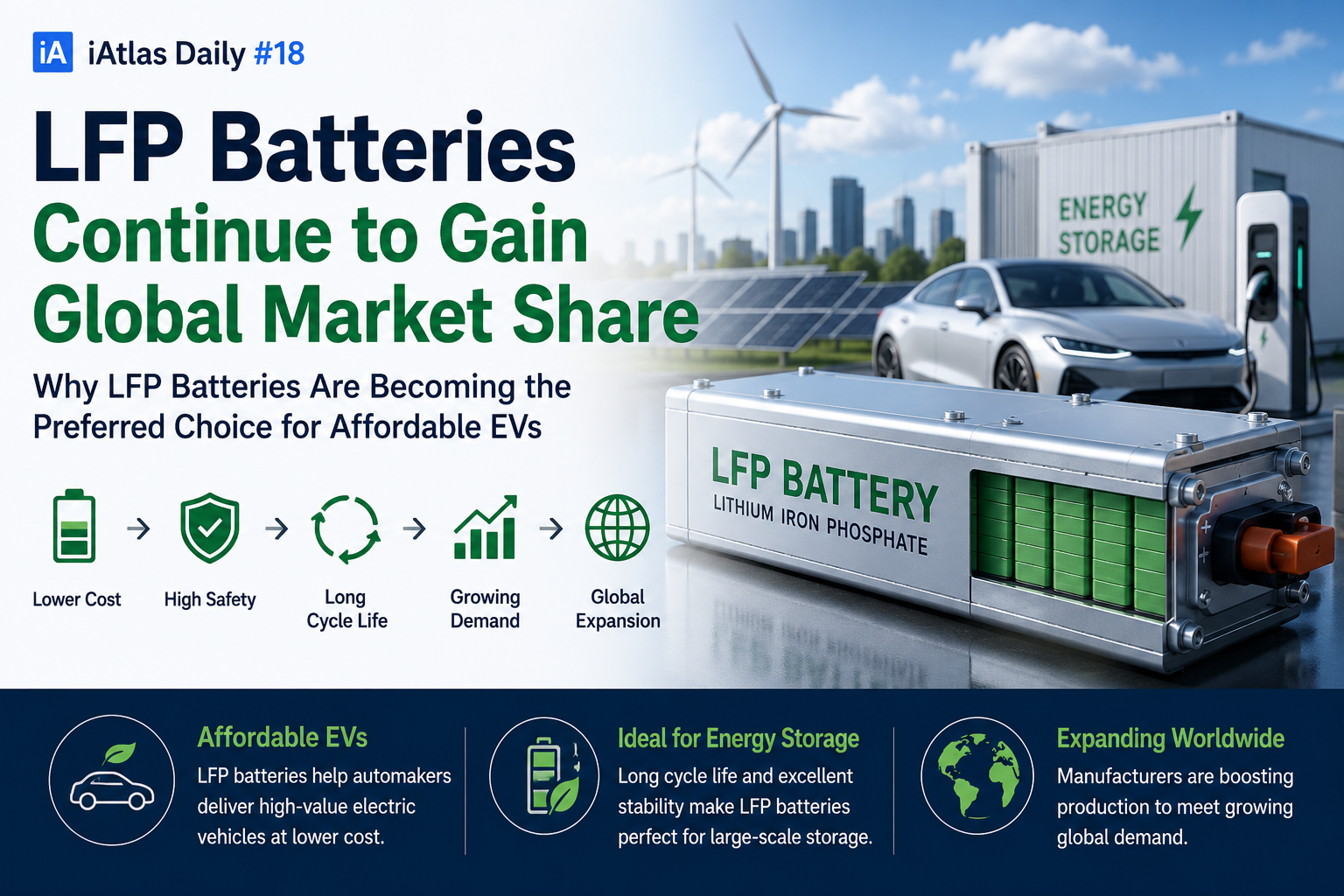
LFP Batteries Continue to Gain Global Market Share
Why LFP Batteries Are Becoming the Preferred Choice for Affordable EVs
📰 iAtlas Daily #18 | July 24, 2026
🔋 What Happened?
LFP battery technology continues to gain global market share as automakers and battery manufacturers expand its use in electric vehicles and energy storage systems.
Once viewed mainly as a low-cost battery option, LFP batteries have improved significantly in energy density, manufacturing efficiency, and charging performance. As a result, they are now being adopted in a wider range of EV models around the world.
Leading battery manufacturers such as CATL and BYD continue to increase LFP battery production to meet growing global demand.
💡 Why It Matters
As battery manufacturers work to reduce costs while maintaining safety and reliability, LFP batteries have become one of the most attractive battery chemistries available today.
Compared with nickel-rich batteries, LFP batteries offer several advantages:
- Lower production costs
- Excellent thermal stability
- Longer cycle life
- Reduced reliance on nickel and cobalt
- Strong suitability for energy storage systems
Although LFP batteries typically provide lower energy density than NMC batteries, continuous improvements are helping close the performance gap.
🌍 Industry Impact
Electric Vehicles
Affordable EVs are expected to remain one of the fastest-growing segments of the global electric vehicle market.
LFP batteries enable manufacturers to lower battery costs while delivering driving ranges that meet the needs of most everyday drivers.
Energy Storage Systems
The long lifespan and high level of safety offered by LFP batteries make them well suited for large-scale renewable energy storage projects.
Battery Supply Chain
Growing demand for LFP batteries is also changing the global supply chain, reducing dependence on nickel and cobalt while increasing demand for lithium, phosphate, and iron-based materials.
🔮 What’s Next?
LFP batteries are expected to remain the dominant battery chemistry for cost-sensitive EVs and stationary energy storage over the next several years.
At the same time, battery manufacturers continue to improve cell design, manufacturing efficiency, and fast-charging performance, allowing LFP batteries to expand into vehicle segments that were once dominated by higher-energy chemistries.
🎯 Atlas Insight
Rather than searching for a single “best” battery, the industry is increasingly selecting battery technologies based on specific applications.
While high-nickel batteries continue to serve premium long-range EVs, LFP batteries are becoming the preferred choice for affordable electric vehicles and large-scale energy storage.
The future battery market is likely to be driven by application-specific optimization, where different battery chemistries coexist to meet different performance and cost requirements.
📚 Related Articles
🔋 Battery #5 | What Is an LFP Battery?
Learn how LFP batteries work and why they have become one of the world’s fastest-growing battery chemistries.
🔋 Battery #7 | Battery Energy Density Explained
Understand how energy density influences EV driving range and why different battery chemistries offer different performance characteristics.
📰 iAtlas Daily #14 | LG Energy Solution Expands ESS Battery Production Beyond EVs
Explore why energy storage systems are becoming a major growth market for battery manufacturers.
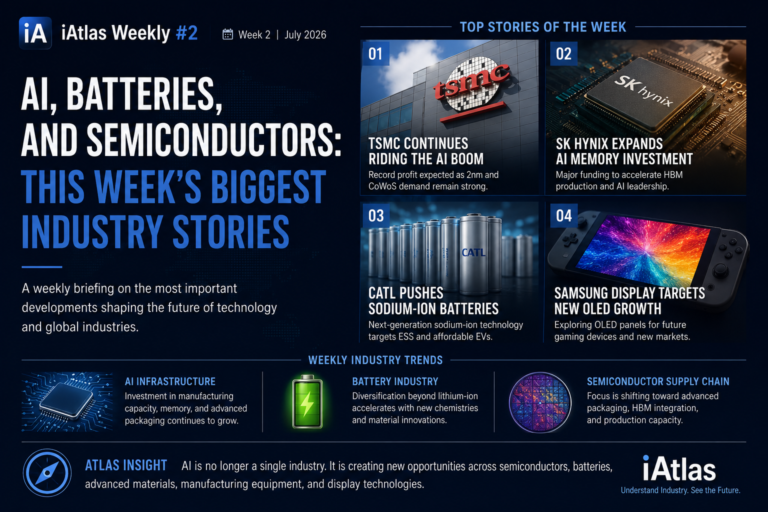
📊 iAtlas Weekly #2 | AI, Battery & Semiconductor Weekly News
Stay up to date with the week’s biggest developments across batteries, semiconductors, AI, and advanced manufacturing.
About iAtlas
iAtlas is an independent publication covering batteries, semiconductors, OLED, advanced materials, AI, and global industrial trends.
We transform complex industrial developments into clear, reliable, and easy-to-understand insights.
Whether you’re following today’s industry news or building long-term expertise, iAtlas helps you understand not only what happened, but why it matters.
Technology creates change.
Insight creates opportunity.
— iAtlas