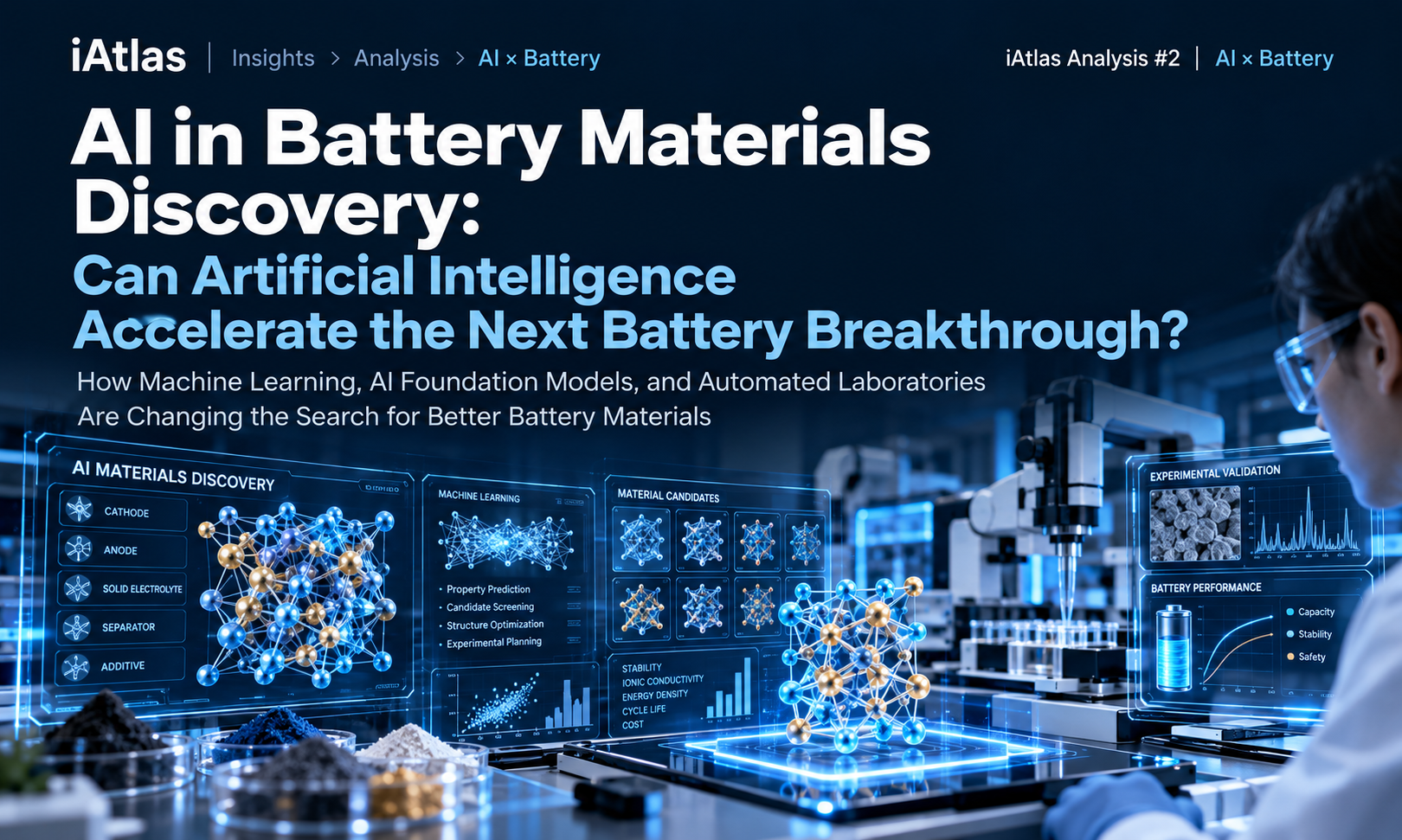
AI in Battery Materials Discovery: Can Artificial Intelligence Accelerate the Next Battery Breakthrough?
How Machine Learning, AI Foundation Models, and Automated Laboratories Are Changing the Search for Better Battery Materials
iAtlas Analysis #2 | AI × Battery
The next major battery breakthrough may begin long before a new battery cell is manufactured.
It may begin with an algorithm identifying a material that researchers have never tested.
For decades, battery development has depended on materials science, electrochemistry, laboratory experimentation, and the expertise of experienced researchers.
Scientists have continuously searched for better cathodes, anodes, electrolytes, and other materials capable of improving energy density, charging performance, safety, and battery lifetime.
But discovering a promising material is difficult.
The number of potential chemical compositions and structures is enormous, while testing each candidate requires time, equipment, and specialized expertise.
Artificial intelligence is changing how researchers navigate this complexity.
Instead of relying exclusively on trial-and-error experimentation, researchers can increasingly use machine learning to predict material properties, prioritize promising candidates, and guide laboratory investigations.
Recent research from Google DeepMind, Microsoft, Pacific Northwest National Laboratory, and Argonne National Laboratory illustrates how these approaches are advancing.
However, an essential distinction remains:
Discovering a promising material with AI is not the same as developing a commercially successful battery.
Understanding this difference is critical to evaluating the technological and industrial impact of AI-driven battery research.
1. Why Battery Materials Discovery Is So Difficult
A modern lithium-ion battery depends on several materials working together.
Its major components include:
- Cathode: Stores and releases lithium through electrochemical reactions.
- Anode: Accommodates lithium during charging.
- Electrolyte: Enables lithium-ion transport between electrodes.
- Separator: Prevents direct electrical contact between electrodes while allowing ionic transport.
Each component influences battery performance.
Changing the cathode may improve energy density but create challenges related to structural stability or cost.
Changing the anode may increase energy-storage capacity while introducing expansion, degradation, or cycle-life problems.
Developing a new electrolyte may improve ionic conductivity while creating new compatibility or interfacial challenges.
The difficulty is that these properties are interconnected.
Researchers must consider multiple objectives simultaneously:
Energy Density + Safety + Cycle Life + Charging Performance + Cost + Manufacturability
A material that performs exceptionally well in one category may be unsuitable in another.
For example, high ionic conductivity alone does not guarantee that a solid electrolyte will work successfully in a practical battery.
It must also satisfy requirements involving chemical stability, electrode compatibility, mechanical properties, and manufacturing feasibility.
This creates a complex optimization problem.
Traditional experimental methods remain essential, but exploring large numbers of material combinations exclusively through laboratory testing can become prohibitively expensive.
That is where AI can provide a new advantage.
2. How AI Changes the Materials Discovery Process
AI-supported materials discovery uses computational models to identify patterns in chemical structures, material properties, and experimental results.
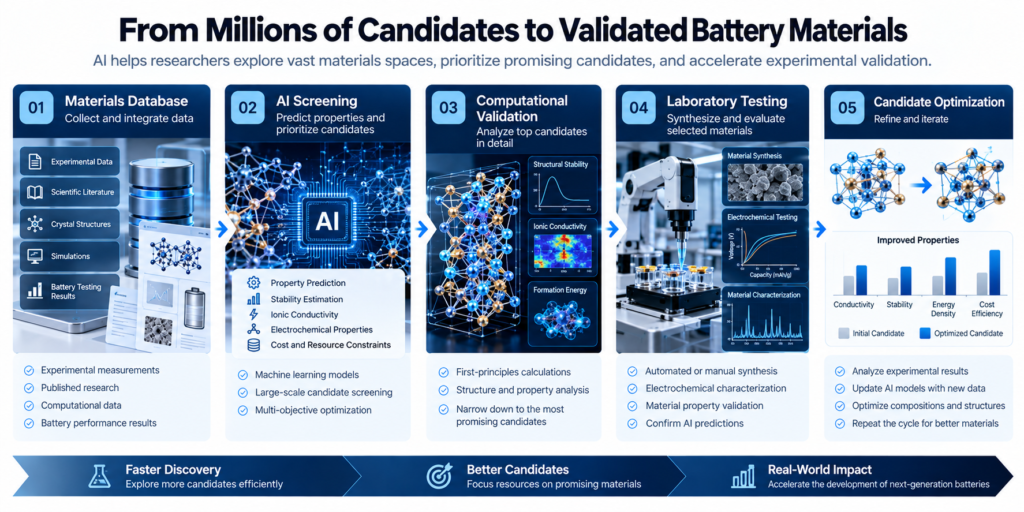
A simplified workflow is:
Materials Database → AI Prediction → Candidate Screening → Computational Validation → Laboratory Testing → Model Improvement
Each stage serves a different purpose.
Step 1: Collect Materials Data
Researchers begin with information from sources such as:
- Experimental measurements
- Published scientific literature
- Crystal-structure databases
- Molecular simulations
- Quantum-mechanical calculations
- Previous battery testing results
These datasets provide examples that models can learn from.
Step 2: Train Predictive Models
Machine learning algorithms analyze relationships between material structures and selected properties.
For example, a model may learn how atomic arrangements relate to material stability or ionic transport behavior.
The objective is to estimate relevant properties without performing every expensive calculation or experiment from the beginning.
Step 3: Screen Candidates
Researchers apply the trained models to large collections of potential materials.
Candidates can be filtered according to requirements such as:
- Predicted stability
- Ionic conductivity
- Electrochemical properties
- Elemental composition
- Cost or resource constraints
This helps researchers prioritize materials for further evaluation.
Step 4: Validate Predictions
The highest-ranked candidates undergo more rigorous computational analysis and laboratory investigation.
These tests determine whether the predicted behavior is sufficiently accurate and practically useful.
Step 5: Improve the Model
Experimental results can be incorporated into the training dataset.
The updated model can then support another round of screening.
This process is closely related to active learning, where new calculations or experiments are selected to improve the model efficiently.
The result is an iterative research system in which computation and experimentation reinforce one another.
3. Google DeepMind: Exploring Millions of New Crystal Structures
One of the most prominent demonstrations of AI-driven materials discovery came from Google DeepMind.
In November 2023, researchers introduced GNoME — Graph Networks for Materials Exploration.
The system uses graph neural networks to help predict the stability of inorganic crystal structures.
This matters because many advanced technologies, including batteries, depend on crystalline materials with suitable physical and chemical characteristics.
What Did GNoME Discover?
According to the research published in Nature, GNoME identified approximately:
- 2.2 million crystal structures predicted to be stable relative to previously known structures.
- 381,000 new structures on the updated computational stability boundary.
- 528 potential lithium-ion conductors highlighted by Google DeepMind.
The researchers also reported that 736 structures had independently been experimentally realized in concurrent work.
These findings substantially expanded the computational database of potentially stable inorganic materials.
However, the numbers require careful interpretation.
The millions of predicted structures were not millions of commercially usable battery materials.
They represented computational predictions across a much broader range of materials applications.
Only a subset may possess properties relevant to energy storage.
Even among those candidates, additional testing is necessary.
Why This Matters for Batteries
Solid-state batteries require materials that allow lithium ions to move efficiently while maintaining suitable chemical and electrochemical stability.
Identifying promising solid electrolytes can therefore involve evaluating many possible inorganic compositions and atomic structures.
AI models such as GNoME can help researchers explore more candidates before committing resources to experimental synthesis.
The potential benefit is not that AI instantly invents a complete battery.
It is that researchers can investigate a much larger materials space while focusing experimental resources on better-informed candidates.
The competitive advantage may come from searching more intelligently, not simply performing more experiments.
4. Microsoft and PNNL: From AI Screening to a Battery Prototype
Another important example emerged from collaboration between Microsoft and the U.S. Department of Energy’s Pacific Northwest National Laboratory (PNNL).
In January 2024, the organizations reported using AI-supported computational tools to identify a promising solid-state electrolyte material.
Their initial search involved more than 32 million material candidates.
AI-supported filtering and computational evaluation helped narrow the search to a much smaller set of promising options.
PNNL scientists subsequently synthesized and characterized a selected candidate.
The research included construction and testing of a proof-of-concept solid-state battery.
Why the Material Was Interesting
The selected material incorporated sodium alongside lithium.
According to Microsoft, the candidate electrolyte could reduce the lithium required in the electrolyte material compared with certain conventional alternatives.
The organizations also described the broader possibility of reducing dependence on critical raw materials.
However, such comparisons should not be interpreted as an established reduction in lithium requirements for commercial battery packs.
The discovery concerned an experimental material and prototype, not a market-ready cell technology.
The Importance of Experimental Validation
The most important aspect of this example may be the connection between computational discovery and physical experimentation.
The workflow moved from:
Large-Scale Candidate Screening → AI-Assisted Selection → Laboratory Synthesis → Material Characterization → Prototype Testing
This is a significant step beyond simply publishing lists of predicted materials.
It demonstrates how AI can guide researchers toward candidates that are subsequently investigated in real laboratories.
Nevertheless, prototype demonstration is only an early development milestone.
Before commercial adoption, a new solid electrolyte would require extensive evaluation of:
- Ionic conductivity under relevant conditions
- Interface resistance
- Long-term cycling stability
- Mechanical and chemical compatibility
- Manufacturing scalability
- Safety and cost
AI can narrow the search for better materials, but industrial qualification remains a separate challenge.
5. AI Foundation Models: A New Direction in Battery Research
Traditional machine learning models are often developed for relatively specific prediction tasks.
For example, one model may estimate material stability while another predicts a particular molecular property.
AI foundation models aim to learn broader representations from large collections of data.
These representations may then support multiple research tasks.
This approach has attracted increasing attention in materials science.
Argonne and the University of Michigan
In August 2025, Argonne National Laboratory described a University of Michigan-led research effort using powerful supercomputers to develop AI foundation models for battery materials discovery.
The work focuses on molecular and materials representations that could support more efficient prediction and design.
Argonne’s 2026 materials research program also includes a multimodal foundation-model project led by researchers associated with the University of Michigan.
The proposed approach combines different forms of materials information to develop a more unified representation of material behavior.
Potential applications extend across energy storage and other advanced technologies.
Why Multimodal Learning Matters
Battery researchers frequently work with very different types of data.
These may include:
- Molecular structures
- Crystal structures
- Spectroscopic measurements
- Simulation outputs
- Experimental performance data
- Scientific text
A model capable of learning from multiple data types may help researchers capture relationships that would otherwise remain separated across databases and research methods.
For instance, computational information about atomic arrangements could potentially be combined with measured electrochemical behavior.
The long-term objective is to make predictive models more flexible and broadly useful.
However, these projects represent active research directions.
Their ability to produce commercially meaningful battery materials must be assessed through subsequent experimental results.
6. Which Battery Materials Could Benefit Most?
AI-supported discovery can be applied to several important materials categories.
Cathode Materials
Cathode materials strongly influence energy density, operating voltage, stability, and raw-material requirements.
AI tools may help researchers investigate alternative crystal structures, compositions, and doping strategies.
Potential research objectives include:
- Reducing reliance on expensive elements
- Improving structural stability
- Enhancing electrochemical performance
- Identifying promising new compositions
Candidates still require experimental evaluation under realistic battery operating conditions.
Anode Materials
Graphite remains a major commercial anode material, while silicon-containing anodes are attracting considerable attention.
Silicon offers high theoretical lithium-storage capacity but faces challenges involving volume expansion, degradation, and interfacial stability.
AI methods may help researchers investigate material combinations, particle structures, protective coatings, and other design parameters.
The challenge is to identify solutions that balance storage capacity with durability and manufacturing compatibility.
For a broader discussion of the transition from advanced anode research toward industrial production, see our related iAtlas article:
Korea Is Betting ₩1.2 Trillion on Silicon Anodes
Liquid Electrolytes
Liquid electrolyte performance depends on interactions between solvents, lithium salts, additives, and electrodes.
These relationships can be complicated because electrolyte formulations contain multiple interacting chemicals.
Machine learning may help predict selected molecular properties and identify promising formulation combinations.
Researchers can investigate:
- Oxidation and reduction stability
- Solvation characteristics
- Ionic transport
- Electrolyte decomposition
- Interphase formation
AI-supported optimization could be especially useful when numerous formulation variables must be balanced.
Solid Electrolytes
Solid-state battery development has become an important application area for computational materials science.
Potential solid electrolytes include different ceramic, glassy, polymer, and composite materials.
Researchers must evaluate ionic conductivity alongside chemical, electrochemical, and mechanical requirements.
AI-assisted screening can help identify candidate structures and compositions.
But high predicted bulk ionic conductivity does not necessarily guarantee successful operation in a battery.
Interfaces, contact conditions, and long-term stability remain critical challenges.
7. Autonomous Laboratories: Connecting AI with Robotics
AI materials discovery becomes more powerful when predictions are connected directly to experimental equipment.
This concept is often described as a self-driving laboratory.
Instead of treating computational analysis and laboratory experimentation as completely separate activities, an autonomous research system can coordinate them.
A simplified workflow is:
AI Selects Experiment → Robotic System Performs Experiment → Measurement Data Collected → AI Updates Prediction → Next Experiment Selected
Human researchers still define research goals, establish constraints, maintain equipment, and interpret important outcomes.
The objective is not necessarily to remove scientists from the laboratory.
It is to reduce repetitive work and increase the efficiency of experimental learning.
Berkeley Lab’s A-Lab
Researchers at Lawrence Berkeley National Laboratory demonstrated an autonomous materials synthesis system known as A-Lab.
The system combines computational materials predictions, robotics, and automated decision-making.
In research published in 2023, the autonomous laboratory demonstrated the synthesis of more than 40 new inorganic materials.
A-Lab is a general inorganic materials research platform rather than a demonstration of mass-produced battery materials.
Nevertheless, it provides a useful example of how AI-generated predictions can connect with physical materials synthesis.
Why This Could Matter for Battery Development
Battery research frequently involves repeated preparation and testing of material samples.
These activities can include:
- Formulation preparation
- Powder processing
- Material synthesis
- Electrochemical characterization
- Data collection and interpretation
Automation may improve reproducibility and increase experimental throughput.
When integrated with AI, robotic laboratory systems could also help determine which experiments are most valuable to perform next.
This creates the possibility of more coordinated materials-development cycles.
However, not all battery experiments are easily automated.
Handling air-sensitive chemicals, controlling contamination, assembling specialized cells, and performing long-duration cycling tests can introduce substantial engineering challenges.
These requirements make laboratory integration an important part of the technology’s commercial potential.
8. Why Data Quality Matters More Than Model Size Alone
AI performance depends heavily on the information used to develop and validate models.
Battery materials research presents several significant data challenges.
Inconsistent Experimental Conditions
Different laboratories may test materials under different temperatures, pressures, electrolyte compositions, or measurement procedures.
Results generated under different conditions cannot always be compared directly.
Limited Negative Results
Scientific publications frequently emphasize successful experiments.
Failed experiments and unsuitable compositions may be reported less consistently.
Yet these results can be valuable for training models to distinguish promising candidates from poor ones.
Small Specialized Datasets
Some advanced battery chemistries have relatively limited experimental datasets.
This can make it difficult to train accurate models or evaluate their generalization.
Differences Between Simulation and Reality
Computational predictions often rely on simplified physical assumptions.
Actual battery operation involves complex interfaces, defects, degradation processes, and manufacturing-related variations.
A model that performs well on idealized material structures may therefore be less reliable in real electrochemical systems.
These challenges emphasize an important principle:
More training data is useful only when the data are sufficiently relevant, representative, and reliable.
9. From Material Discovery to Commercial Battery Production
The largest limitation of AI-driven materials discovery is not necessarily prediction capability.
It is the distance between identifying a promising material and producing a commercially viable battery.
A typical development pathway involves several stages.
AI Prediction → Laboratory Validation → Material Optimization → Cell Testing → Pilot Production → Customer Qualification → Commercial Manufacturing
Each stage introduces additional requirements.
Laboratory Validation
Researchers must confirm that the predicted properties are reproducible and meaningful.
Material Optimization
Promising materials may require improvements in purity, particle morphology, stability, synthesis methods, or composition.
Cell-Level Testing
Materials must function alongside other components in realistic electrochemical cells.
Manufacturing Compatibility
The material must be compatible with practical processing methods and equipment.
Customer Qualification
Battery manufacturers and end users require evidence of consistent performance, safety, quality, and reliability.
Economic Feasibility
Even an excellent material may fail commercially if production costs are too high or supply chains are impractical.
This is particularly important in the battery industry, where large-scale manufacturing requires substantial capital investment.
AI may accelerate the early discovery and optimization stages.
However, it does not eliminate the need for manufacturing engineering, durability testing, or industrial qualification.
10. The Business Implications: Who Benefits from AI Materials Discovery?
AI-driven materials research could influence several parts of the battery industry’s competitive landscape.
Battery Cell Manufacturers
Manufacturers may use AI-supported research to improve existing chemistries or investigate future material systems.
Potential advantages include faster candidate selection and improved coordination between materials research and cell engineering.
Advanced Materials Suppliers
Cathode, anode, and electrolyte suppliers may use AI to investigate new formulations and optimize material properties.
The ability to connect research results with manufacturing requirements could become particularly valuable.
Research Laboratories and Universities
AI-supported simulation and automated experimentation can expand the number of hypotheses researchers can investigate.
However, computational infrastructure and experimental capabilities remain important.
AI Software and Scientific Computing Providers
Companies developing materials databases, predictive models, simulation platforms, and research software may find new opportunities in battery R&D.
Laboratory Equipment and Automation Suppliers
Automated materials research requires reliable physical infrastructure.
Depending on the experimental application, this may include robotic handling, analytical instruments, automated synthesis systems, environmental controls, and data acquisition.
For moisture-sensitive or oxygen-sensitive materials, controlled-atmosphere processing may also be necessary.
As AI research becomes more closely connected to experimentation, the integration of software, laboratory equipment, and process controls could become an increasingly important engineering challenge.
This suggests that the economic opportunity is broader than AI model development alone.
11. What Will Determine the Winners?
The emergence of AI does not guarantee that the companies with the largest models will discover the best commercial battery materials.
Several capabilities will determine practical success.
First, proprietary experimental data may become a competitive resource.
Companies capable of generating consistent, high-quality materials datasets may have advantages in developing reliable prediction tools.
Second, electrochemical expertise remains essential.
AI can identify statistical relationships, but researchers must determine whether those relationships correspond to physically meaningful and practically useful behavior.
Third, experimental infrastructure matters.
Predictions create value when laboratories can synthesize, characterize, and evaluate candidates effectively.
Fourth, manufacturing experience can determine commercialization.
A new material must eventually work inside a scalable and economically competitive production process.
The strongest competitive position may therefore come from combining:
AI Capability + Materials Expertise + Experimental Validation + Manufacturing Know-How
Rather than replacing traditional research capabilities, AI may increase their value when they are effectively integrated.
12. Industry Outlook: From Faster Screening to Intelligent R&D
Several developments could shape the next phase of AI-supported battery research.
More Advanced Foundation Models
Larger and more flexible models may support different materials prediction and design tasks.
Their practical value will depend on validation, efficiency, and reliability.
Greater Integration of Physics and AI
Physics-informed and hybrid models may become increasingly important for understanding electrochemical behavior.
Combining domain knowledge with machine learning may improve robustness when data are limited.
Closed-Loop Experimentation
Laboratories may increasingly connect AI recommendations with automated synthesis and characterization systems.
Such systems could help accelerate research cycles, although integration remains technically demanding.
Research-to-Manufacturing Data Integration
A longer-term opportunity involves connecting material properties and laboratory results with pilot-scale manufacturing and cell performance data.
This could help researchers select materials based not only on theoretical performance, but also on practical production requirements.
Multi-Objective Material Optimization
Future AI tools may increasingly account for multiple constraints at once.
Rather than simply maximizing ionic conductivity or energy-storage capacity, researchers may seek combinations of performance, safety, cost, and manufacturability.
This shift would make AI-based discovery more relevant to commercial battery development.
Nevertheless, industrial adoption will depend on demonstrated results rather than the number of candidates predicted by computational models.
Conclusion: AI Is Changing How Battery Innovation Begins
Battery innovation has always depended on discovering and improving materials.
Artificial intelligence is introducing a new way to approach that challenge.
Large-scale predictive models can help researchers explore extensive chemical spaces, identify promising candidates, and prioritize experiments.
Work from Google DeepMind demonstrates the scale of computational materials exploration.
The Microsoft–PNNL collaboration illustrates how AI-supported screening can connect with physical battery experimentation.
Research at Argonne and the University of Michigan points toward increasingly capable foundation models for materials science.
Together, these developments suggest that battery research may become more data-driven, predictive, and experimentally integrated.
But the ultimate measure of success is not how many materials an AI system predicts.
It is whether those predictions lead to batteries that are safer, more durable, more affordable, and commercially manufacturable.
The next battery breakthrough may begin with an AI prediction. But it will become an industrial breakthrough only when materials science, experimentation, and manufacturing turn that prediction into reality.
Related Articles
Korea Is Betting ₩1.2 Trillion on Silicon Anodes
Explore why promising battery materials require much more than laboratory performance to achieve industrial-scale commercialization.
Battery Electrode Coating Explained
Understand how advanced electrode materials are processed into battery electrodes and why manufacturing consistency matters.
Explore the AI × Battery Series
Previous Article — iAtlas Analysis #1
How AI Is Transforming the Battery Industry: From Materials Discovery to Smart Manufacturing
An overview of how AI is reshaping the entire battery value chain.
Next Article — iAtlas Analysis #3
AI-Powered Battery Manufacturing: How Machine Learning Could Improve Yield, Quality, and Production Efficiency
A deeper examination of AI applications inside modern battery factories.
References & Further Reading
1. Google DeepMind — Millions of New Materials Discovered with Deep Learning (2023)
An overview of GNoME, including large-scale crystal structure prediction and potential lithium-ion conductor candidates.
2. Nature — Scaling Deep Learning for Materials Discovery (2023)
Primary research paper describing graph neural networks for inorganic crystal structure discovery.
3. Microsoft Azure Quantum — AI Screening for Battery Materials (2024)
An overview of the Microsoft–PNNL collaboration investigating AI-assisted discovery of a solid-state electrolyte candidate.
University of Michigan-led research using supercomputing resources to develop materials foundation models.
5. Argonne Leadership Computing Facility — Multimodal Foundation Models for Materials (2026)
Research program involving multimodal AI models for materials prediction and discovery.
Discussion of predicted materials and experimental synthesis using autonomous laboratory technology.
Review of computational and machine learning approaches for understanding solid electrolytes.
ℹ️ About iAtlas
iAtlas is an independent publication covering batteries, semiconductors, OLED, advanced materials, AI, and global industrial trends.
We transform complex industrial developments into clear, reliable, and easy-to-understand insights.
Whether you’re following today’s industry news or building long-term expertise, iAtlas helps you understand not only what happened, but why it matters.
Technology creates change.
Insight creates opportunity.
— iAtlas