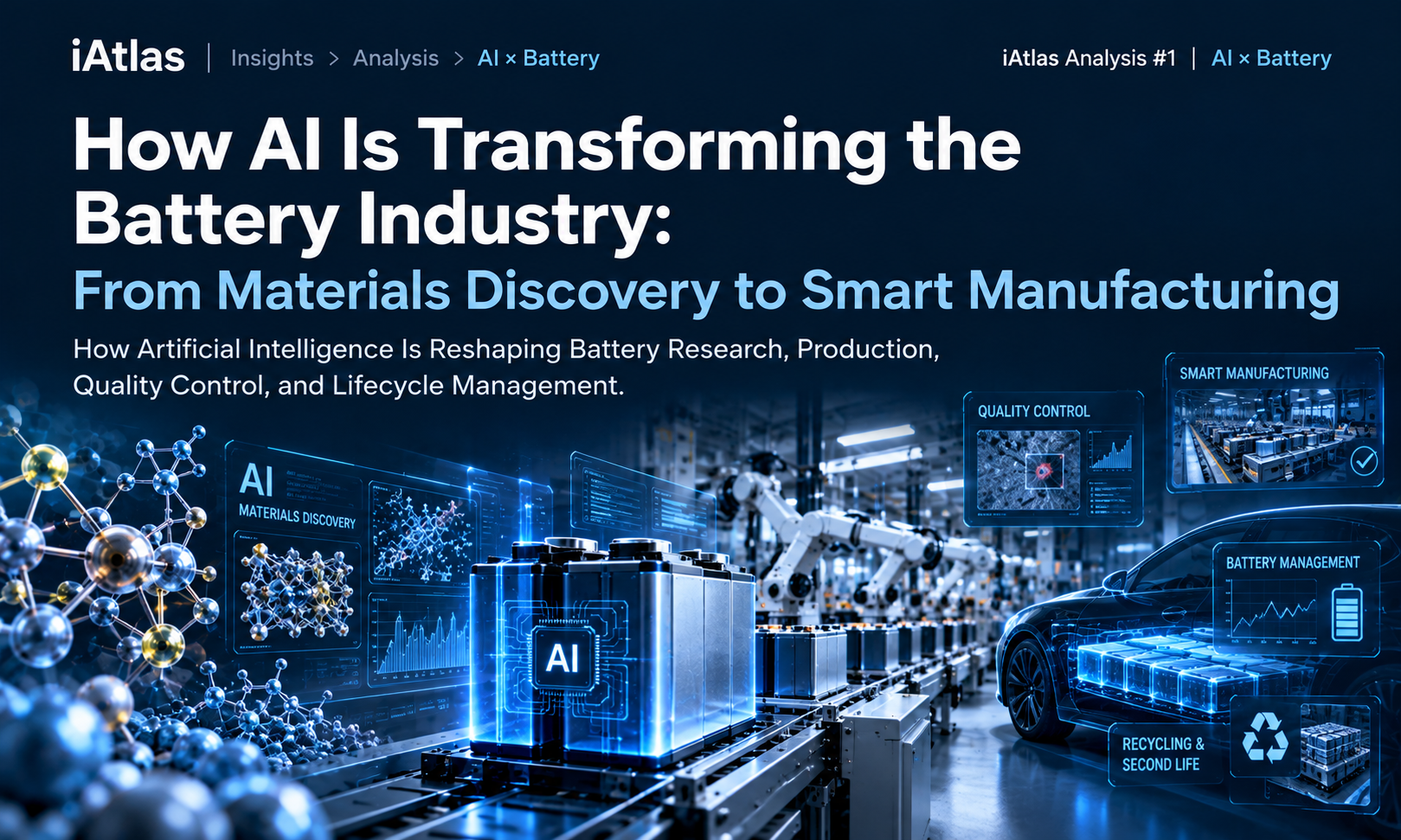
How AI Is Transforming the Battery Industry: From Materials Discovery to Smart Manufacturing
How Artificial Intelligence Is Reshaping Battery Research, Production, Quality Control, and Lifecycle Management
iAtlas Analysis #1 | AI × Battery

AI is transforming the battery industry by accelerating materials discovery, improving manufacturing efficiency, strengthening quality control, and enabling more intelligent battery management.
For decades, battery innovation has largely focused on developing better materials, improving energy density, extending battery life, and reducing manufacturing costs.
These priorities remain essential. However, another factor is increasingly influencing how batteries are developed and produced: the ability to turn complex data into faster and more reliable decisions.
From identifying promising electrode materials to detecting manufacturing defects and predicting battery degradation, AI is creating new opportunities across the battery value chain.
The implications extend beyond scientific research.
As battery production becomes more complex and capital-intensive, AI could influence not only how batteries perform, but also how efficiently manufacturers produce them and how successfully they compete.
1. Why the Battery Industry Is Turning to AI
Battery development presents a difficult combination of scientific, engineering, and economic challenges.
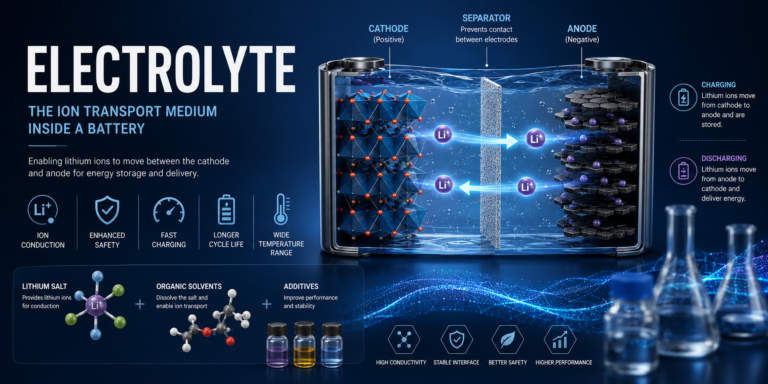
A battery cell contains multiple interacting components, including cathode materials, anode materials, electrolytes, and separators.
Changing one component can affect several performance characteristics at the same time.
For example, improving energy density may introduce challenges related to thermal stability, charging performance, or cycle life.
Manufacturing introduces another layer of complexity.
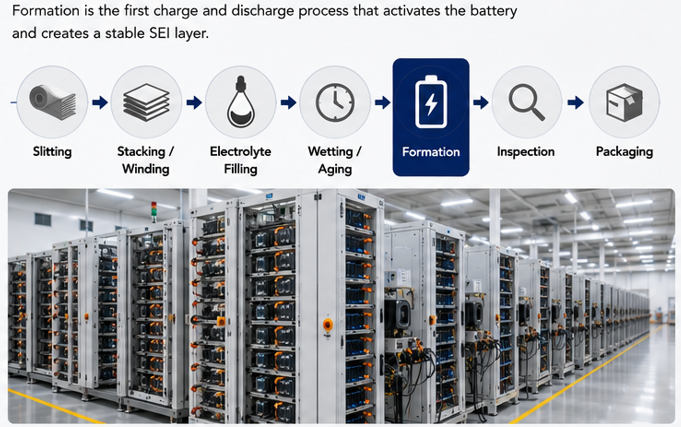
Battery production requires precise control over processes such as:
- Electrode mixing and coating
- Drying and calendering
- Electrode slitting and cell assembly
- Electrolyte filling and wetting
- Formation and aging
- Final inspection and testing
Variations across these stages can influence battery quality, performance, and manufacturing yield.
Traditional development approaches rely heavily on experimentation, process knowledge, and statistical analysis.
AI does not eliminate these methods. Instead, it offers additional tools for recognizing patterns, predicting outcomes, and identifying promising solutions within complex datasets.
The value of AI is particularly significant when relationships between process conditions, material properties, and battery performance are difficult to describe using simple mathematical models.
This creates opportunities across four major areas: research, manufacturing, quality management, and battery operation.

2. AI in Battery Materials Discovery
Developing new battery materials traditionally requires extensive experimentation.
Researchers must evaluate potential chemical compositions, synthesize materials, characterize their properties, and test their electrochemical performance.
This process can be expensive and time-consuming.
AI-supported materials discovery aims to improve the efficiency of this work.
Machine learning models can analyze existing experimental and computational data to identify relationships between material structures and performance characteristics.
These models can help researchers estimate properties such as:
- Ionic conductivity
- Electrochemical stability
- Material compatibility
- Potential energy-storage performance
- Selected thermal and physical properties
Instead of testing every possible candidate experimentally, researchers can use predictive models to prioritize materials with promising characteristics.
Research Example: AI Foundation Models for Battery Materials
Researchers from the University of Michigan, using computing resources at Argonne National Laboratory, have been developing large-scale AI foundation models for battery materials research.
Their work focuses on understanding molecular structures and predicting properties relevant to electrolytes and electrodes.
The broader objective is to explore large chemical search spaces more efficiently and identify candidates for further investigation.
This approach could support the development of advanced electrolytes, improved electrode materials, and future battery chemistries.
However, an important distinction remains.
AI can help identify promising materials, but experimental validation is still required to demonstrate whether those materials work in practical batteries.
A material that performs well in a computational model may still face limitations related to synthesis, stability, manufacturing compatibility, or cost.
AI therefore serves as a research accelerator rather than a replacement for electrochemical experimentation.
3. AI-Powered Battery Manufacturing
Materials innovation is only one part of the battery industry’s challenge.
A promising laboratory technology must eventually be produced consistently, safely, and economically at industrial scale.
This is where AI-supported manufacturing can become particularly valuable.
Battery gigafactories generate extensive production data through sensors, inspection systems, manufacturing equipment, and process-control software.
AI systems can analyze this information to identify patterns that may be difficult to recognize through conventional monitoring alone.
Process Optimization
Consider electrode coating.
The final quality of an electrode depends on factors such as slurry characteristics, coating conditions, drying profiles, and subsequent calendering operations.
Changes in these parameters can affect electrode uniformity and downstream cell performance.
AI models trained on sufficiently representative manufacturing data may help identify combinations of process settings associated with more consistent results.
Similar approaches can be investigated in drying, electrolyte filling, formation, and other manufacturing stages.
The objective is not simply to automate individual machines.
It is to understand relationships between processes and improve decisions across the production system.
Predictive Maintenance
Battery factories also depend on expensive equipment operating within tightly controlled conditions.
Unexpected failures can interrupt production, increase scrap, and create additional maintenance costs.
Predictive maintenance systems analyze equipment signals and operating trends to identify potential abnormalities before they develop into major failures.
When appropriately implemented, these systems can help manufacturers schedule maintenance more effectively and reduce avoidable downtime.
Manufacturing Economics
AI becomes commercially relevant when improvements can be translated into measurable operational benefits.
Potential benefits include:
- Higher production yield
- Lower scrap and rework
- Reduced energy consumption
- Better equipment utilization
- Faster troubleshooting
- More consistent product quality
However, these improvements are not automatic.
They depend on reliable sensor data, process understanding, integration with factory systems, and the ability to validate AI recommendations under real manufacturing conditions.
4. Digital Twins: Connecting Physical Production with Virtual Models
One of the most promising developments in advanced battery manufacturing is the integration of digital twins.
A digital twin is a virtual representation of a physical system that can be updated using operational data.
In battery manufacturing, digital twins may represent individual process steps, manufacturing equipment, production lines, or larger factory operations.
For example, a digital model of an electrode drying process could help engineers investigate how temperature, airflow, and operating speed influence drying behavior.
Combining these models with real production data may improve their predictive capabilities.
AI can contribute by identifying complex relationships, estimating difficult-to-measure conditions, and supporting optimization.
From Monitoring to Predictive Manufacturing
Traditional monitoring focuses primarily on observing current process conditions.
More advanced systems attempt to predict how process changes will affect future outcomes.
The progression can be understood as follows:
Process Monitoring → Data Analysis → Predictive Modeling → Optimization Recommendations → Validated Process Control
Not every digital twin incorporates AI, and not every AI model requires a digital twin.
Their combination, however, creates opportunities to connect process physics with data-driven analysis.
Fraunhofer researchers are developing digital methods for battery production, including process simulation, measurement technologies, and digital twin approaches.
These developments illustrate how virtual engineering tools are moving closer to practical manufacturing applications.
For battery producers, their importance lies in the possibility of improving process development and production stability without relying exclusively on repeated physical trial-and-error.
5. AI for Battery Quality Control
Quality control is one of the most commercially important areas for AI adoption.
Battery defects can originate at multiple production stages.
Examples include coating irregularities, electrode misalignment, contamination, welding imperfections, and deviations in cell assembly.
Some defects are visible through conventional inspection methods.
Others may require more sophisticated measurements or become apparent only during later testing.
AI-based quality systems can analyze images, sensor signals, and production histories to help identify abnormal patterns.
Automated Visual Inspection
Computer vision models can be trained to recognize relevant surface or assembly defects.
When paired with suitable cameras and measurement systems, these models can support automated inspection at industrial production speeds.
However, model performance depends on factors such as image quality, representative training data, and the ability to distinguish true defects from harmless variations.
Predictive Quality Analysis
A more advanced approach connects manufacturing data with downstream quality results.
For example, if particular process conditions are repeatedly associated with lower-performing cells, predictive models may help engineers identify elevated quality risks earlier.
This could reduce the amount of additional processing performed on products that are unlikely to meet specifications.
It could also help manufacturers investigate the underlying causes of defects.
The long-term opportunity is to move from identifying defective products after production toward preventing defects through earlier process intervention.
Nevertheless, safety-critical quality decisions require rigorous validation.
AI predictions should not be treated as a substitute for appropriate inspections, testing, and engineering judgment.
6. AI in Battery Management and Lifetime Prediction
AI applications continue after a battery leaves the factory.
Electric vehicles and stationary energy storage systems rely on battery management systems to monitor and manage battery operation.
Two important battery-management concepts are:
State of Charge (SOC): An estimate of the battery’s remaining charge relative to its usable capacity.
State of Health (SOH): An indication of battery condition relative to a defined reference or its original performance characteristics.
Estimating these values accurately can be challenging because battery behavior changes with temperature, operating conditions, aging, and usage history.
AI models can learn relationships between measured operating data and battery behavior.
They can contribute to estimating battery health, identifying degradation trends, and predicting remaining useful life.
Research Example: Faster Battery Health Diagnostics
In 2025, researchers at the National Renewable Energy Laboratory reported a physics-informed neural network approach for battery diagnostics.
By combining elements of physical battery modeling with neural network methods, the research demonstrated a substantial improvement in computational speed for predicting battery health compared with the conventional models used in its evaluation.
This illustrates an important direction in battery AI research: combining established electrochemical knowledge with machine learning rather than relying exclusively on black-box predictions.
Practical applications could include improved lifetime estimation, more informed maintenance planning, and better management of energy storage assets.
However, models must remain reliable across different battery chemistries, operating conditions, and aging patterns.
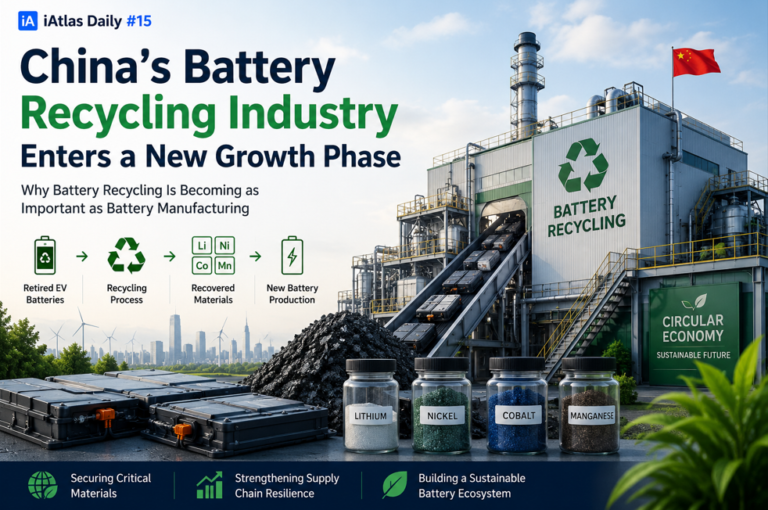
7. AI and the Battery Recycling Economy
Battery recycling and second-life applications create another potential role for AI.
As batteries reach the end of their first service life, their condition, chemistry, and remaining value need to be assessed.
This can be difficult because batteries may have different usage histories and degradation characteristics.
AI-supported diagnostic methods could help estimate battery condition and assist decisions about reuse, repurposing, or recycling.
In automated recycling systems, AI and machine vision may also support identification, sorting, and process monitoring.
Potential applications include:
- Battery identification and classification
- State-of-health assessment
- Second-life suitability evaluation
- Automated sorting support
- Recycling process optimization
These applications remain dependent on reliable identification methods, appropriate safety procedures, and the availability of relevant data.
The economic value of AI will depend on whether it can improve throughput, decision accuracy, material recovery economics, or operational safety in practical facilities.
8. Why AI Could Change Competition in the Battery Industry
The competitive structure of the battery industry has traditionally been shaped by materials expertise, manufacturing know-how, production capacity, customer qualification, and cost competitiveness.
These factors will remain important.
However, AI introduces an additional potential advantage: the ability to learn from data across research, manufacturing, and field operation.
A manufacturer with extensive production data may be able to identify quality patterns, improve process settings, or develop more accurate prediction models.
A research organization with high-quality experimental databases may be better positioned to train useful materials-discovery models.
A battery-management provider with representative operating data may develop more robust lifetime-prediction tools.
Yet access to large datasets alone does not guarantee leadership.
The real advantage comes from combining data quality, domain expertise, validated models, and the ability to implement improvements in commercial operations.
This suggests that future battery competition may increasingly involve three interconnected capabilities:
Electrochemical Expertise + Manufacturing Excellence + Data Intelligence
The strongest companies may be those capable of integrating all three rather than treating AI as a separate technology initiative.
9. The Challenges: Why AI Adoption Is Not Automatic
Despite its potential, the practical deployment of AI in battery applications faces significant obstacles.
Data Quality and Availability
Battery datasets can vary substantially in format, measurement conditions, cell chemistry, and testing procedures.
Poor-quality or inconsistent data can reduce model reliability.
Model Generalization
An AI model trained on one cell design, chemistry, production line, or operating environment may not perform equally well under different conditions.
Interpretability
Engineers need to understand whether predictions reflect meaningful physical relationships or misleading statistical correlations.
This becomes especially important for decisions affecting product quality and safety.
Industrial Integration
AI models must work alongside manufacturing execution systems, process controllers, inspection equipment, and established quality procedures.
Economic Justification
Manufacturers need to demonstrate that the benefits of AI exceed the costs of data infrastructure, software development, integration, and ongoing maintenance.
These challenges help explain why successful laboratory demonstrations do not always translate directly into commercially scalable solutions.
10. Industry Outlook: From AI Experiments to Data-Driven Battery Operations
The next stage of AI adoption in the battery industry is likely to depend less on isolated demonstrations and more on practical integration.
Several developments deserve particular attention.
First, research and experimentation may become more tightly connected. AI models could guide experimental priorities, while new test results continuously improve the underlying models.
Second, manufacturing data may become increasingly valuable. Companies that connect process histories with final cell performance will have more opportunities to identify the causes of quality variation.
Third, physics-informed AI may gain importance. Combining electrochemical principles with machine learning could improve prediction reliability, particularly when experimental data are limited.
Fourth, battery lifecycle data may become more integrated. Information from manufacturing, testing, operation, and end-of-life evaluation could support better decisions throughout a battery’s lifetime.
However, these developments should be viewed as an evolving industrial direction rather than a guarantee of rapid adoption across every factory or battery application.
The pace of progress will depend on data availability, technical maturity, safety requirements, and measurable investment returns.
Conclusion: The Next Battery Advantage May Be Intelligence
Artificial intelligence will not replace the fundamental importance of battery chemistry, materials science, or manufacturing engineering.
Instead, its greatest value may come from making those capabilities more effective.
AI can help researchers prioritize promising materials, support engineers in optimizing manufacturing processes, improve quality analysis, and provide new tools for understanding battery degradation.
As these technologies mature, battery manufacturers may increasingly compete not only on what they produce, but also on how effectively they learn from the data generated throughout the battery lifecycle.
The future of the battery industry will still depend on better batteries. But building those batteries more intelligently may become an increasingly important competitive advantage.
Related Articles
Battery Electrode Coating Explained
Understand how electrode coating works and why process consistency is critical to battery manufacturing quality.
Battery Cell Assembly Explained
Explore the precision manufacturing processes that transform electrodes and separators into complete battery cells.
Discover how the first charging process establishes battery characteristics and generates valuable quality-control data.
Learn how manufacturers evaluate cell stability and identify potential defects after formation.
References & Further Reading
1. Argonne National Laboratory — AI Foundation Models for Battery Materials
Research on AI foundation models designed to accelerate the discovery of new battery materials.
2. Fraunhofer IPA — Digitalization and AI in Battery Cell Manufacturing
Research covering digitalization, machine learning, production optimization, and AI integration in battery cell manufacturing.
3. Fraunhofer ITWM — Digital Twins in Battery Production
Research exploring the role of digital twins, process modeling, and simulation in battery manufacturing.
4. National Renewable Energy Laboratory — AI Models for Battery Diagnostics
Research on artificial intelligence and physics-informed approaches for improving battery health diagnostics.
5. npj Computational Materials — Machine Learning for Battery Science
Research addressing machine learning methods, battery materials, and applications of data-driven techniques in battery science.
6. eTransportation — A Roadmap for Trustworthy Battery AI
A review of the challenges and opportunities involved in developing reliable and practical battery AI applications.
ℹ️ About iAtlas
iAtlas is an independent publication covering batteries, semiconductors, OLED, advanced materials, AI, and global industrial trends.
We transform complex industrial developments into clear, reliable, and easy-to-understand insights.
Whether you’re following today’s industry news or building long-term expertise, iAtlas helps you understand not only what happened, but why it matters.
Technology creates change.
Insight creates opportunity.
— iAtlas