Battery Slurry Explained: The Foundation of Electrode Manufacturing
Understanding Electrode Slurry Composition, Properties, Rheology, and Its Role in Lithium-ion Battery Manufacturing
Category: Battery Technology
Content Type: Manufacturing
Learning Path: Battery Manufacturing
Related Industries: Electric Vehicles · Energy Storage Systems · Consumer Electronics
Last Updated: August 2026
Industry Snapshot
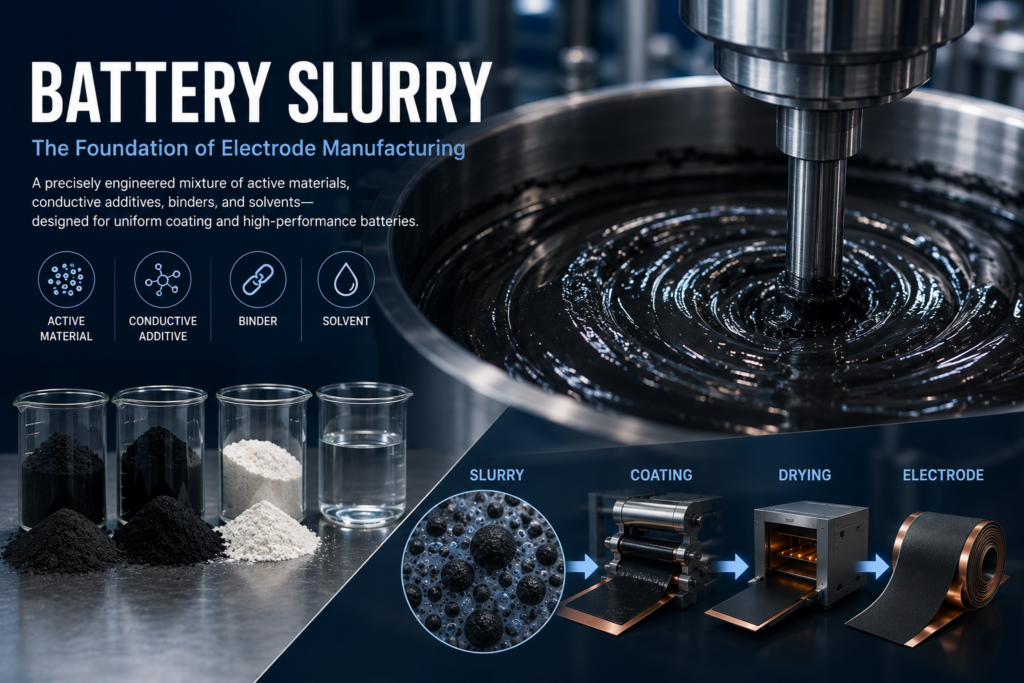
Battery slurry is the processable mixture used to manufacture the cathode and anode electrodes of a lithium-ion battery.
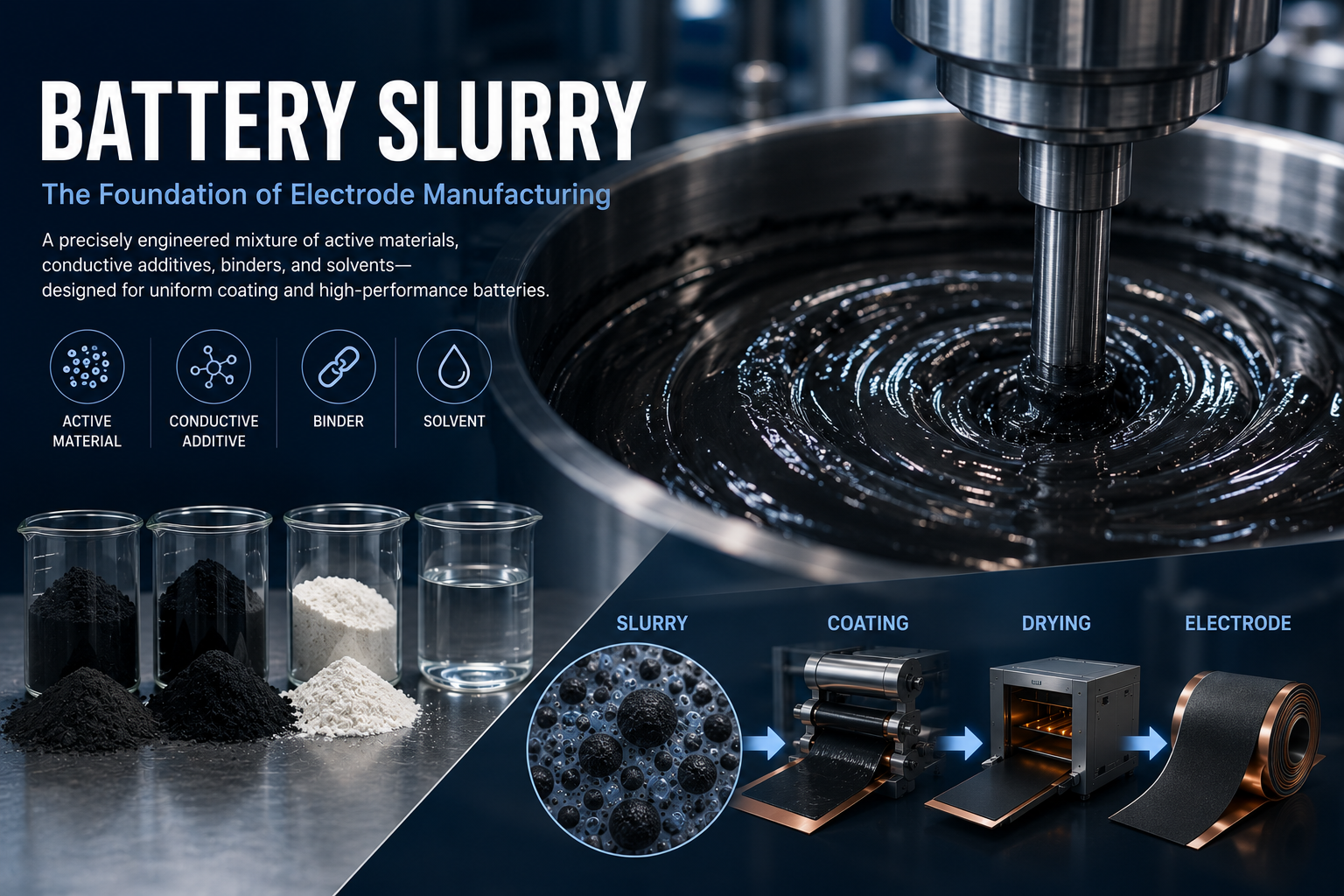
Before active battery materials can become an electrode, powders such as cathode or anode active materials are combined with conductive additives, binders, and a liquid medium. Through controlled mixing and dispersion, these ingredients form an electrode slurry.
The slurry is then delivered to the coating process, where it is applied onto a metallic current collector.
A well-prepared slurry must do more than simply contain the correct ingredients. It needs appropriate dispersion, viscosity, rheology, stability, and solid content to produce a uniform electrode coating.
Because of this, slurry characteristics can influence manufacturing quality several processes later.
At a Glance
| Category | Description |
|---|---|
| Definition | Processable mixture used to manufacture battery electrodes |
| Main Components | Active Material · Conductive Additive · Binder · Liquid Medium |
| Cathode Collector | Aluminum Foil |
| Anode Collector | Copper Foil |
| Key Properties | Viscosity · Rheology · Dispersion · Solid Content · Stability |
| Previous Process | Material Mixing |
| Next Process | Electrode Coating |
What Is Battery Slurry?
Battery slurry is the mixture applied to a current collector during lithium-ion battery electrode manufacturing.
A simplified slurry system can be represented as:
- Active Material
- Conductive Additive
- Binder
- Liquid Medium
↓
Mixing & Dispersion
↓
Electrode Slurry
↓
Electrode Coating
The slurry acts as the manufacturing medium that allows microscopic battery materials to be distributed across a large electrode surface.
After coating and drying, the liquid component is removed and the remaining solid materials form the functional electrode layer.
What Is Inside Battery Slurry?
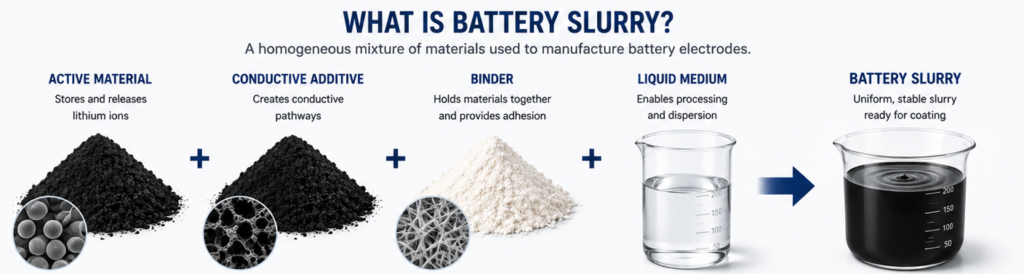
Each component performs a different role.
Active Material
The active material is responsible for storing and releasing lithium ions.
Examples include:
Cathode
- LFP
- NMC
- NCA
Anode
- Graphite
- Silicon-Graphite
Active material generally represents the majority of the solid material in the electrode.
Conductive Additive
Conductive additives create electronic pathways between active material particles and the current collector.
Typical materials include:
- Carbon Black
- Conductive Carbon
- Carbon Nanotubes (CNT)
Even though conductive additives usually represent a relatively small portion of the electrode formulation, their distribution can significantly influence electrical conductivity.
Binder
Binder provides mechanical integrity.
It helps:
- Hold particles together
- Maintain electrode structure
- Adhere the coating to the current collector
Typical binder systems include:
Cathode: PVDF
Anode: CMC + SBR
The binder system also influences slurry rheology and coating behavior.
Liquid Medium
A liquid medium allows the solid materials to be processed and coated.
A common cathode system uses:
NMP
while many graphite anodes use:
Water
The liquid is largely removed during the subsequent electrode drying process.
Cathode Slurry vs Anode Slurry
Cathode and anode slurries perform similar manufacturing functions but can have significantly different formulations.
| Cathode Slurry | Anode Slurry | |
| Active Material | LFP · NMC · NCA | Graphite · Silicon-Graphite |
| Conductive Additive | Carbon-based | Carbon-based |
| Common Binder | PVDF | CMC + SBR |
| Common Liquid Medium | NMP | Water |
| Current Collector | Aluminum | Copper |
| Final Product | Cathode Electrode | Anode Electrode |
These differences mean cathode and anode slurries can require different mixing, pumping, coating, and drying conditions.

Why Slurry Uniformity Matters
A battery electrode contains enormous numbers of microscopic particles.
For the electrode to perform consistently, these materials need to be distributed as uniformly as practical throughout the slurry.
Consider a poorly dispersed slurry.
Poor Dispersion -> Uneven Material Distribution -> Non-uniform Coating ->
Local Conductivity or Adhesion Differences -> Electrode Performance Variation
The slurry therefore plays an important role in translating a battery material formulation into a manufacturable electrode.
Dispersion and Agglomeration
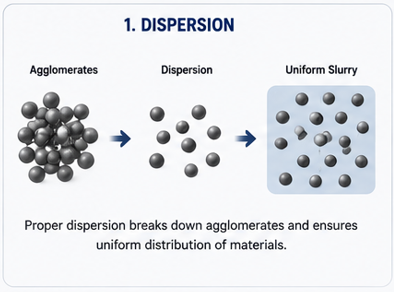
Fine battery powders naturally tend to form clusters called agglomerates.
If large agglomerates remain in the slurry, they can interfere with coating uniformity and electrode microstructure.
The mixing process therefore aims to break down excessive agglomeration and distribute the materials more evenly.
A simplified process is:
Powder Agglomerates -> Wetting -> Shear & Dispersion -> Deagglomeration
-> Uniform Slurry
The objective is not necessarily to break every particle apart, but to achieve the dispersion state required by the electrode formulation and coating process.
What Is Slurry Viscosity?
Viscosity describes resistance to flow.
A simple comparison is:
Water → Low Viscosity
Honey → Higher Viscosity
Battery slurry must have a viscosity range suitable for the manufacturing process.
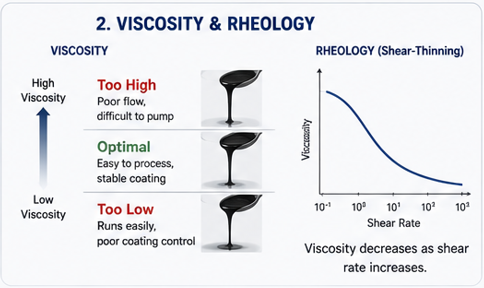
If viscosity is too low
The slurry may:
- Flow excessively
- Become difficult to control during coating
- Show poor coating stability
If viscosity is too high
The slurry may:
- Become difficult to pump
- Require higher processing force
- Coat unevenly
- Create process instability
The target viscosity therefore depends on the slurry formulation and coating technology.
What Is Slurry Rheology?
Viscosity alone does not fully describe battery slurry behavior.
Battery slurry is typically a complex suspension whose flow characteristics can change depending on the applied force.
This behavior is studied through rheology.
Many electrode slurries exhibit shear-thinning behavior.
This means:
Low Shear
→ Higher apparent viscosity
Higher Shear
→ Lower apparent viscosity
This behavior can be useful during manufacturing because slurry must remain stable during storage while also flowing effectively through pumps and coating equipment.
Why Rheology Matters During Coating
A slurry experiences different conditions as it moves through production equipment.
Mixing Tank -> Transfer Line -> Pump -> Filter -> Coating Head -> Current Collector
Each stage can expose the slurry to different shear conditions.
A slurry that performs well inside the mixing vessel may not necessarily behave the same way inside the coating head.
This is why slurry rheology and coating performance must be considered together.
Solid Content
Solid content describes how much of the slurry consists of solid electrode materials relative to the liquid phase.
The solids include:
- Active Material
- Conductive Additive
- Binder components
Increasing solid content can reduce the amount of liquid that must later be removed during drying.
However, higher solid content can also increase viscosity and make mixing or coating more difficult.
Manufacturers therefore need to balance:
Processability ↔ Drying Requirement ↔ Electrode Quality
Slurry Stability
After mixing, the slurry may not always be coated immediately.
It may be temporarily stored or transported through the production system.
During this period, the slurry should remain sufficiently stable.
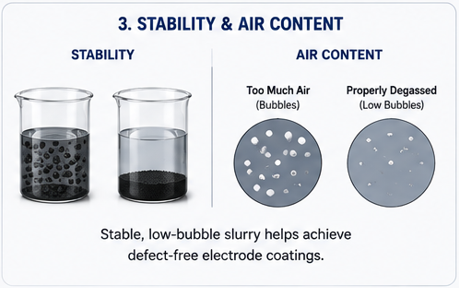
Potential instability includes:
- Sedimentation
- Particle separation
- Agglomeration
- Viscosity change
- Binder redistribution
If the slurry changes significantly before coating, electrode quality can become inconsistent.
Air Bubbles and Degassing
Air can enter the slurry during material loading and mixing.
If bubbles remain in the slurry, they can interfere with coating and potentially create surface defects.
For this reason, slurry preparation may include:
Vacuum Mixing
or
Vacuum Degassing
to reduce entrapped gases.
The objective is to deliver a stable and relatively bubble-free slurry to the coating process.
Slurry Quality Control
Before coating, manufacturers can evaluate several slurry characteristics.
| Parameter | Purpose |
| Viscosity | Evaluate flow characteristics |
| Solid Content | Confirm material concentration |
| Density | Monitor slurry consistency |
| Particle Dispersion | Identify agglomeration |
| Rheology | Understand flow under different shear conditions |
| Temperature | Maintain consistent processing conditions |
| Stability | Identify settling or separation |
| Bubble Content | Reduce coating defects |
Quality control helps ensure that slurry entering the coating process remains within the required production window.
From Slurry to Electrode Coating
Once the slurry meets manufacturing specifications, it moves to the coating process.
For the cathode:
Cathode Slurry -> Coating -> Aluminum Current Collector
For the anode:
Anode Slurry -> Coating -> Copper Current Collector
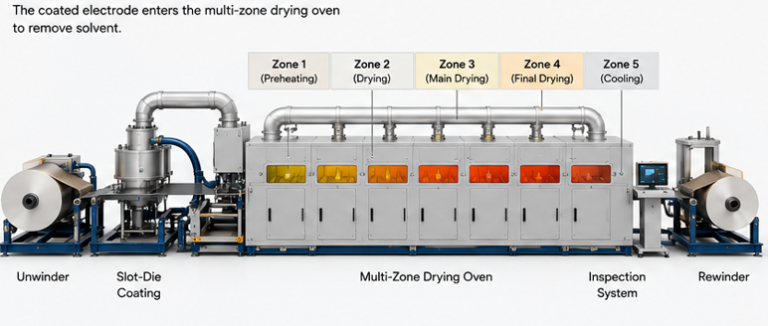
The wet electrode then proceeds to drying, where most of the liquid medium is removed.
This means slurry quality directly affects the starting condition of the coated electrode.
Common Slurry Problems
Several issues can affect electrode manufacturing.
Agglomeration
Large particle clusters remain in the slurry.
Sedimentation
Solid particles settle over time.
Air Entrapment
Bubbles remain inside the slurry.
Incorrect Viscosity
Flow characteristics move outside the desired process window.
Poor Dispersion
Conductive additives, binder, or active materials are distributed unevenly.
Batch Variation
Different slurry batches exhibit different characteristics.
Any of these issues can contribute to downstream coating variation.
Slurry and Electrode Quality
Slurry properties can influence several characteristics of the finished electrode.
These include:
- Coating thickness uniformity
- Surface quality
- Material distribution
- Adhesion
- Porosity after downstream processing
- Electrical conductivity
- Cell-to-cell consistency
For this reason, slurry engineering is closely connected to overall electrode engineering.
Emerging Slurry Technologies
Battery manufacturing is evolving beyond traditional batch slurry processing.
Continuous Mixing
Instead of producing one large batch at a time, materials can be continuously fed into a mixing system.
Potential advantages include:
- Continuous production
- Smaller equipment footprint
- Reduced processing time
- Improved production integration
Higher-Solid Slurry
Increasing solid content can potentially reduce drying requirements, although processing becomes more challenging.
Water-Based Processing
Manufacturers and researchers continue to explore water-based processing to reduce reliance on certain organic solvents.
Dry Electrode Processing
Dry electrode technology goes one step further by attempting to manufacture electrodes with little or no conventional liquid slurry process.
This could significantly change future electrode manufacturing.
Atlas Insight
Slurry sits at an important intersection between battery chemistry and manufacturing engineering.
A new cathode or anode material cannot succeed commercially based only on its electrochemical performance.
It must also be manufacturable.
That means the material needs to be mixed, dispersed, transported, coated, dried, compressed, and processed consistently at industrial scale.
As battery chemistry becomes more advanced, slurry engineering becomes increasingly important.
High-nickel cathodes, silicon-rich anodes, new binders, conductive networks, and higher-solid formulations can all change slurry behavior.
For this reason, future battery development will increasingly require battery scientists and manufacturing engineers to optimize materials and processes together.
Did You Know?
- Battery slurry is a suspension containing multiple solid and liquid components.
- Cathode and anode slurries often use different binder and liquid systems.
- Slurry viscosity can change depending on shear conditions.
- Poor dispersion can create problems several manufacturing steps later.
- Higher solid content may reduce drying demand but can make processing more difficult.
- Dry electrode technology could eliminate much of the conventional slurry process.
FAQ
What is battery slurry?
Battery slurry is a processable mixture of active material, conductive additives, binder, and a liquid medium used to manufacture battery electrodes.
Is battery slurry the same as electrolyte?
No. Battery slurry is used during electrode manufacturing and most of its liquid component is removed during drying. Electrolyte is later introduced into the assembled battery cell and remains part of the operating cell.
What is the difference between cathode and anode slurry?
They contain different active materials and commonly use different binder and liquid systems. Cathode slurry often uses PVDF and NMP, while graphite anode slurry commonly uses CMC, SBR, and water.
Why is slurry viscosity important?
Viscosity influences pumping, transport, and coating behavior.
What is slurry rheology?
Rheology describes how the slurry flows and deforms under different conditions, including different shear rates.
Why are bubbles removed from battery slurry?
Entrapped air can interfere with coating uniformity and contribute to electrode defects.
What happens after slurry preparation?
The slurry is transferred to the electrode coating process and applied onto a metallic current collector.
Battery Manufacturing Learning Path
Overview
Part 1 — Electrode Manufacturing
- Material Mixing
- Slurry (Current)
- Electrode Coating
- Electrode Drying
- Calendering
- Slitting
Part 2 — Cell Assembly
- Battery Cell Assembly
- Notching
- Winding
- Stacking
- Electrolyte Filling
- Cell Sealing
Part 3 — Cell Finishing
- Formation
- Aging
- Degassing
- Battery Cell Testing & Grading
Part 4 — System Assembly
- Battery Module Assembly
- Battery Pack Assembly
Explore More
Fundamentals
- Battery
- Lithium-ion Battery
- Battery Cell
- Battery Module
- Battery Pack
- Battery Management System(BMS)
- Battery Thermal Management System(BTMS)
- Battery Safety
Materials
Manufacturing
- Battery Manufacturing Process
- Material Mixing
- Slurry (Current)
- Electrode Coating
- Calendering
- Slitting
- Cell Assembly
- Formation
Technologies
- Dry Electrode Technology
- Fast Charging
- Solid-state Battery
References
Recommended primary sources for this article:
- Energy Advances — Battery electrode slurry rheology and its impact on manufacturing
- Journal of Energy Storage — Electrode manufacturing for lithium-ion batteries: Analysis of current and next generation processing
- Journal of Energy Chemistry — Revisiting the electrode manufacturing: A look into electrode rheology and active material microenvironment
- Journal of Power Sources — Complex rheological response of Li-ion battery anode slurries
About iAtlas
iAtlas is an independent publication covering batteries, semiconductors, OLED, advanced materials, AI, and global industrial trends.
We transform complex industrial developments into clear, reliable, and easy-to-understand insights.
Whether you’re following today’s industry news or building long-term expertise, iAtlas helps you understand not only what happened, but why it matters.
Technology creates change.
Insight creates opportunity.
— iAtlas