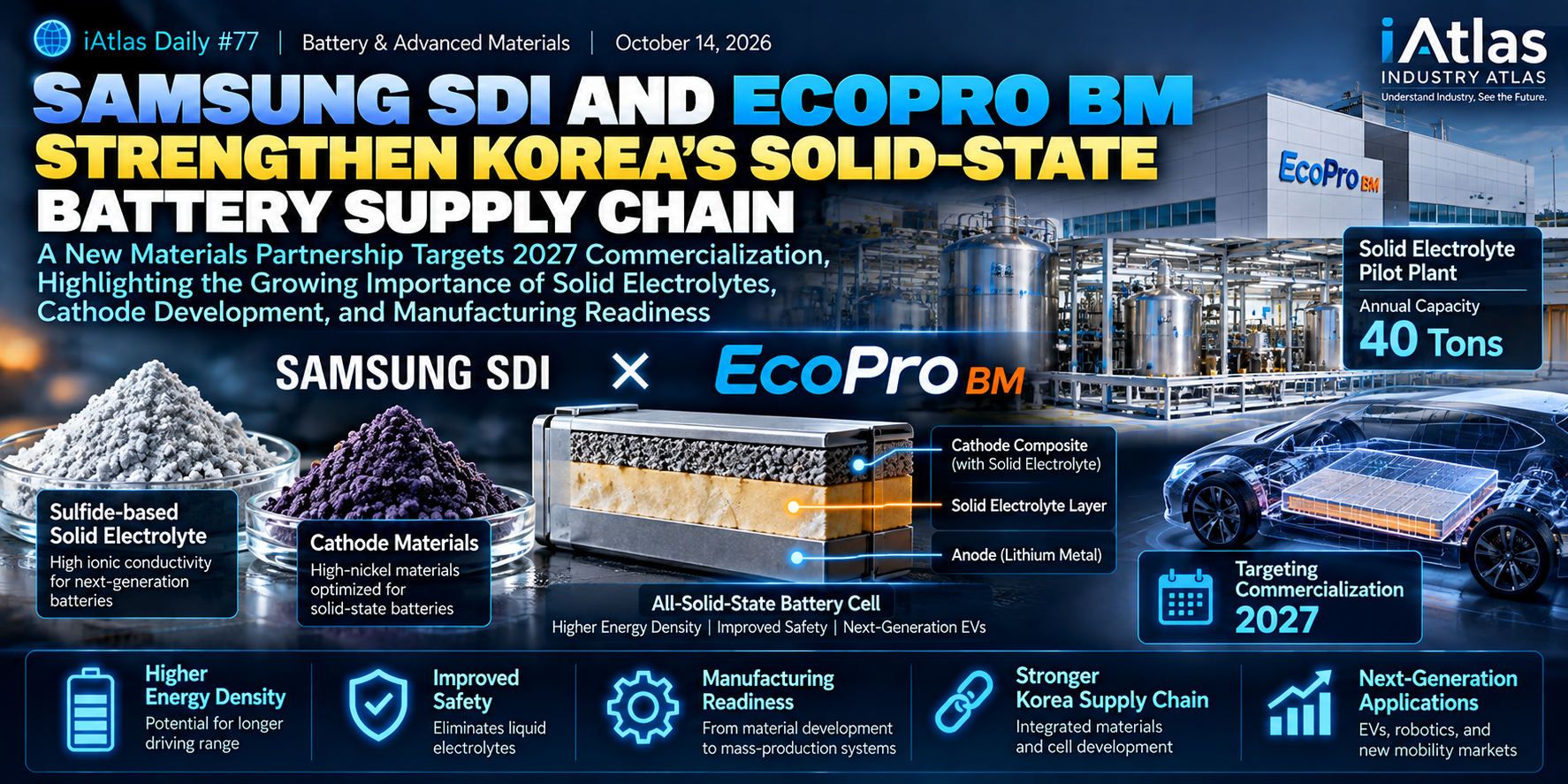
Samsung SDI and EcoPro BM Strengthen Korea’s Solid-State Battery Supply Chain
A New Materials Partnership Targets 2027 Commercialization, Highlighting the Growing Importance of Solid Electrolytes, Cathode Development, and Manufacturing Readiness
iAtlas Daily #77 | Battery & Advanced Materials | October 14, 2026
The Big Story
The Samsung SDI EcoPro BM partnership marks another step toward building a domestic supply chain for all-solid-state batteries, as the two South Korean companies strengthen cooperation on cathode materials and sulfide-based solid electrolytes.
On October 6, 2026, EcoPro BM announced that it had signed a memorandum of understanding (MOU) with Samsung SDI to jointly develop materials for next-generation solid-state batteries.
The companies aim to support the commercialization of sulfide-based all-solid-state batteries in 2027.
Under the agreement, Samsung SDI will focus on battery cell development and manufacturing technology, while EcoPro BM will develop key materials, including solid electrolytes and cathode materials.
The partnership covers more than early-stage research. It also includes quality evaluation and preparation for mass-production systems.
However, the agreement does not establish a confirmed commercial supply volume or guarantee that large-scale production will begin in 2027.
Its significance lies in bringing material development and cell manufacturing closer together.
The next major challenge for solid-state batteries is not simply proving that the technology works. It is building a manufacturing system capable of producing it reliably and economically.
1. What the Samsung SDI EcoPro BM Agreement Covers
The cooperation focuses on materials that are essential to the performance and manufacturability of sulfide-based solid-state batteries.
| Area | Cooperation |
|---|---|
| Battery cell development | Samsung SDI |
| Cell manufacturing technology | Samsung SDI |
| Solid electrolyte development | EcoPro BM |
| Solid-state cathode materials | EcoPro BM |
| Quality evaluation | Joint cooperation |
| Mass-production readiness | Joint cooperation |
| Commercialization target | 2027 |
The scope includes cathode active materials, solid electrolytes used within cathode structures, and electrolyte materials used in the separator layer.
These components must function together to deliver acceptable energy density, cycle life, safety, and manufacturing yield.
The partnership therefore reflects a move toward coordinated development across the battery value chain.
For solid-state batteries, the relationship between materials and cell architecture is particularly important.
2. Why Solid Electrolytes Are So Important
Conventional lithium-ion batteries generally use liquid electrolytes to transport lithium ions between the electrodes.
All-solid-state batteries replace the liquid electrolyte with a solid ion-conducting material.
Several solid-electrolyte technologies are being developed, including sulfide-based, oxide-based, and polymer-based systems.
Samsung SDI and EcoPro BM are focusing their cooperation on sulfide-based technology.
Sulfide solid electrolytes are attractive because some compositions offer high lithium-ion conductivity and can form close contact with electrode materials under suitable processing conditions.
However, they also introduce significant manufacturing challenges.
These include:
- Sensitivity to moisture
- Potential hydrogen sulfide generation when certain sulfide materials react with water
- Interfacial instability between electrodes and electrolytes
- Mechanical contact degradation during cycling
- Powder-processing and densification requirements
- Manufacturing cost and scalability
These challenges demonstrate why a commercially successful solid-state battery requires more than a high-performance electrolyte formulation.
It also requires consistent material quality and a carefully controlled manufacturing environment.
3. EcoPro BM’s 40-Ton Pilot Plant
One of the most important details in the announcement is EcoPro BM’s existing solid-electrolyte production capability.
The company reports that it operates a sulfide-based solid-electrolyte pilot plant with an annual capacity of approximately 40 metric tons.
This facility supports the development of manufacturing processes and material quality-control capabilities.
Pilot production is a critical step between laboratory research and full commercial manufacturing.
At the laboratory stage, researchers may produce small quantities of electrolyte powder under tightly controlled conditions.
Commercial production requires those properties to remain consistent across substantially larger batches.
Important parameters can include particle-size distribution, chemical composition, ionic conductivity, impurity levels, and moisture exposure.
A pilot plant allows manufacturers to study whether their processes can deliver repeatable results as production volumes increase.
However, a 40-ton annual pilot capacity should not be confused with confirmed commercial-scale output.
Actual production, utilization, customer qualification, and future capacity expansion are separate considerations.
4. Why Cathode Materials Must Evolve Together
Solid-state battery development is not limited to replacing a liquid electrolyte.
Cathode materials and electrode structures must also be compatible with the new electrolyte system.
EcoPro BM brings experience in high-nickel cathode materials, an area where Korean suppliers have developed significant manufacturing expertise.
But materials designed for conventional lithium-ion batteries cannot automatically be transferred into solid-state cells without additional development.
Solid-state cathodes require attention to several factors.
Electrochemical compatibility
The cathode and solid electrolyte must maintain stable interfaces during charging and discharging.
Ionic transport
Lithium ions must move efficiently through the composite cathode structure.
Mechanical stability
Volume changes during battery cycling can affect contact between solid particles.
Manufacturing consistency
Material composition, particle characteristics, and processing conditions must remain tightly controlled.
By coordinating cathode and electrolyte development, Samsung SDI and EcoPro BM may be able to address these issues earlier in the manufacturing development process.
This is one reason why cooperation between battery-cell manufacturers and materials suppliers is becoming increasingly important.
5. Why 2027 Matters — and What It Does Not Mean
The companies have identified 2027 as their commercialization target.
This provides a timeline for their development efforts, but it should not be interpreted as a guarantee of high-volume commercial production.
Several stages typically separate pilot development from widespread market adoption.
| Development Stage | Key Objective |
|---|---|
| Material research | Establish suitable electrochemical properties |
| Pilot production | Demonstrate repeatable material manufacturing |
| Prototype cells | Validate performance and safety |
| Customer qualification | Confirm application-specific requirements |
| Production preparation | Establish equipment and quality systems |
| Commercial production | Manufacture qualified products economically |
A manufacturer may achieve initial commercial production before reaching the scale required for mass-market electric vehicles.
Production economics, qualification timelines, and customer demand will influence the pace of expansion.
EcoPro BM has indicated that its earliest potential mass-production timing is 2027 and that it is preparing its manufacturing plans in line with customer demand.
The important question is therefore not only whether production begins in 2027.
It is whether the companies can demonstrate a repeatable and economically viable manufacturing process.
6. What This Means for Battery Manufacturing Equipment
Solid-state batteries could create new requirements for battery manufacturing equipment.
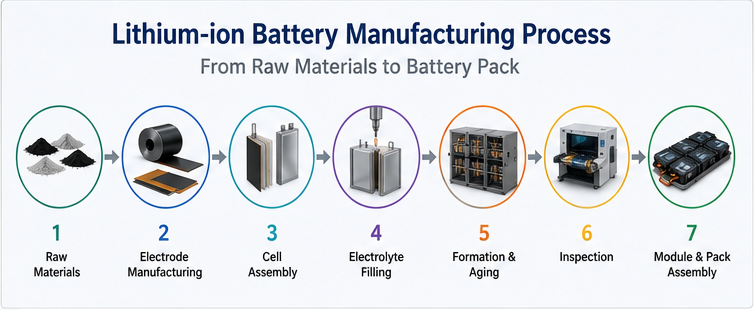
Conventional lithium-ion battery production relies on established processes such as electrode coating, drying, calendaring, assembly, electrolyte filling, formation, and testing.
Solid-state batteries may change some of these requirements depending on the cell design and electrolyte chemistry.
For sulfide-based systems, potential areas of importance include:
| Equipment or Process | Manufacturing Relevance |
|---|---|
| Powder synthesis and processing | Consistent solid-electrolyte properties |
| Mixing and dispersion | Uniform distribution of active materials and electrolytes |
| Dry-room and inert-atmosphere systems | Moisture exposure control |
| Pressing and densification | Improved particle contact and layer integrity |
| Electrode and separator fabrication | Controlled layer thickness and uniformity |
| Inspection and metrology | Detection of defects and material inconsistencies |
| Cell testing | Performance, safety, and cycle-life qualification |
The exact equipment requirements will depend on the production process adopted by each manufacturer.
Not every solid-state battery will require an identical manufacturing line.
Nevertheless, the development of sulfide-based batteries could increase demand for specialized materials-processing equipment and environmental-control technologies.
This may create opportunities for equipment suppliers involved in powder handling, process automation, atmosphere control, and quality inspection.
These are potential industry implications, not confirmed equipment purchases resulting from the MOU.
7. Why Korea Is Building a Solid-State Battery Ecosystem
Korea already has an established lithium-ion battery supply chain involving cell manufacturers, cathode suppliers, equipment companies, and materials developers.
Solid-state batteries create an opportunity to extend this industrial base into new technologies.
However, they also require additional capabilities.
High-performance materials must be produced consistently.
Battery-cell manufacturers must develop compatible architectures.
Equipment suppliers must support new processes.
And customers must validate the resulting products.
The Samsung SDI EcoPro BM partnership illustrates how these activities are becoming more interconnected.
Rather than developing every technology independently, companies are coordinating material and manufacturing development earlier.
This approach could reduce integration risks and support faster qualification.
But commercial success will ultimately depend on technical performance, cost, reliability, and the ability to manufacture at scale.
Industry Impact
The agreement has implications across the battery value chain.
Battery manufacturers: Closer cooperation with materials suppliers may improve development efficiency and support manufacturing qualification.
Cathode-material suppliers: Solid-state batteries create opportunities to develop specialized materials beyond conventional liquid-electrolyte systems.
Solid-electrolyte producers: Pilot-scale production and quality control will become important differentiators.
Equipment manufacturers: New materials and processes could create demand for specialized manufacturing systems.
Electric vehicle manufacturers: Commercially viable solid-state batteries could eventually provide additional options for vehicle design, performance, and safety.
Emerging applications: Robotics and other applications requiring compact, high-performance batteries may become potential markets, subject to cost and product qualification.
What to Watch
2027 commercialization progress
Watch whether Samsung SDI and EcoPro BM report specific milestones in cell qualification, pilot production, and initial commercial deployment.
Solid-electrolyte production capacity
EcoPro BM’s future capacity expansion plans could indicate progress beyond pilot-scale manufacturing.
Material performance
Ionic conductivity, interface stability, cycle life, and moisture tolerance will remain important technical indicators.
Manufacturing yield
Consistent production quality will be essential for commercial competitiveness.
Customer adoption
Confirmed product applications and customer qualifications will provide stronger evidence of commercialization than development targets alone.
Equipment investment
New manufacturing lines and process-equipment orders could reveal how the solid-state battery supply chain is developing.
iAtlas Insight
The Samsung SDI EcoPro BM partnership highlights a fundamental challenge in next-generation battery technology.
A promising battery chemistry does not automatically become a commercially successful product.
Between laboratory research and industrial production lies a complex manufacturing system involving materials, equipment, process engineering, quality control, and customer qualification.
Solid-state batteries make these relationships especially important.
Their performance depends not only on the properties of individual materials, but also on how those materials interact within a complete battery cell.
That is why cooperation between cell manufacturers and materials suppliers matters.
EcoPro BM’s solid-electrolyte development and Samsung SDI’s cell-manufacturing expertise represent complementary capabilities.
Together, they may help address some of the challenges involved in scaling sulfide-based solid-state technology.
However, the transition from pilot production to commercial manufacturing remains uncertain.
The next breakthrough in solid-state batteries may not come from a single new material.
It may come from successfully integrating materials, manufacturing processes, and quality systems into a production platform that can operate reliably at scale.
That is where the next phase of battery competition will be decided.
Related Articles
Battery Manufacturing Process Explained: From Raw Materials to Battery Pack
Understand the major production stages involved in manufacturing lithium-ion batteries, and why process control is essential to battery performance.
What Is a Battery? Understanding the Fundamentals of Energy Storage
Explore the basic principles of batteries, including how electrochemical materials store and release energy.
Battery Aging Explained: Why Battery Performance Changes Over Time
Learn how material degradation, operating conditions, and battery chemistry influence long-term performance.
References
1. EcoPro BM — Official Announcement (October 7, 2026)
EcoPro BM and Samsung SDI Sign MOU on All-Solid-State Battery Materials Cooperation.
2. Yonhap News Agency — October 6, 2026
EcoPro BM and Samsung SDI Cooperate on Solid-State Battery Materials Development.
3. Seoul Economic Daily — October 6, 2026
EcoPro BM, Samsung SDI Partner on Solid-State Battery Materials.
4. EnergyTrend — October 9, 2026
Samsung SDI Signs New Partnership on All-Solid-State Batteries, Targeting Mass Production in 2027.
ℹ️ About iAtlas
iAtlas is an independent publication covering batteries, semiconductors, OLED, advanced materials, AI, and global industrial trends.
We transform complex industrial developments into clear, reliable, and easy-to-understand insights.
Whether you’re following today’s industry news or building long-term expertise, iAtlas helps you understand not only what happened, but why it matters.
Technology creates change.
Insight creates opportunity.
— iAtlas