Battery Cell Grading Explained: How Manufacturers Sort Lithium-Ion Cells by Quality and Performance
🔋 iAtlas Battery #30 | 🏭 Manufacturing → 📊 Battery Cell Grading
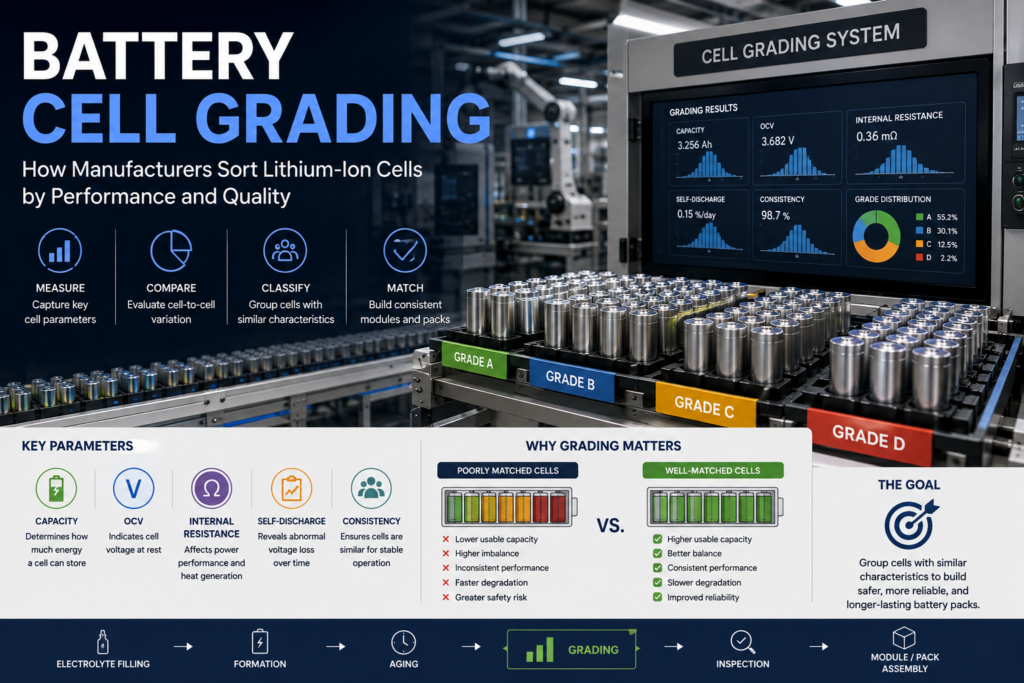
Not every lithium-ion battery cell leaving a production line performs exactly the same.
Even when cells use the same materials, design, and manufacturing process, small variations can appear in capacity, open circuit voltage, internal resistance, self-discharge, and other characteristics.
These differences matter when hundreds or thousands of cells are assembled into battery modules and packs.
This is why manufacturers use battery cell grading.
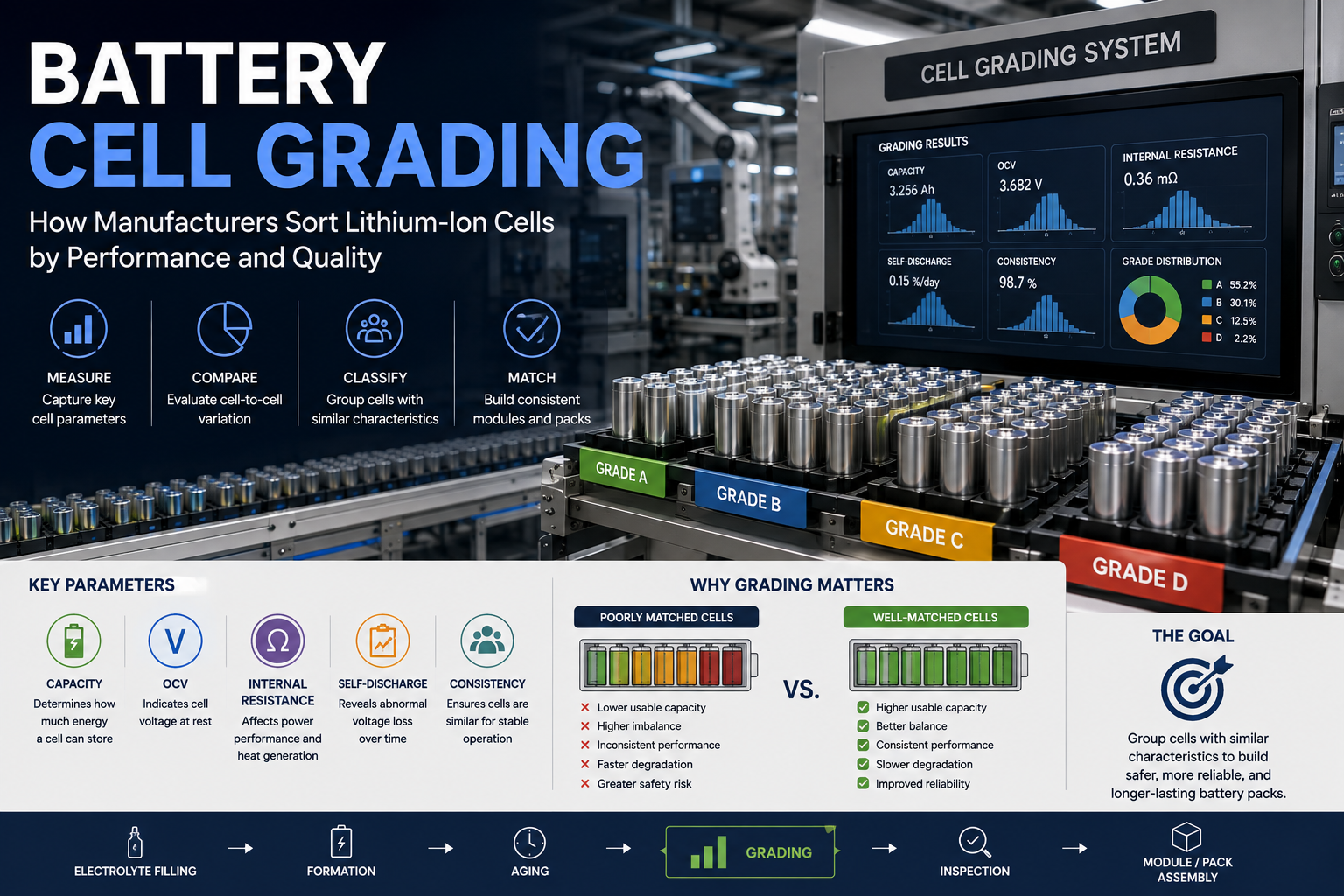
Battery cell grading is the process of measuring, comparing, and classifying manufactured cells according to defined performance and quality criteria. Cells with similar characteristics can then be grouped together, while cells that fall outside acceptable limits can be separated.
In this article, we’ll explore how battery cell grading works, which parameters are commonly evaluated, how grading differs from inspection, and why consistent cell matching is important for battery module and pack performance.
Table of Contents
- What Is Battery Cell Grading?
- Why Battery Cell Grading Matters
- Where Grading Fits in Battery Manufacturing
- How Battery Cell Grading Works
- Key Parameters Used for Cell Grading
- Capacity and Cell Consistency
- OCV and Self-Discharge
- Internal Resistance
- Why Cell Grading Matters for Module and Pack Performance
- Battery Cell Grading vs. Battery Inspection
- Future Trends in Battery Cell Grading
- Frequently Asked Questions
- Key Takeaways
1. What Is Battery Cell Grading?
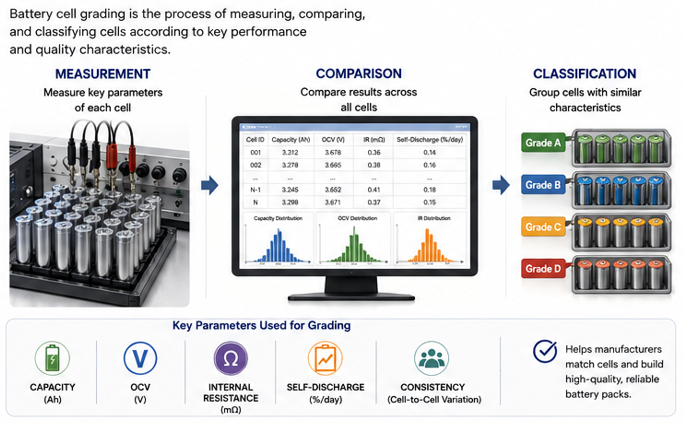
Battery cell grading is the process of measuring and classifying manufactured battery cells according to defined electrical and performance characteristics.
Rather than treating every qualified cell as identical, manufacturers use measurement data to identify differences between cells.
Common parameters considered during grading can include:
- Capacity
- Open Circuit Voltage (OCV)
- Internal resistance
- Self-discharge behavior
- Cell consistency
- Other manufacturer-defined performance characteristics
The objective is not simply to identify good and bad cells.
Grading also helps manufacturers identify cells with similar characteristics that can be grouped together for subsequent module and pack assembly.
This distinction is important.
A cell may pass quality inspection but still have slightly different electrical characteristics from another acceptable cell.
Battery cell grading helps organize these acceptable cells into more consistent groups.
2. Why Battery Cell Grading Matters
Individual battery cells naturally exhibit some manufacturing variation.
Small differences can originate from many upstream processes, including:
- Material preparation
- Coating
- Electrode thickness
- Cell assembly
- Electrolyte filling
- Formation
- Aging
A single cell may still meet specification, but combining cells with significantly different characteristics can create imbalance at the module or pack level.
Cell grading helps reduce this problem by allowing manufacturers to group cells with comparable characteristics.
This can contribute to:
- More consistent module performance
- Better usable capacity
- Improved power delivery
- Reduced cell imbalance
- More predictable degradation
- Improved pack reliability
Grading therefore connects cell-level manufacturing quality with module- and pack-level performance.
3. Where Grading Fits in Battery Manufacturing
Cell grading occurs during the final stages of cell manufacturing.
A simplified sequence is:
Electrolyte Filling
↓
Formation
↓
Aging
↓
Grading
↓
Inspection / Final Quality Control
↓
Module & Pack Assembly
Each stage answers a different question.
Formation
Has the cell been properly electrochemically activated?
Aging
Does the cell remain stable over time?
Grading
How does this cell compare with other cells, and which group should it belong to?
Inspection
Does the cell satisfy the required quality and defect criteria?
This sequence makes grading an important bridge between individual cell manufacturing and battery system assembly.
4. How Battery Cell Grading Works
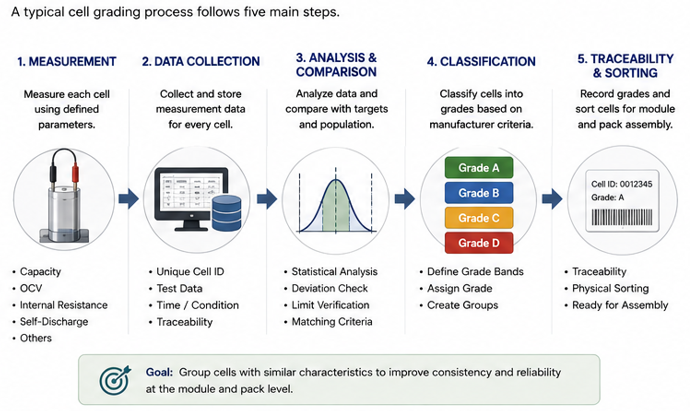
A modern battery cell grading process can be understood in five basic steps.
Step 1 — Measurement
Each cell is measured according to predefined parameters.
Depending on the manufacturing process, these may include:
- Capacity
- OCV
- Internal resistance
- Self-discharge
- Other electrical characteristics
Step 2 — Data Collection
Measurement data is stored and associated with each individual cell.
Cell identification systems can maintain traceability between manufacturing history and grading results.
Step 3 — Analysis and Comparison
The measured data is compared with:
- Target specifications
- Statistical distributions
- Production limits
- Matching requirements
This allows manufacturers to understand where each cell sits within the production population.
Step 4 — Classification
Cells are classified into defined groups or grades according to the manufacturer’s criteria.
The exact grading method varies by manufacturer, chemistry, cell design, and intended application.
Step 5 — Traceability and Sorting
Cells are physically sorted and their grading information is recorded.
Qualified groups can then proceed toward module or pack assembly.
5. Key Parameters Used for Cell Grading
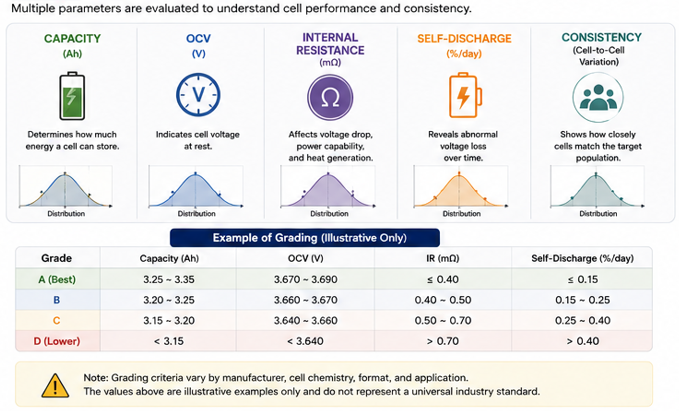
Battery grading is not normally based on one measurement alone.
Manufacturers evaluate multiple parameters to understand the characteristics of each cell.
Capacity
Capacity represents the amount of charge a cell can store and deliver under specified test conditions.
Cells intended for the same module generally benefit from having similar usable capacities.
Open Circuit Voltage (OCV)
OCV is the voltage measured when no external current is flowing.
Measurements taken at defined conditions can help evaluate cell condition and consistency.
Internal Resistance
Internal resistance influences:
- Voltage drop under load
- Heat generation
- Power capability
- Energy efficiency
Cells with substantially different resistance characteristics may behave differently when connected together.
Self-Discharge
Voltage changes observed during aging can help identify cells with abnormal self-discharge behavior.
Cell-to-Cell Consistency
Manufacturers also evaluate how closely individual cells match the target population.
The objective is not necessarily to create a universal Grade A, B, C, D standard.
Grading criteria are manufacturer-specific and depend on cell chemistry, format, application, and production requirements.
6. Capacity and Cell Consistency
Capacity is one of the most intuitive parameters used to understand cell variation.
Imagine a battery module containing cells with noticeably different capacities.
When the module operates, the lowest-capacity cell may reach its operating limit earlier than the others.
As a result, the usable performance of the entire module can become constrained by weaker cells.
This is one reason manufacturers seek to group cells with similar capacity characteristics.
However, capacity alone does not provide a complete picture.
Two cells with similar capacity may still differ in:
- Internal resistance
- Self-discharge
- Voltage behavior
- Temperature response
Effective grading therefore requires multiple measurements rather than a single performance number.
7. OCV and Self-Discharge
OCV becomes particularly useful when combined with aging data.
After formation, manufacturers can measure a cell’s OCV, store the cell for a defined aging period, and then measure it again.
The change in voltage provides information about the cell’s behavior over time.
Abnormally large changes may indicate:
- Excessive self-discharge
- Internal leakage pathways
- Micro-short circuits
- Contamination
- Other cell abnormalities
This creates a direct connection between battery aging and battery cell grading.
Aging generates time-dependent information.
Grading uses that information, together with other measurements, to classify and group cells.
8. Internal Resistance
Internal resistance is another important characteristic when matching cells.
When current flows through a battery, internal resistance contributes to voltage drop and heat generation.
If cells within the same module have significantly different resistance characteristics, they may respond differently under identical operating conditions.
This can contribute to:
- Uneven heat generation
- Uneven voltage response
- Different power behavior
- Increasing imbalance over time
For this reason, resistance measurements can be combined with capacity and voltage data during cell classification.
9. Why Cell Grading Matters for Module and Pack Performance
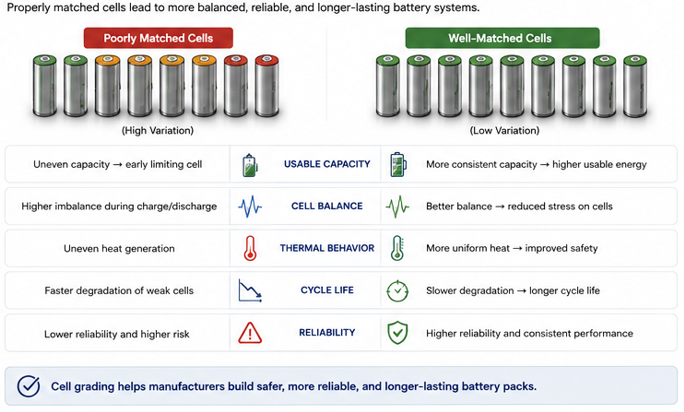
The importance of grading becomes clearer when cells are connected together.
A battery pack is only as consistent as the cells operating inside it.
Without Effective Cell Matching
A module may contain cells with different:
- Capacities
- Internal resistances
- Voltage characteristics
- Self-discharge behavior
These differences can contribute to imbalance and make pack management more difficult.
With Effective Cell Matching
Cells with similar characteristics can be grouped together.
This supports:
- More balanced charge and discharge behavior
- More consistent thermal behavior
- Better utilization of available capacity
- More predictable pack performance
- Improved long-term reliability
Cell grading therefore does not increase the intrinsic performance of an individual cell.
Instead, it helps manufacturers build more consistent battery systems from the cells they have produced.
10. Battery Cell Grading vs. Battery Inspection
Battery cell grading and battery inspection are closely related but serve different purposes.
| Battery Cell Grading | Battery Inspection |
|---|---|
| Compares cells with one another | Checks cells against quality requirements |
| Focuses on classification and matching | Focuses on defect and specification verification |
| Uses performance data | May use electrical, visual, dimensional, X-ray, and leak-test data |
| Creates groups of similar cells | Determines whether defects or unacceptable conditions exist |
| Supports module/pack matching | Supports final quality assurance |
A useful way to remember the difference is:
Inspection asks: “Is this cell acceptable?”
Grading asks: “Which cells are most similar to this cell?”
The two processes complement each other.
A cell can pass inspection and still need to be assigned to an appropriate performance group.
11. Future Trends in Battery Cell Grading
As battery factories become increasingly data-driven, cell grading is evolving from simple sorting toward advanced manufacturing analytics.
Important trends include:
AI-Based Classification
Machine-learning systems can analyze larger combinations of production and electrical data to identify patterns that conventional threshold-based grading may miss.
Predictive Quality
Instead of waiting for every long-duration measurement, manufacturers may increasingly use manufacturing data to predict future cell behavior.
Integrated Manufacturing Data
Data from:
Mixing → Coating → Assembly → Formation → Aging → Grading
can potentially be connected to each individual cell.
This makes it possible to investigate how upstream process conditions influence final cell performance.
Automated Cell Matching
Advanced production systems can automatically identify cell combinations suitable for specific modules or packs.
Digital Traceability
Individual cell data can remain connected throughout:
Cell → Module → Pack
providing a stronger foundation for manufacturing analysis and lifecycle management.
12. Frequently Asked Questions
What is battery cell grading?
Battery cell grading is the process of measuring, comparing, and classifying manufactured cells according to defined performance characteristics.
Is cell grading the same as battery testing?
No. Testing generates measurement data, while grading uses relevant data to classify or group cells.
What parameters are used for battery grading?
Common parameters can include capacity, OCV, internal resistance, self-discharge behavior, and other manufacturer-defined characteristics.
What is Grade A battery cell?
There is no single universal Grade A specification applicable to every lithium-ion cell. Grading criteria vary by manufacturer, chemistry, format, application, and quality requirements.
Why are cells matched before module assembly?
Cells with similar electrical characteristics generally behave more consistently when connected together in a module or pack.
Does cell grading improve battery capacity?
Grading does not increase the capacity of an individual cell. It helps manufacturers group cells with similar characteristics so the resulting battery system can operate more consistently.
What comes after cell grading?
Qualified and appropriately grouped cells can proceed through final quality processes and toward module and pack assembly, depending on the manufacturer’s production sequence.
13. Key Takeaways
- Battery cell grading measures, compares, and classifies manufactured lithium-ion cells.
- Capacity, OCV, internal resistance, and self-discharge are important characteristics used to evaluate cell consistency.
- Aging provides time-dependent data that can support grading decisions.
- Grading and inspection have different purposes: inspection verifies acceptability, while grading classifies and matches cells.
- There is no universal Grade A/B/C/D standard applicable to every battery manufacturer.
- Effective cell matching supports more consistent module and pack performance.
- Future grading systems will increasingly combine manufacturing data, automation, predictive analytics, and AI.
📚 Key Terms
Battery Cell Grading
The process of measuring, comparing, and classifying manufactured battery cells according to defined electrical and performance characteristics.
Cell Matching
The process of grouping battery cells with similar characteristics so they can operate more consistently when assembled into modules or packs.
Capacity
The amount of electrical charge a battery cell can store and deliver under specified conditions. Capacity is an important parameter when comparing cells for grouping.
Open Circuit Voltage (OCV)
The voltage measured across a battery cell when no external current is flowing. OCV measurements can help evaluate cell condition and consistency.
Internal Resistance (IR)
Resistance within a battery cell that contributes to voltage drop and heat generation when current flows. Differences in internal resistance can affect cell behavior within a module.
Self-Discharge
The gradual loss of stored charge while a battery is at rest. Abnormally high self-discharge can indicate internal defects or unwanted electrical pathways.
Cell-to-Cell Variation
Differences in electrical and electrochemical characteristics among cells manufactured under nominally identical conditions.
Traceability
The ability to connect measurement, grading, and manufacturing information to an individual battery cell or production batch.
🎓 Battery Learning Path
🏭 Manufacturing
✅ iAtlas Battery #28 — Battery Manufacturing Process
✅ iAtlas Battery #29 — Battery Aging Process
📍 iAtlas Battery #30 — Battery Cell Grading (Current)
Welcome to the Battery Manufacturing Learning Path, where you’ll explore how individual manufacturing processes work together to transform battery materials into consistent, production-ready lithium-ion cells.
🔄 Cell Finishing & Quality Flow
The final stages of battery cell manufacturing can be understood as:
Formation
↓
Aging
↓
Grading ← Current
↓
Inspection
↓
Module / Pack Assembly
Related Equipment Articles
✅ iAtlas Battery #26 — Formation Equipment
✅ iAtlas Battery #27 — Inspection Equipment
This flow shows how electrochemical activation, stabilization, classification, and final quality verification work together before cells move toward battery system assembly.
📖 Continue Reading
⬅ Previous Article
🔋 iAtlas Battery #29
Battery Aging Process Explained: Why Lithium-Ion Cells Must Rest Before Final Grading
Learn how controlled aging allows newly formed lithium-ion cells to stabilize and helps manufacturers detect abnormal self-discharge and cell-to-cell variation.
➡ Next Learning Path
🏢 Battery Companies
The next iAtlas Battery Learning Path explores the companies shaping the global battery industry—from major cell manufacturers to their technologies, manufacturing footprints, product strategies, and competitive positions.
Next: 🔋 iAtlas Battery #31 — CATL Explained
📚 Related Articles
Continue exploring lithium-ion battery manufacturing and quality control:
- 🔋 iAtlas Battery #26 — Battery Formation Equipment Explained
- 🔋 iAtlas Battery #27 — Battery Inspection Equipment Explained
- 🔋 iAtlas Battery #28 — Battery Manufacturing Process Explained
- 🔋 iAtlas Battery #29 — Battery Aging Process Explained
- 📘 Open Circuit Voltage (OCV)
- 📘 Internal Resistance (IR)
- 📘 Self-Discharge
- 📘 Battery Capacity
- 📘 Cell Matching
Additional Battery Library articles will be linked as they are published.
📚 References
Battery Manufacturing & Research
- U.S. Department of Energy — Vehicle Technologies Office
- Argonne National Laboratory
- Journal of Power Sources
- Journal of Energy Storage
Battery Testing & Measurement
🔷 About iAtlas
iAtlas is an independent publication dedicated to making industrial knowledge more accessible.
From batteries and semiconductors to advanced materials, AI, and global manufacturing, iAtlas transforms complex technologies into practical, easy-to-understand insights.
Whether you’re following today’s industry news or building long-term expertise, iAtlas helps you understand not only what happened, but why it matters.
Technology creates change.
Insight creates opportunity.
— iAtlas