Electrode Drying Explained: How Wet Coatings Become Battery Electrodes
Understanding Solvent Removal, Drying Temperature, Binder Migration, and Electrode Quality in Lithium-ion Battery Manufacturing
Category: Battery Technology
Content Type: Manufacturing
Learning Path: Battery Manufacturing
Related Industries: Electric Vehicles · Energy Storage Systems · Consumer Electronics
Last Updated: August 2026
Industry Snapshot
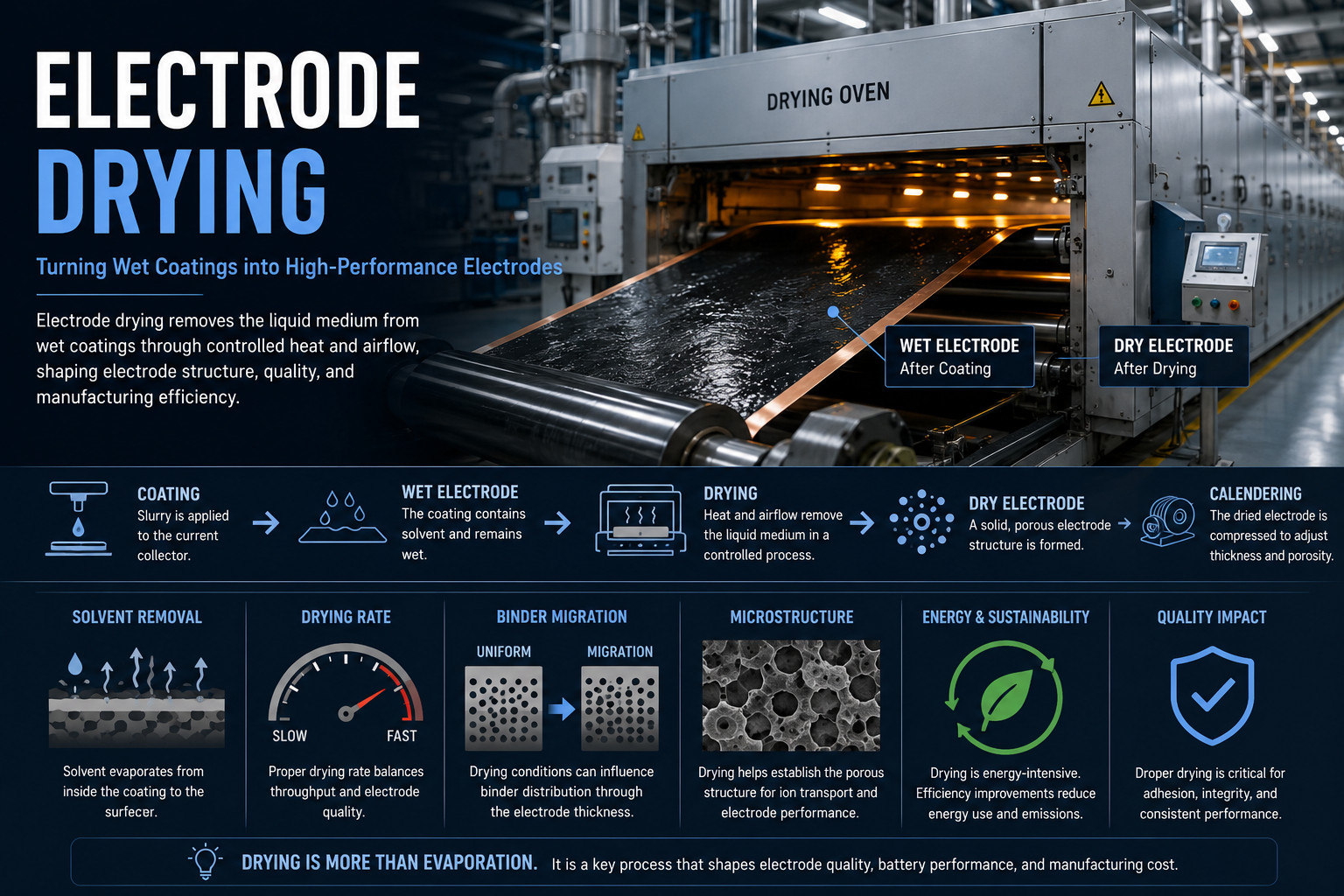
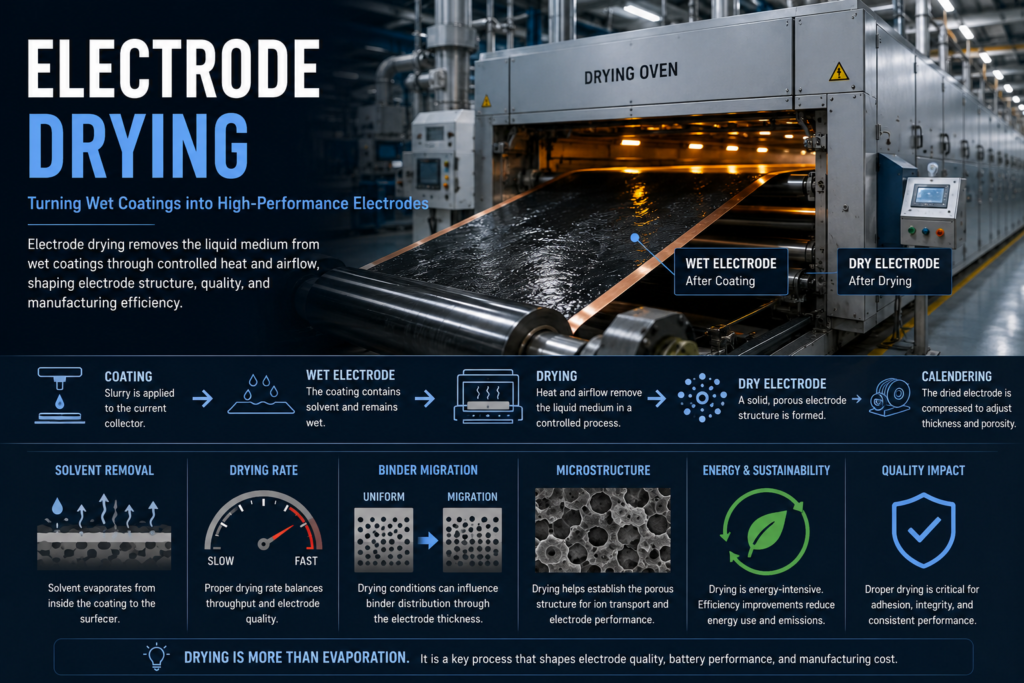
Battery electrode drying is the manufacturing process that removes most of the liquid medium from a freshly coated electrode, transforming a wet slurry layer into a solid porous electrode.
The process immediately follows electrode coating.
Battery Slurry
→ Electrode Coating
→ Wet Electrode
→ Electrode Drying
→ Dry Electrode
Drying may appear to be a straightforward evaporation process, but it has a major influence on electrode structure and manufacturing quality.
Drying conditions can affect the distribution of binder and conductive additives, electrode adhesion, porosity, cracking behavior, and ultimately battery performance.
It is also an important contributor to the energy demand of conventional battery electrode manufacturing.
At a Glance
| Category | Description |
|---|---|
| Process | Electrode Drying |
| Stage | Electrode Manufacturing |
| Input | Wet Coated Electrode |
| Main Function | Remove Liquid Medium |
| Cathode Example | NMP Removal |
| Anode Example | Water Removal |
| Key Controls | Temperature · Airflow · Line Speed · Drying Rate |
| Previous Process | Electrode Coating |
| Next Process | Calendering |
What Is Battery Electrode Drying?
Battery electrode drying removes the liquid phase used to prepare and coat an electrode slurry.
Immediately after coating, the active material, conductive additive, and binder are still dispersed within a liquid medium.
The electrode therefore remains wet.
During drying:
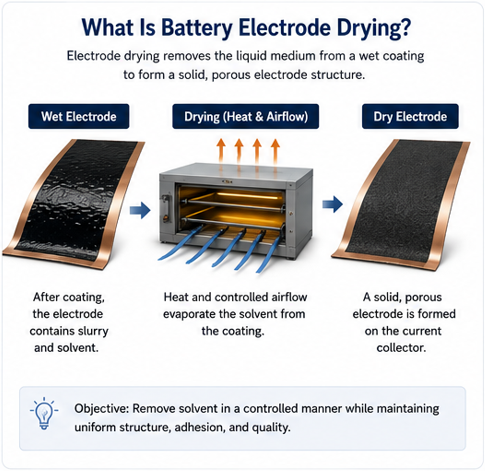
Wet Electrode
↓
Heat & Controlled Airflow
↓
Liquid Evaporation
↓
Solid Electrode Structure
The objective is not simply to dry the surface.
The process must remove the liquid in a controlled manner while maintaining a uniform and mechanically stable electrode structure.
What Is Removed During Drying?
The liquid depends on the electrode formulation.
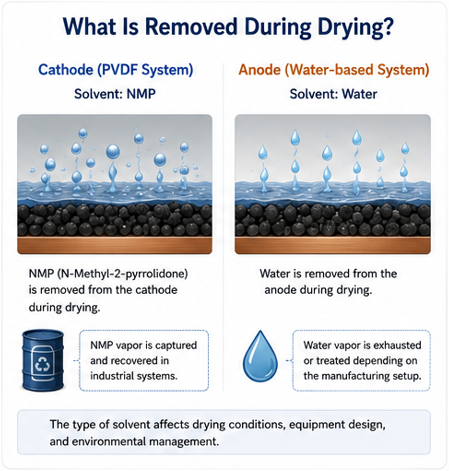
Cathode
Conventional cathode manufacturing frequently uses:
PVDF Binder + NMP Solvent
NMP, or N-Methyl-2-pyrrolidone, is removed during drying.
Because NMP is an organic solvent, industrial cathode manufacturing may also require solvent collection and recovery systems.
Anode
Graphite anodes commonly use water-based binder systems such as:
CMC + SBR + Water
In these systems, water is the primary liquid removed during drying.
This distinction affects both process design and manufacturing infrastructure.
How Electrode Drying Works
After coating, the moving current collector enters a drying system as part of the continuous production line.
A simplified process is:
Coating Head
→ Wet Electrode
→ Drying Zone
→ Solvent Evaporation
→ Dry Electrode
→ Rewinding
Industrial electrode production commonly uses long drying ovens integrated into roll-to-roll manufacturing lines.
As the electrode travels through the dryer, heat and airflow promote evaporation from the coated layer.
Multi-Zone Drying
Industrial dryers can contain multiple temperature and airflow zones rather than operating under one uniform condition.
A simplified concept is:
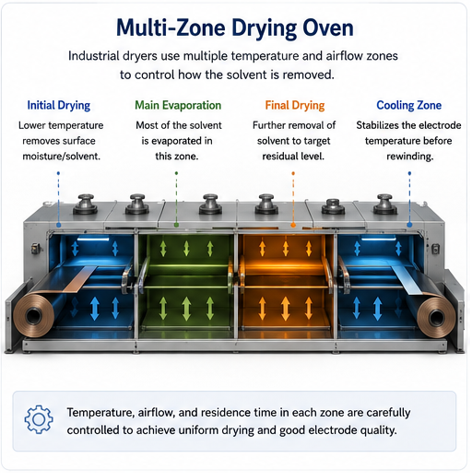
Wet Electrode
→ Initial Drying
→ Main Evaporation
→ Final Drying
→ Dry Electrode
Each zone can be controlled to manage how quickly the liquid leaves the electrode.
This allows manufacturers to optimize the overall drying profile rather than applying maximum heat immediately.
Why Drying Rate Matters
Increasing drying speed can improve manufacturing throughput.
However, drying an electrode too aggressively can create problems.
If solvent evaporates rapidly from the electrode surface, internal concentration gradients can develop while material inside the coating is still redistributing.
On the other hand, very slow drying increases:
- Process time
- Dryer length requirements
- Energy consumption
- Manufacturing cost
Battery manufacturers therefore need to balance productivity and electrode quality.
Drying Temperature
Temperature is one of the primary process variables in electrode drying.
Higher temperatures can accelerate evaporation.
But simply increasing temperature does not necessarily produce the best electrode.
The appropriate drying condition depends on variables including:
- Electrode chemistry
- Solvent system
- Binder
- Coating thickness
- Electrode loading
- Line speed
- Airflow
- Dryer design
These parameters interact with each other.
As a result, electrode drying is better understood as a controlled heat and mass transfer process rather than simple heating.
Solvent Evaporation
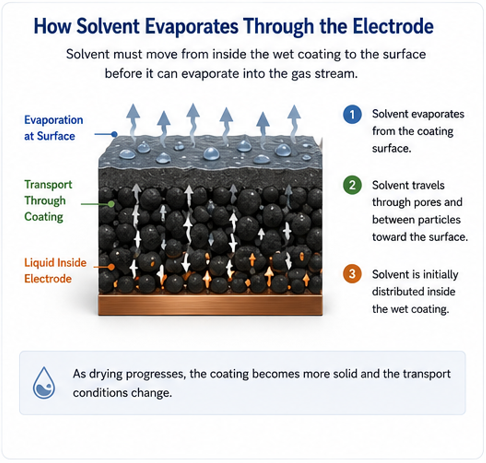
During drying, solvent must travel from inside the wet coating toward the surface and then evaporate into the surrounding gas stream.
Conceptually:
Liquid Inside Electrode
↓
Transport Toward Surface
↓
Surface Evaporation
↓
Vapor Removal
As drying continues, the electrode becomes increasingly solid and transport conditions change.
This makes the drying behavior dynamic throughout the process.
Binder Migration
One of the most important concepts in battery electrode drying is binder migration.
The binder helps hold electrode particles together and contributes to adhesion between the electrode layer and current collector.
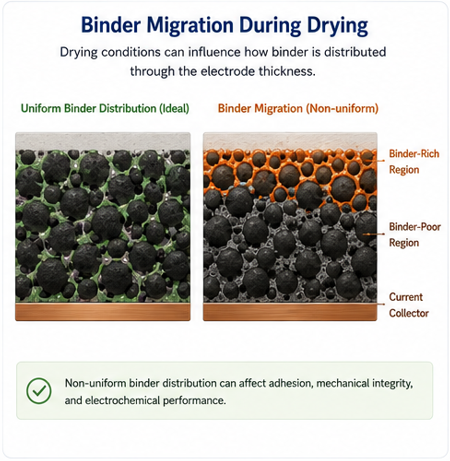
During drying, however, liquid movement can influence the distribution of binder within the coating.
Under certain drying conditions, binder can become unevenly distributed through the electrode thickness.
Instead of:
Uniform Binder Distribution
the electrode may develop:
Binder-Rich Region
and
Binder-Poor Region
This can influence the mechanical and electrochemical properties of the finished electrode.
Why Binder Distribution Matters
An electrode must maintain several functions simultaneously.
Particles need sufficient contact with one another.
The coating must adhere to the current collector.
Electron-conducting pathways need to remain effective.
At the same time, the porous structure must allow electrolyte and lithium ions to move through the electrode.
Poor binder distribution can therefore influence:
- Adhesion
- Mechanical integrity
- Electrical pathways
- Electrode microstructure
- Electrochemical performance
This is why drying conditions can affect the battery even though most of the solvent itself does not remain in the finished electrode.
Electrode Microstructure
A battery electrode is not simply a dense solid film.
After drying, it contains a complex structure consisting of:
- Active material particles
- Conductive additives
- Binder
- Pores
The resulting porous network is important because electrolyte later needs to penetrate the electrode.
Lithium ions must then travel through the electrolyte-filled pores during battery operation.
Manufacturing therefore needs to create an electrode that provides both:
Electronic Transport
and
Ionic Transport
Drying is one of the processes that helps establish this structure.
Drying Thick Electrodes
Battery manufacturers are interested in higher-loading and thicker electrodes because they can potentially increase the amount of active material within a cell.
However, thick electrodes create additional manufacturing challenges.
The solvent must travel farther through the coating during drying.
This can increase the risk of:
- Non-uniform drying
- Binder redistribution
- Cracking
- Longer drying time
- Increased process difficulty
As electrode loading increases, drying technology becomes even more important.
Common Electrode Drying Problems
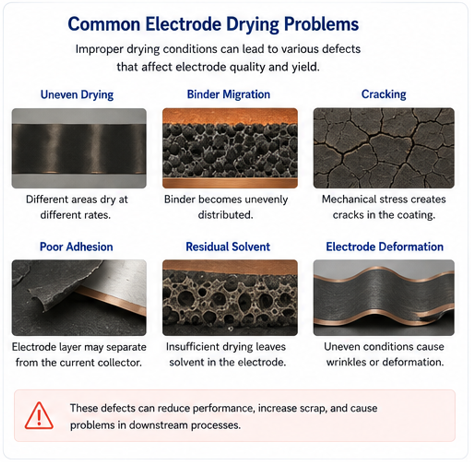
Several types of manufacturing issues can develop when drying conditions are poorly controlled.
Uneven Drying
Different regions of the electrode dry at different rates.
Binder Migration
Binder becomes unevenly distributed through the electrode.
Cracking
Mechanical stress can create cracks in the electrode coating.
Poor Adhesion
The electrode layer may not bond sufficiently to the current collector.
Residual Solvent
Insufficient drying can leave unwanted liquid within the electrode.
Electrode Deformation
Uneven thermal or mechanical conditions can affect the electrode sheet.
Many of these defects may not be easily corrected during later manufacturing stages.
Drying and Electrode Adhesion
The dried electrode must remain firmly attached to the current collector during subsequent processes.
After drying, the electrode will experience additional mechanical processing including:
Calendering
and
Slitting
Weak adhesion can lead to particle loss, coating separation, or other defects.
Drying therefore needs to create an electrode that is sufficiently stable for downstream manufacturing.
NMP Recovery
Cathode manufacturing using NMP introduces another important factory consideration.
Instead of simply exhausting solvent vapor, manufacturing facilities may incorporate NMP recovery systems.
The general flow is:
Cathode Dryer
↓
NMP-Containing Exhaust
↓
Solvent Recovery
↓
Recovered NMP
Solvent recovery can reduce emissions and allow valuable solvent to be collected for treatment or reuse.
This makes electrode drying not only an electrode-quality issue but also an environmental and factory-infrastructure issue.
Why Electrode Drying Uses So Much Energy
Drying requires energy to evaporate large quantities of liquid while continuously processing electrode material.
Additional energy may be required for:
- Heating
- Air circulation
- Exhaust handling
- Solvent recovery
- Environmental control
Large-scale production also requires substantial dryer length and factory space.
For this reason, reducing drying time and energy consumption has become an important battery manufacturing research area.
Drying Speed vs Manufacturing Productivity
Consider two extreme cases.
Slow Drying
Better process control potential
but
Lower throughput + Higher production cost
Extremely Fast Drying
Higher throughput potential
but
Greater risk of electrode non-uniformity
The manufacturing challenge is therefore:
Dry the electrode as quickly as possible without compromising electrode quality.
This trade-off becomes increasingly important as gigafactories seek higher production capacity.
Quality Control After Drying
After the electrode exits the dryer, manufacturers can evaluate characteristics such as:
- Residual moisture or solvent
- Electrode thickness
- Coating uniformity
- Surface defects
- Adhesion
- Electrode loading
- Dimensional consistency
Inline inspection can also detect defects while the roll-to-roll process is operating.
Process data from coating and drying can increasingly be combined to improve manufacturing control.
From Drying to Calendering
Once drying is complete, the electrode contains active materials, conductive additives, binder, and a porous structure attached to the current collector.
However, the electrode is not yet finished.
The next major process is calendering.
Dry Electrode
↓
Calender Rolls
↓
Controlled Compression
↓
Adjusted Thickness & Porosity
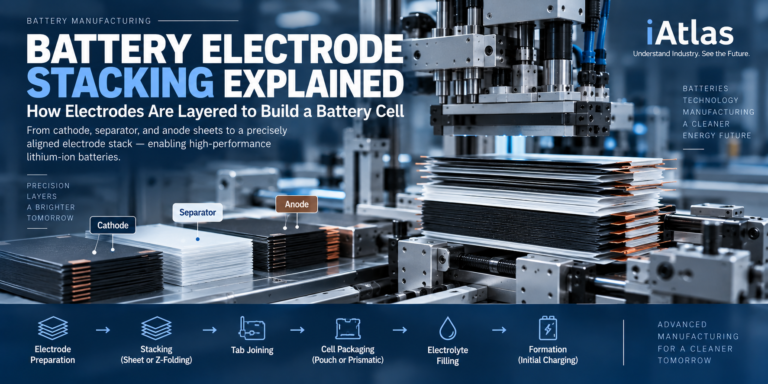
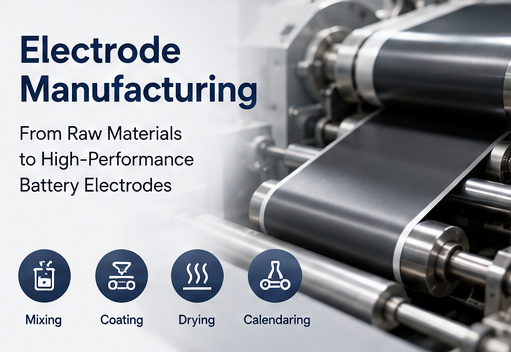
Calendering changes the physical structure of the dried electrode by compressing it to a controlled thickness and density.
This creates an important manufacturing connection:
Coating determines how material is deposited.
Drying determines how the wet coating solidifies.
Calendering determines how the dried electrode is compressed.
Together, these processes strongly influence the final electrode structure.
Emerging Electrode Drying Technologies
Battery manufacturers are exploring several approaches to reduce drying time, energy consumption, and factory footprint.
High-Efficiency Drying
Improved airflow, heat transfer, and process control can increase drying efficiency.
Infrared Drying
Infrared energy can provide additional heating mechanisms for electrode drying.
Laser-Based Drying
Laser energy is being investigated as a method for rapid and controlled electrode processing.
Advanced Process Control
Sensors and data analytics can help optimize temperature, airflow, and line speed in real time.
High-Solid Slurry
Reducing the amount of liquid in the initial slurry means less solvent must ultimately be removed.
Dry Electrode Manufacturing
Dry electrode technology takes this concept much further.
Instead of:
Slurry → Coating → Drying
the goal is to manufacture electrodes with little or no conventional solvent-based slurry processing.
This could dramatically reduce the drying requirements of battery factories.
Atlas Insight
Battery electrode drying illustrates an important principle of battery manufacturing:
Removing something from an electrode can be just as important as adding something to it.
The solvent is largely temporary—it enables slurry preparation and coating but is then removed.
Yet how it is removed can influence the permanent structure of the electrode.
This explains why drying is increasingly viewed not simply as a utility process but as part of electrode engineering.
The industrial implications are equally significant.
Long drying ovens, heating systems, airflow management, solvent recovery, and environmental controls consume factory space, equipment investment, and energy.
Therefore, improvements in electrode drying can potentially deliver benefits across three dimensions:
- Battery Performance
- Manufacturing Productivity
- Factory Energy Efficiency
This is also why dry electrode technology has attracted so much attention: eliminating or substantially reducing conventional drying could change both electrode manufacturing and the architecture of future battery factories.
Did You Know?
- Electrode drying begins immediately after slurry coating.
- Conventional cathode processing commonly requires removal of NMP.
- Graphite anode manufacturing commonly uses water-based slurry systems.
- Drying conditions can influence binder distribution within an electrode.
- Electrode drying is closely connected to coating quality and subsequent calendering.
- Thicker electrodes can make drying more challenging.
- Drying equipment can occupy a significant portion of an electrode manufacturing line.
- Dry electrode technology seeks to reduce or eliminate conventional solvent-based drying.
FAQ
What is battery electrode drying?
Battery electrode drying is the process of removing the liquid medium from a freshly coated cathode or anode to create a solid porous electrode.
What happens after electrode coating?
The wet electrode normally enters a drying process before subsequent electrode manufacturing steps such as calendering and slitting.
What solvent is removed from cathode electrodes?
Conventional PVDF-based cathode processing commonly uses NMP, which is removed during drying.
What is removed from water-based anode slurry?
Water is the primary liquid removed from common CMC/SBR graphite anode formulations.
Why is drying rate important?
Drying rate affects manufacturing throughput but can also influence material redistribution, binder distribution, electrode structure, and defects.
What is binder migration?
Binder migration refers to the redistribution of binder during electrode drying, potentially creating non-uniform binder concentrations through the electrode.
Why are battery drying ovens so large?
Industrial roll-to-roll manufacturing requires enough residence time to remove liquid while the electrode moves continuously through the production line.
What happens after electrode drying?
The next major electrode manufacturing process is calendering, where the dried electrode is compressed to control thickness, density, and porosity.
Battery Manufacturing Learning Path
Overview
Electrode Manufacturing
- Material Mixing
- Battery Slurry
- Battery Electrode Coating
- Electrode Drying (Current)
- Calendering
- Slitting
Cell Assembly
- Battery Cell Assembly
- Notching
- Winding
- Stacking
- Electrolyte Filling
- Cell Sealing
Cell Finishing
- Formation
- Aging
- Degassing
- Battery Cell Testing & Grading
System Assembly
- Battery Module Assembly
- Battery Pack Assembly
Explore More
Fundamentals
- Battery
- Lithium-ion Battery
- Battery Cell
- Battery Module
- Battery Pack
- Battery Management System(BMS)
- Battery Thermal Management System(BTMS)
- Battery Safety
Materials
Manufacturing
- Battery Manufacturing Process
- Material Mixing
- Battery Slurry
- Battery Electrode Coating
- Electrode Drying (Current)
- Calendering
- Slitting
Technologies
- Dry Electrode Technology
- High-Loading Electrodes
- Silicon Anode
References
Recommended primary research areas for this article:
- Advanced Energy Materials — A Review of Lithium-Ion Battery Electrode Drying: Mechanisms and Metrology
- Journal of Power Sources — Binder Migration During Drying of Lithium-Ion Battery Electrodes
- Journal of Power Sources — Investigation of Film Solidification and Binder Migration During Drying of Li-Ion Battery Anodes
- Journal of Energy Storage — Electrode Manufacturing for Lithium-Ion Batteries: Analysis of Current and Next Generation Processing
- Drying Technology — Critical Review of Drying Processes for Electrode Materials
About iAtlas
iAtlas is an independent publication covering batteries, semiconductors, OLED, advanced materials, AI, and global industrial trends.
We transform complex industrial developments into clear, reliable, and easy-to-understand insights.
Whether you’re following today’s industry news or building long-term expertise, iAtlas helps you understand not only what happened, but why it matters.
Technology creates change.
Insight creates opportunity.
— iAtlas