Anode Explained: The Negative Electrode That Stores Lithium Ions
Understanding Anode Materials, Functions, and Their Impact on Battery Performance
Category: Battery Technology
Content Type: Materials
Related Industries: Electric Vehicles · Energy Storage Systems · Consumer Electronics
Last Updated: August 2026
Industry Snapshot
The anode is one of the four essential components of a lithium-ion battery. During charging, lithium ions move from the cathode and are stored inside the anode. During discharge, the stored lithium ions return to the cathode, generating electrical energy.
Although cathode materials often receive more attention because they determine battery chemistry, anode materials are equally important for charging speed, cycle life, energy density, and battery durability. Continuous innovation in anode technology is enabling faster charging and higher-capacity batteries for electric vehicles and energy storage systems.
At a Glance
| Category | Description |
|---|---|
| Definition | Negative electrode that stores lithium ions during charging |
| Main Function | Store and release lithium ions |
| Common Materials | Graphite, Silicon, Silicon-Graphite, Lithium Titanate (LTO) |
| Determines | Charging speed, cycle life, power capability |
| Major Applications | EVs, ESS, Consumer Electronics |
What Is an Anode?
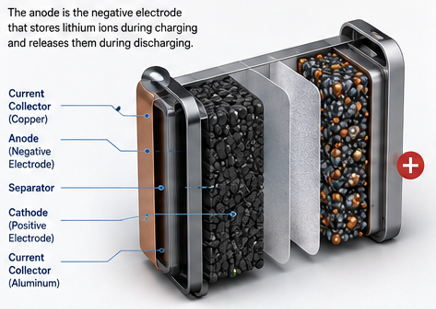
An anode is the negative electrode of a lithium-ion battery during discharge.
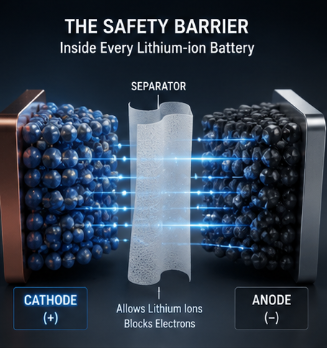
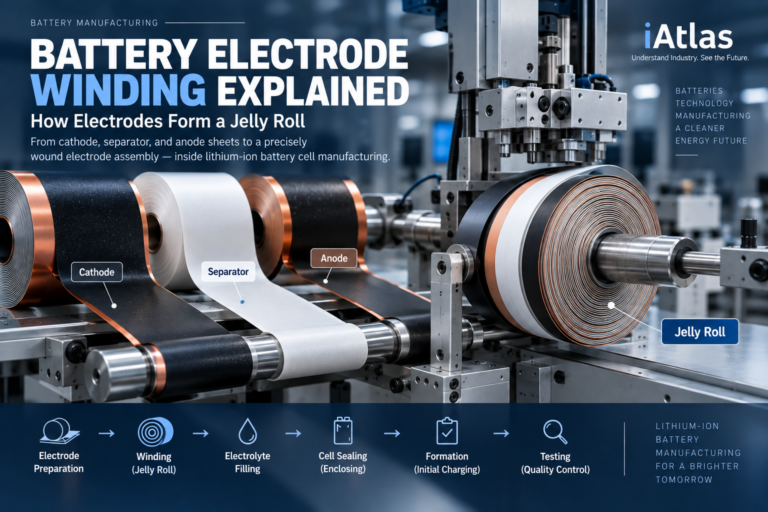
Unlike the cathode, which supplies lithium ions, the anode temporarily stores lithium ions while the battery is being charged. When the battery discharges, those ions move back to the cathode through the electrolyte, while electrons flow through the external circuit to power devices.
The ability of the anode to repeatedly store and release lithium ions is critical to battery performance and longevity.
How an Anode Works
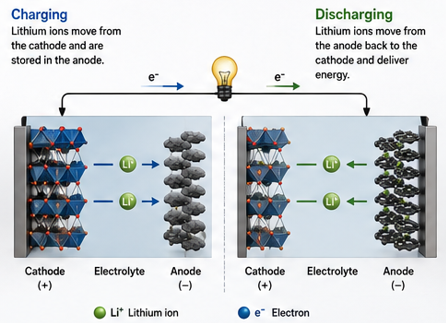
Charging
- Lithium ions leave the cathode.
- Ions pass through the electrolyte.
- Lithium ions are intercalated into the anode.
Discharging
- Lithium ions leave the anode.
- Ions return to the cathode.
- Electrons flow through the external circuit.
This reversible process enables rechargeable batteries to complete hundreds or even thousands of charge-discharge cycles.
Common Anode Materials
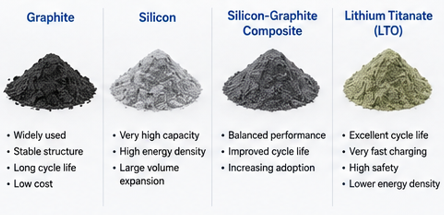
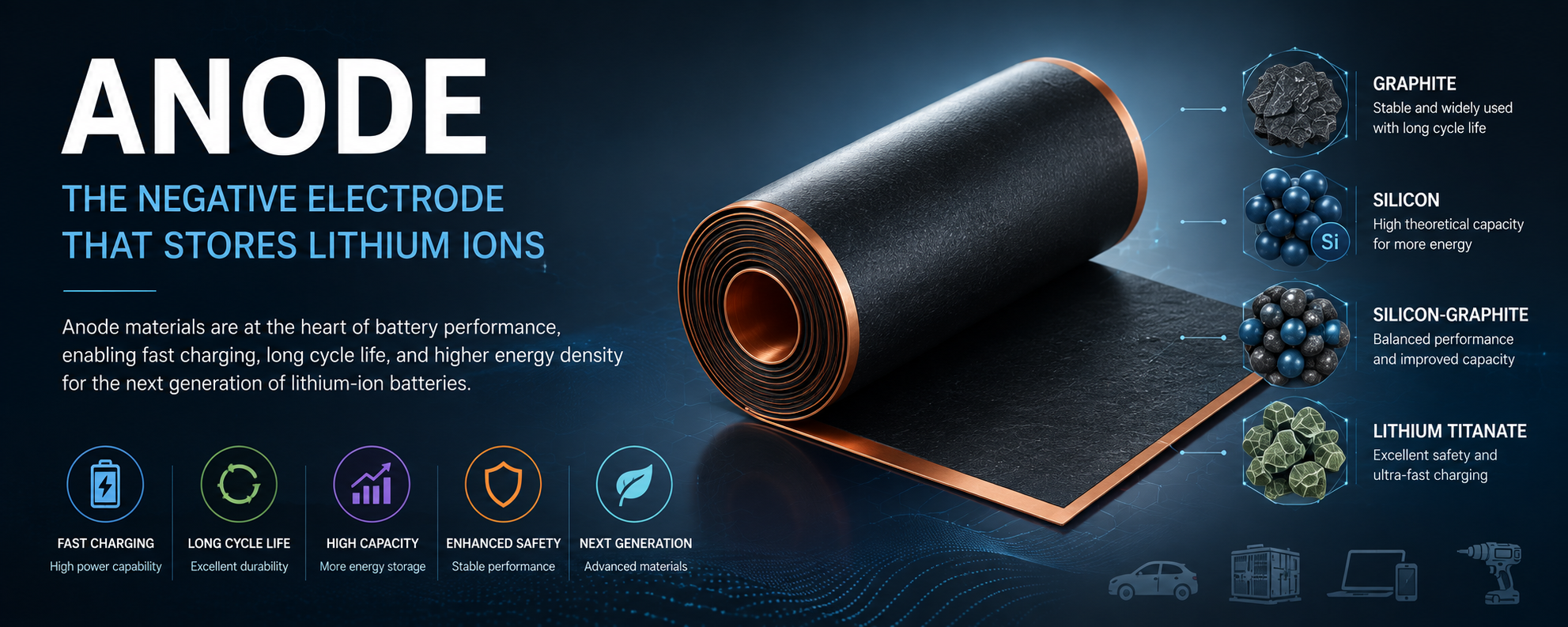
Graphite
The most widely used anode material due to its stability, long cycle life, and relatively low cost.
Silicon
Can store significantly more lithium than graphite, offering much higher theoretical capacity. However, silicon expands substantially during charging, creating engineering challenges.
Silicon-Graphite Composite
Combines graphite’s stability with silicon’s high capacity, making it one of the fastest-growing commercial anode technologies.
Lithium Titanate (LTO)
Known for exceptional cycle life, rapid charging capability, and excellent safety, although it has lower energy density than graphite-based anodes.
Comparison of Anode Materials
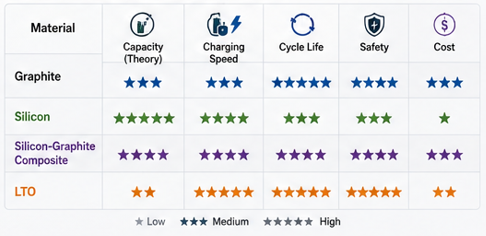
| Material | Capacity | Charging Speed | Cycle Life | Cost |
|---|---|---|---|---|
| Graphite | High | Good | Excellent | Low |
| Silicon | Very High | Excellent | Moderate | High |
| Silicon-Graphite | Very High | Excellent | Good | Medium |
| LTO | Moderate | Excellent | Outstanding | High |
Anode Manufacturing Process
Typical anode production includes:
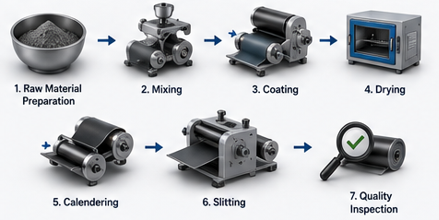
Raw Material Preparation
↓
Mixing
↓
Coating
↓
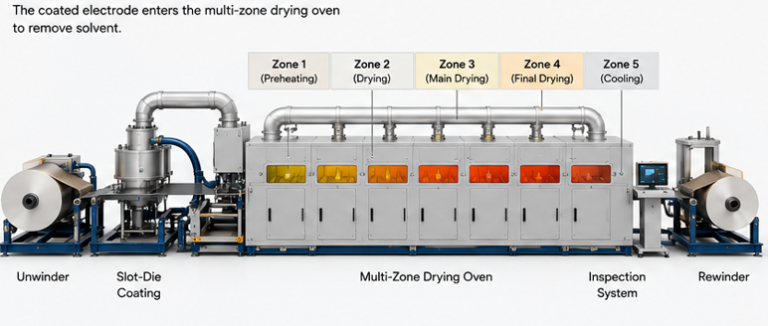
Drying
↓
Calendering
↓
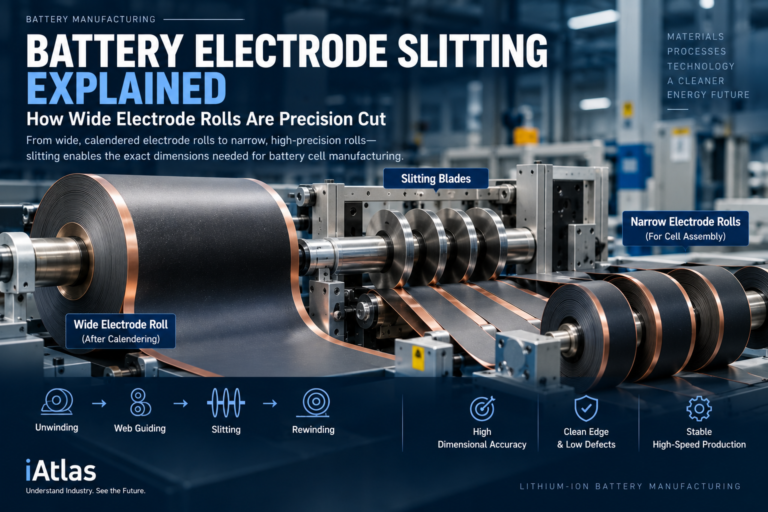
Slitting
↓
Quality Inspection
Unlike cathode production, graphite anodes generally do not require a high-temperature calcination step, though heat treatment is used during synthetic graphite production.
Key Performance Factors
| Parameter | Importance |
|---|---|
| Specific Capacity | Determines energy storage capability |
| Charging Speed | Influences fast-charging performance |
| Cycle Life | Determines battery durability |
| Volume Expansion | Important for silicon-based anodes |
| Safety | Prevents lithium plating and degradation |
Applications
Anode materials are used in:
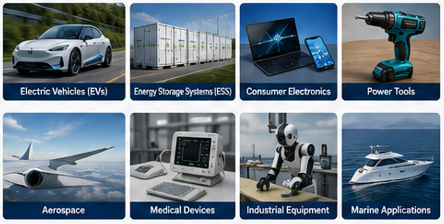
- Electric Vehicles (EVs)
- Energy Storage Systems (ESS)
- Consumer Electronics
- Power Tools
- Aerospace
- Medical Devices
- Industrial Equipment
Industry Ecosystem
The anode supply chain includes:
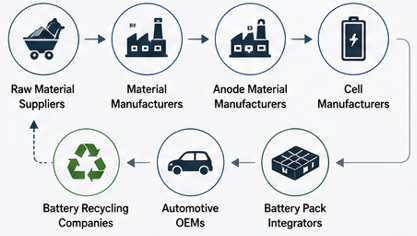
- Natural Graphite Producers
- Synthetic Graphite Manufacturers
- Silicon Material Suppliers
- Anode Material Manufacturers
- Cell Manufacturers
- Battery Pack Integrators
- Automotive OEMs
- Battery Recycling Companies
Atlas Insight
Anode technology is entering a new era driven by silicon innovation.
Many next-generation batteries are gradually increasing silicon content to improve energy density without sacrificing reliability. As material science advances, silicon-rich and even lithium-metal anodes could significantly reduce charging times and increase driving range, making them key technologies for future electric vehicles.
Did You Know?
- Graphite remains the dominant commercial anode material.
- Silicon can theoretically store nearly ten times more lithium than graphite.
- Most commercial EV batteries today use graphite with a small percentage of silicon.
- Researchers are developing lithium-metal anodes for next-generation batteries.
FAQ
What is an anode?
The anode is the negative electrode that stores lithium ions during charging.
Why is graphite widely used?
It offers an excellent balance of capacity, durability, safety, and cost.
Why is silicon attracting attention?
Its much higher lithium storage capacity could significantly increase battery energy density.
Can batteries use pure silicon anodes today?
Pure silicon is still challenging because it expands dramatically during charging. Most commercial batteries currently use silicon-graphite composites.
Explore More
Fundamentals
- Battery
- Lithium-ion Battery
- Battery Cell
- Battery Module
- Battery Pack
- Battery Management System(BMS)
- Battery Thermal Management System(BTMS)
- Battery Safety
Materials
- Cathode
- Anode (Current)
- Electrolyte
- Separator
Manufacturing
- Cell Assembly
- Module Assembly
- Pack Assembly
Technologies
- Cell-to-Pack (CTP)
- Cell-to-Chassis (CTC)
- Wireless BMS
- Thermal Runaway
- Fast Charging
References
- International Energy Agency (IEA) – Global EV Outlook 2025
- U.S. Department of Energy – Vehicle Technologies Office
- Argonne National Laboratory – Battery Research
- Nature Energy
- Journal of Power Sources
- LG Energy Solution – Battery Technology
- CATL – Technology
About iAtlas
iAtlas is an independent publication covering batteries, semiconductors, OLED, advanced materials, AI, and global industrial trends.
We transform complex industrial developments into clear, reliable, and easy-to-understand insights.
Whether you’re following today’s industry news or building long-term expertise, iAtlas helps you understand not only what happened, but why it matters.
Technology creates change.
Insight creates opportunity.
— iAtlas