Battery Material Mixing Explained: The First Step in Electrode Manufacturing
Understanding How Active Materials, Conductive Additives, Binders, and Solvents Become a Uniform Electrode Slurry
Category: Battery Technology
Content Type: Manufacturing
Learning Path: Battery Manufacturing
Related Industries: Electric Vehicles · Energy Storage Systems · Consumer Electronics
Last Updated: August 2026
Industry Snapshot
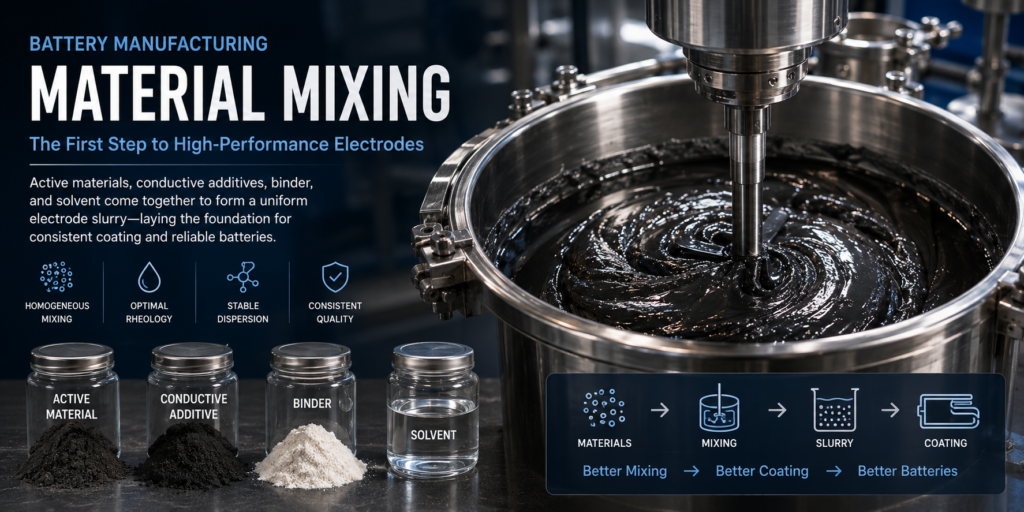
Battery material mixing is one of the first major processes in lithium-ion battery electrode manufacturing.
Before cathode and anode materials can be coated onto metal current collectors, powdered active materials must be combined with conductive additives, binders, and solvents to create a uniform mixture known as an electrode slurry.
The goal is not simply to mix ingredients together.
The materials must be distributed uniformly so that the slurry has the appropriate viscosity, stability, dispersion, and coating characteristics required by the next manufacturing process.
Poor mixing can lead to non-uniform electrodes, coating defects, inconsistent electrical conductivity, and ultimately variation in battery performance.
For this reason, mixing is a critical starting point for controlling electrode quality.
At a Glance
| Category | Description |
|---|---|
| Process | Battery Material Mixing |
| Stage | Electrode Manufacturing |
| Input | Active Material · Conductive Additive · Binder · Solvent |
| Output | Electrode Slurry |
| Key Controls | Dispersion · Viscosity · Mixing Time · Temperature |
| Next Process | Electrode Coating |
What Is Battery Material Mixing?
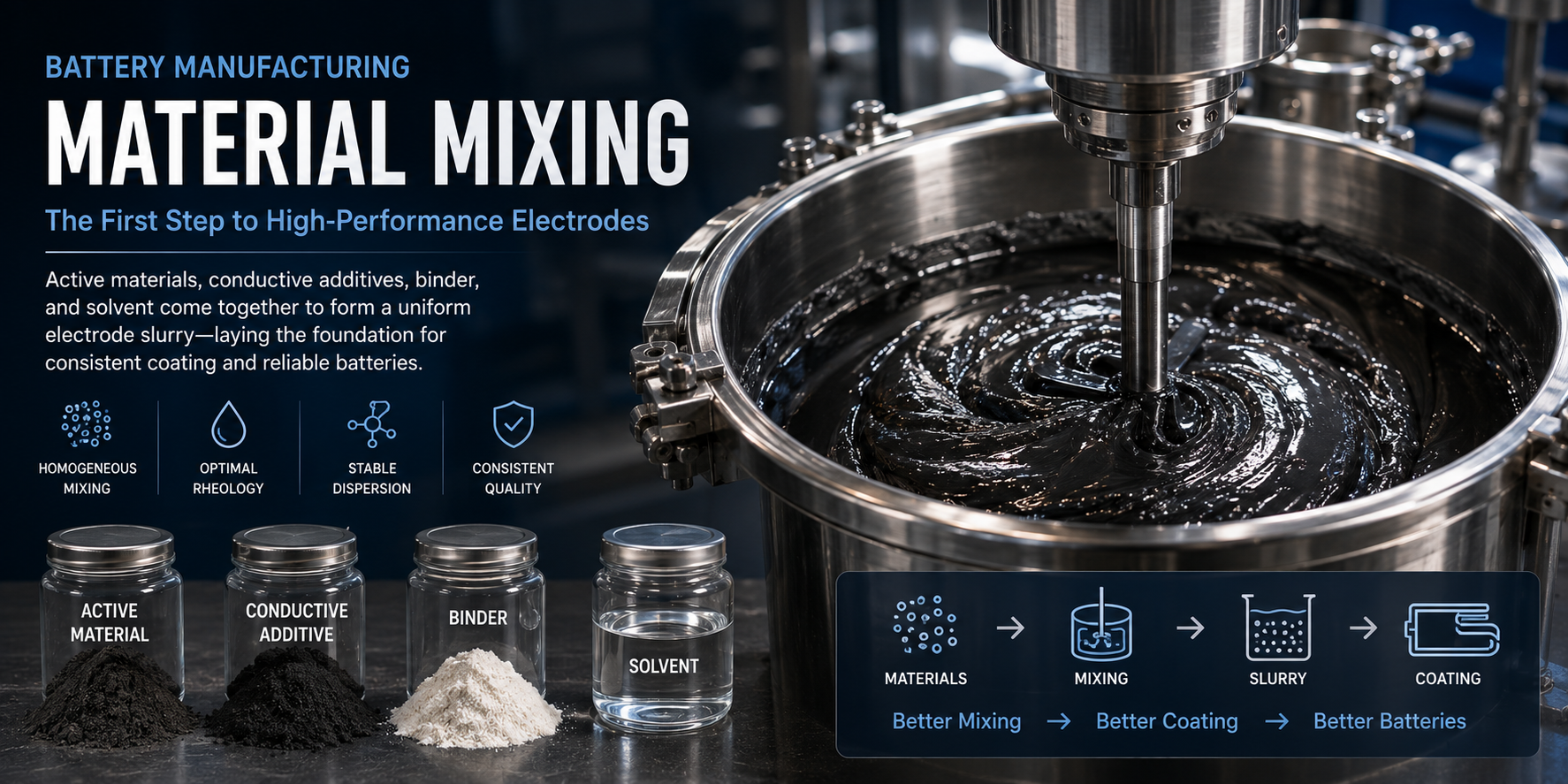
Battery material mixing is the process of combining the materials required to manufacture a battery electrode.
A simplified formulation consists of:
- Active Material
- Conductive Additive
- Binder
- Solvent
↓
Mixing & Dispersion
↓
Electrode Slurry
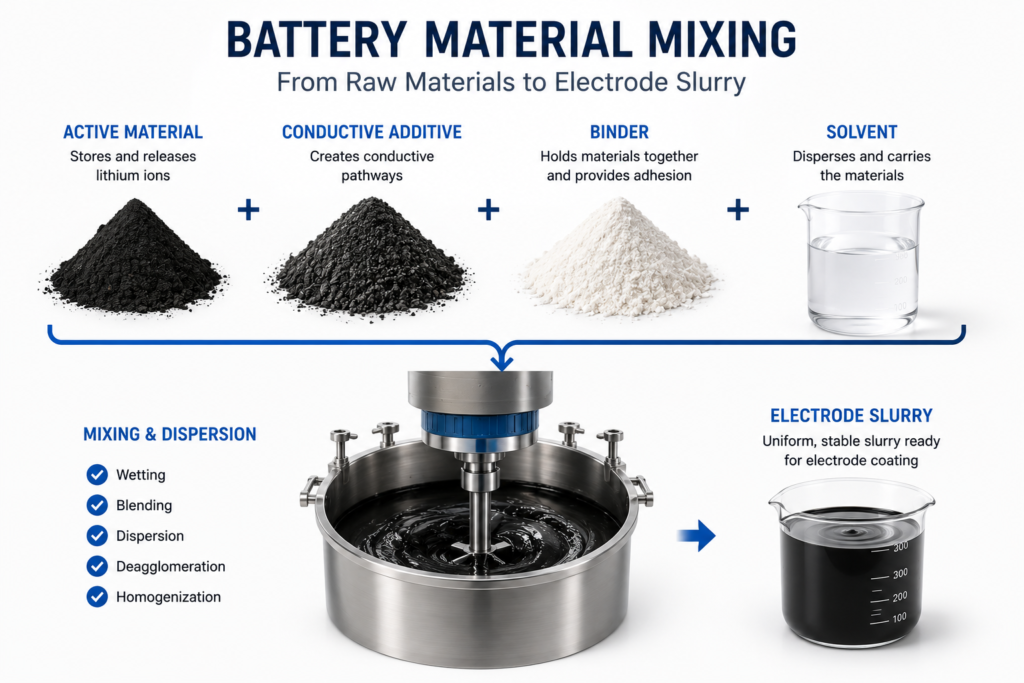
The resulting slurry must be sufficiently uniform to be coated consistently onto a current collector.
For cathodes, that current collector is typically aluminum foil.
For anodes, copper foil is commonly used.
Mixing therefore creates the bridge between battery materials and electrode manufacturing.
What Goes Into an Electrode Slurry?
An electrode slurry contains several components, each with a different function.
Active Material
The active material stores and releases lithium ions during battery operation.
Examples include:
Cathode
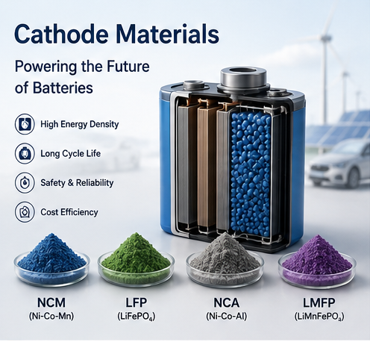
- LFP
- NMC
- NCA
Anode
- Graphite
- Silicon-Graphite
The active material generally represents the largest portion of the electrode’s solid content.
Conductive Additive
Many active materials do not provide sufficient electronic conductivity on their own.
Conductive additives create conductive pathways throughout the electrode.
Common examples include:
- Carbon Black
- Conductive Carbon
- Carbon Nanotubes (CNT)
Their purpose is to help electrons move efficiently through the electrode structure.
Binder
The binder holds the electrode materials together and helps them adhere to the current collector.
Without sufficient binding strength, electrode material can crack, separate, or detach during manufacturing and battery cycling.
Common examples include:
Cathode
- PVDF
Anode
- SBR
- CMC
Binder selection depends on electrode chemistry and the manufacturing process.
Solvent
The solvent helps create a processable slurry by dispersing or dissolving the other components.
A common cathode manufacturing system uses:
PVDF + NMP
Many graphite anode processes use water-based systems involving:
CMC + SBR + Water
The choice of solvent affects slurry preparation as well as the subsequent drying process.
Cathode vs Anode Mixing
Cathode and anode slurry preparation follow the same basic principle but can use different material systems.
| Cathode Slurry | Anode Slurry | |
| Active Material | LFP · NMC · NCA | Graphite · Silicon-Graphite |
| Conductive Material | Carbon-based additives | Carbon-based additives |
| Typical Binder | PVDF | CMC · SBR |
| Typical Solvent | NMP | Water |
| Current Collector | Aluminum | Copper |
These differences influence mixing conditions, slurry behavior, drying requirements, and manufacturing equipment.
Mixing Is More Than Blending
Producing a battery slurry requires more than simply rotating several ingredients together.
Powder particles can form agglomerates, creating regions where materials are not distributed uniformly.
The mixing process therefore performs several functions:
Wetting -> Blending -> Dispersion -> Deagglomeration -> Homogenization
The objective is to distribute the different materials throughout the slurry while achieving stable and repeatable rheological properties.
Why Dispersion Matters
Imagine a slurry where conductive carbon is concentrated in only one region.
Some areas of the final electrode may have strong electrical conductivity, while others may have poor conductive pathways.
Likewise, uneven binder distribution can affect adhesion between the electrode coating and current collector.
Good dispersion helps create a more uniform electrode structure.
This can influence:
- Electrical conductivity
- Electrode adhesion
- Coating uniformity
- Cell consistency
- Battery performance
Mixing quality therefore affects downstream processes long after the slurry leaves the mixer.
Slurry Viscosity
One of the most important slurry characteristics is viscosity.
Viscosity describes a fluid’s resistance to flow.
If the slurry viscosity is too low, the material may flow excessively during coating.
If it is too high, pumping and coating can become difficult.
The appropriate viscosity depends on factors such as:
- Material composition
- Solid content
- Particle characteristics
- Binder concentration
- Solvent content
- Temperature
- Shear conditions
The objective is not simply to achieve a high or low viscosity but to create a slurry that behaves consistently under the intended coating conditions.
Slurry Rheology
Battery slurry behavior can be more complicated than the viscosity of a simple liquid.
Many electrode slurries exhibit non-Newtonian behavior, meaning their apparent viscosity changes depending on the applied shear conditions.
This is why slurry rheology is important.
Manufacturers need to understand how the slurry behaves during:
- Mixing
- Pumping
- Transport
- Filtration
- Coating
A slurry that appears stable inside a storage container may behave differently when pumped through a coating system.
Key Mixing Parameters
Several process variables influence the quality of electrode slurry.
| Parameter | Why It Matters |
| Mixing Speed | Influences shear and dispersion |
| Mixing Time | Determines how completely materials are distributed |
| Temperature | Influences viscosity and material behavior |
| Material Addition Sequence | Affects wetting and dispersion |
| Solid Content | Influences slurry viscosity and coating |
| Vacuum Conditions | Can help reduce entrapped air |
| Particle Dispersion | Influences electrode uniformity |
These variables must be optimized for each electrode formulation.
Material Addition Sequence
The order in which materials are introduced into the mixer can influence slurry quality.
For example, the binder may first be prepared with the appropriate solvent before active and conductive materials are progressively introduced.
However, the exact sequence depends on:
- Electrode chemistry
- Binder system
- Mixer design
- Manufacturing recipe
There is therefore no single universal mixing sequence for every lithium-ion battery electrode.
Manufacturers develop specific mixing recipes to achieve consistent slurry characteristics.
Mixing Equipment
Battery electrode slurry can be produced using different mixing technologies depending on production scale and material characteristics.
Typical systems may include:
- Planetary Mixers
- High-Shear Mixers
- Dual-Shaft Mixers
- Continuous Mixing Systems
Industrial mixing systems may also incorporate:
- Vacuum operation
- Temperature control
- Automated material feeding
- Process monitoring
- Slurry discharge systems
As battery production scales, manufacturers increasingly focus on improving mixing consistency while reducing process time and energy consumption.
Why Vacuum Mixing Is Used
Air can become trapped in slurry during material loading and mixing.
Entrapped bubbles may create problems during downstream coating.
Vacuum operation can help remove trapped gases and improve slurry uniformity before coating.
This is particularly important when stable, defect-free electrode coatings are required.
From Mixing to Coating
Once the slurry meets the required process specifications, it moves to the next stage:
Electrode Coating
The slurry is delivered to a coating system and applied onto a metallic current collector.
For the cathode:
Cathode Slurry → Aluminum Foil
For the anode:
Anode Slurry → Copper Foil
The quality of the coating process therefore depends heavily on the slurry produced during mixing.
A coating machine cannot fully compensate for poorly prepared slurry.
Common Mixing Problems
Poorly controlled mixing can create several manufacturing problems.
Agglomeration
Particles remain clustered instead of being uniformly dispersed.
Air Bubbles
Entrapped air can contribute to coating defects.
Incorrect Viscosity
The slurry may become difficult to pump or coat uniformly.
Non-uniform Binder Distribution
Adhesion can vary across the electrode.
Sedimentation
Solid particles can settle if slurry stability is insufficient.
Batch-to-Batch Variation
Different batches may behave differently during coating, creating inconsistent electrode quality.
Controlling these issues is important for stable mass production.
Quality Control
Before slurry proceeds to electrode coating, manufacturers may evaluate characteristics such as:
- Viscosity
- Solid content
- Particle dispersion
- Density
- Temperature
- Slurry stability
More advanced analysis can also evaluate particle-size distribution and rheological behavior.
The purpose is to confirm that the slurry meets the required manufacturing specification before coating begins.
Atlas Insight
Mixing may appear to be one of the simplest steps in battery manufacturing, but it has a disproportionate influence on downstream quality.
Modern electrodes are becoming increasingly complex.
Silicon-containing anodes, high-nickel cathodes, advanced conductive networks, and dry-electrode technologies are creating new requirements for material dispersion and process control.
At the same time, battery manufacturers are exploring continuous mixing as an alternative to conventional batch production.
Continuous systems may offer advantages in production consistency, footprint, energy consumption, and manufacturing throughput.
As battery factories become larger and more automated, slurry preparation is evolving from a basic material-mixing operation into a highly controlled materials-engineering process.
Did You Know?
- Electrode slurry contains more than just active battery material.
- Cathode and anode slurry can use very different binder and solvent systems.
- Cathode electrodes are commonly coated onto aluminum foil.
- Anode electrodes are commonly coated onto copper foil.
- Slurry viscosity directly influences downstream coating behavior.
- Vacuum can be used to reduce entrapped air in the slurry.
- Mixing quality can influence battery performance several manufacturing steps later.
FAQ
What is battery material mixing?
Battery material mixing combines active material, conductive additives, binder, and solvent to create a homogeneous electrode slurry.
What is battery slurry?
Battery slurry is the mixture applied to a current collector during electrode coating.
Why is binder added?
Binder helps hold electrode particles together and provides adhesion between the electrode coating and current collector.
Why are conductive additives needed?
They help create electronic conduction pathways throughout the electrode.
What is the difference between cathode and anode slurry?
They use different active materials and can also use different binder and solvent systems. Cathode production commonly uses PVDF/NMP systems, while graphite anodes frequently use water-based CMC/SBR systems.
Why is viscosity important?
Viscosity influences slurry transport and how uniformly the slurry can be applied during electrode coating.
What comes after battery mixing?
The prepared slurry moves to the electrode coating process, where it is applied to aluminum or copper current collectors.
Battery Manufacturing Learning Path
Overview
Part 1 — Electrode Manufacturing
- Material Mixing
- Slurry
- Electrode Coating
- Electrode Drying
- Calendering
- Slitting
Part 2 — Cell Assembly
- Battery Cell Assembly
- Notching
- Winding
- Stacking
- Electrolyte Filling
- Cell Sealing
Part 3 — Cell Finishing
- Formation
- Aging
- Degassing
- Battery Cell Testing & Grading
Part 4 — System Assembly
- Battery Module Assembly
- Battery Pack Assembly
Explore More
Fundamentals
- Battery
- Lithium-ion Battery
- Battery Cell
- Battery Module
- Battery Pack
- Battery Management System(BMS)
- Battery Thermal Management System(BTMS)
- Battery Safety
Materials
Manufacturing
- Battery Manufacturing Process
- Material Mixing (Current)
- Slurry
- Electrode Coating
- Calendering
- Slitting
- Cell Assembly
- Formation
Technologies
- Dry Electrode Technology
- Fast Charging
- Solid-state Battery
References
Recommended source categories for this article:
- U.S. Department of Energy (DOE) – Battery Manufacturing
- Argonne National Laboratory – Battery Manufacturing Research
- International Energy Agency (IEA) – Batteries and Secure Energy Transitions
- Journal of Power Sources – Battery Manufacturing Research
- Nature Energy – Battery Manufacturing and Technology
About iAtlas
iAtlas is an independent publication covering batteries, semiconductors, OLED, advanced materials, AI, and global industrial trends.
We transform complex industrial developments into clear, reliable, and easy-to-understand insights.
Whether you’re following today’s industry news or building long-term expertise, iAtlas helps you understand not only what happened, but why it matters.
Technology creates change.
Insight creates opportunity.
— iAtlas