Battery Manufacturing Process Explained: From Raw Materials to Finished Lithium-Ion Cells
🔋 iAtlas Battery #28 | 🏭 Manufacturing → 🔋 Battery Manufacturing Process
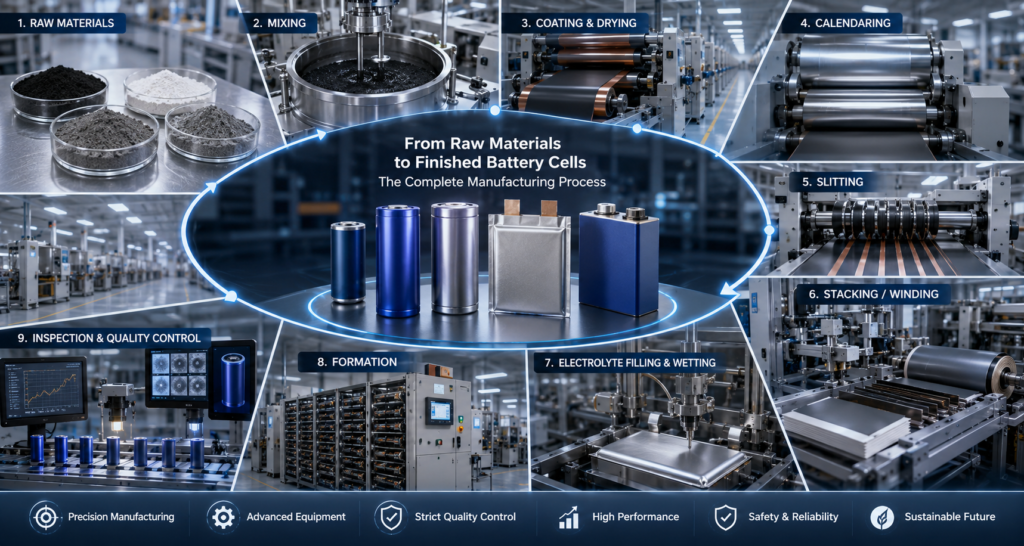
A lithium-ion battery may look like a simple energy-storage device, but producing one requires a long sequence of tightly controlled manufacturing processes.
Active materials must first be mixed into a uniform slurry. That slurry is coated onto metal current collectors, dried, compressed, and cut into precisely sized electrodes. The electrodes are then assembled into cells, filled with electrolyte, activated through formation, and inspected before they can move to module or pack production.
Each stage affects the next.
A coating defect can become an electrode defect. Poor slitting can create problems during cell assembly. Incomplete electrolyte wetting can influence formation. And defects created anywhere in the process may ultimately appear during final inspection.
Understanding the complete battery manufacturing process therefore requires more than learning individual machines. It requires understanding how materials, processes, equipment, and quality control work together.
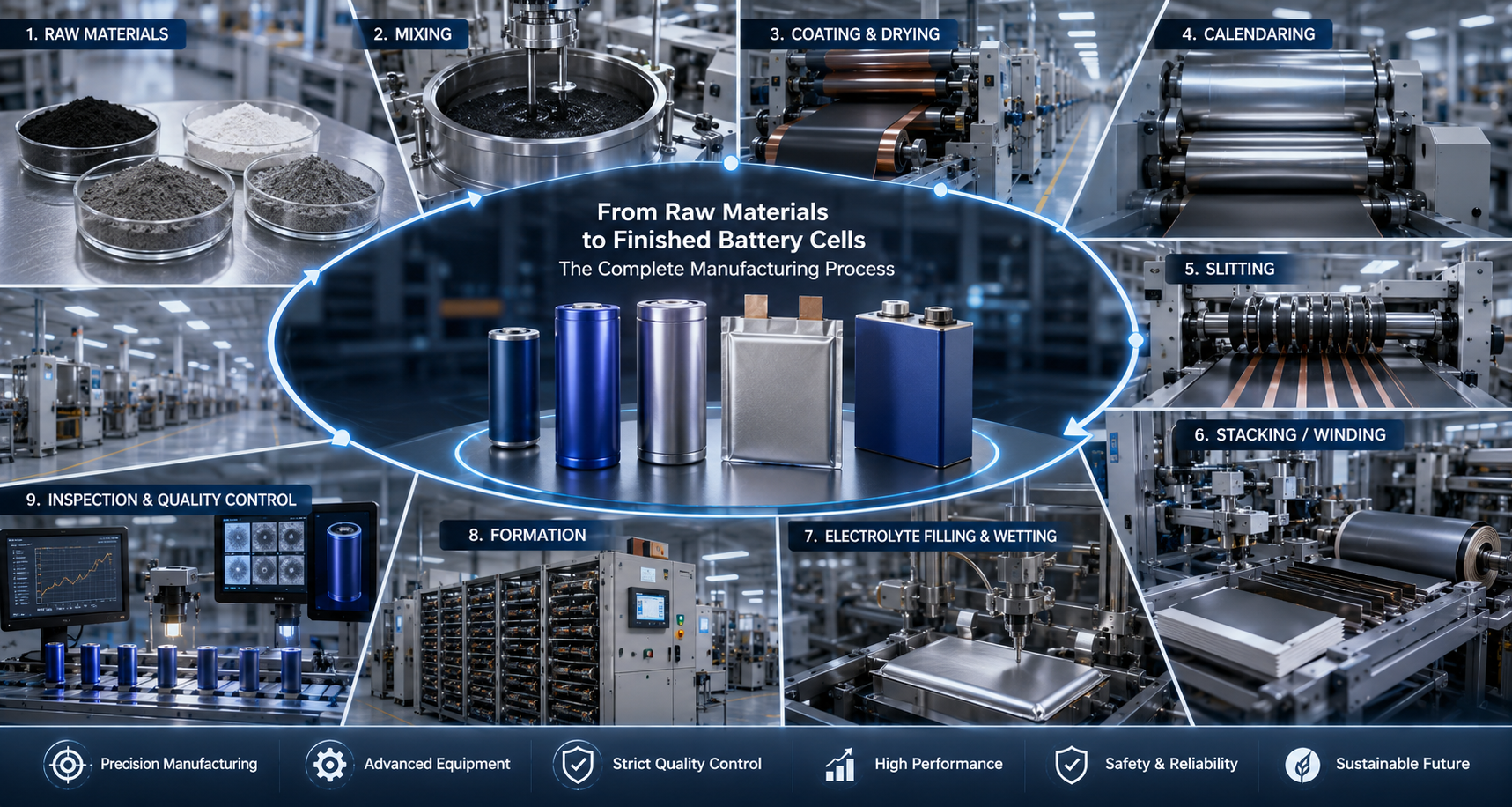
This guide connects the major stages of lithium-ion battery cell manufacturing—from raw materials to finished cells—and explains why each step matters.
Table of Contents
- What Is the Battery Manufacturing Process?
- Stage 1: Raw Materials and Electrode Mixing
- Stage 2: Electrode Coating
- Stage 3: Electrode Drying
- Stage 4: Calendaring
- Stage 5: Slitting
- Stage 6: Stacking or Winding
- Stage 7: Electrolyte Filling and Wetting
- Stage 8: Formation
- Stage 9: Inspection and Quality Control
- Why Manufacturing Environment Matters
- How the Entire Process Connects
- Frequently Asked Questions
- Key Takeaways
1. What Is the Battery Manufacturing Process?
The battery manufacturing process transforms battery materials into finished electrochemical cells through a sequence of electrode manufacturing, cell assembly, activation, and quality-control steps.
A simplified lithium-ion battery production flow can be represented as:
Raw Materials → Mixing → Coating → Drying → Calendaring → Slitting → Stacking/Winding → Electrolyte Filling → Wetting → Formation → Inspection → Finished Cell

These processes can be grouped into four major stages.
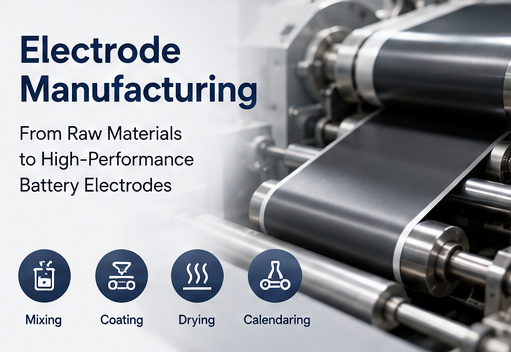
Electrode Manufacturing
- Mixing
- Coating
- Drying
- Calendaring
- Slitting
Cell Assembly
- Stacking or winding
- Cell insertion
- Tab and terminal-related assembly
- Cell enclosure and sealing steps
Cell Finishing
- Electrolyte filling
- Wetting
- Formation
- Aging
Quality Control
- Electrical testing
- Visual inspection
- Dimensional inspection
- Internal inspection
- Leak testing
- Cell grading
The exact sequence varies according to cell format, chemistry, and manufacturer, but these stages represent the fundamental structure of modern lithium-ion battery production.
2. Stage 1: Raw Materials and Electrode Mixing
Battery production begins with electrode materials.
For the cathode, active material is combined with conductive additives, binder, and a suitable solvent or processing medium. The anode follows a similar preparation process using its own material system.
These ingredients are processed using battery mixing equipment to produce a homogeneous slurry.
Mixing quality affects:
- Particle distribution
- Slurry viscosity
- Coating uniformity
- Electrode consistency
- Final cell performance
Poorly mixed slurry can cause problems during coating and may eventually lead to non-uniform electrochemical behavior.
Mixing is therefore much more than material preparation—it establishes the foundation for subsequent electrode manufacturing.
Related: 🔋 iAtlas Battery #18 — Battery Mixing Equipment
3. Stage 2: Electrode Coating
Once the slurry reaches the required properties, it is applied to a metallic current collector.
Typically:
- Cathode → Aluminum foil
- Anode → Copper foil
Battery coating equipment controls the amount and distribution of slurry applied across the moving foil.
Slot-die coating is widely used because it provides precise control over coating thickness and uniformity.
Important parameters include:
- Coating thickness
- Coating width
- Web speed
- Slurry flow
- Edge quality
- Surface uniformity
Variations created during coating can affect electrode loading and ultimately cell capacity.
Related: 🔋 iAtlas Battery #19 — Battery Coating Equipment
4. Stage 3: Electrode Drying
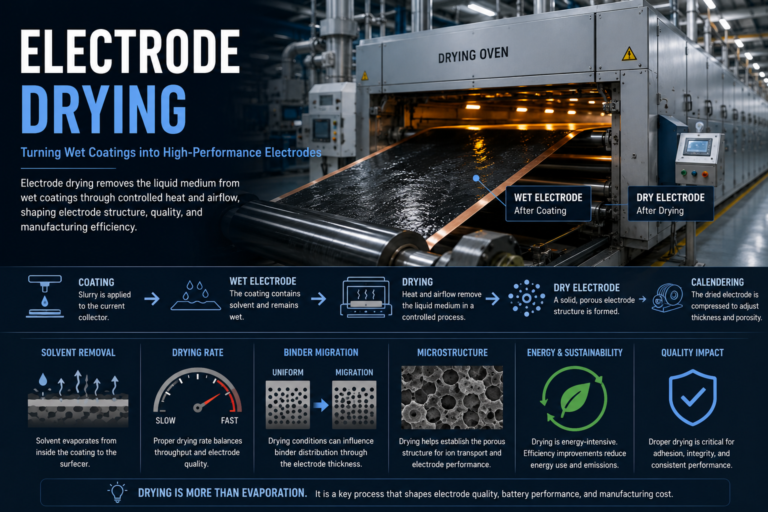
Freshly coated electrodes still contain solvent or moisture that must be removed before later manufacturing processes.
The coated foil therefore passes through a controlled drying system.
Battery drying equipment carefully manages:
- Temperature
- Airflow
- Residence time
- Solvent removal
- Web stability
Drying too quickly can create binder migration or surface defects, while insufficient drying may leave unwanted residual material.
Drying conditions must therefore balance production speed with electrode quality.
Related: 🔋 iAtlas Battery #20 — Battery Drying Equipment
5. Stage 4: Calendaring
After drying, electrodes pass through precision rollers.
This process is called calendaring.
Battery calendaring equipment compresses the electrode to achieve target:
- Thickness
- Density
- Porosity
- Surface uniformity
Increasing compression generally increases electrode density, but excessive compression can reduce pore volume and affect electrolyte penetration.
Calendaring therefore requires careful control between energy density and electrochemical transport characteristics.
Related: 🔋 iAtlas Battery #21 — Battery Calendaring Equipment
6. Stage 5: Slitting
Electrodes are typically manufactured as wide rolls.
Before cell assembly, these rolls must be divided into narrower dimensions that match the intended cell design.
Battery slitting equipment uses precision cutting systems to produce electrode strips with controlled width and edge quality.
Important concerns include:
- Burr formation
- Cutting accuracy
- Dust generation
- Edge cracking
- Web tension
- Blade condition
Poor slitting quality can create downstream assembly problems and, in severe cases, increase the risk of internal defects.
Related: 🔋 iAtlas Battery #22 — Battery Slitting Equipment
7. Stage 6: Stacking or Winding
Once the electrodes are prepared, cathodes, anodes, and separators must be assembled into the internal structure of the cell.
There are two major approaches.
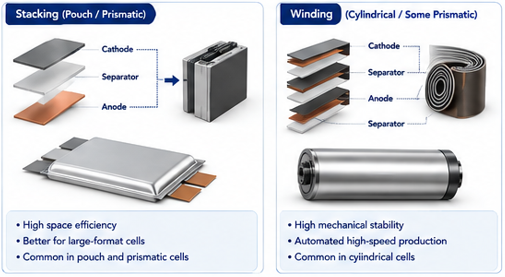
Stacking
Battery stacking equipment places electrode sheets and separators into a layered structure.
Stacking is commonly associated with pouch cells and is also used in various prismatic cell designs.
Critical factors include:
- Layer alignment
- Separator handling
- Positioning accuracy
- Contamination control
Related: 🔋 iAtlas Battery #23 — Battery Stacking Equipment
Winding
Battery winding equipment continuously winds electrodes and separators into a spiral structure often called a jelly roll.
Winding is widely used for cylindrical cells and is also used in some prismatic designs.
Important variables include:
- Winding tension
- Separator tension
- Electrode alignment
- Winding speed
- Final geometry
Related: 🔋 iAtlas Battery #24 — Battery Winding Equipment
8. Stage 7: Electrolyte Filling and Wetting
The assembled cell structure still cannot operate without electrolyte.
Electrolyte provides the ion-conducting pathway between the cathode and anode.
Battery electrolyte filling equipment dispenses a controlled amount of electrolyte into the cell.
Vacuum-assisted processes can help remove trapped air and promote electrolyte penetration.
Critical parameters include:
- Filling amount
- Vacuum level
- Filling speed
- Electrolyte temperature
- Moisture control
After filling, sufficient time is required for electrolyte to penetrate the porous electrode and separator structures. This is generally referred to as wetting.
Incomplete wetting may contribute to increased resistance and non-uniform electrochemical behavior.
Related: 🔋 iAtlas Battery #25 — Battery Electrolyte Filling Equipment
9. Stage 8: Formation
Electrolyte-filled cells then undergo their first controlled electrochemical activation.
This process is known as formation.
Battery formation equipment applies carefully controlled charge and discharge profiles while monitoring cell behavior.
One of the most important events during early formation is the development of the Solid Electrolyte Interphase (SEI) on the anode.
Formation systems monitor parameters such as:
- Voltage
- Current
- Capacity
- Temperature
- Time
Formation is particularly important because conditions during the first charge can influence long-term cell performance.
Related: 🔋 iAtlas Battery #26 — Battery Formation Equipment
10. Stage 9: Inspection and Quality Control
The final stages verify whether manufactured cells meet required quality specifications.
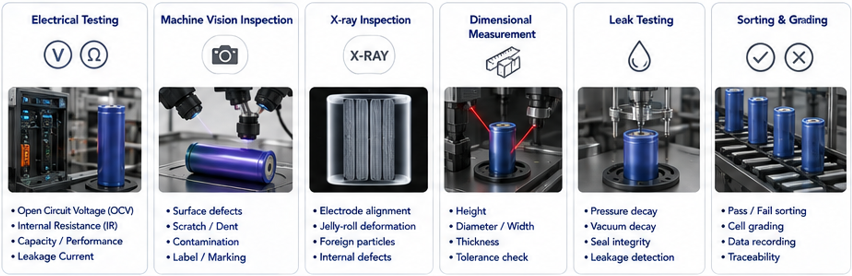
Modern battery inspection equipment may combine several technologies.
Electrical Inspection
Measures parameters such as:
- Open Circuit Voltage (OCV)
- Internal resistance
- Capacity
Vision Inspection
Detects:
- Surface damage
- Contamination
- Dimensional abnormalities
- External defects
X-ray Inspection
Provides non-destructive examination of internal structures such as electrode alignment and wound assemblies.
Leak Testing
Checks whether the cell enclosure maintains adequate sealing integrity.
Inspection data can also be connected with production records to improve traceability and process optimization.
Related: 🔋 iAtlas Battery #27 — Battery Inspection Equipment
11. Why Manufacturing Environment Matters
Battery manufacturing does not depend only on machines.
The surrounding manufacturing environment also plays an important role.
Moisture Control
Certain battery materials and electrolytes are sensitive to moisture.
Processes such as cell assembly and electrolyte handling therefore require tightly controlled humidity conditions.
Particle Control
Foreign particles can introduce defects into electrodes or assembled cells.
Clean manufacturing environments help minimize contamination.
Temperature Control
Temperature affects:
- Slurry behavior
- Drying
- Electrolyte viscosity
- Formation
- Measurement consistency
Process Traceability
Modern battery factories collect data across multiple manufacturing stages.
Instead of evaluating only the final cell, manufacturers can trace quality information back through individual production processes.
12. How the Entire Battery Manufacturing Process Connects
One of the most important lessons in battery manufacturing is that no process operates independently.
Consider this chain:
Mixing quality
↓
affects coating uniformity
Coating uniformity
↓
affects electrode loading
Drying conditions
↓
affect electrode structure
Calendaring
↓
controls thickness, density, and porosity
Slitting quality
↓
affects electrode edge condition
Stacking or winding
↓
determines internal alignment
Electrolyte filling
↓
affects wetting
Formation
↓
stabilizes electrochemical behavior
Inspection
↓
determines whether the final cell meets quality requirements
This is why battery manufacturing should be understood as an integrated production system, rather than as a collection of independent machines.

13. Frequently Asked Questions
What are the main stages of the battery manufacturing process?
Lithium-ion battery manufacturing can broadly be divided into electrode manufacturing, cell assembly, cell finishing, and quality control.
What happens first in battery manufacturing?
At the electrode production level, raw materials are prepared and mixed into electrode slurry before coating onto current collectors.
What is the difference between stacking and winding?
Stacking builds the electrode assembly layer by layer, while winding rolls electrodes and separators into a spiral structure.
Why is moisture control important?
Some battery materials and electrolyte systems are sensitive to moisture, making controlled environments important during specific manufacturing stages.
Why is formation necessary?
Formation performs the first controlled electrochemical activation of the cell and supports the development of stable interfacial layers such as the SEI.
What is the final battery manufacturing step?
The exact sequence varies by manufacturer, but cells generally undergo aging, testing, inspection, grading, and other finishing steps before proceeding to module or pack production.
14. Key Takeaways
- The battery manufacturing process consists of multiple interconnected stages rather than one single production step.
- Electrode manufacturing includes mixing, coating, drying, calendaring, and slitting.
- Cell assembly typically uses either stacking or winding depending on the cell design.
- Electrolyte filling and wetting prepare the assembled cell for electrochemical activation.
- Formation establishes the cell’s initial electrochemical behavior.
- Inspection verifies electrical, dimensional, external, and internal quality.
- A defect introduced early in production can influence multiple downstream processes.
- Understanding the complete process is essential for understanding how lithium-ion battery quality is created.
📚 Key Terms
Battery Manufacturing Process
The complete sequence of processes used to transform battery materials into finished lithium-ion cells, including electrode manufacturing, cell assembly, electrolyte filling, formation, and quality control.
Electrode Manufacturing
The production stage in which active materials are mixed, coated onto current collectors, dried, calendared, and slit to produce battery electrodes.
Cell Assembly
The manufacturing stage where cathodes, anodes, and separators are assembled through stacking or winding and placed into the cell enclosure.
Cell Finishing
Processes performed after cell assembly, including electrolyte filling, wetting, formation, aging, and related finishing operations.
Stacking
A cell assembly method that arranges cathodes, separators, and anodes layer by layer to create a flat electrode structure.
Winding
A cell assembly method that rolls cathodes, separators, and anodes together to create a spiral electrode structure commonly known as a jelly roll.
Formation
The first controlled electrochemical activation of a battery cell. Formation helps establish stable interfacial layers such as the SEI and prepares the cell for normal operation.
Quality Control
Inspection and testing activities used throughout battery manufacturing to identify defects, verify specifications, and ensure production consistency.
Process Traceability
The ability to connect manufacturing conditions, equipment data, inspection results, and other production information to individual cells or production batches.
🎓 Battery Learning Path
🏭 Manufacturing
📍 iAtlas Battery #28 — Battery Manufacturing Process (Current)
▶ Electrode Manufacturing
▶ Cell Assembly
▶ Cell Finishing
▶ Quality Control
Welcome to the Battery Manufacturing Learning Path, where you’ll explore how materials, processes, equipment, and quality control work together to transform battery materials into finished lithium-ion cells.
⚙️ Equipment Learning Path — Completed
If you want to explore the individual machines behind the manufacturing process:
✅ iAtlas Battery #18 — Mixing Equipment
✅ iAtlas Battery #19 — Coating Equipment
✅ iAtlas Battery #20 — Drying Equipment
✅ iAtlas Battery #21 — Calendaring Equipment
✅ iAtlas Battery #22 — Slitting Equipment
✅ iAtlas Battery #23 — Stacking Equipment
✅ iAtlas Battery #24 — Winding Equipment
✅ iAtlas Battery #25 — Electrolyte Filling Equipment
✅ iAtlas Battery #26 — Formation Equipment
✅ iAtlas Battery #27 — Inspection Equipment
📖 Continue Reading
⬅ Previous Learning Path
🔋 iAtlas Battery #27
Battery Inspection Equipment Explained: How Manufacturers Verify Battery Quality Before Shipment
Learn how machine vision, electrical testing, X-ray inspection, dimensional measurement, and leak testing help manufacturers identify defective battery cells and maintain production quality.
➡ Next Article
🔋 iAtlas Battery #29
Battery Electrode Manufacturing Explained: From Slurry Mixing to Finished Electrodes
Discover how mixing, coating, drying, calendaring, and slitting work together to transform battery materials into precisely manufactured electrodes.
📚 References
Industry & Manufacturing
- U.S. Department of Energy – Vehicle Technologies Office
- Argonne National Laboratory – ReCell Center
- International Energy Agency (IEA) – Global EV Outlook
Research
🔷 About iAtlas
iAtlas is an independent publication dedicated to making industrial knowledge more accessible.
From batteries and semiconductors to advanced materials, AI, and global manufacturing, iAtlas transforms complex technologies into practical, easy-to-understand insights.
Whether you’re following today’s industry news or building long-term expertise, iAtlas helps you understand not only what happened, but why it matters.
Technology creates change.
Insight creates opportunity.
— iAtlas