Battery Calendaring Equipment Explained: 7 Ways Roll Pressing Improves Battery Performance
🔋 iAtlas Battery #21 | ⚙️ Equipment → 🏭 Calendaring Equipment
After an electrode has been coated and dried, it is not yet ready for battery assembly. The coating still contains microscopic pores, an uneven surface, and a thickness that may vary slightly across the electrode.
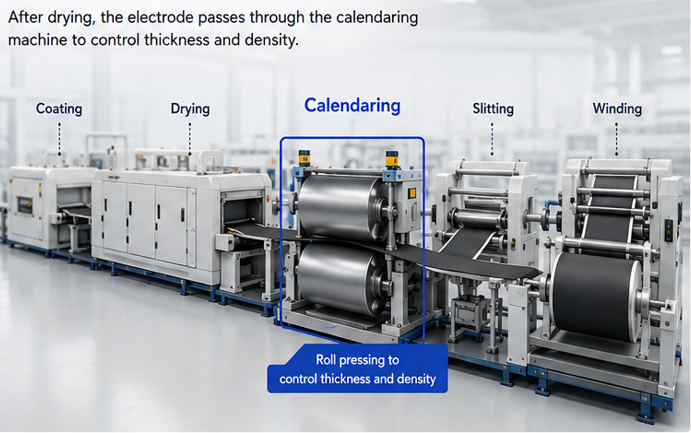
The next step is calendaring—a precision roll-pressing process that compresses the electrode to a target thickness and density. Although it may appear to be a simple mechanical operation, calendaring plays a crucial role in determining energy density, electrical conductivity, and long-term battery performance.
By carefully controlling pressure, roll temperature, and line speed, manufacturers can optimize the internal structure of the electrode while maintaining production consistency.
This article explains how battery calendaring equipment works, why it is essential in lithium-ion battery manufacturing, and the key technologies shaping modern roll-press systems.
Table of Contents
- What Is Battery Calendaring Equipment?
- Why Calendaring Matters
- Main Components of a Calendaring Line
- How the Calendaring Process Works
- Critical Process Parameters
- Common Calendaring Defects
- Future Trends in Calendaring Equipment
- Frequently Asked Questions
- Key Takeaways
1. What Is Battery Calendaring Equipment?
Battery calendaring equipment compresses coated and dried electrodes between two precision rollers.
Its primary objectives are to:
- Reduce electrode thickness
- Increase electrode density
- Improve particle contact
- Create a smoother surface
- Ensure uniform thickness across the electrode
Unlike ordinary industrial rolling machines, battery calenders require extremely high precision. Even small variations in roll pressure or gap can affect battery performance and manufacturing yield.
After calendaring, the electrode moves to the slitting process, where it is cut into the required widths for cell assembly.
2. Why Calendaring Matters
Calendaring influences several key properties of a lithium-ion battery.
Increasing Energy Density
Compressing the electrode reduces its thickness while increasing the amount of active material within a given volume.
Higher electrode density generally improves volumetric energy density, allowing more energy to be stored in the same battery size.
Improving Electrical Conductivity
Calendaring increases contact between active materials and conductive additives.
This reduces internal resistance and enables electrons to move more efficiently through the electrode.
Controlling Porosity
Not all pores should be eliminated.
A certain level of porosity is required for electrolyte penetration and lithium-ion transport.
The challenge is to achieve the right balance between:
- High density
- Adequate porosity
- Good ionic conductivity
Surface Uniformity
The roll-press process also smooths the electrode surface.
A more uniform surface improves downstream processes such as:
- Slitting
- Stacking
- Winding
It also reduces thickness variation within the finished cell.
3. Main Components of a Calendaring Line
A battery calendaring system consists of several integrated components.
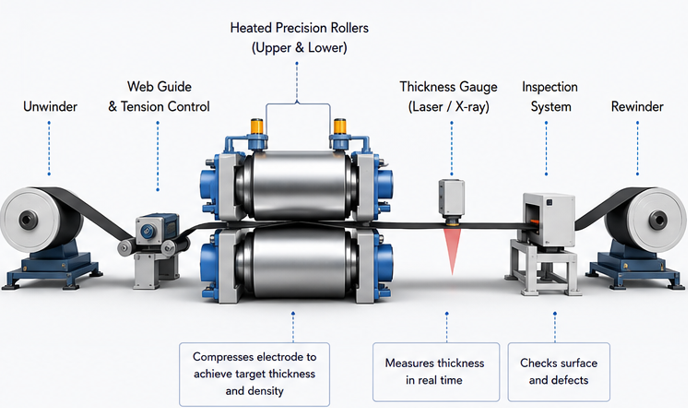
Precision Rollers
The rollers apply controlled pressure to compress the electrode.
Their surface finish and diameter directly influence thickness accuracy and surface quality.
Roll Gap Control
The distance between the rollers determines the final electrode thickness.
Modern systems automatically adjust the roll gap using servo-controlled actuators with micrometer-level precision.
Heating System
Some production lines use heated rollers to improve binder flexibility and achieve more stable compression.
Roll temperature must remain uniform to avoid uneven densification.
Web Transport System
The transport system maintains constant web speed and tension throughout the process.
Stable handling prevents wrinkles and misalignment before the electrode enters the rollers.
Thickness Measurement
Laser or X-ray gauges continuously measure electrode thickness after calendaring.
The measurements are used for automatic feedback control to maintain product consistency.
4. How the Calendaring Process Works
The dried electrode enters the calendaring machine at a controlled speed.
As it passes between the rollers:
- Pressure compresses the porous coating.
- Electrode thickness decreases.
- Particle contact increases.
- Surface roughness is reduced.
- Density becomes more uniform.
The processed electrode then moves directly to inspection before entering the slitting stage.
Manufacturers carefully balance compression because excessive rolling may reduce porosity too much, limiting electrolyte penetration and ion transport.
5. Critical Process Parameters
Several variables determine calendaring quality.
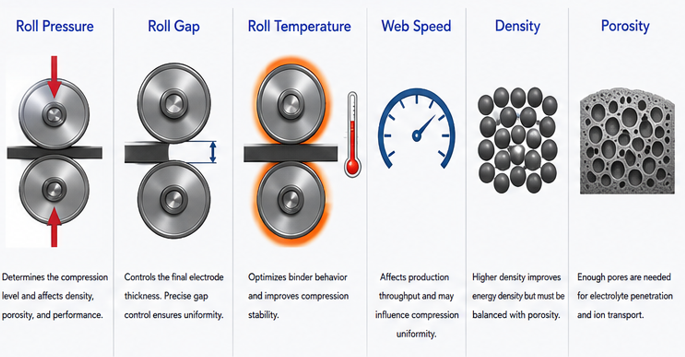
- Roll Pressure – Controls electrode compression and density.
- Roll Gap – Determines final electrode thickness.
- Roll Temperature – Influences binder behavior and compression stability.
- Web Speed – Affects production throughput and consistency.
- Electrode Density – Must meet the design specification.
- Porosity – Sufficient pores must remain for electrolyte infiltration.
These parameters are continuously monitored and adjusted during production.
6. Common Calendaring Defects
Improper calendaring may create defects that affect cell performance.
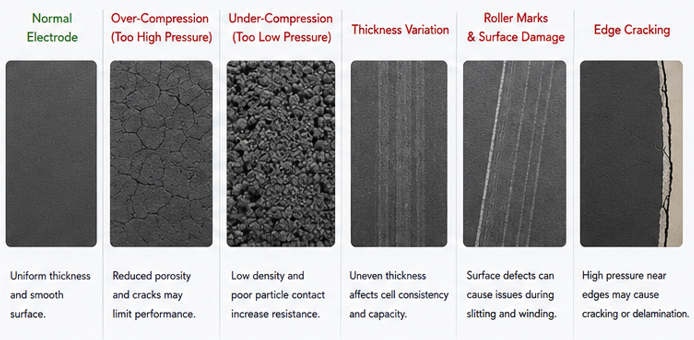
Over-Compression
- Reduced porosity
- Poor electrolyte wetting
- Lower fast-charging capability
Under-Compression
- Low density
- High internal resistance
- Reduced energy density
Thickness Variation
Uneven roll pressure or misalignment may create thickness differences across the electrode width.
Surface Damage
Excessive pressure or contaminated rollers can leave scratches or marks on the electrode.
Edge Cracking
High compression near the electrode edges may produce localized cracking, especially in thick electrodes.
7. Future Trends in Calendaring Equipment
Battery manufacturers continue to improve calendaring technology to support next-generation cells.
Key trends include:
- Wider and faster production lines
- Higher-precision servo roll-gap control
- AI-based process optimization
- Inline thickness and density measurement
- Digital twin simulation
- Equipment optimized for thick electrodes and silicon-rich anodes
These innovations help increase production efficiency while maintaining tight quality tolerances.
Why Calendaring Matters in Modern Battery Manufacturing
Modern EV batteries require higher energy density, longer cycle life, and consistent quality.
Calendaring helps manufacturers achieve these goals by controlling electrode density, thickness, and porosity before cell assembly.
As battery production scales globally, precision calendaring has become one of the most important quality-control processes in lithium-ion battery manufacturing.
8. Frequently Asked Questions
Why is calendaring performed after drying?
Drying removes solvent and stabilizes the coating. Calendaring then compresses the electrode to its final thickness and density.
Does calendaring increase battery capacity?
It can improve volumetric energy density, but excessive compression may reduce porosity and negatively affect performance.
Are cathodes and anodes calendared differently?
Yes. Different materials require different pressure, density, and porosity targets.
Can calendaring repair coating defects?
No. Major coating defects introduced during earlier processes generally cannot be corrected by roll pressing.
Why is roll temperature controlled?
Temperature affects binder flexibility and helps achieve stable, repeatable compression.
9. Key Takeaways
- Battery calendaring equipment compresses coated and dried electrodes using precision rollers.
- The process determines electrode thickness, density, and surface quality.
- Proper calendaring improves electrical conductivity, volumetric energy density, and manufacturing consistency.
- Excessive compression can reduce porosity and limit battery performance.
- Future calendaring systems will rely increasingly on automation, AI, and real-time process monitoring.
📚 Key Terms
Calendaring
A roll-pressing process that compresses coated and dried battery electrodes to achieve the target thickness, density, and surface uniformity before slitting.
Roll Gap
The precisely controlled distance between the upper and lower rollers. It determines the final electrode thickness after compression.
Roll Pressure
The force applied by the calendaring rollers to compress the electrode. Proper pressure improves particle contact while maintaining the required porosity.
Electrode Density
The amount of active material contained within a given electrode volume. Higher density generally increases volumetric energy density but must be balanced with sufficient porosity.
Porosity
The volume of microscopic pores within an electrode. Proper porosity allows electrolyte penetration and efficient lithium-ion transport.
Thickness Uniformity
The consistency of electrode thickness across its entire width and length. High uniformity improves cell consistency and manufacturing yield.
Volumetric Energy Density
The amount of energy stored per unit volume of a battery. Optimized calendaring increases volumetric energy density by reducing electrode thickness and increasing density.
🎓 Battery Learning Path
⚙️ Equipment
- ✅ #18 — Mixing Equipment
- ✅ #19 — Coating Equipment
- ✅ #20 — Drying Equipment
- 📍 #21 — Calendaring Equipment
- ▶ #22 — Slitting Equipment
- ▶ #23 — Stacking & Winding Equipment
- ▶ #24 — Electrolyte Filling Equipment
- ▶ #25 — Formation Equipment
- ▶ #26 — Inspection Equipment
📖 Continue Reading
⬅ Previous Article
🔋 iAtlas Battery #20
Battery Drying Equipment Explained: How Controlled Drying Shapes Electrode Quality
Learn how multi-zone drying ovens remove solvent while controlling binder migration, porosity, and electrode quality.
➡ Next Article
🔋 iAtlas Battery #22
Battery Slitting Equipment Explained: How Precision Cutting Improves Cell Manufacturing
Discover how slitting equipment controls electrode width, edge quality, and dimensional accuracy before cell assembly.
📚 Related Library Articles
- Battery Electrode
- Current Collector
- Porosity
- Electrode Density
- Lithium-ion Battery Manufacturing
References
- International Energy Agency (IEA)
- U.S. Department of Energy – Vehicle Technologies Office
- Battery University
- Nature Energy (Battery Manufacturing Research)
🔷 About iAtlas
iAtlas is an independent publication covering batteries, semiconductors, OLED, advanced materials, AI, and global industrial trends.
We transform complex industrial developments into clear, reliable, and easy-to-understand insights.
Whether you’re following today’s industry news or building long-term expertise, iAtlas helps you understand not only what happened, but why it matters.
Technology creates change.
Insight creates opportunity.
— iAtlas