Battery Inspection Equipment Explained: How Manufacturers Verify Battery Quality Before Shipment
🔋 iAtlas Battery #27 | ⚙️ Equipment → 🔍 Inspection Equipment
By the time a lithium-ion battery reaches the final stage of manufacturing, it has already passed through material preparation, electrode production, cell assembly, electrolyte filling, and formation. However, even after these carefully controlled processes, manufacturers cannot assume that every battery cell meets quality standards.
This is where battery inspection equipment becomes essential.
Battery inspection equipment evaluates each cell for electrical performance, dimensional accuracy, visual defects, leakage, and internal integrity before the battery is approved for shipment or pack assembly.
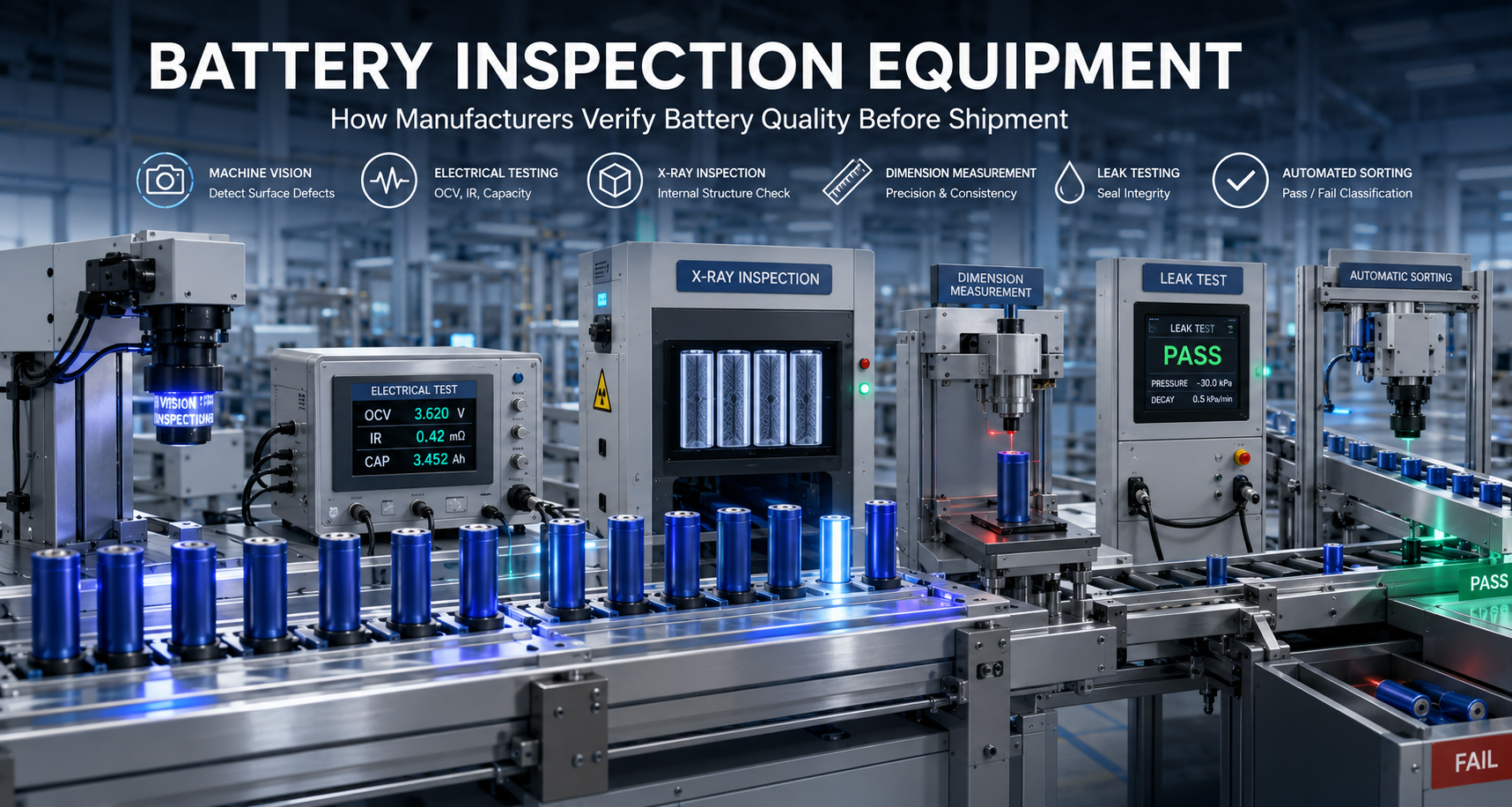
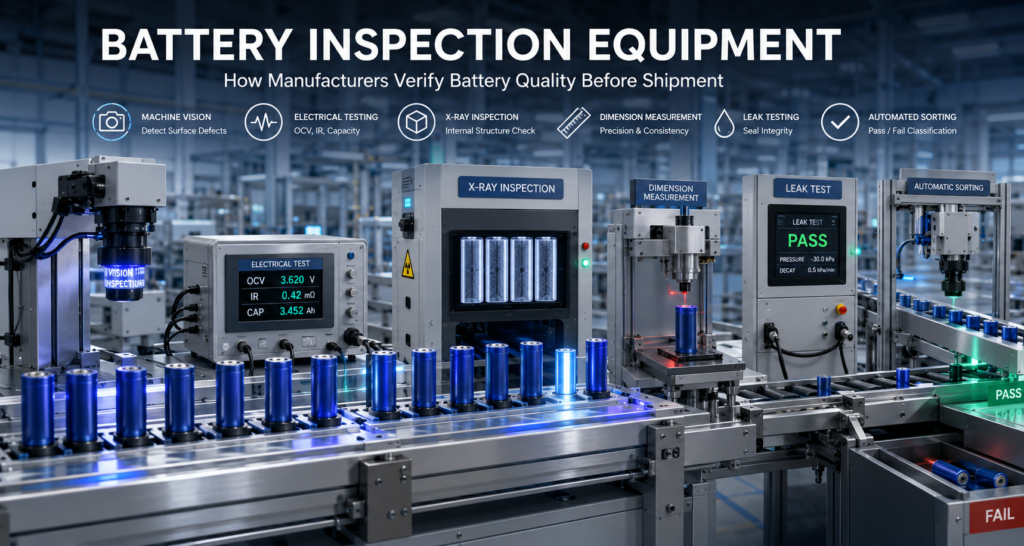
Modern inspection systems combine machine vision, laser measurement, electrical testing, X-ray imaging, and automated data analysis to identify defects that are impossible to detect with the human eye.
In this article, we’ll explore how battery inspection equipment works, why it is critical for lithium-ion battery manufacturing, and the technologies ensuring safe and reliable battery production.
Table of Contents
- What Is Battery Inspection Equipment?
- Why Battery Inspection Matters
- Main Components of an Inspection Line
- How Battery Inspection Works
- Critical Inspection Parameters
- Common Battery Defects Detected
- Future Trends in Battery Inspection Equipment
- Frequently Asked Questions
- Key Takeaways
1. What Is Battery Inspection Equipment?
Battery inspection equipment verifies the quality and consistency of battery cells after manufacturing.
Its purpose is to identify defective cells before they move to module assembly, pack assembly, or shipment.
Inspection equipment is used for:
- Cylindrical cells
- Prismatic cells
- Pouch cells
The primary objectives are to:
- Verify electrical performance
- Detect manufacturing defects
- Confirm dimensional accuracy
- Ensure product consistency
- Improve manufacturing yield
Unlike process equipment, inspection systems do not change the battery. Instead, they determine whether the battery satisfies predefined quality standards.
2. Why Battery Inspection Matters
Even highly automated production lines generate occasional defects.
Inspection ensures that defective cells do not proceed to later manufacturing stages.
Protecting Battery Safety
Inspection helps identify abnormalities before batteries reach customers.
Potential issues include:
- Internal short circuits
- Leakage
- Swelling
- Mechanical damage
- Electrical abnormalities
Improving Manufacturing Yield
Early detection prevents defective cells from consuming additional production resources.
Supporting Traceability
Modern factories record inspection data for every battery cell.
This information supports:
- Quality analysis
- Root cause investigation
- Process optimization
- Customer traceability
3. Main Components of an Inspection Line
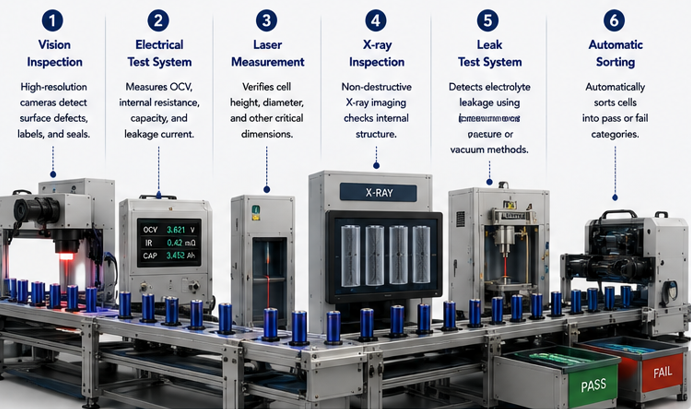
Vision Inspection System
High-resolution cameras inspect:
- Surface defects
- Electrode alignment
- Label quality
- Seal condition
Electrical Test System
Measures:
- Open circuit voltage (OCV)
- Internal resistance (IR)
- Capacity verification
- Leakage current
Laser Measurement System
Verifies:
- Cell dimensions
- Thickness
- Height
- Diameter
X-ray Inspection System
Non-destructive X-ray imaging detects internal defects including:
- Electrode misalignment
- Jelly-roll deformation
- Foreign particles
Leak Test System
Checks sealing integrity using pressure or vacuum methods.
Automated Sorting System
Cells automatically pass or fail based on inspection results.
4. How Battery Inspection Works
A typical inspection sequence includes:
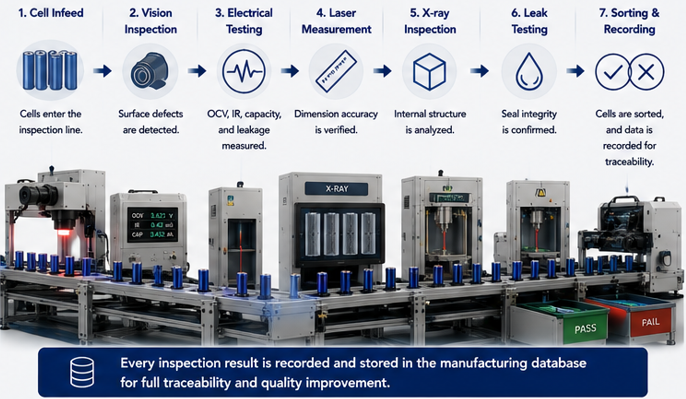
- Cells enter the inspection station.
- Visual inspection detects surface defects.
- Electrical testing measures battery performance.
- Laser systems verify dimensions.
- X-ray inspection evaluates internal structure.
- Leak testing confirms sealing integrity.
- Cells are automatically classified as pass or fail.
Every inspection result is recorded in the manufacturing database for traceability.
5. Critical Inspection Parameters
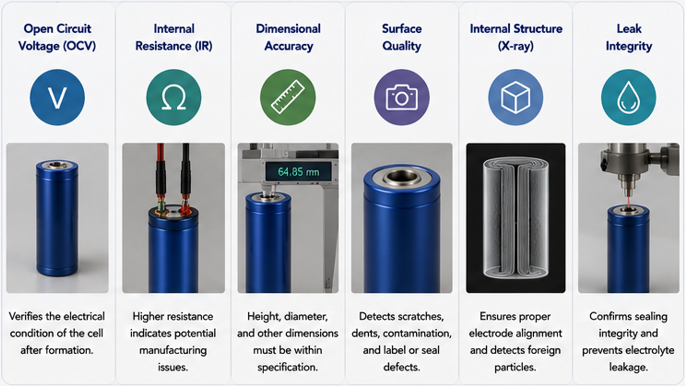
Several parameters determine inspection quality.
Open Circuit Voltage (OCV)
OCV confirms the battery’s electrical condition after formation.
Internal Resistance (IR)
Higher-than-normal resistance may indicate manufacturing problems.
Dimensional Accuracy
Battery dimensions must remain within strict tolerances.
Surface Quality
Vision systems identify scratches, dents, contamination, and labeling defects.
Internal Structure
X-ray inspection verifies electrode positioning and internal assembly quality.
Leak Integrity
Leak testing confirms electrolyte containment before shipment.
6. Common Battery Defects Detected
Inspection systems commonly detect:
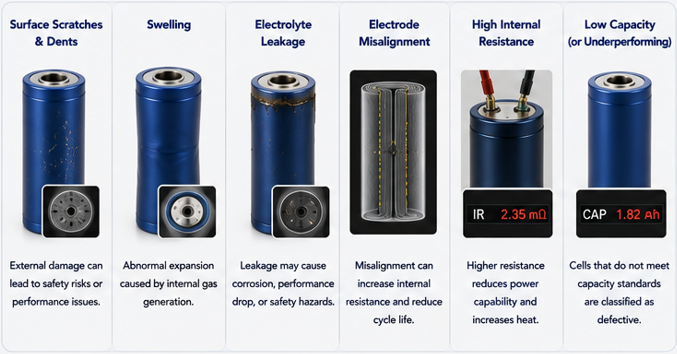
Surface Damage
Scratches, dents, or contamination.
High Internal Resistance
May indicate poor formation or assembly issues.
Low Capacity
Cells failing to meet specification.
Electrode Misalignment
Detected through X-ray inspection.
Electrolyte Leakage
Leak testing identifies sealing failures.
Swelling
Abnormal expansion caused by internal gas generation.
7. Future Trends in Battery Inspection Equipment
Inspection technology continues evolving through:
- AI-powered defect recognition
- High-speed inline X-ray inspection
- Digital twin quality monitoring
- Cloud-based manufacturing analytics
- 100% automated visual inspection
- Predictive quality analysis
- Smart factory integration
These technologies reduce inspection time while improving defect detection accuracy.
8. Frequently Asked Questions
Why is battery inspection performed after formation?
Formation stabilizes battery chemistry. Inspection verifies that the battery achieved the required electrical and physical quality before shipment.
What is OCV?
Open Circuit Voltage (OCV) is the voltage of a battery when no current is flowing. It provides an important indication of battery condition.
Can X-ray inspection detect internal defects?
Yes. X-ray systems reveal internal misalignment, foreign particles, and structural abnormalities without damaging the battery.
Why is internal resistance important?
Higher internal resistance reduces power output and often indicates manufacturing problems.
Does every battery undergo inspection?
Most modern lithium-ion battery factories perform automated inspection on every production cell.
9. Key Takeaways
- Battery inspection equipment verifies battery quality before shipment.
- Vision systems, electrical testing, laser measurement, X-ray inspection, and leak testing work together to detect defects.
- Inspection improves battery safety, manufacturing yield, and traceability.
- Common defects include swelling, leakage, scratches, internal resistance abnormalities, and electrode misalignment.
- AI and smart manufacturing technologies continue improving inspection accuracy and efficiency.
📚 Key Terms
Battery Inspection Equipment
Automated systems used to evaluate the electrical, mechanical, and visual quality of lithium-ion battery cells before shipment or module assembly.
Open Circuit Voltage (OCV)
The voltage of a battery when no current is flowing. OCV is commonly measured after formation to verify the battery’s electrical condition.
Internal Resistance (IR)
The resistance to current flow inside a battery cell. Higher internal resistance often indicates manufacturing defects or poor electrochemical performance.
Machine Vision Inspection
A camera-based inspection system that automatically detects scratches, dents, contamination, seal defects, and labeling errors on battery cells.
X-ray Inspection
A non-destructive inspection method that uses X-rays to reveal internal battery structures, including electrode alignment, jelly-roll condition, and foreign particles.
Leak Test
A quality-control process that verifies the sealing integrity of a battery cell to prevent electrolyte leakage.
Traceability
The ability to record and track manufacturing and inspection data for every individual battery cell throughout its production lifecycle.
🎓 Battery Learning Path
⚙️ Equipment
✅ iAtlas Battery #18 — Mixing Equipment
✅ iAtlas Battery #19 — Coating Equipment
✅ iAtlas Battery #20 — Drying Equipment
✅ iAtlas Battery #21 — Calendaring Equipment
✅ iAtlas Battery #22 — Slitting Equipment
✅ iAtlas Battery #23 — Stacking Equipment
✅ iAtlas Battery #24 — Winding Equipment
✅ iAtlas Battery #25 — Electrolyte Filling Equipment
✅ iAtlas Battery #26 — Formation Equipment
📍 iAtlas Battery #27 — Inspection Equipment (Current)
Congratulations! You’ve completed the Battery Equipment Learning Path, covering every major manufacturing process from material preparation to final quality inspection.
📖 Continue Reading
⬅ Previous Article
🔋 iAtlas Battery #26
Battery Formation Equipment Explained: Why the First Charge Determines Battery Life
Learn how formation equipment creates the protective SEI layer and prepares lithium-ion batteries for long-term performance.
➡ Next Article
🔋 iAtlas Battery #28
Battery Manufacturing Process Explained: From Raw Materials to Finished Cells
Discover how every manufacturing process—from mixing to final inspection—works together to produce high-quality lithium-ion batteries.
📚 Related Articles
Continue exploring battery manufacturing and quality control:
- 🔋 iAtlas Battery #24 — Battery Winding Equipment Explained
- 🔋 iAtlas Battery #25 — Battery Electrolyte Filling Equipment Explained
- 🔋 iAtlas Battery #26 — Battery Formation Equipment Explained
- 🔋 iAtlas Battery #28 — Battery Manufacturing Process Explained
- 📘 Open Circuit Voltage (OCV)
- 📘 Internal Resistance (IR)
- 📘 X-ray Inspection
- 📘 Battery Cell
- 📘 Quality Control
Additional Library articles will be linked as they are published.
📚 References
Industry & Research
- International Energy Agency (IEA) – Global EV Outlook
- U.S. Department of Energy – Vehicle Technologies Office
- Nature Energy
Inspection & Test Equipment
🔷 About iAtlas
iAtlas is an independent publication dedicated to making industrial knowledge more accessible.
From batteries and semiconductors to advanced materials, AI, and global manufacturing, iAtlas transforms complex technologies into practical, easy-to-understand insights.
Whether you’re following today’s industry news or building long-term expertise, iAtlas helps you understand not only what happened, but why it matters.
Technology creates change.
Insight creates opportunity.
— iAtlas