Separator Explained: The Safety Barrier Inside a Lithium-ion Battery
Understanding How Battery Separators Control Ion Transport, Prevent Short Circuits, and Improve Safety
Category: Battery Technology
Content Type: Materials
Related Industries: Electric Vehicles · Energy Storage Systems · Consumer Electronics
Last Updated: August 2026
Industry Snapshot
The separator is one of the four essential components of a lithium-ion battery, together with the cathode, anode, and electrolyte.
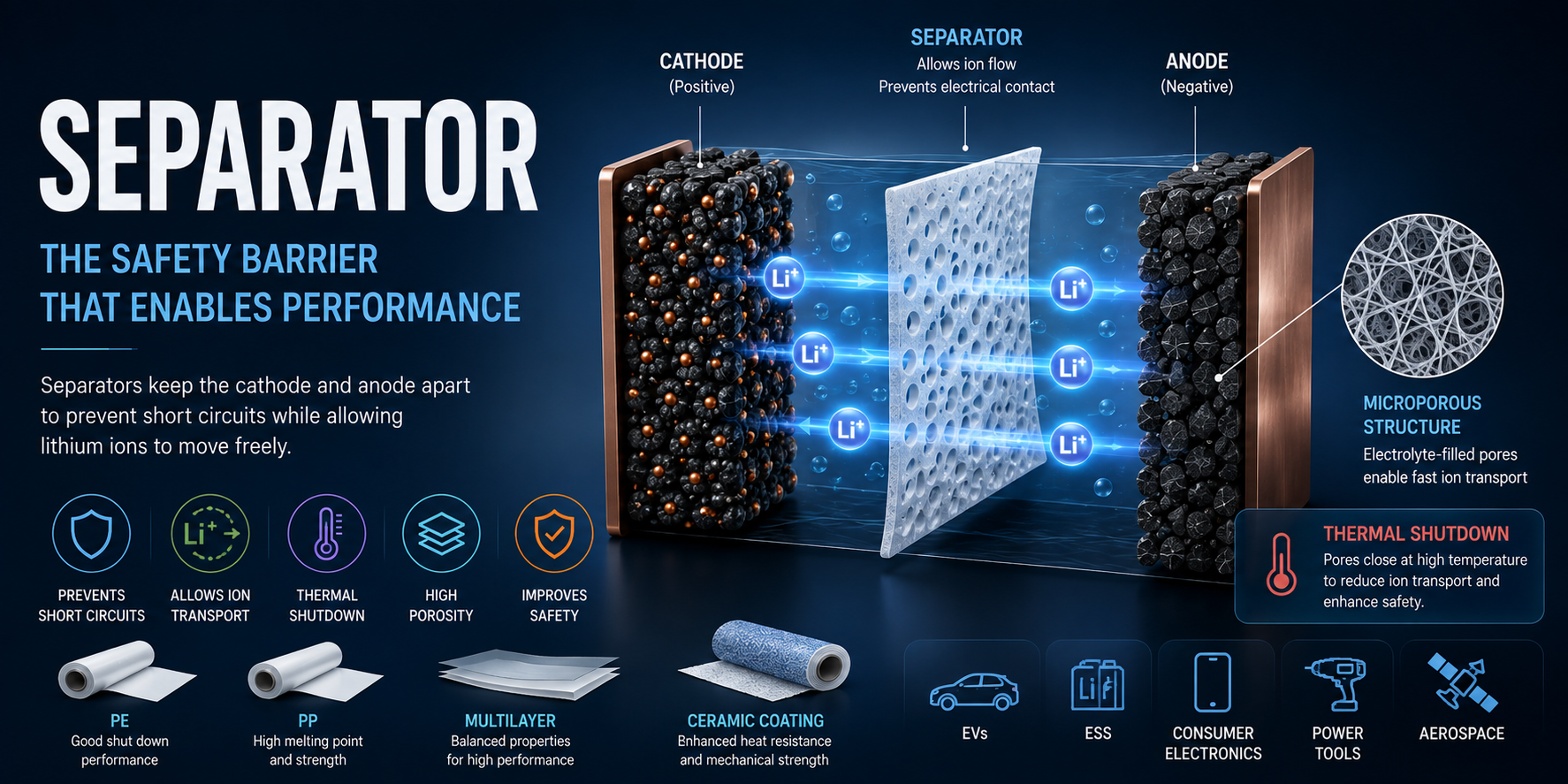
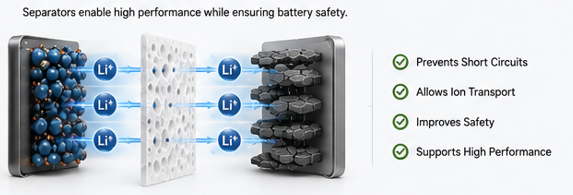
Its primary role is simple but critical: keep the cathode and anode physically separated while allowing lithium ions to move between them.
If the two electrodes come into direct electrical contact, an internal short circuit can occur, potentially causing rapid heat generation and serious safety problems. At the same time, the separator must remain porous enough for lithium ions in the electrolyte to move efficiently during charging and discharging.
This combination of electrical insulation, ion transport, mechanical strength, and thermal stability makes separator technology an important factor in battery performance and safety.
At a Glance
| Category | Description |
|---|---|
| Definition | Porous insulating membrane between the cathode and anode |
| Main Function | Prevent electrical contact while allowing ion transport |
| Common Materials | PE, PP, PE/PP multilayer films |
| Key Properties | Porosity, thickness, mechanical strength, thermal stability |
| Safety Role | Helps prevent internal short circuits |
| Major Applications | EVs, ESS, Consumer Electronics |
What Is a Battery Separator?
A battery separator is a thin, porous membrane positioned between the cathode and anode.
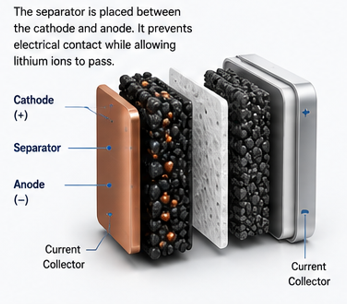
It performs two seemingly opposite functions.
First, it electrically isolates the positive and negative electrodes.
Second, its microscopic pores allow electrolyte and lithium ions to move through the battery.
This means the separator must block electrons while allowing the movement of ions.
In a conventional lithium-ion battery:
Cathode
↓
Separator + Electrolyte
↓
Anode
The separator does not directly store energy, but without it, safe and stable battery operation would not be possible.
How a Separator Works
During charging and discharging, lithium ions travel between the cathode and anode through the electrolyte.
The separator provides a porous pathway through which this ion-containing electrolyte can penetrate.
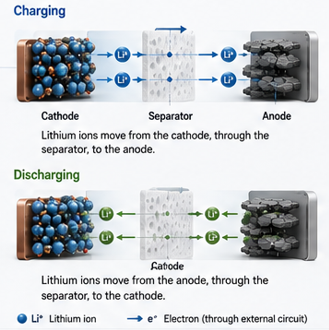
During Charging
Lithium ions move:
Cathode → Separator → Anode
During Discharging
Lithium ions move:
Anode → Separator → Cathode
Electrons cannot travel directly through the separator. Instead, they must move through the external electrical circuit.
This separation of ion transport and electron transport is fundamental to battery operation.
What Are Battery Separators Made Of?
Most conventional lithium-ion battery separators are manufactured from polyolefin materials.
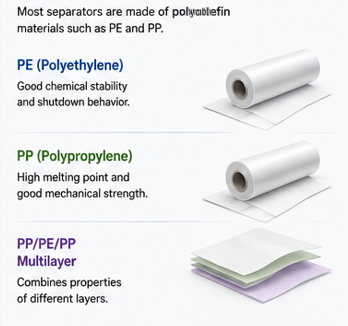
Polyethylene (PE)
PE separators are widely used because they provide good chemical stability and can contribute to thermal shutdown behavior.
Polypropylene (PP)
PP offers good mechanical strength and relatively high thermal resistance.
Multilayer Separators
Some separators combine multiple polymer layers, such as:
PP / PE / PP
This structure can combine the characteristics of different materials to improve mechanical and thermal performance.
Separator Structure
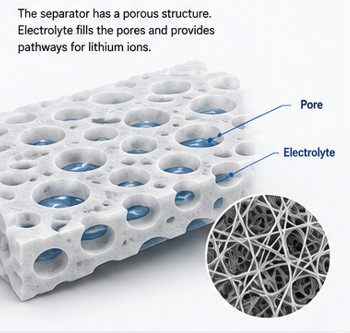
Battery separators contain a network of microscopic pores.
These pores allow the electrolyte to penetrate the separator and provide pathways for lithium-ion transport.
Three characteristics are particularly important:
Thickness
Thinner separators can help increase the amount of active material inside a battery cell, potentially improving energy density.
However, separators must remain mechanically strong enough to prevent damage.
Porosity
Higher porosity can improve electrolyte absorption and ion transport.
Too much porosity, however, may reduce mechanical strength.
Pore Size
Pore size must be carefully controlled to provide uniform ion transport while maintaining electrical isolation.
Separator design therefore requires a balance between:
Ion Transport · Mechanical Strength · Safety · Thickness
Separator and Battery Safety
The separator is one of the battery’s most important passive safety components.
If the separator is damaged by:
- Excessive heat
- Mechanical deformation
- Manufacturing defects
- Foreign particles
- Dendrite penetration
the cathode and anode may come into direct contact.
This can create an internal short circuit, generating heat inside the battery.
Under severe conditions, this can contribute to thermal runaway.
For this reason, separator quality and consistency are critical during battery manufacturing.
What Is Separator Shutdown?
Some polyolefin separators provide a safety mechanism known as thermal shutdown.
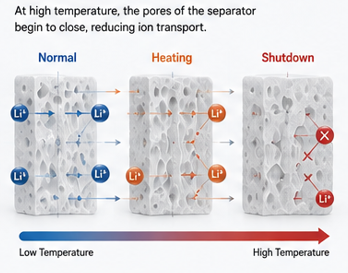
When the internal battery temperature becomes abnormally high, the separator’s microscopic pores can begin to close.
As the pores close:
Ion transport decreases
↓
Electrochemical reactions slow
↓
Current flow can be reduced
This behavior can help limit further heat generation.
However, shutdown does not guarantee battery safety under every failure condition. If temperatures continue to rise, the separator itself may shrink or lose mechanical integrity.
Therefore, shutdown behavior must work together with other battery safety systems.
Coated Separators
Advanced lithium-ion batteries increasingly use coated separators.
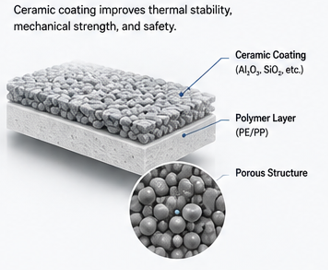
A conventional polymer separator can be coated with materials such as ceramic particles or functional polymer layers.
Ceramic coatings can help improve:
- Thermal stability
- Mechanical strength
- Heat resistance
- Dimensional stability
- Safety under abnormal conditions
Coated separators are particularly important for batteries designed for demanding applications such as electric vehicles.
Key Performance Factors
| Parameter | Why It Matters |
| Thickness | Influences energy density and mechanical protection |
| Porosity | Affects electrolyte absorption and ion transport |
| Pore Size | Influences uniform ionic conduction |
| Mechanical Strength | Helps prevent tearing and puncture |
| Thermal Stability | Reduces deformation at high temperatures |
| Wettability | Determines how effectively electrolyte penetrates the separator |
| Electrical Insulation | Prevents direct contact between electrodes |
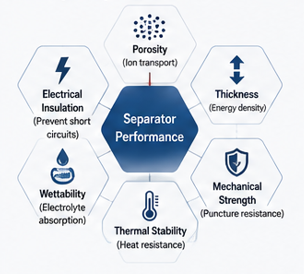
No single parameter determines separator quality.
The best separator must balance all of these characteristics while remaining compatible with the battery chemistry and manufacturing process.
Separator Manufacturing
A simplified separator manufacturing process can be represented as:
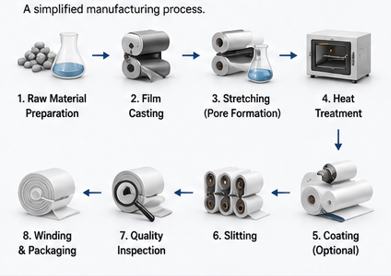
Polymer Raw Material
↓
Film Formation
↓
Stretching / Pore Formation
↓
Heat Treatment
↓
Surface Treatment or Coating
↓
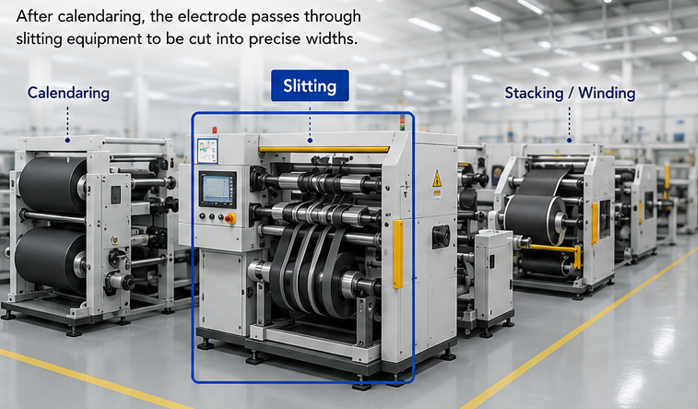
Slitting
↓
Quality Inspection
Two broad manufacturing approaches are commonly associated with microporous separator production: dry processes and wet processes.
Both aim to create a thin film containing highly controlled microscopic pores.
The exact manufacturing method influences separator structure, mechanical properties, thickness, and production cost.
Why Manufacturing Quality Matters
Separator defects can have a disproportionate impact on battery safety.
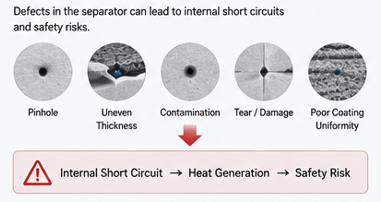
Potential problems include:
- Uneven thickness
- Pinhole defects
- Contamination
- Poor coating uniformity
- Mechanical damage
- Improper pore structure
Even very small defects can become important because modern battery cells contain tightly stacked or wound electrode layers.
This is why separator production requires precise process control and inspection.
Applications
Battery separators are used across virtually all conventional lithium-ion battery applications, including:
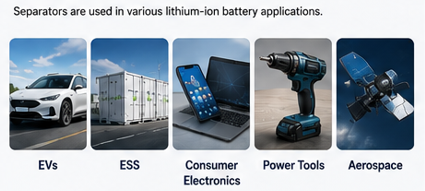
- Electric Vehicles (EVs)
- Energy Storage Systems (ESS)
- Smartphones
- Laptops
- Power Tools
- Industrial Equipment
- Medical Devices
- Aerospace Systems
Separator requirements vary depending on cell chemistry, cell format, energy density, operating temperature, and safety requirements.
Industry Ecosystem
The separator industry connects chemical materials, precision film manufacturing, coating technology, and battery production.
A simplified supply chain is:
Polymer & Raw Material Suppliers
↓
Separator Manufacturers
↓
Coating & Functional Material Suppliers
↓
Battery Cell Manufacturers
↓
Battery Pack Integrators
↓
EV · ESS · Electronics Manufacturers
As battery production expands globally, separator manufacturing capacity has become an important part of the battery supply chain.
Atlas Insight
Separator technology is evolving alongside the battery industry’s push toward higher energy density and faster charging.
As cells become more energy-dense, separators must become thinner without sacrificing mechanical or thermal stability.
Advanced coatings, improved pore structures, heat-resistant materials, and functional separator technologies are therefore becoming increasingly important.
At the same time, next-generation batteries may change the traditional role of the separator.
In some solid-state battery architectures, a solid electrolyte can perform both ion-conduction and physical-separation functions, potentially changing the conventional cathode–separator–anode structure.
The future of separator technology is therefore closely connected to the broader evolution of battery materials.
Did You Know?
- A battery separator is typically only tens of micrometers thick.
- The separator blocks direct electrical contact but allows lithium-ion transport.
- Microscopic pores are essential to separator performance.
- Ceramic coatings can improve thermal and mechanical stability.
- Separator defects can contribute to internal short circuits.
- Some separators can reduce ion transport through thermal shutdown behavior.
FAQ
What is a separator in a lithium-ion battery?
A separator is a porous insulating membrane positioned between the cathode and anode. It prevents direct electrical contact while allowing lithium ions to move through the electrolyte.
Does a separator conduct electricity?
The separator is designed to electrically isolate the electrodes. Lithium ions can move through its electrolyte-filled pores, while electrons travel through the external circuit.
What materials are used for battery separators?
Polyethylene (PE), polypropylene (PP), and multilayer polyolefin structures are commonly used in conventional lithium-ion batteries.
Why is separator porosity important?
Porosity allows electrolyte penetration and lithium-ion transport. It must be carefully balanced with mechanical strength and safety.
What is a ceramic-coated separator?
It is a polymer separator with an additional ceramic-containing coating designed to improve characteristics such as thermal and dimensional stability.
How does a separator affect battery safety?
A properly functioning separator keeps the electrodes physically isolated. Damage, shrinkage, contamination, or defects can increase the risk of internal short circuits.
Explore More
Fundamentals
- Battery
- Lithium-ion Battery
- Battery Cell
- Battery Module
- Battery Pack
- Battery Management System(BMS)
- Battery Thermal Management System(BTMS)
- Battery Safety
Materials
- Cathode
- Anode
- Electrolyte
- Separator (Current)
Manufacturing
- Battery Manufacturing Process
- Material Mixing
- Electrode Coating
- Calendering
- Cell Assembly
- Formation
- Aging
Technologies
- Cell-to-Pack (CTP)
- Cell-to-Chassis (CTC)
- Wireless BMS
- Thermal Runaway
- Fast Charging
References
- Nature Energy
- Journal of Power Sources
- Journal of Energy Storage
- International Energy Agency (IEA) – Global EV Outlook 2025
- U.S. Department of Energy – Vehicle Technologies Office
- Argonne National Laboratory – Battery Research
About iAtlas
iAtlas is an independent publication covering batteries, semiconductors, OLED, advanced materials, AI, and global industrial trends.
We transform complex industrial developments into clear, reliable, and easy-to-understand insights.
Whether you’re following today’s industry news or building long-term expertise, iAtlas helps you understand not only what happened, but why it matters.
Technology creates change.
Insight creates opportunity.
— iAtlas