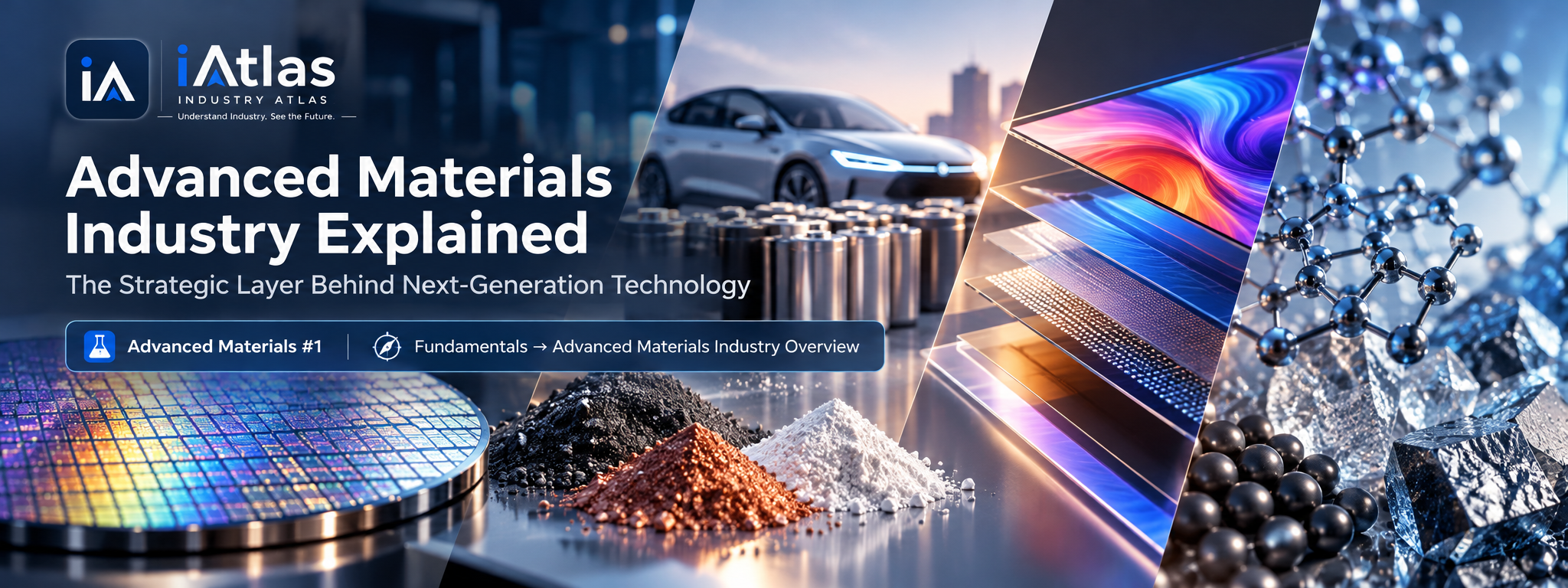
Advanced Materials Industry Explained: The Strategic Layer Behind Next-Generation Technology
🧪 Advanced Materials #1 | 🧭 Fundamentals → Advanced Materials Industry Overview
Modern technology is often described through the products we can see: semiconductors, electric vehicles, batteries, OLED displays, data centers, renewable energy systems, and advanced electronics.
But behind nearly every improvement in these technologies lies another industry that receives far less attention:
advanced materials.
A faster semiconductor may require a new dielectric material.
A higher-energy battery may depend on a different cathode or electrolyte.
A brighter and longer-lasting OLED display may require improved organic materials and encapsulation layers.
In many advanced industries, the next technology breakthrough increasingly begins with the materials that make it possible.
This is why advanced materials should not be viewed simply as a collection of specialty chemicals or laboratory materials.
They are becoming a strategic industrial layer connecting chemistry, manufacturing, technology, and global supply chains.
1. Advanced Materials Sit Upstream of Technology
The importance of advanced materials becomes clearer when we look at where they sit in the industrial value chain.
A simplified structure looks like this:
Raw Materials
↓
Refining & Chemical Processing
↓
Advanced Materials
↓
Components & Manufacturing Processes
↓
Devices & Systems
↓
Final Applications
Advanced materials occupy a critical position between basic resources and sophisticated manufacturing.
They are engineered to deliver specific characteristics such as:
- electrical conductivity
- dielectric performance
- thermal resistance
- chemical stability
- optical properties
- mechanical strength
- ionic conductivity
- ultra-high purity
- controlled surface behavior
The key point, however, is not simply the chemistry itself.
From an industry perspective, these materials enable manufacturers to achieve performance that conventional materials cannot provide.
That makes them an essential upstream layer of many technology industries.
2. One Materials Industry Supports Many Technology Industries
Unlike industries centered around one final product, advanced materials extend across multiple markets.
Semiconductors
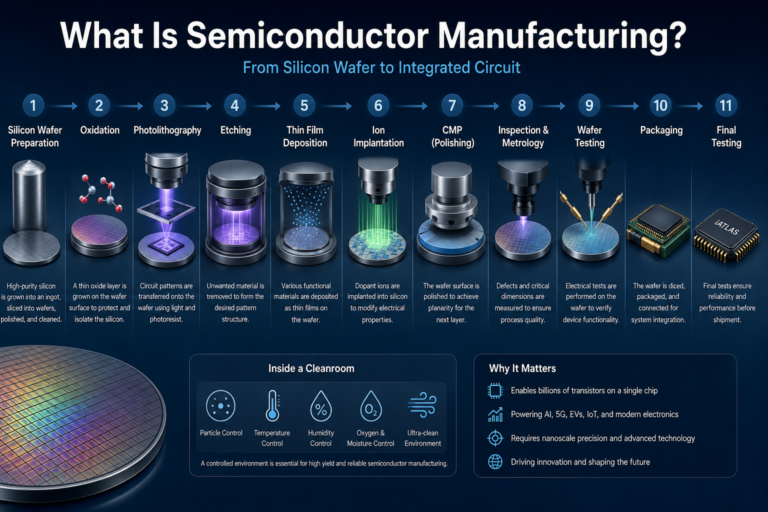
Semiconductor manufacturing requires a wide range of specialized materials, including:
- silicon wafers
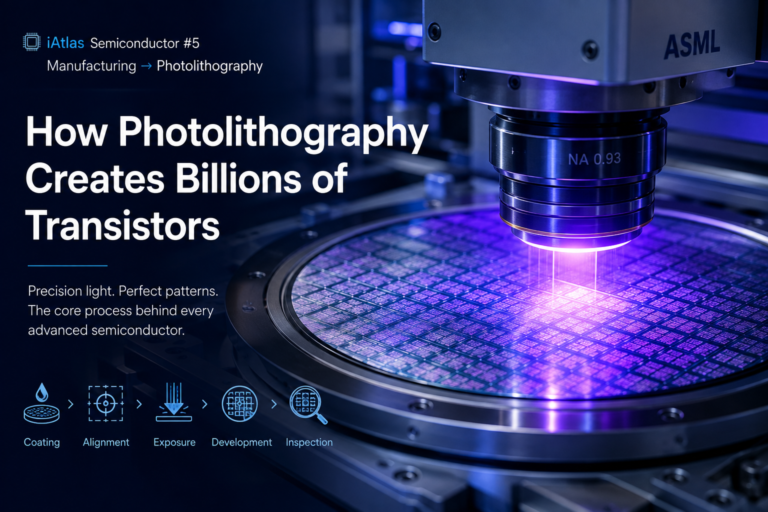
- photoresists
- deposition precursors
- dielectric materials
- specialty gases
- wet chemicals
- CMP materials
- metals and interconnect materials
- packaging materials
As device structures become smaller and more three-dimensional, the performance requirements placed on these materials continue to increase.
The industry is therefore moving toward materials with tighter specifications, higher purity, and greater process compatibility.
Batteries
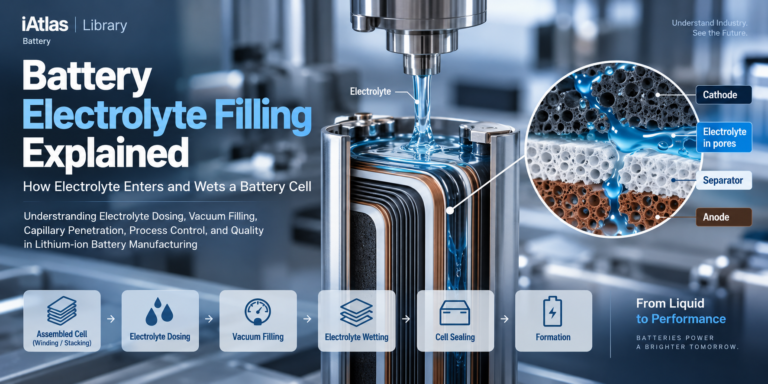
Battery performance is also fundamentally linked to materials.
Key material categories include:
- cathode materials
- anode materials
- electrolytes
- separators
- conductive materials
- binders
- current collectors
- solid electrolytes
Changes in battery chemistry can reshape entire supply chains.
For example, the growth of LFP batteries changed demand for cathode materials, while emerging technologies such as sodium-ion and solid-state batteries could create new materials ecosystems.
In batteries, materials are not simply inputs.
They strongly influence:
energy density, safety, cycle life, cost, and manufacturability.
OLED & Displays
Advanced display technologies depend on another specialized materials ecosystem.
Examples include:
- light-emitting organic materials
- host and dopant materials
- transport layers
- encapsulation materials
- quantum-dot materials
- optical films
- specialty polymers
Small improvements in lifetime, efficiency, color purity, or moisture resistance can translate directly into competitive advantages for display manufacturers.
This creates strong connections between chemical companies, material developers, equipment companies, panel manufacturers, and electronics brands.
Energy and Mobility
Advanced materials also play essential roles in:
- electric motors
- permanent magnets
- hydrogen technologies
- solar cells
- power electronics
- lightweight vehicles
- energy storage
- wind turbines
As energy and mobility systems become more sophisticated, the demand for highly engineered materials continues to increase.
3. The Advanced Materials Industry Value Chain
The advanced materials industry can broadly be viewed through several stages.
① Raw Materials
Minerals, metals, hydrocarbons, and chemical feedstocks provide the starting point.
Examples include:
- lithium
- nickel
- cobalt
- graphite
- copper
- gallium
- germanium
- rare-earth elements
↓
② Refining & Chemical Conversion
Raw materials are refined and transformed into higher-purity chemical intermediates.
↓
③ Material Formulation & Synthesis
Companies engineer materials with specific chemical, electrical, optical, or mechanical properties.
This is where much of the technical differentiation begins.
↓
④ Purification & Quality Control
For advanced applications, simply producing the correct chemical composition is often not enough.
Manufacturers may need extremely tight control over:
- purity
- moisture
- oxygen
- metallic contamination
- particle size
- morphology
- trace impurities
- batch consistency
↓
⑤ Integration into Manufacturing Processes
Materials must then function reliably inside actual manufacturing processes such as:
- ALD
- CVD
- coating
- deposition
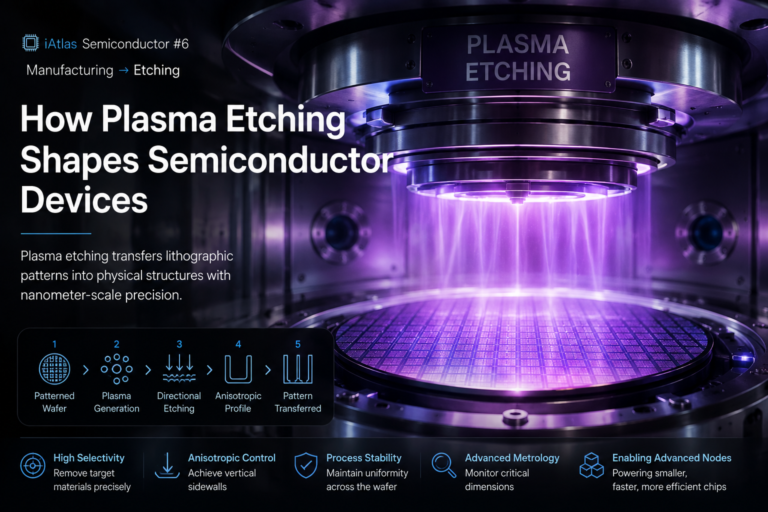
- etching
- mixing
- sintering
- encapsulation
- electrode manufacturing
↓
⑥ Device Manufacturing
The materials are integrated into semiconductors, batteries, displays, and other components.
↓
⑦ Final Applications
The materials ultimately become part of products such as:
AI servers · smartphones · EVs · robots · displays · data centers · energy-storage systems
This helps explain why many advanced-material companies remain invisible to consumers while still occupying strategically important positions within global industry.
4. Why the Advanced Materials Industry Is Becoming More Important
Several structural changes are increasing the importance of this industry.
Technology Is Reaching Material Limits
For decades, many technologies improved mainly through better design and manufacturing.
Increasingly, however, manufacturers are reaching limitations imposed by the materials themselves.
Further improvements may require:
New Materials → New Processes → New Device Architectures
This can be seen across industries.
Semiconductors introduced new dielectric and interconnect materials as scaling became more difficult.
Battery companies continue to develop new cathode, anode, and electrolyte systems.
Display manufacturers rely on increasingly sophisticated organic and encapsulation materials.
Materials innovation is therefore becoming deeply interconnected with product innovation.
5. Purity Is Becoming a Competitive Capability
Advanced-material industries differ from commodity-material industries because small variations can have large consequences.
Trace contamination may affect:
- semiconductor yield
- battery cycle life
- OLED lifetime
- film uniformity
- deposition behavior
- device reliability
As manufacturing becomes more sophisticated, material suppliers increasingly compete not only on composition but also on:
Purity + Consistency + Process Compatibility + Scalability
This creates significant barriers to entry.
A material that performs well in a laboratory must still be manufactured repeatedly at industrial scale and integrated into a customer’s actual production process.
That transition from material development to qualified industrial supply is one of the most important competitive barriers in the advanced-materials industry.
6. Materials Are Becoming a Supply-Chain Issue
Advanced materials are no longer purely an R&D topic.
They are increasingly becoming part of national and corporate supply-chain strategies.
A material may depend on:
- minerals from one region
- refining in another
- chemical synthesis in another
- specialized equipment from another
- final manufacturing in another
A disruption several tiers upstream can therefore affect an industry far downstream.
This changes how companies and governments evaluate materials.
The key question is no longer only:
“Can this material deliver better performance?”
It is also:
“Can the industry manufacture it reliably, economically, and securely at scale?”
7. From Material Innovation to Industrial Power
A useful way to understand competition in advanced materials is through four layers.
Material Technology
Can the company develop a material with superior properties?
↓
Manufacturing Capability
Can it manufacture the material consistently at industrial scale?
↓
Customer Qualification
Can it meet the production requirements of semiconductor, battery, or display manufacturers?
↓
Supply-Chain Position
Can it maintain cost, quality, and supply stability over many years?
The strongest advanced-material companies build advantages across all four layers.
That makes the industry fundamentally different from simply discovering a new chemical compound.
Commercialization is as important as invention.
8. Why the Industry Is Difficult to Map
Advanced materials do not form one simple market.
The ecosystem includes:
- global chemical companies
- mining and refining companies
- electronic-material specialists
- battery-material manufacturers
- specialty-chemical suppliers
- niche technology companies
A single company may participate in several areas at once.
Another company may dominate only one extremely narrow material segment.
This creates a fragmented industrial structure.
To understand the sector properly, we need to look beyond individual products and follow the chain:
Materials → Processes → Applications → Customers → Supply Chains
That is the approach iAtlas will use for this industry.
9. The Industries to Watch
Within the broader advanced-materials ecosystem, several areas deserve particular attention.
Semiconductor Materials
Driven by advanced logic, memory, AI chips, and advanced packaging.
Battery Materials
Driven by EVs, ESS, and changes in battery chemistry.
OLED & Display Materials
Driven by premium displays, OLED expansion, and next-generation display technologies.
Electronic Chemicals
Ultra-high-purity chemicals and precursors used throughout semiconductor and electronics manufacturing.
Advanced Polymers
Specialized polymers used in electronics, mobility, energy, and high-performance industrial applications.
Emerging Materials
Including:
- graphene
- carbon nanotubes
- silicon-based materials
- 2D materials
- advanced composite materials
Each represents a different market.
But they all share one common theme:
As technology becomes more advanced, the materials behind the technology become more strategically important.
10. The iAtlas View
The next generation of industrial competition will not be determined only by who manufactures the final product.
It will also depend on who controls the technologies and materials hidden deep inside the supply chain.
Semiconductor performance depends on materials.
Battery performance depends on materials.
Display performance depends on materials.
Energy technologies depend on materials.
And increasingly, the ability to produce those materials reliably affects:
technology leadership, manufacturing competitiveness, supply-chain resilience, and industrial strategy.
That is why advanced materials deserve to be understood not merely as technical ingredients—
but as an industry of their own.
Advanced Materials Learning Path
Next Article
🧪 Advanced Materials #2 | 🧭 Fundamentals → Advanced Materials Value Chain
How the Advanced Materials Value Chain Works: From Raw Materials to High-Tech Industries
References
Recommended primary-source areas:
- U.S. Department of Energy — Advanced Materials and Manufacturing Technologies Office
- International Energy Agency — Global Critical Minerals Outlook 2025
- International Energy Agency — Beyond NMC Batteries
- International Energy Agency — Critical Minerals
- U.S. Geological Survey — 2025 List of Critical Minerals
ℹ️ About iAtlas
iAtlas is an independent publication covering batteries, semiconductors, OLED, advanced materials, AI, and global industrial trends.
We transform complex industrial developments into clear, reliable, and easy-to-understand insights.
Whether you’re following today’s industry news or building long-term expertise, iAtlas helps you understand not only what happened, but why it matters.
Technology creates change.
Insight creates opportunity.
— iAtlas