CATL Explained: How the World’s Largest EV Battery Maker Built Its Competitive Advantage
🔋 iAtlas Battery #31 | 🏢 Companies → CATL
When discussing the global lithium-ion battery industry, one company is impossible to ignore: CATL.
Contemporary Amperex Technology Co., Limited—better known as CATL—has grown from a Chinese battery manufacturer into one of the most influential companies in the global electric-vehicle and energy-storage industries.
Its importance goes beyond manufacturing scale.
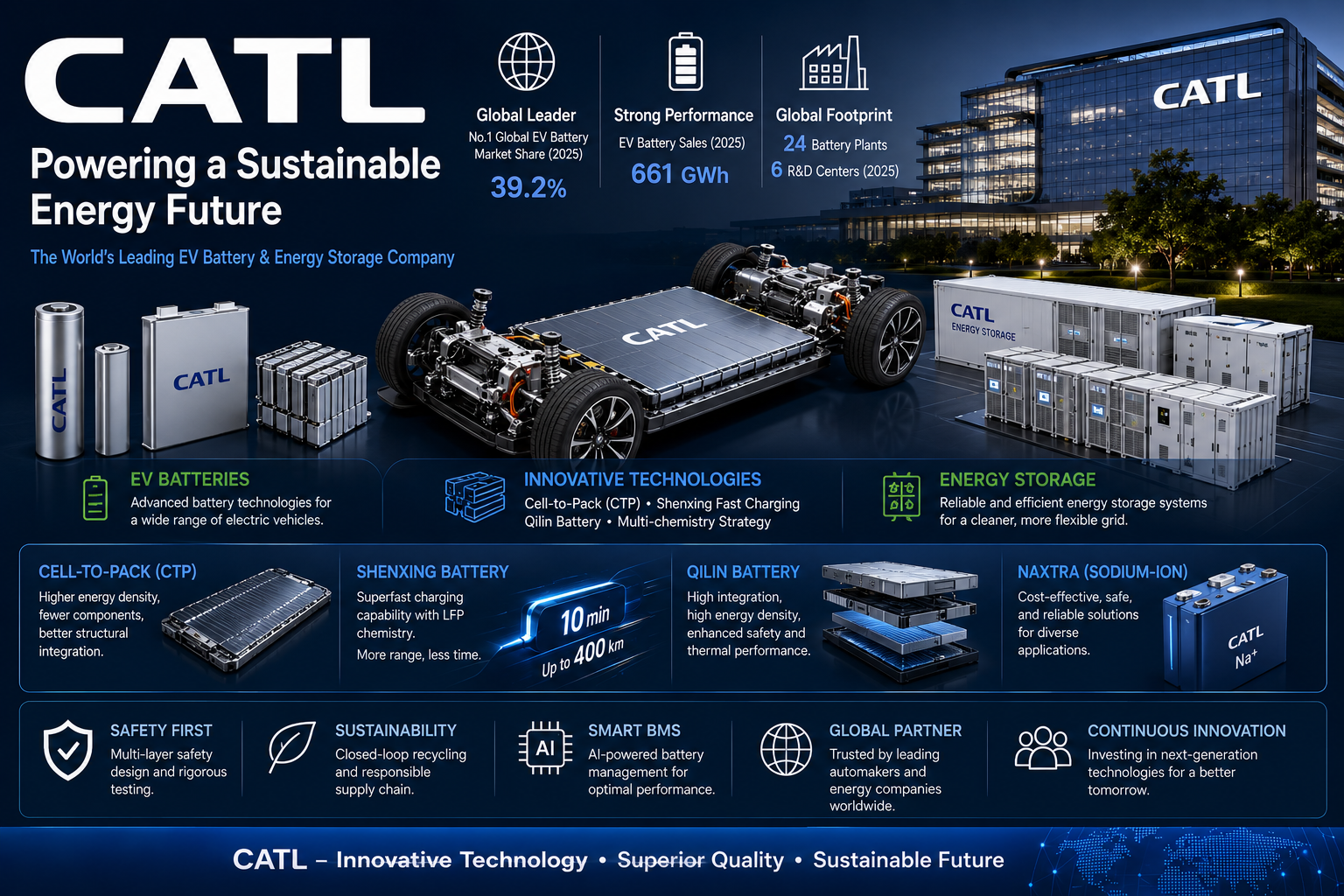
CATL has built capabilities across battery chemistry, cell design, pack architecture, manufacturing, energy storage, battery management, recycling, and next-generation technologies. Innovations such as the Cell-to-Pack (CTP) architecture and Shenxing fast-charging battery have also helped reshape how the industry thinks about battery cost, packaging efficiency, and charging performance.
Understanding CATL therefore provides a useful window into the broader transformation of the global battery industry.
In this article, we’ll explore what CATL does, how its battery business is structured, which technologies differentiate the company, and why CATL has become such an important force in the global battery market.
Table of Contents
- What Is CATL?
- How CATL Became a Global Battery Leader
- CATL’s Core Business Areas
- CATL’s Battery Chemistry Strategy
- Cell-to-Pack Technology
- Shenxing Fast-Charging Battery
- Qilin Battery and Pack Architecture
- CATL in Energy Storage
- Manufacturing Scale and Global Expansion
- CATL’s Major Customers
- Recycling and Battery Supply Chain
- Next-Generation Battery Technologies
- What Makes CATL Competitive?
- Key Challenges Facing CATL
- Frequently Asked Questions
- Key Takeaways
1. What Is CATL?
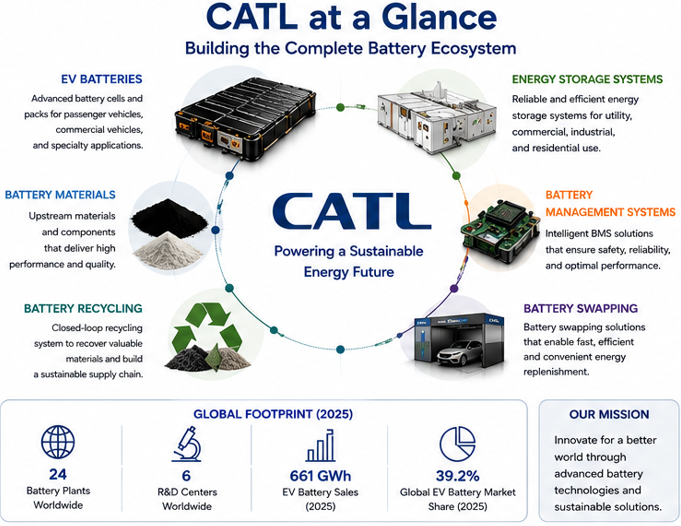
CATL, or Contemporary Amperex Technology Co., Limited, is a Chinese battery technology company headquartered in Ningde, Fujian Province.
The company develops and manufactures lithium-ion batteries and related technologies for two major markets:
- Electric vehicles
- Energy storage systems
CATL’s activities extend beyond individual battery cells.
Its technology portfolio includes:
- Battery materials
- Battery cells
- Battery modules and packs
- Battery management systems
- Energy-storage systems
- Battery recycling
- Battery swapping
- Next-generation battery technologies
This broad technology base allows CATL to participate across multiple layers of the battery value chain.
2. How CATL Became a Global Battery Leader
CATL was founded in 2011.
Its growth coincided with the rapid expansion of China’s electric-vehicle market and the development of a large domestic battery supply chain.
Several factors supported CATL’s rise.
China’s EV Market
China became the world’s largest electric-vehicle market, creating enormous domestic demand for battery cells.
This provided battery manufacturers with opportunities to scale production rapidly.
Manufacturing Scale
Large-scale manufacturing allowed CATL to improve production efficiency and reduce battery costs.
Technology Development
CATL invested heavily in battery chemistry, manufacturing, pack design, fast charging, and battery-management technologies.
Customer Expansion
The company expanded from Chinese automakers to major global vehicle manufacturers.
Supply-Chain Integration
CATL has also developed relationships and investments across battery materials, recycling, and other parts of the battery ecosystem.
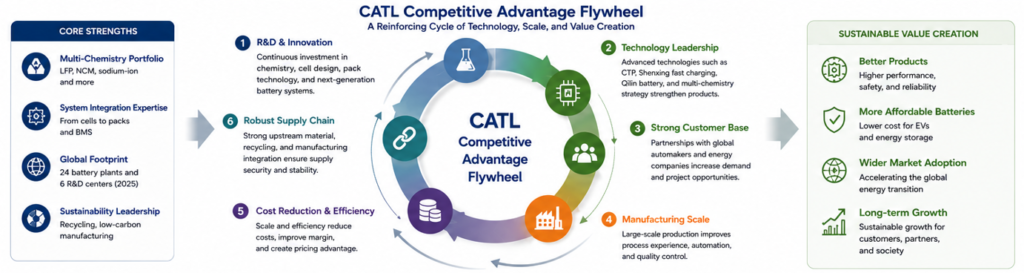
These factors created a reinforcing cycle:
Technology → Customers → Scale → Lower Cost → More Investment → More Technology
3. CATL’s Core Business Areas
CATL should not be understood only as an EV battery cell manufacturer.
Its business increasingly spans several parts of the energy ecosystem.
EV Batteries
EV batteries remain CATL’s core business.
The company supplies batteries for passenger vehicles and commercial applications across multiple markets.
Energy Storage Systems
CATL also produces battery systems for stationary energy-storage applications.
These systems can be used for:
- Renewable-energy integration
- Grid stabilization
- Commercial energy storage
- Utility-scale storage
Battery Materials and Recycling
Battery recycling allows valuable materials such as lithium, nickel, and cobalt to potentially return to the battery supply chain.
Battery Swapping
CATL has also developed battery-swapping concepts aimed at reducing charging downtime in selected mobility applications.
4. CATL’s Battery Chemistry Strategy
One of CATL’s important competitive characteristics is that it does not depend on only one battery chemistry.
The company develops different technologies for different applications.
LFP
Lithium iron phosphate batteries offer several advantages:
- Relatively low material cost
- Strong thermal stability
- Long cycle life
- Reduced reliance on nickel and cobalt
Improvements in pack architecture have helped compensate for some of LFP’s lower cell-level energy density compared with high-nickel chemistries.
Nickel-Based Batteries
Higher-energy-density chemistries remain relevant where driving range and packaging constraints are particularly important.
Sodium-Ion Batteries
CATL has also invested in sodium-ion technology.
Sodium is more abundant than lithium, and sodium-ion batteries may become useful in applications where cost, low-temperature performance, and supply-chain diversification are important.
This multi-chemistry strategy reflects an important battery-industry principle:
There is no single battery chemistry that is optimal for every application.
5. Cell-to-Pack Technology
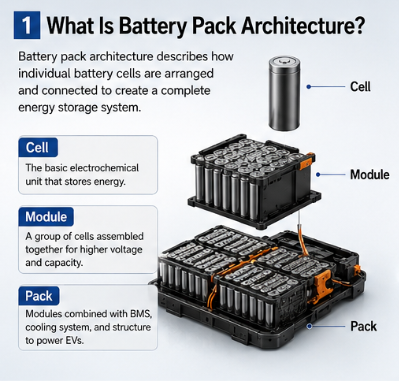
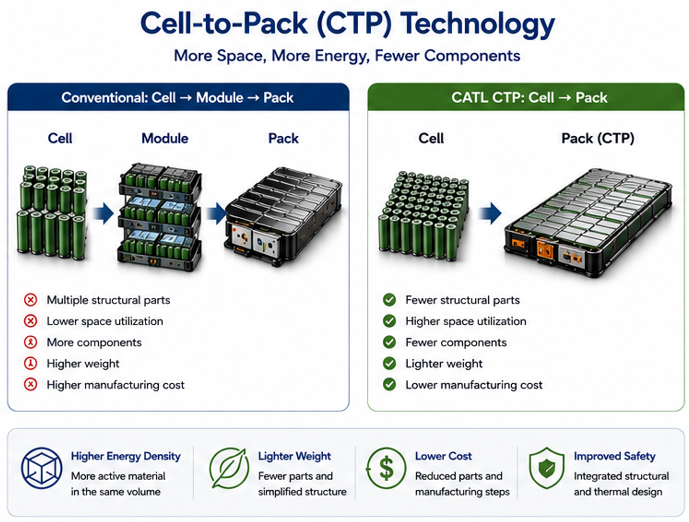
Traditional battery packs generally follow:
Cell → Module → Pack
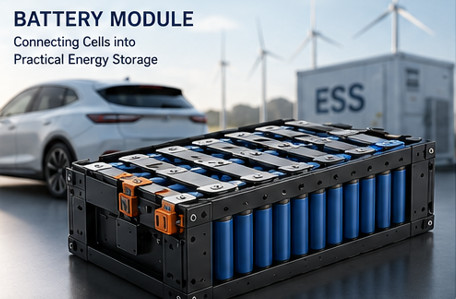
CATL’s Cell-to-Pack (CTP) approach reduces or eliminates conventional module structures.
The architecture becomes closer to:
Cell → Pack
Removing intermediate structural components can improve packaging efficiency.
Potential benefits include:
- More active battery material within the available pack volume
- Fewer components
- Simplified pack architecture
- Potential reductions in weight and cost
CTP illustrates an important industry shift.
Battery performance is no longer determined only by improving cell chemistry.
Pack architecture itself has become a major area of innovation.
6. Shenxing Fast-Charging Battery
Charging speed has become one of the most important competitive areas in electric vehicles.
CATL’s Shenxing battery family was developed around fast-charging performance using LFP chemistry.
This is significant because LFP was historically associated primarily with:
- Cost
- Safety
- Cycle life
rather than extreme charging performance.
Improving fast charging requires more than simply increasing charger power.
Battery engineers must manage:
- Ion transport
- Electrode kinetics
- Internal resistance
- Heat generation
- Lithium plating risk
- Battery-management strategies
Shenxing demonstrates how battery manufacturers are increasingly trying to improve several performance dimensions simultaneously.
7. Qilin Battery and Pack Architecture
CATL’s Qilin Battery represents another generation of its CTP architecture.
The design focuses on improving the integration of:
- Battery cells
- Structural components
- Thermal management
- Pack space
Thermal management is especially important.
As charging and discharging power increases, batteries generate more heat.
A well-designed pack must therefore manage:
Energy Density ↔ Thermal Management ↔ Safety ↔ Fast Charging
rather than optimizing only one characteristic.
Qilin illustrates how modern battery competition increasingly occurs at the system-design level, not just at the chemistry level.
8. CATL in Energy Storage
Electric vehicles receive much of the attention in the battery industry, but stationary energy storage is becoming another major growth market.
Energy-storage systems can help manage the mismatch between electricity production and consumption.
For example:
Solar Generation → Battery Storage → Electricity Demand
Battery storage can support:
- Renewable-energy integration
- Peak-load management
- Grid stabilization
- Backup power
- Electricity-market optimization
ESS batteries also have different priorities from many EV batteries.
EV batteries strongly emphasize:
- Energy density
- Weight
- Fast charging
- Vehicle range
Stationary storage may place greater emphasis on:
- Cycle life
- Safety
- Cost
- Reliability
- Long-duration operation
CATL’s presence in both markets allows the company to apply battery technology across multiple energy applications.
9. Manufacturing Scale and Global Expansion
Scale is one of CATL’s most important competitive advantages.
Battery manufacturing requires enormous investment in:
- Factories
- Production equipment
- Quality control
- Materials
- Energy
- Engineering
- Supply chains
As production volume increases, manufacturers can gain experience and improve processes.
This creates a manufacturing learning effect:
More Production
↓
More Process Data
↓
Better Yield & Automation
↓
Lower Cost
↓
Greater Competitiveness
CATL has expanded its manufacturing presence beyond China as automakers seek increasingly localized battery supply chains.
International expansion can help battery manufacturers:
- Stay closer to customers
- Reduce logistics complexity
- Support regional vehicle production
- Respond to localization policies
- Diversify manufacturing footprints
However, global expansion also introduces regulatory, geopolitical, and capital-investment challenges.
10. CATL’s Major Customers
CATL’s growth has been supported by relationships with numerous major automakers.
Its customer base has included both Chinese and international manufacturers.
Examples publicly associated with CATL battery supply or technology relationships have included companies such as:
- Tesla
- BMW
- Mercedes-Benz
- Volkswagen Group
- Geely
- NIO
- Li Auto
- Various other Chinese EV manufacturers
The exact customer relationship, battery chemistry, vehicle platform, and supply arrangement can differ by market and project.
A broad customer portfolio provides several advantages:
- Higher production scale
- Reduced dependence on a single automaker
- Exposure to different vehicle segments
- More manufacturing experience across battery formats and requirements
11. Recycling and Battery Supply Chain
Battery manufacturing depends on a complex materials supply chain.
Important materials can include:
- Lithium
- Nickel
- Cobalt
- Graphite
- Copper
- Aluminum
Recycling provides a potential route for recovering some of these materials from manufacturing scrap and end-of-life batteries.
A circular battery supply chain can be represented as:
Raw Materials
↓
Battery Manufacturing
↓
Vehicle / ESS Use
↓
End-of-Life Battery
↓
Recycling
↓
Recovered Materials
↓
New Battery Manufacturing
For large battery manufacturers, recycling can become strategically important for both sustainability and materials security.
12. Next-Generation Battery Technologies
CATL continues to invest beyond conventional lithium-ion batteries.
Important development areas include:
Sodium-Ion Batteries
Designed to diversify battery chemistry and potentially reduce dependence on lithium-intensive supply chains for suitable applications.
Condensed Battery Technology
CATL has announced high-energy-density battery concepts intended for applications requiring greater energy performance.
Solid-State and Advanced Batteries
Like other major battery manufacturers, CATL continues research into next-generation systems that could potentially improve energy density and safety.
However, laboratory performance alone is not enough.
A commercially successful battery must satisfy:
Performance + Safety + Manufacturing Yield + Cost + Scale + Reliability
This is one reason next-generation battery commercialization often takes significantly longer than laboratory announcements suggest.
13. What Makes CATL Competitive?
CATL’s competitive position cannot be explained by one technology alone.
Several capabilities reinforce one another.
Manufacturing Scale
Large production volumes can reduce costs and accelerate manufacturing learning.
Chemistry Portfolio
Multiple battery chemistries allow CATL to address different market requirements.
Pack Engineering
CTP and related architectures improve battery-system integration.
Customer Base
Relationships with major automakers provide scale and technology feedback.
R&D
Continuous development supports improvements in chemistry, charging, thermal management, and manufacturing.
Supply Chain
Materials sourcing, recycling, and manufacturing integration strengthen CATL’s industrial ecosystem.
The result is a competitive system rather than a single competitive product.
14. Key Challenges Facing CATL
Being the market leader does not eliminate risk.
CATL faces several important challenges.
Increasing Competition
Major competitors include Chinese, Korean, and Japanese battery manufacturers.
Price Competition
Rapid capacity expansion can create pressure on battery prices and profitability.
Geopolitical Risk
Battery supply chains have become strategically important to governments.
Trade rules, localization policies, and technology restrictions can affect international expansion.
Technology Transition
The industry continues moving toward:
- Faster charging
- Higher energy density
- Lower cost
- Improved safety
- Sodium-ion
- Solid-state batteries
Market leaders must continue investing to avoid being disrupted by new technologies.
Global Manufacturing Complexity
Operating across multiple countries introduces challenges involving regulation, workforce, supply chains, and capital investment.
CATL’s future position will therefore depend not simply on maintaining today’s scale, but on continuing to adapt as battery technology and global industrial policy evolve.
15. Frequently Asked Questions
What does CATL stand for?
CATL stands for Contemporary Amperex Technology Co., Limited.
Where is CATL based?
CATL is headquartered in Ningde, Fujian Province, China.
What does CATL manufacture?
CATL develops lithium-ion battery cells and systems for electric vehicles and energy storage, along with related technologies such as battery management, recycling, and advanced battery systems.
What is CATL’s Cell-to-Pack technology?
Cell-to-Pack reduces or removes the conventional module layer so cells can be integrated more directly into the battery pack.
Does CATL make LFP batteries?
Yes. LFP is an important part of CATL’s battery portfolio.
Does CATL develop sodium-ion batteries?
Yes. CATL has been one of the major battery manufacturers actively developing and commercializing sodium-ion technology.
Is CATL only an EV battery company?
No. CATL also has a substantial energy-storage business and participates in other areas of the battery ecosystem.
16. Key Takeaways
- CATL is one of the world’s most influential battery manufacturers, with major businesses in EV batteries and energy storage.
- The company’s competitive position combines manufacturing scale, R&D, customer relationships, supply-chain capabilities, and battery-system engineering.
- CATL uses multiple battery chemistries rather than relying on a single technology.
- Cell-to-Pack technology demonstrates how pack architecture can improve battery-system efficiency without relying only on cell chemistry improvements.
- Technologies such as Shenxing show how LFP batteries are expanding into higher-performance applications.
- Energy storage is becoming an increasingly important second growth pillar alongside EV batteries.
- Sodium-ion and other next-generation technologies could further broaden CATL’s battery portfolio.
- CATL’s long-term competitiveness will depend on balancing technology, manufacturing cost, global expansion, and geopolitical complexity.
📚 Key Terms
CATL
Contemporary Amperex Technology Co., Limited, a battery technology company primarily engaged in the R&D, production, and sales of EV batteries and energy-storage batteries.
LFP (Lithium Iron Phosphate)
A lithium-ion battery chemistry using lithium iron phosphate as the cathode material. LFP batteries are widely used because of their cost, cycle-life, and thermal-stability characteristics.
NCM Battery
A lithium-ion battery using nickel, cobalt, and manganese-based cathode materials. NCM chemistry is commonly used when higher energy density is an important requirement.
Cell-to-Pack (CTP)
A battery-pack architecture that reduces or eliminates conventional module structures and integrates battery cells more directly into the pack.
Qilin Battery
CATL’s CTP-based battery technology platform designed around high system integration, thermal management, and packaging efficiency.
Shenxing Battery
CATL’s fast-charging battery family developed around LFP chemistry and high-rate charging performance.
Sodium-Ion Battery
A rechargeable battery technology that uses sodium ions rather than lithium ions as the primary charge carrier. CATL is developing sodium-ion products for mobility and energy-storage applications.
Energy Storage System (ESS)
A system that stores electrical energy for later use. CATL supplies battery cells and integrated systems for utility, commercial, industrial, and other stationary applications.
Battery Recycling
The recovery and processing of materials from manufacturing scrap and end-of-life batteries so that valuable resources can potentially return to the battery supply chain.
🎓 Battery Learning Path
🏢 Companies
📍 iAtlas Battery #31 — CATL (Current)
▶ iAtlas Battery #32 — LG Energy Solution
▶ iAtlas Battery #33 — Panasonic Energy
▶ iAtlas Battery #34 — Samsung SDI
▶ iAtlas Battery #35 — SK On
▶ View Full Battery Companies Learning Path →
Welcome to the Battery Companies Learning Path, where you’ll explore the companies shaping the global battery industry—from established cell manufacturers to emerging battery makers and next-generation technology companies.
🌎 What You’ll Explore
The Battery Companies Learning Path covers four major groups across the global battery ecosystem:
🥇 Global Battery Leaders
Explore the companies driving today’s EV and energy-storage battery markets through manufacturing scale, technology, and global expansion.
CATL · LG Energy Solution · Panasonic Energy · Samsung SDI · SK On · BYD
🔋 Major & Emerging Battery Manufacturers
Discover battery manufacturers expanding across EV, ESS, cylindrical, pouch, prismatic, and LFP markets.
EVE Energy · CALB · Gotion High-Tech · Sunwoda · REPT BATTERO · Farasis Energy · SVOLT Energy · AESC
🌍 Global Battery Manufacturing Ventures
Understand how automakers and battery companies are building regional battery supply chains through dedicated battery businesses and joint ventures.
Prime Planet Energy & Solutions · ACC · PowerCo · Ultium Cells
🚀 Next-Generation Battery Companies
Explore companies developing technologies that could influence the next generation of batteries, including solid-state, lithium-metal, and silicon-anode systems.
Solid Power · QuantumScape · Factorial Energy · ProLogium · SES AI · Amprius Technologies
Learning Path Goal: Understand not only who the major battery companies are, but also how their technologies, manufacturing strategies, product portfolios, partnerships, and competitive advantages differ.
🏭 Previous Learning Path — Manufacturing
Before exploring the companies behind the battery industry, the previous Learning Path examined how lithium-ion cells are manufactured and evaluated:
Battery Manufacturing Process
↓
Formation
↓
Aging
↓
Cell Grading
↓
Inspection
Understanding these manufacturing processes makes it easier to see why battery companies compete not only through chemistry, but also through manufacturing technology, yield, scale, cell design, pack architecture, and quality control.
📖 Continue Reading
⬅ Previous Article
🔋 iAtlas Battery #30
Battery Cell Grading Explained: How Manufacturers Sort Lithium-Ion Cells by Quality and Performance
Learn how manufacturers use capacity, OCV, internal resistance, self-discharge, and other characteristics to classify and match lithium-ion battery cells before module and pack assembly.
➡ Next Article
🔋 iAtlas Battery #32
LG Energy Solution Explained: How Korea’s Battery Giant Competes in the Global EV Battery Market
Explore LG Energy Solution’s battery technologies, product portfolio, global manufacturing network, major partnerships, and competitive position in the global battery industry.
📚 Related Articles
Continue exploring the technologies behind CATL’s battery strategy:
- 🔋 Battery Cell Formats Explained
- 🔋 Battery Pack Architecture Explained
- 🔋 Battery Management System Explained
- 🔋 Battery Thermal Management Explained
- 🔋 LFP Battery Explained
- 🔋 NCM Battery Explained
- 🔋 Sodium-Ion Battery Explained
- 🔋 Cell-to-Pack Technology Explained
- 🔋 Battery Manufacturing Process Explained
Additional Battery Library articles will be linked as they are published.
📚 References
Official CATL Sources
- CATL — Company Profile
- CATL — Corporate Strategies
- CATL — 2025 Annual Report Highlights
- CATL — 2026 Multi-Chemistry Technologies
- CATL — Sodium-Ion Energy Storage
- CATL — CTP 3.0 Qilin Battery
Industry & Market References
- International Energy Agency (IEA) — Global EV Outlook
- SNE Research — Global EV Battery Market
- Benchmark Mineral Intelligence — Battery Supply Chain Research
- Argonne National Laboratory — Battery Research
🔷 About iAtlas
iAtlas is an independent publication dedicated to making industrial knowledge more accessible.
From batteries and semiconductors to advanced materials, AI, and global manufacturing, iAtlas transforms complex technologies into practical, easy-to-understand insights.
Whether you’re following today’s industry news or building long-term expertise, iAtlas helps you understand not only what happened, but why it matters.
Technology creates change.
Insight creates opportunity.
— iAtlas