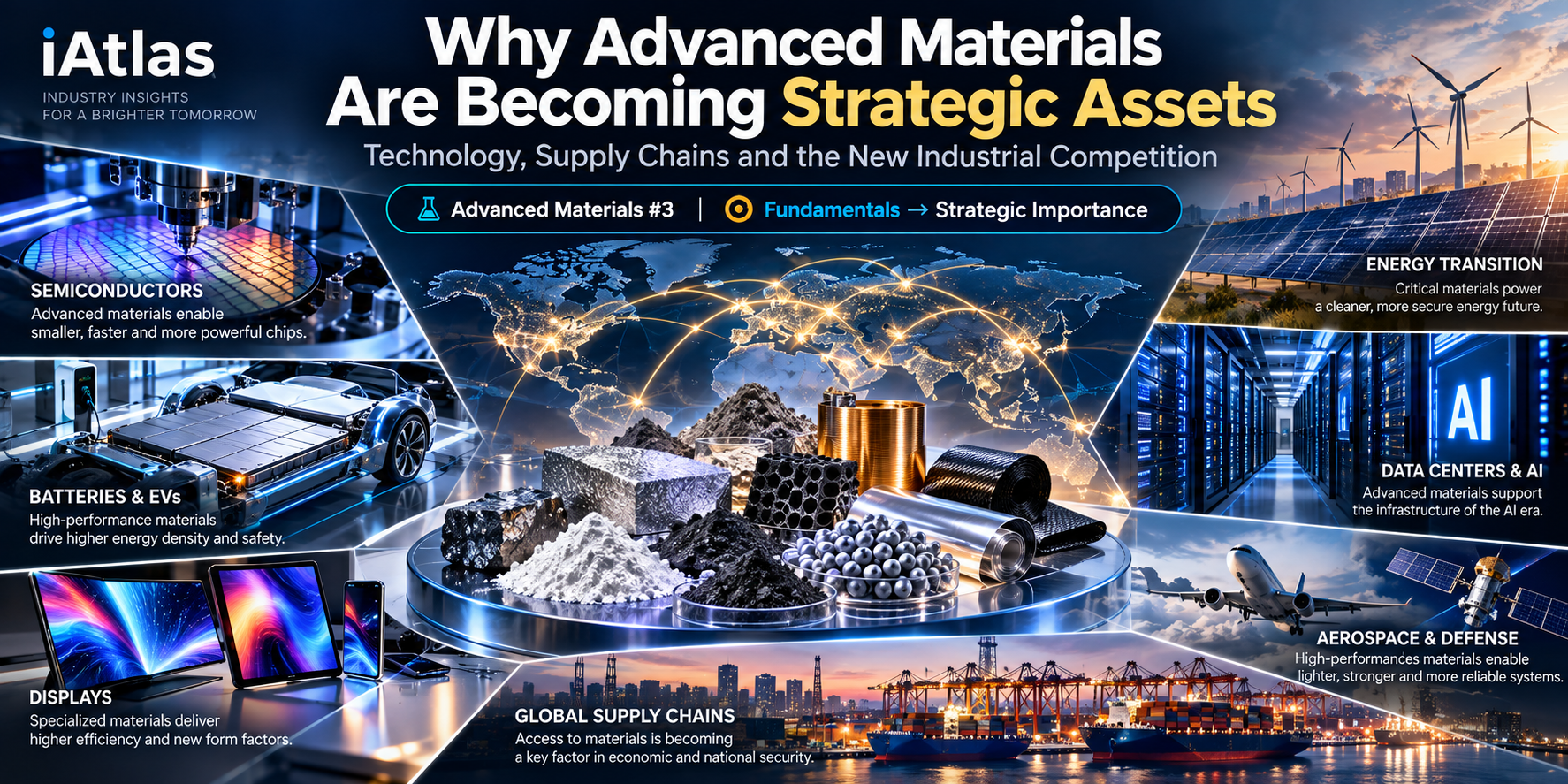
Why Advanced Materials Are Becoming Strategic Assets
🧪 Advanced Materials #3 | 🧭 Fundamentals → Strategic Importance

Advanced materials were once discussed mainly as a scientific or engineering topic.
Today, they are increasingly discussed in a very different context:
industrial competitiveness, economic security, supply-chain resilience, and national strategy.
The reason is simple.
Modern technologies are becoming more dependent on materials that are difficult to develop, difficult to manufacture, difficult to qualify, or difficult to source reliably.
Semiconductors require increasingly sophisticated electronic materials.
Batteries depend on carefully engineered cathodes, anodes, electrolytes, and critical minerals.
Advanced displays rely on specialized organic and functional materials.
Energy systems require rare-earth magnets, high-performance metals, catalysts, and advanced composites.
As technology becomes more complex, the materials behind it become more strategic.
This shift is changing how companies and governments think about the advanced materials industry.
1. Advanced Materials Are No Longer Just Inputs
In conventional manufacturing, materials are often treated as inputs.
They are purchased, processed, and converted into products.
But in advanced industries, materials can directly determine what is technologically possible.
A new material may enable:
- higher semiconductor performance
- faster battery charging
- longer battery life
- improved OLED efficiency
- lighter vehicles
- more efficient motors
- better thermal management
- higher-temperature operation
- stronger and lighter structures
This means materials increasingly influence not only production cost, but also product performance and technological capability.
The relationship can be simplified as:
Materials Capability
↓
Manufacturing Capability
↓
Device Performance
↓
Industrial Competitiveness
If a company or country lacks access to the necessary materials, it may struggle to compete even if it has strong downstream manufacturing capabilities.
2. Technology Is Becoming More Materials-Intensive
Many major technologies are approaching physical and engineering limits.
As these limits become harder to overcome through design alone, new materials become increasingly important.
Semiconductors
Continued scaling requires:
- new dielectric materials
- new deposition precursors
- new interconnect materials
- advanced photoresists
- new packaging materials
Batteries
Performance improvements increasingly depend on:
- higher-performance cathodes
- silicon-rich anodes
- improved electrolytes
- solid electrolytes
- new separator technologies
Energy Systems
Advanced energy technologies require:
- high-performance permanent magnets
- catalysts
- specialty metals
- advanced ceramics
- corrosion-resistant materials
Displays
Display performance increasingly depends on:
- specialized organic compounds
- quantum-dot materials
- encapsulation materials
- optical films
The common theme is clear:
The more advanced the technology becomes, the more important material innovation becomes.
3. Supply Concentration Creates Strategic Risk
A material can be technologically excellent and still create industrial risk if its supply chain is highly concentrated.
Many critical materials pass through only a small number of countries or suppliers.
This creates several potential risks:
- export restrictions
- geopolitical conflict
- production disruptions
- transportation bottlenecks
- regulatory changes
- limited alternative suppliers
The IEA has repeatedly highlighted the high concentration of many critical-mineral supply chains and the resulting risks to energy and economic security. Its 2025 outlook emphasizes that processing and refining capacity for many strategic minerals remains highly concentrated. IEA
This matters because a material does not need to represent a large share of product cost to become strategically important.
If no substitute is available, even a small input can become a bottleneck.
4. The Bottleneck May Be in Processing, Not Mining
When people think about critical materials, attention often goes directly to mining.
But ownership of natural resources is only one part of the value chain.
The real bottleneck may exist in:
- refining
- separation
- chemical conversion
- purification
- precursor production
- advanced material synthesis
This distinction is important.
A country may have access to mineral resources but still depend heavily on another country to convert those resources into usable industrial materials.
For example:
Ore
↓
Refined Material
↓
High-Purity Chemical
↓
Advanced Material
↓
Qualified Industrial Product
The strategic value often increases as the material moves downstream.
That is why policy is increasingly focused on the entire value chain, rather than mining alone.
5. High-Purity Manufacturing Creates Another Barrier
Advanced materials cannot always be produced using conventional industrial processes.
Many applications require extremely precise control over:
- purity
- moisture
- oxygen
- particle contamination
- metallic impurities
- particle size
- composition
- morphology
- batch consistency
For semiconductor, battery, display, and other advanced applications, small variations can have large consequences.
This means that manufacturing capability itself becomes strategic.
Having access to the raw material is not enough.
The industry must also possess:
Process Technology + Equipment + Quality Control + Production Know-How
This combination can take years to develop.
6. Customer Qualification Makes Materials Difficult to Replace
Advanced materials often require extensive customer qualification.
A semiconductor fab, battery manufacturer, or display producer cannot simply switch to a new supplier overnight.
A material change can affect:
- process stability
- yield
- reliability
- equipment compatibility
- product lifetime
- safety
- final performance
New suppliers may therefore need to go through lengthy testing and validation.
Once a supplier is qualified, the relationship can become difficult to replace quickly.
This creates another strategic characteristic:
Supply security depends not only on how many suppliers exist, but on how many suppliers are actually qualified.
A market may appear competitive on paper while remaining highly dependent on only one or two approved sources for a specific process.
7. Advanced Materials Are Becoming Part of Economic Security
Governments increasingly treat materials as part of economic and industrial security.
The European Commission describes advanced materials as important for industrial competitiveness, resilience, and strategic autonomy. It has identified energy, mobility, construction, and electronics as priority application areas and is preparing an Advanced Materials Act intended to strengthen research, production capacity, and deployment in Europe. Research and innovation
This is a significant shift.
Advanced materials are no longer viewed only through the lens of science policy.
They are increasingly connected to:
- industrial policy
- trade policy
- supply-chain strategy
- technology sovereignty
- manufacturing competitiveness
That makes materials policy directly relevant to future technology leadership.
8. The U.S. Is Also Strengthening Domestic Materials Supply Chains
The same trend is visible in the United States.
The U.S. Department of Energy has increased its focus on critical minerals, materials, manufacturing, recycling, and domestic supply-chain capacity.
Its materials programs cover the chain from resource development to manufactured products and recycling, with emphasis on reducing vulnerable dependencies and strengthening domestic production. The Department of Energy’s Energy.gov
In 2026, DOE also announced new funding for projects aimed at addressing gaps in critical-mineral and material supply chains, including pilot-scale processing and recovery technologies. The Department of Energy’s Energy.gov
The message is clear:
materials capability is increasingly being treated as industrial infrastructure.
9. Materials Are Connected to Multiple Strategic Industries at Once
Another reason advanced materials are becoming strategic is that one material can support several industries simultaneously.
For example, critical and advanced materials can be used across:
- semiconductors
- batteries
- electric vehicles
- renewable energy
- aerospace
- defense
- robotics
- data centers
- telecommunications
This creates cross-industry competition for the same upstream resources and processing capacity.
A material shortage may therefore affect several sectors at once.
This is fundamentally different from a component that serves only one narrow market.
The broader the range of strategic applications, the greater the importance of supply security.
10. AI Is Expanding the Strategic Importance of Materials
AI is often discussed as a software or semiconductor story.
But the physical infrastructure behind AI depends on a much broader materials ecosystem.
AI systems require:
- advanced logic chips
- high-bandwidth memory
- advanced packaging
- server infrastructure
- power electronics
- cooling systems
- data-center construction
- electricity infrastructure
These systems depend on materials including:
- semiconductor materials
- copper
- specialty metals
- high-performance polymers
- thermal-interface materials
- magnetic materials
As AI infrastructure expands, demand therefore spreads upstream into materials.
This creates another reason why advanced materials increasingly matter to national technology strategies.
11. Energy Transition Technologies Intensify Materials Competition
The energy transition also increases strategic demand.
Technologies such as:
- EV batteries
- grid-scale storage
- wind turbines
- electric motors
- solar power
- power electronics
require large volumes of specialized materials.
The U.S. Department of Energy notes that rising demand and constrained supply of materials such as lithium and rare-earth elements can limit the expansion of next-generation energy technologies. The Department of Energy’s Energy.gov
The IEA similarly tracks critical-mineral supply because of increasing demand from both energy and broader strategic applications. IEA
This creates competition not only between companies, but also between industries for access to the same materials.
12. Recycling Is Becoming a Strategic Capability
When supply is concentrated, recycling becomes more than an environmental issue.
It can become a source of strategic supply.
Recycling may help recover:
- lithium
- nickel
- cobalt
- rare-earth elements
- copper
- specialty metals
This can reduce dependence on primary resources and diversify supply.
It can also shorten supply chains by recovering material closer to the point of consumption.
For this reason, both the IEA and U.S. Department of Energy increasingly include recycling and recovery in discussions of material security and supply diversification. IEA
The future materials industry may therefore become increasingly circular.
13. Substitution Can Become a Strategic Technology
Another response to supply risk is substitution.
If a strategically important material is:
- expensive
- scarce
- geographically concentrated
- vulnerable to export restrictions
companies may attempt to redesign products around alternative materials.
This can create entirely new markets.
For example, battery chemistry changes can reduce dependence on some materials while increasing dependence on others.
The rapid growth of LFP batteries demonstrates how a change in chemistry can reshape material demand and supply chains. The IEA notes that LFP now accounts for almost half of the global electric-car battery market, while emerging chemistries such as sodium-ion and solid-state batteries may create additional supply-chain shifts. IEA
This illustrates an important point:
Material innovation can be driven not only by performance, but also by supply security.
14. Strategic Materials Do Not Always Need to Be Rare
A material does not need to be geologically rare to become strategic.
The real issue may be:
- limited refining capacity
- highly concentrated production
- difficult purification
- proprietary processing
- limited qualified suppliers
- specialized equipment
- long customer qualification cycles
This means strategic importance is determined by more than natural scarcity.
A useful framework is:
Importance to Technology
×
Difficulty of Substitution
×
Supply Concentration
×
Manufacturing Complexity
=
Strategic Importance
This helps explain why some relatively common materials can still become critical bottlenecks.
15. Companies Are Rethinking Supply Strategy
For manufacturers, advanced materials are increasingly becoming a strategic procurement issue.
Traditional purchasing focused heavily on:
- price
- quality
- delivery
Advanced industries must increasingly consider:
- geographic diversification
- second-source qualification
- long-term supply agreements
- inventory strategy
- local production
- supplier financial stability
- upstream dependency
- recycling options
This changes the role of procurement.
The question is no longer simply:
“Which supplier offers the best price?”
It increasingly becomes:
“Which supplier can support our production reliably under multiple supply-chain scenarios?”
That is a much more strategic question.
16. Strategic Autonomy Does Not Mean Full Self-Sufficiency
There is an important distinction here.
A country does not need to produce every material domestically.
Modern materials supply chains are too complex and interconnected for complete self-sufficiency to be realistic in most cases.
The more practical objective is often resilience.
That can include:
- diversified suppliers
- trusted trade partners
- domestic processing capacity
- strategic inventories
- recycling
- alternative materials
- joint investment
- long-term offtake agreements
The IEA emphasizes that diversification requires looking across the full value chain and building partnerships rather than focusing on only one stage. IEA
The objective is therefore not necessarily independence.
It is reducing the risk that one disruption can stop an entire industry.
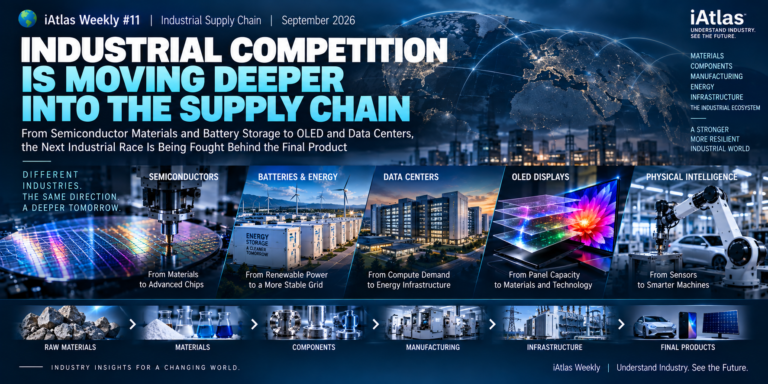
17. The Competitive Race Is Moving Upstream
For decades, much of industrial competition was visible at the final-product level.
Which company makes the best smartphone?
Which automaker sells the most EVs?
Which semiconductor manufacturer has the most advanced process?
But as advanced technologies mature, competition is increasingly moving upstream.
The questions become:
- Who controls the critical raw materials?
- Who owns the refining technology?
- Who can manufacture electronic-grade materials?
- Who has the qualified supplier relationships?
- Who can scale production fastest?
- Who can diversify supply?
This changes where industrial power resides.
The company making the final product may be the most visible.
But the company controlling an irreplaceable upstream material may hold significant strategic leverage.
18. The iAtlas View
Advanced materials are becoming strategic assets because they sit at the intersection of four forces:
Technology
↓
Manufacturing
↓
Supply Chains
↓
Geopolitics
They enable advanced technologies.
They determine what manufacturers can produce.
They depend on complex global supply chains.
And increasingly, governments are trying to secure access to them.
This creates a fundamental shift in how materials should be understood.
The question is no longer only:
“What can this material do?”
It is also:
“Who can produce it?”
“Where is it produced?”
“How difficult is it to replace?”
“What happens if supply is interrupted?”
Those questions transform advanced materials from technical inputs into strategic industrial assets.
Advanced Materials Learning Path
Previous Article
🧪 Advanced Materials #2 | 🧭 Fundamentals → Advanced Materials Value Chain
How the Advanced Materials Value Chain Works: From Raw Materials to High-Tech Industries
Next Article
🧪 Advanced Materials #4 | 🏭 Manufacturing → Lab-to-Factory Scale-Up
From Laboratory to Mass Production: How Advanced Materials Scale
Continue the Learning Path
- From Laboratory to Mass Production
- Purity, Consistency & Qualification
- Where Advanced Materials Demand Comes From
- The Major Families of Advanced Materials
- Semiconductor Materials
- Battery Materials
- OLED & Display Materials
References
- European Commission — Advanced Materials for Industrial Leadership
European strategy linking advanced materials to competitiveness, resilience, strategic autonomy, and industrial leadership. - European Commission — Towards the Advanced Materials Act
Overview of the forthcoming EU framework intended to strengthen advanced-material development, production capacity, circularity, and strategic autonomy. - International Energy Agency — Global Critical Minerals Outlook 2025
Analysis of supply concentration, investment, demand growth, diversification, and critical-mineral security. - International Energy Agency — Beyond NMC Batteries
Analysis of how LFP, sodium-ion, manganese-rich, and solid-state battery technologies are changing material supply chains. - U.S. Department of Energy — Secure Material Supply Chains
DOE strategy covering supply diversification, material efficiency, alternatives, recovery, reuse, and recycling.
ℹ️ About iAtlas
iAtlas is an independent publication covering batteries, semiconductors, OLED, advanced materials, AI, and global industrial trends.
We transform complex industrial developments into clear, reliable, and easy-to-understand insights.
Whether you’re following today’s industry news or building long-term expertise, iAtlas helps you understand not only what happened, but why it matters.
Technology creates change.
Insight creates opportunity.
— iAtlas