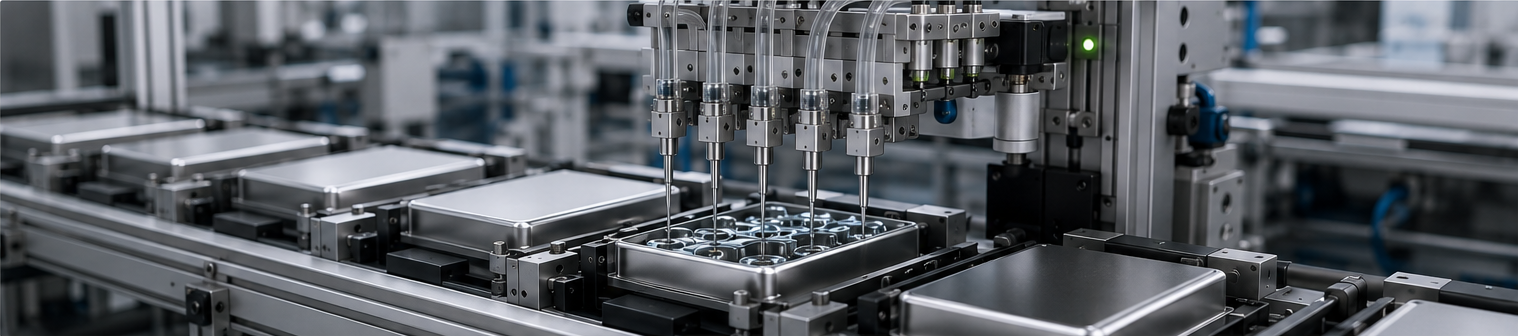
Electrolyte Filling Explained: Why Moisture Control Is Critical for Lithium-Ion Batteries
🔋 iAtlas Battery #15 | 🏭 Manufacturing → 💧 Electrolyte Filling
Introduction
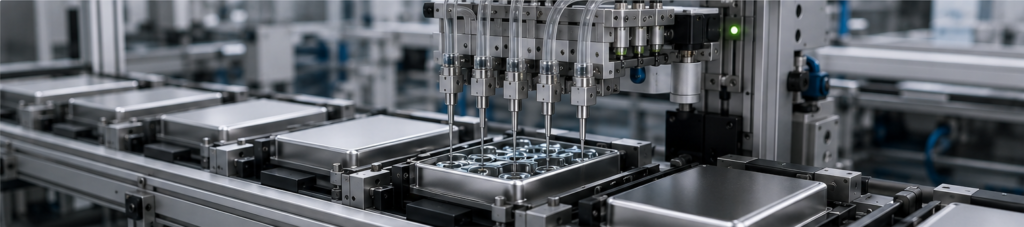
Electrolyte filling is one of the most sensitive processes in lithium-ion battery manufacturing.
Once electrodes and separators have been assembled into a battery cell, the electrolyte must be introduced to create the pathway through which lithium ions move during charging and discharging.
Unlike many manufacturing steps, electrolyte filling must be performed under extremely dry conditions. Even trace amounts of moisture can trigger unwanted chemical reactions, reduce battery life, and compromise safety.
Modern battery manufacturers therefore combine dry rooms, vacuum filling systems, and precise process control to ensure every cell receives the correct amount of electrolyte.
Table of Contents
- What Is Electrolyte Filling?
- Why Electrolytes Matter
- Vacuum Filling Process
- Why Moisture Control Is Critical
- Electrolyte Wetting and Aging
- Future Trends
- Frequently Asked Questions
What Is Electrolyte Filling?
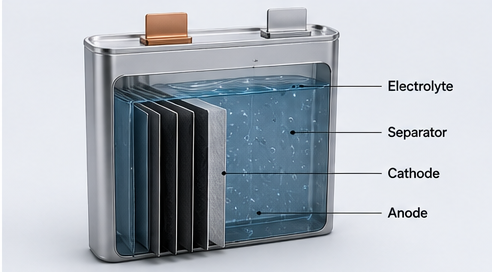
Electrolyte filling is the manufacturing process in which liquid electrolyte is injected into a battery cell after assembly.
The electrolyte fills microscopic pores within the electrodes and separator, creating the ionic pathway required for lithium-ion transport.
Without proper electrolyte filling, a battery cannot operate effectively.
Why Electrolytes Matter
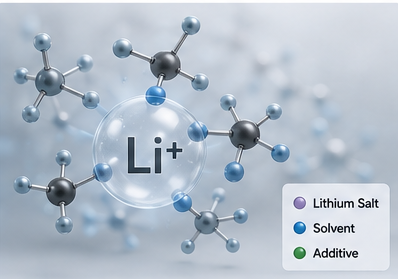
The electrolyte performs one essential function:
It transports lithium ions between the cathode and anode while preventing direct electronic contact.
A typical lithium-ion battery electrolyte consists of:
- Lithium salt (such as LiPF₆)
- Organic carbonate solvents
- Performance-enhancing additives
The amount and distribution of electrolyte directly affect:
- Capacity
- Fast-charging capability
- Cycle life
- Safety
- Internal resistance
Vacuum Filling Process
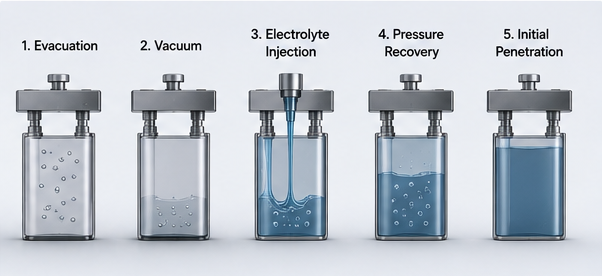
Most EV battery manufacturers use vacuum filling.
The process typically includes:
- Cell evacuation
- Vacuum generation
- Electrolyte injection
- Pressure recovery
- Initial electrolyte penetration
Vacuum filling removes trapped air inside the battery cell, allowing the electrolyte to spread uniformly throughout the electrode structure.
This improves manufacturing consistency and battery performance.
Why Moisture Control Is Critical
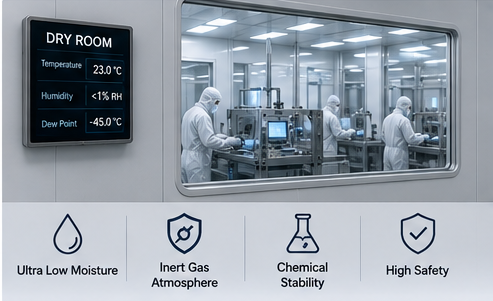
Moisture is one of the biggest enemies of lithium-ion battery production.
Water reacts with electrolyte components such as LiPF₆ to produce harmful substances, including hydrofluoric acid (HF).
Excess moisture may cause:
- Capacity loss
- Gas generation
- Higher internal resistance
- Shorter cycle life
- Reduced safety
To prevent these problems, electrolyte filling is performed inside dry rooms with extremely low dew points, often below −40°C.
Many production lines also use inert gas environments for additional protection.
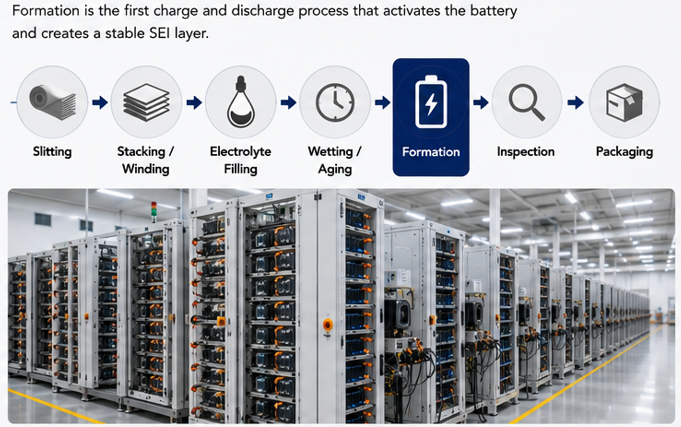
Electrolyte Wetting and Aging
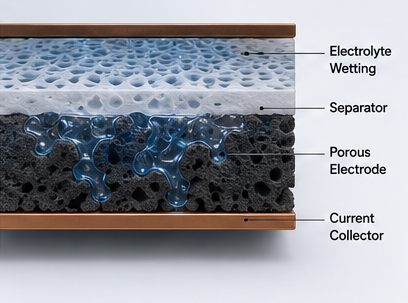
After filling, the electrolyte does not immediately reach every part of the battery.
Instead, the cell enters a wetting period.
During this stage:
- Electrolyte penetrates porous electrodes
- Separator becomes fully saturated
- Internal interfaces stabilize
Proper wetting improves consistency before the battery proceeds to formation and aging.
Future Trends
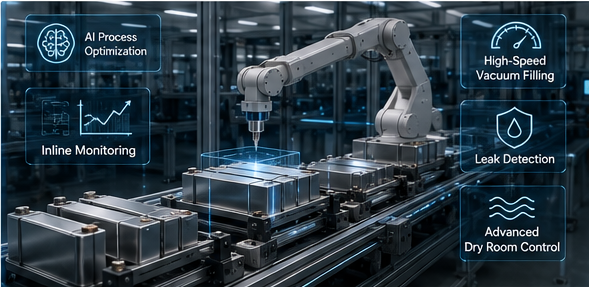
Battery manufacturers continue improving electrolyte filling technology.
Current industry trends include:
- High-speed vacuum filling
- AI-based process optimization
- Inline electrolyte monitoring
- Automated leak inspection
- Advanced dry room control
These innovations support higher production efficiency while maintaining consistent battery quality.
Frequently Asked Questions
What is electrolyte filling?
Electrolyte filling is the process of injecting electrolyte into a battery cell after assembly to enable lithium-ion transport.
Why is moisture harmful?
Moisture reacts with electrolyte chemicals, generating harmful by-products that reduce battery performance and safety.
Why is vacuum filling used?
Vacuum filling removes trapped air and ensures uniform electrolyte distribution throughout the battery cell.
What happens after electrolyte filling?
The battery enters a wetting stage before proceeding to formation and aging.
Key Takeaways
- Electrolyte filling activates lithium-ion battery cells.
- Moisture control is essential for battery quality and safety.
- Vacuum filling improves electrolyte penetration and manufacturing consistency.
- Wetting allows electrolyte to fully saturate electrodes and separators.
- Modern production lines rely on dry rooms and precise environmental control.
🎓 Battery Learning Path
🏭 Manufacturing
✅🔋 iAtlas Battery #13 — Electrode Manufacturing
✅🔋 iAtlas Battery #14 — Cell Assembly
📍 🔋 iAtlas Battery #15 — Electrolyte Filling (Current)
▶ 🔋 iAtlas Battery #16 — Formation & Aging
▶ 🔋 iAtlas Battery #17 — Battery Inspection & Quality Control
Continue exploring how lithium-ion batteries move from assembled cells to fully activated energy storage devices.
📖 Continue Reading
⬅ Previous Article
🔋 iAtlas Battery #14
Cell Assembly Explained: 7 Essential Steps in Lithium-Ion Battery Manufacturing
Discover how electrodes, separators, welding, and sealing create complete lithium-ion battery cells before electrolyte injection.
➡ Next Article
🔋 iAtlas Battery #16
Formation & Aging Explained: Why Every Battery Must Be Charged Before It Can Be Used
Learn how formation creates the SEI layer, why aging stabilizes battery performance, and how these processes determine battery lifespan and safety.
References
- International Energy Agency (IEA)
- U.S. Department of Energy – Vehicle Technologies Office
- Battery University
- Nature Energy – Lithium-ion Battery Manufacturing
About iAtlas
iAtlas is an independent publication covering batteries, semiconductors, OLED, advanced materials, AI, and global industrial trends.
We transform complex industrial developments into clear, reliable, and easy-to-understand insights.
Whether you’re following today’s industry news or building long-term expertise, iAtlas helps you understand not only what happened, but why it matters.
Technology creates change.
Insight creates opportunity.
— iAtlas