Battery Manufacturing Process Explained: From Materials to Finished Cells
Understanding How Lithium-ion Battery Cells Are Manufactured Step by Step
Category: Battery Technology
Content Type: Manufacturing · Pillar Page
Related Industries: Electric Vehicles · Energy Storage Systems · Consumer Electronics
Last Updated: August 2026
Industry Snapshot
The battery manufacturing process transforms raw battery materials into precisely engineered lithium-ion cells through a sequence of tightly controlled production steps.
A modern lithium-ion battery cell begins with active materials such as cathode and anode powders. These materials are mixed into electrode slurries, coated onto metal foils, dried, compressed, and cut before being assembled with a separator.
The assembled cell is then filled with electrolyte, sealed, electrically activated through formation, aged, and tested before it can be used in a battery module or pack.
Each manufacturing step affects battery capacity, energy density, cycle life, consistency, and safety, making process control one of the most important capabilities in the battery industry.
At a Glance
| Category | Description |
|---|---|
| Definition | Process of converting battery materials into finished cells |
| Main Stages | Electrode Manufacturing · Cell Assembly · Cell Finishing |
| Key Processes | Mixing · Coating · Calendering · Slitting · Assembly · Filling · Formation |
| Critical Controls | Moisture · Contamination · Thickness · Alignment · Temperature |
| Final Output | Qualified lithium-ion battery cell |
| Major Applications | EVs · ESS · Consumer Electronics |
What Is the Battery Manufacturing Process?
Lithium-ion battery manufacturing is not a single production step.
It is an integrated sequence of material processing, precision coating, mechanical assembly, electrolyte handling, electrochemical activation, and quality inspection.
The overall process can be divided into three major stages:
Electrode Manufacturing
Battery materials are converted into cathode and anode electrodes.
Cell Assembly
The electrodes, separator, and electrolyte are assembled into a battery cell.
Cell Finishing
The newly assembled cell is electrochemically activated, stabilized, tested, and graded.
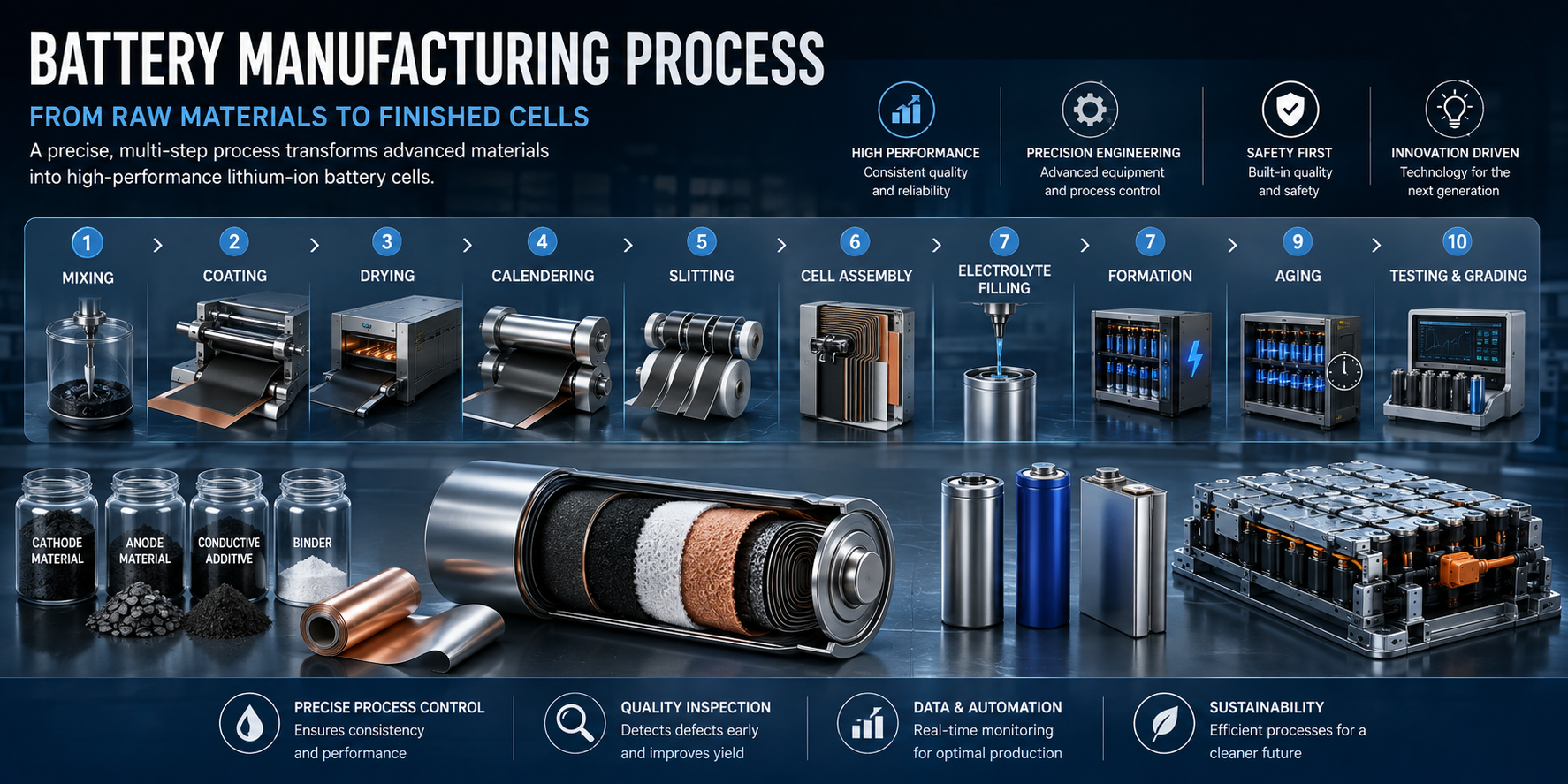
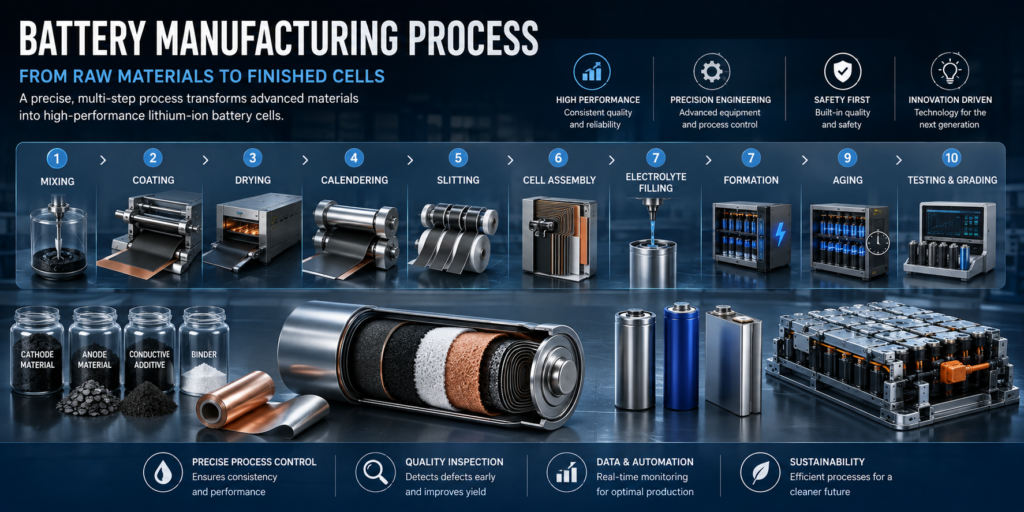
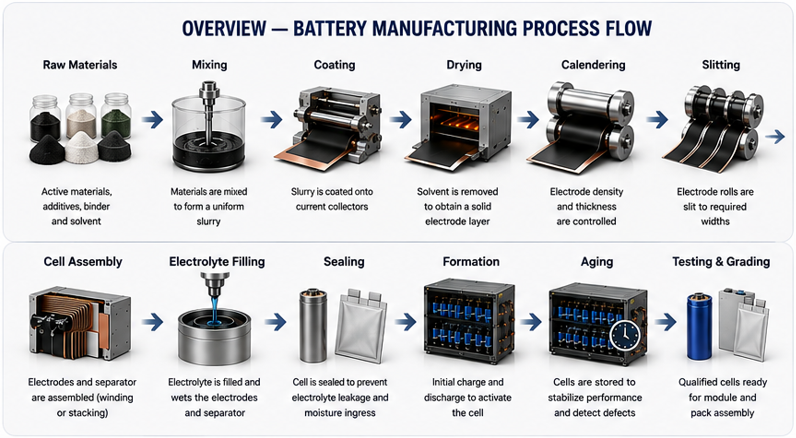
A simplified production flow looks like this:
Raw Materials -> Mixing -> Electrode Coating -> Drying -> Calendering -> Slitting -> Cell Assembly -> Electrolyte Filling -> Sealing -> Formation -> Aging -> Testing & Grading -> Finished Battery Cell
Stage 1 — Electrode Manufacturing
The first stage creates the positive and negative electrodes used inside the battery cell.
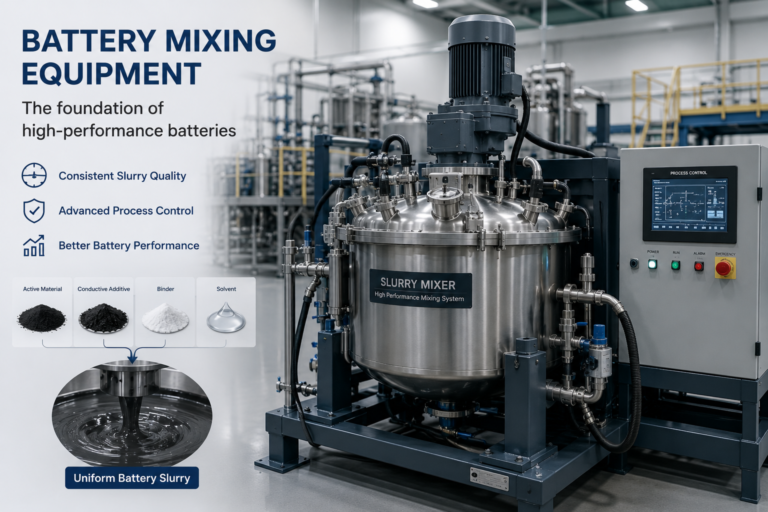
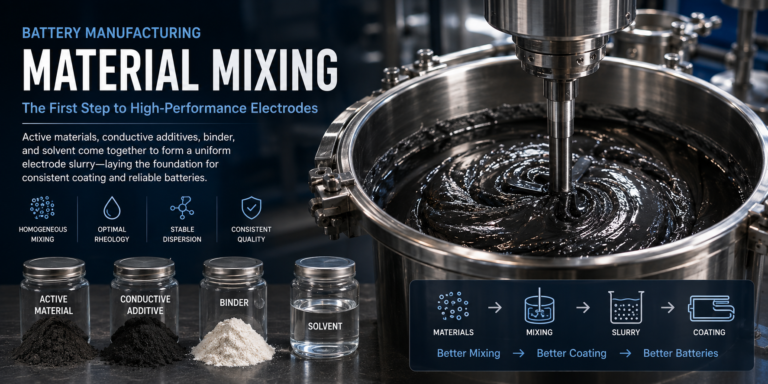
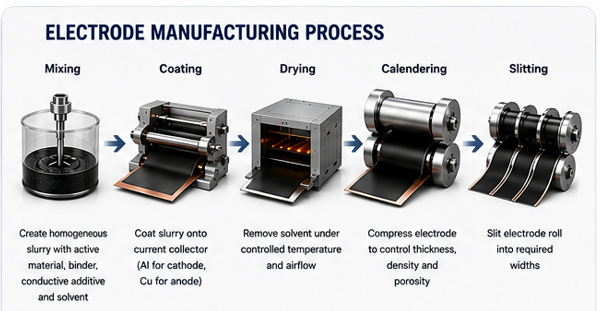
Material Mixing
Cathode and anode materials begin as powders.
The active material is mixed with other components such as:
- Conductive additives
- Binder
- Solvent
The objective is to create a homogeneous electrode slurry.
Uniform mixing is important because poor dispersion can cause uneven electrode performance and cell-to-cell variation.
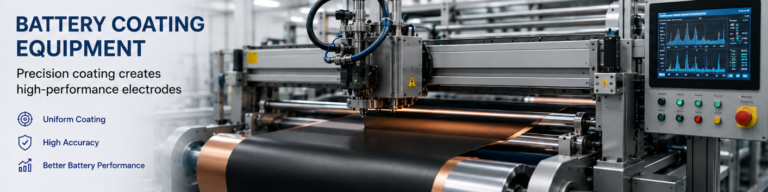
Electrode Coating
The prepared slurry is coated onto a thin metallic current collector.
Typically:
Cathode → Aluminum Foil
Anode → Copper Foil
The coating process must precisely control:
- Coating thickness
- Loading amount
- Uniformity
- Surface quality
Even small variations can influence battery capacity and performance.
Electrode Drying
After coating, the electrode passes through a drying system.
The purpose is to remove solvent from the wet electrode coating while maintaining a stable electrode structure.
Drying conditions such as temperature, airflow, and line speed must be carefully controlled.
Improper drying can lead to defects such as cracking, uneven binder distribution, or residual solvent.
Calendering
The dried electrode is compressed between rollers.
This process is known as calendering.
Calendering controls:
- Electrode thickness
- Density
- Porosity
- Surface uniformity
Higher density can improve volumetric energy density, but excessive compression may reduce the pathways required for efficient lithium-ion transport.
The process therefore requires a balance between energy density and ion transport.
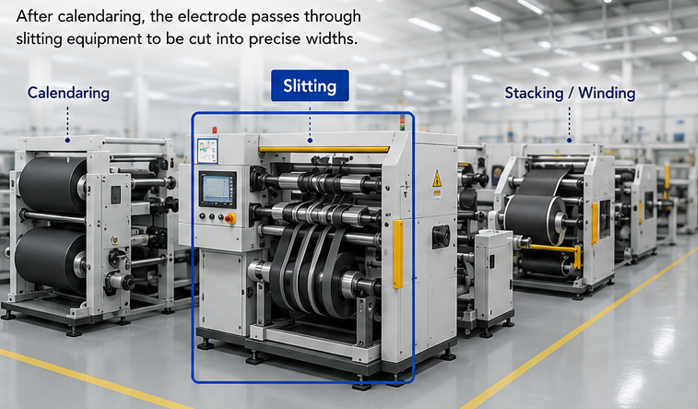
Slitting
Large electrode rolls are cut into narrower widths suitable for the intended battery cell design.
This process is called slitting.
Accurate slitting is important because poor edge quality can create:
- Burrs
- Particles
- Dimensional variation
These defects can potentially affect battery performance and safety.
Stage 2 — Cell Assembly
Once cathode and anode electrodes are prepared, they are assembled with the separator to form the internal structure of the battery cell.
Notching
Depending on the cell design, electrode sheets may be cut into specific shapes before assembly.
This process creates the electrode geometry and tab regions required for electrical connection.
Precision is important because electrode alignment directly influences cell quality.
Winding or Stacking
There are two major approaches to assembling electrodes.
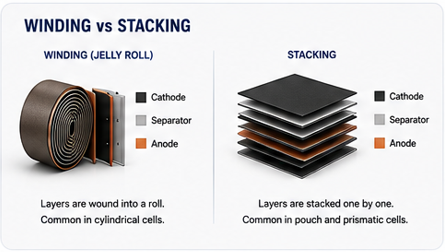
Winding
Cathode, separator, and anode layers are wound into a roll.
This structure is commonly called a jelly roll.
Winding is widely used in cylindrical cells and some prismatic designs.
Stacking
Individual electrode and separator sheets are layered repeatedly.
Stacking is widely associated with pouch and prismatic battery designs.
Regardless of the method, precise alignment between the cathode, separator, and anode is essential.
Cell Insertion
The assembled electrode structure is inserted into the cell housing.
Depending on the cell format, this may be:
- Cylindrical can
- Prismatic case
- Pouch film
Electrical tabs are then connected to the appropriate terminals.
Electrolyte Filling
After assembly, the cell is filled with electrolyte.
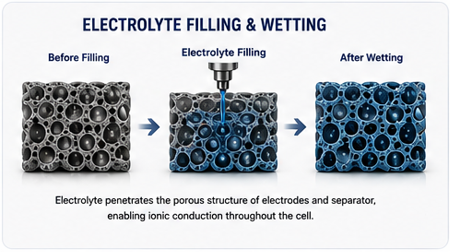
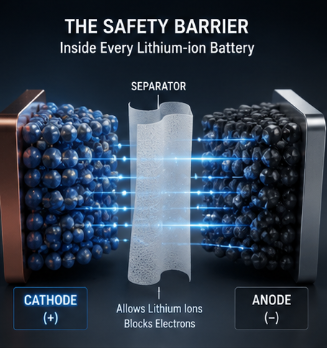
The electrolyte penetrates the porous structure of:
- Cathode
- Separator
- Anode
and provides the ion-conducting pathway required for battery operation.
Uniform electrolyte wetting is critical.
Poor wetting can create areas with higher resistance and uneven electrochemical performance.
For this reason, electrolyte filling and wetting are carefully controlled manufacturing processes.
Why Moisture Control Matters
Lithium-ion battery manufacturing requires strict environmental control, particularly during cell assembly and electrolyte handling.
Moisture can react with certain battery materials and electrolyte components, potentially generating unwanted reaction products and degrading cell performance.
For this reason, critical production processes are often conducted in low-humidity dry-room environments.
Important environmental controls include:
- Dew point
- Moisture concentration
- Particle contamination
- Temperature
- Cleanliness
Environmental control is therefore part of the manufacturing process itself, not merely a facility requirement.
Cell Sealing
After electrolyte filling and wetting, the cell must be sealed.
The sealing method depends on the cell format.
Examples include:
- Can sealing
- Laser welding
- Pouch heat sealing
The objective is to prevent electrolyte leakage and protect the internal battery components from environmental contamination.
Stage 3 — Cell Finishing
A newly assembled battery cell is not yet ready for commercial use.
It must first undergo electrochemical activation and stabilization.
Formation
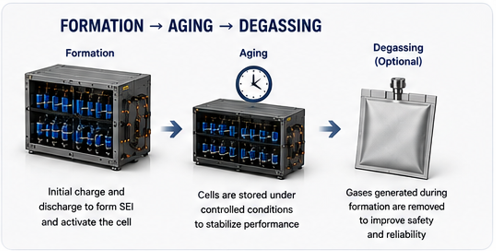
Formation is the first controlled charging and discharging process performed on a newly manufactured battery cell.
During formation, important electrochemical interfaces are established.
One of the most important is the Solid Electrolyte Interphase (SEI) formed primarily on the anode surface.
A stable SEI is essential for:
- Cycle life
- Coulombic efficiency
- Battery stability
- Long-term performance
Formation conditions therefore have a major influence on final cell quality.
Aging
After formation, cells are stored under controlled conditions for a defined period.
This process is called aging.
During aging, manufacturers monitor characteristics such as:
- Voltage
- Self-discharge
- Internal resistance
- Stability
Abnormal cells can be identified before final shipment.
Degassing
Some cell designs, particularly pouch cells, may require degassing after formation.
Electrochemical reactions during early cycling can generate gases inside the cell.
Degassing removes these gases before final sealing and helps stabilize the cell structure.
Cell Testing and Grading
Finished cells undergo electrical and quality testing.
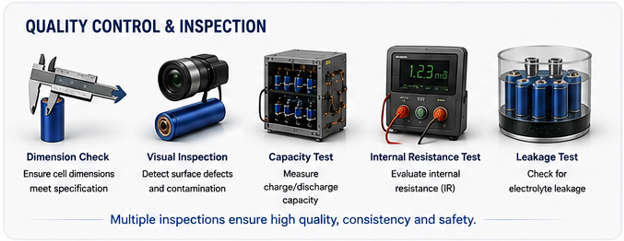
Typical measurements include:
- Capacity
- Voltage
- Internal resistance
- Self-discharge
- Leakage
- Dimensional inspection
Cells can then be classified according to their measured characteristics.
This process is commonly called cell grading.
Cells with similar characteristics can be grouped together for module and pack assembly.
Key Manufacturing Control Points
Battery manufacturing requires precision across the entire production line.
| Control Point | Why It Matters |
| Slurry Uniformity | Influences electrode consistency |
| Coating Thickness | Affects capacity and cell balance |
| Electrode Density | Influences energy density and ion transport |
| Slitting Quality | Helps reduce burrs and particles |
| Electrode Alignment | Reduces assembly defects |
| Moisture Control | Protects sensitive battery materials |
| Electrolyte Wetting | Supports uniform electrochemical performance |
| Formation Conditions | Influences SEI formation and cell life |
| Final Testing | Identifies abnormal cells |
The final battery cell is therefore only as reliable as the processes used to manufacture it.
Battery Manufacturing and Cell Formats
Manufacturing methods also vary according to battery cell format.
Cylindrical Cells
Typically use wound electrode structures enclosed in a rigid cylindrical metal can.
Prismatic Cells
May use wound or stacked electrode structures inside a rigid rectangular enclosure.
Pouch Cells
Typically use stacked or wound electrodes enclosed in flexible laminated pouch material.
Although the fundamental electrochemistry is similar, equipment and production methods can differ significantly between cell formats.
From Cell to Battery Pack
Battery cell manufacturing is only the first major stage of battery system production.
Qualified cells continue through:
Battery Cell -> Module Assembly -> Battery Pack Assembly -> Battery Management System Integration -> Thermal Management Integration -> Final Battery System
Some modern battery architectures, such as Cell-to-Pack (CTP), reduce or eliminate the traditional module stage.
Atlas Insight
Battery manufacturing is increasingly becoming a competitive technology in its own right.
Battery performance depends not only on chemistry but also on how consistently and precisely that chemistry can be manufactured at scale.
Modern battery factories therefore focus heavily on:
- Automation
- Inline inspection
- Machine vision
- Data analytics
- AI-based quality control
- Energy-efficient drying
- Dry electrode technologies
- Higher production yield
As battery production scales toward increasingly large factories, even small improvements in yield, cycle time, energy consumption, and defect detection can have significant economic impact.
The future of battery manufacturing will therefore be shaped by both materials innovation and manufacturing innovation.
Did You Know?
- Battery manufacturing can involve dozens of tightly controlled process steps.
- Cathode electrodes typically use aluminum current collectors, while anodes commonly use copper.
- Formation is the first controlled electrochemical cycling of a newly manufactured battery cell.
- Moisture control is especially important during cell assembly and electrolyte handling.
- Small manufacturing defects can affect both battery performance and safety.
- Battery factories increasingly use automated inspection and production data to detect defects earlier.
FAQ
What are the main stages of battery manufacturing?
Lithium-ion battery manufacturing can broadly be divided into electrode manufacturing, cell assembly, and cell finishing.
What happens during electrode manufacturing?
Active materials are mixed into slurry, coated onto current collectors, dried, compressed through calendering, and cut through slitting.
What is the difference between winding and stacking?
Winding rolls the electrode and separator layers together, while stacking builds the cell from individual layered sheets.
Why is electrolyte filling important?
The electrolyte must uniformly penetrate the electrodes and separator to provide an effective lithium-ion transport pathway.
Why is formation necessary?
Formation establishes important electrochemical interfaces, including the SEI on the anode, and activates the newly manufactured cell.
Why are battery cells aged after formation?
Aging allows manufacturers to monitor voltage stability, self-discharge, and other characteristics before cells proceed to final grading and shipment.
Battery Manufacturing Learning Path
This article is the starting point for the iAtlas Battery Manufacturing learning path.
Overview
- Battery Manufacturing Process (Current)
Part 1 — Electrode Manufacturing
- Material Mixing
- Slurry
- Electrode Coating
- Electrode Drying
- Calendering
- Slitting
Part 2 — Cell Assembly
- Battery Cell Assembly
- Notching
- Winding
- Stacking
- Electrolyte Filling
- Cell Sealing
Part 3 — Cell Finishing
- Formation
- Aging
- Degassing
- Battery Cell Testing & Grading
Part 4 — System Assembly
- Battery Module Assembly
- Battery Pack Assembly
Explore More
Fundamentals
- Battery
- Lithium-ion Battery
- Battery Cell
- Battery Module
- Battery Pack
- Battery Management System(BMS)
- Battery Thermal Management System(BTMS)
- Battery Safety
Materials
Manufacturing
- Battery Manufacturing Process (Current)
- Material Mixing
- Electrode Coating
- Calendering
- Cell Assembly
- Formation
- Aging
Technologies
- Cell-to-Pack (CTP)
- Cell-to-Chassis (CTC)
- Fast Charging
- Dry Electrode Technology
References
Recommended primary sources for this article:
- U.S. Department of Energy (DOE) – Battery Manufacturing
- Argonne National Laboratory – Battery Manufacturing Research
- International Energy Agency (IEA) – Batteries and Secure Energy Transitions
- Journal of Power Sources – Battery Manufacturing Research
- Nature Energy – Battery Manufacturing and Technology
About iAtlas
iAtlas is an independent publication covering batteries, semiconductors, OLED, advanced materials, AI, and global industrial trends.
We transform complex industrial developments into clear, reliable, and easy-to-understand insights.
Whether you’re following today’s industry news or building long-term expertise, iAtlas helps you understand not only what happened, but why it matters.
Technology creates change.
Insight creates opportunity.
— iAtlas