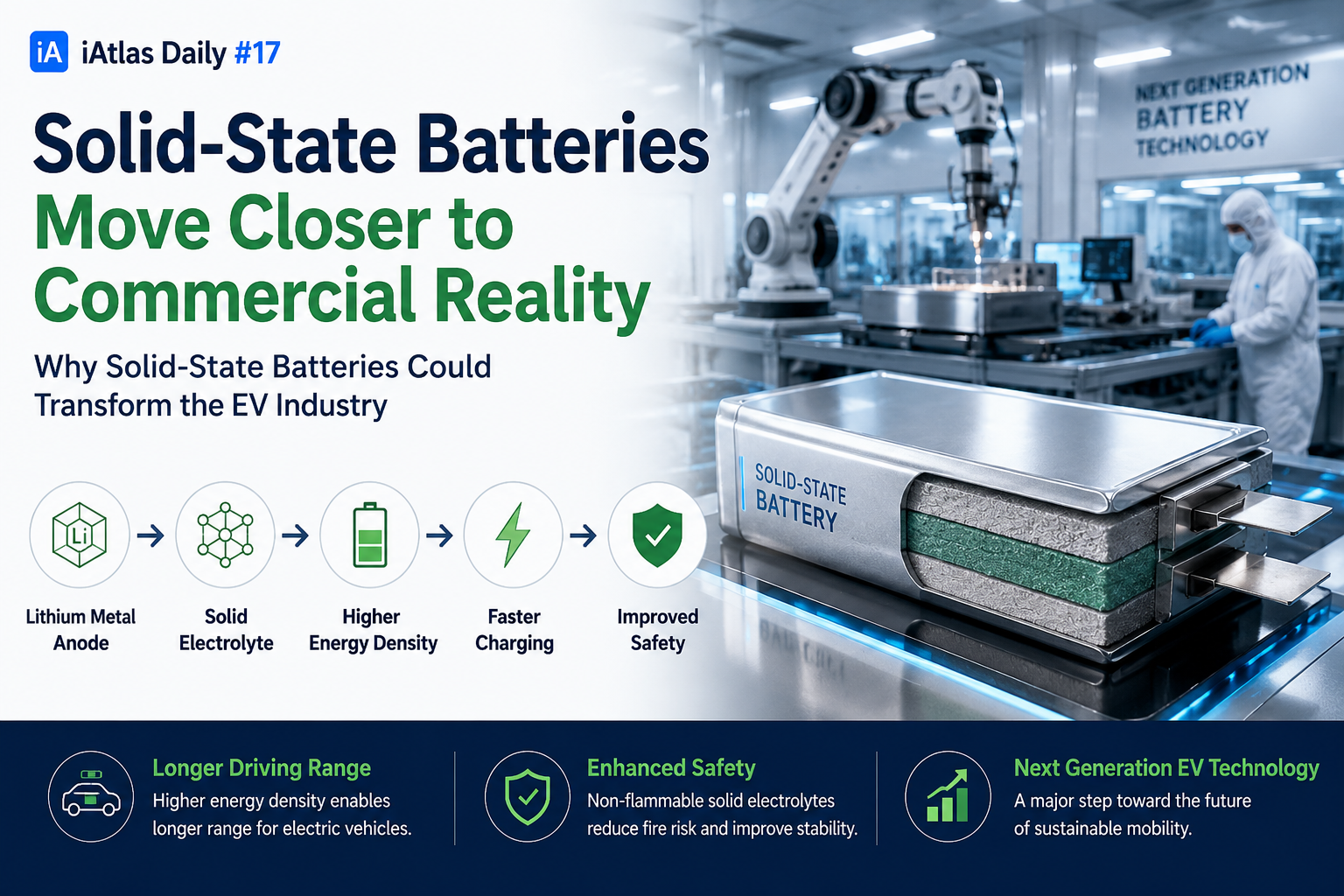
Solid-State Batteries Are Moving Closer to Commercial Reality
Why the Race for Safer, Higher-Energy Batteries Is Accelerating
📰 iAtlas Daily #17 | July 23, 2026
🔋 What Happened?
Several automakers and battery manufacturers have announced continued progress toward commercializing solid-state battery technology.
Companies including Toyota, Samsung SDI, and other global battery developers are investing heavily in pilot production lines, new solid electrolyte materials, and manufacturing processes designed to bring solid-state batteries closer to mass production.
Although large-scale commercialization still faces technical and manufacturing challenges, industry momentum continues to build.
💡 Why It Matters
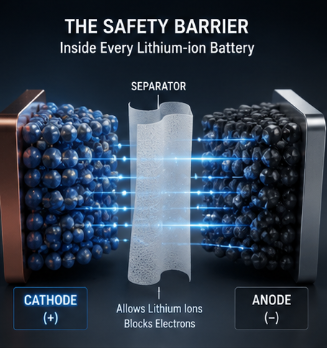
Today’s lithium-ion batteries rely on liquid electrolytes, which provide high performance but also introduce challenges related to safety, thermal management, and energy density.
Solid-state batteries replace the liquid electrolyte with a solid material.
This approach has the potential to deliver:
- Higher energy density
- Faster charging capability
- Improved thermal stability
- Enhanced safety
- Longer battery life
If these challenges can be overcome at scale, solid-state batteries could become one of the biggest technological shifts since the commercialization of lithium-ion batteries.
🌍 Industry Impact
EV Manufacturers
Longer driving range and shorter charging times remain key priorities for electric vehicles.
Solid-state batteries could help manufacturers deliver both while improving vehicle safety.
Battery Manufacturers
Commercial production requires entirely new manufacturing processes, materials, and quality control technologies.
Companies that successfully scale production may gain a significant competitive advantage.
Battery Materials
The transition toward solid electrolytes is expected to create new opportunities for advanced ceramic materials, sulfide electrolytes, oxide electrolytes, polymer electrolytes, and lithium metal anodes.
What’s Next?
The next phase of solid-state battery development will focus less on laboratory breakthroughs and more on industrial-scale manufacturing.
Battery manufacturers are now investing in pilot production lines to validate production yields, improve material stability, and reduce manufacturing costs. While technical progress has been encouraging, achieving consistent quality at mass-production scale remains one of the industry’s biggest challenges.
The companies that successfully bridge the gap between research and commercial manufacturing are likely to shape the next generation of electric vehicles.
🎯 Atlas Insight
The race toward solid-state batteries is no longer simply about inventing a better battery.
It is becoming a competition to develop manufacturing technologies capable of producing millions of reliable battery cells at an economically viable cost.
The company that first solves both the technology and manufacturing challenges may redefine the future of electric mobility.
📚 Related Articles
🔋 Battery #3 | What Is a Lithium-Ion Battery?
Learn how today’s lithium-ion batteries work and why researchers are looking beyond conventional battery technology.
🔋 Battery #5 | What Is an LFP Battery?
Compare LFP batteries with solid-state batteries and understand the strengths of each technology.
📰 iAtlas Daily #16 | BYD’s Fast-Charging Technology Is Reshaping the EV Battery Race
Discover how charging performance is becoming another major battleground alongside next-generation battery chemistry.
📊 iAtlas Weekly #2 | AI, Battery & Semiconductor Weekly News
Catch up on the week’s biggest developments across batteries, semiconductors, AI, OLED, and advanced manufacturing.
About iAtlas
iAtlas is an independent publication covering batteries, semiconductors, OLED, advanced materials, AI, and global industrial trends.
We transform complex industrial developments into clear, reliable, and easy-to-understand insights.
Whether you’re following today’s industry news or building long-term expertise, iAtlas helps you understand not only what happened, but why it matters.
Technology creates change.
Insight creates opportunity.
— iAtlas