

What If Your Smart Glasses Never Needed Charging?
How Northwestern University’s GlassTENG Turns Eye Blinks and Facial Movements into Electrical Signals for Wearable Health Monitoring
iAtlas Daily #80 | Emerging Technologies & Wearable Electronics | October 19, 2026
The Big Story
GlassTENG Smart Glasses could change how wearable devices monitor our health. Imagine a pair of glasses that detects eye blinks, jaw movements, and even heartbeats using tiny sensors that generate their own electrical signals.
Researchers at Northwestern University have developed a prototype that brings this concept closer to reality. Instead of relying on conventional battery-powered sensing elements, the system converts everyday facial movements into electrical signals.
The technology does not yet eliminate the need for batteries in an entire smart-glasses system. However, it demonstrates how self-powered sensors could help create smaller, lighter, and more energy-efficient wearable devices.
It sounds like something from a science fiction movie.
But researchers at Northwestern University have developed a prototype that brings part of this idea closer to reality.
The technology, called GlassTENG, uses tiny sensors embedded in an ordinary-looking glasses frame to convert facial movements into electrical signals.
Every blink, eyebrow movement, jaw clench, and even the subtle pulse of an artery creates a small amount of mechanical energy.
GlassTENG captures these movements using a technology known as a triboelectric nanogenerator.
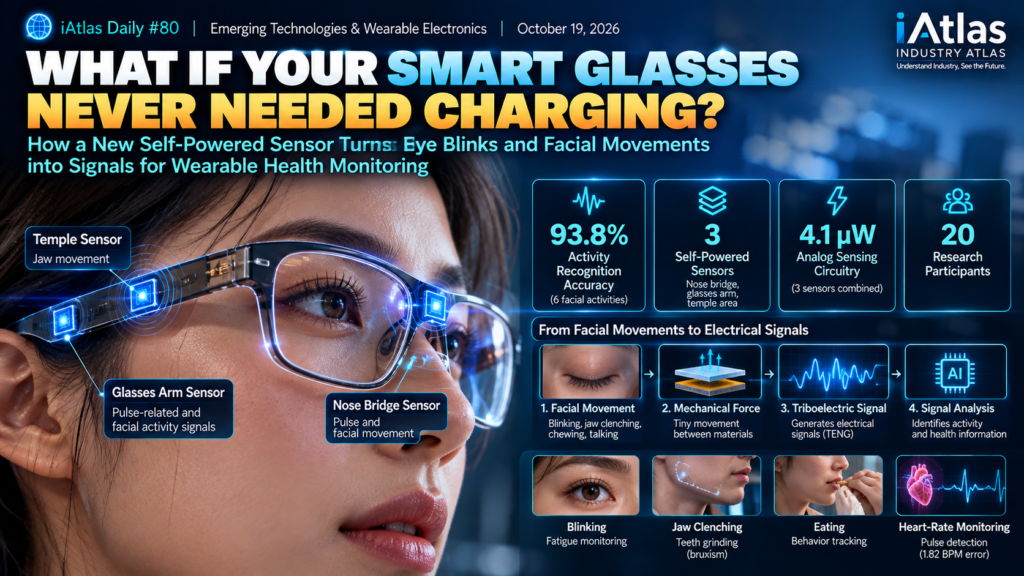
In a study involving 20 participants, the researchers demonstrated that the system could distinguish six facial activities with 93.8% accuracy.
The research was highlighted by Northwestern University on October 12, 2026, ahead of its presentation at the 2026 ACM International Symposium on Wearable Computers.
The achievement does not mean that an entire pair of smart glasses can already operate indefinitely without charging.
Instead, it demonstrates something potentially more important for the future of wearable electronics.
Some sensors may be able to generate their own electrical signals from the movements they are designed to measure.
That could change how future wearable health devices are designed.
1. How Do GlassTENG Smart Glasses Generate Electricity?
The basic principle behind GlassTENG is surprisingly simple.
When two different materials come into contact and then separate, electrical charges can accumulate on their surfaces.
This phenomenon is known as the triboelectric effect.
A familiar example is the static electricity generated when certain materials rub against each other.
Researchers can use this principle to create tiny devices that convert mechanical movement into electrical signals.
These devices are called triboelectric nanogenerators, or TENGs.
GlassTENG integrates three custom-designed TENG sensors into a glasses frame.
When the wearer blinks, raises their eyebrows, clenches their jaw, or makes other facial movements, small mechanical forces act on the sensors.
Those movements generate electrical signals.
The resulting signal patterns can then be analyzed to identify the activity.
A simplified process looks like this:
Facial Movement → Mechanical Force → Triboelectric Signal → Signal Analysis → Activity Recognition
Unlike a conventional sensor that requires continuous external excitation, the triboelectric sensing element generates a signal directly from movement.
This is why researchers describe the sensing mechanism as self-powered.
However, additional electronics are still needed to process and transmit the information.
2. Three Tiny Sensors, Multiple Health Signals
One of the interesting aspects of GlassTENG is that it does not rely on a single sensor.
The prototype uses three sensors positioned around the glasses frame.
Each location captures different types of movement.
| Sensor Location | What It Can Detect |
|---|---|
| Nose bridge | Arterial pulse and facial movement |
| Extended glasses arm | Pulse-related and facial activity signals |
| Temple area | Jaw muscle movement |
By combining information from multiple locations, the system can distinguish activities that might otherwise produce similar signals.
For example, chewing and jaw clenching both involve jaw movement.
But their electrical patterns can differ in timing, intensity, and duration.
The research team used machine-learning algorithms to analyze these patterns.
This combination of self-powered sensing and signal classification allows a relatively simple wearable structure to capture several types of physiological and behavioral information.
3. What Did the Researchers Actually Demonstrate?
The researchers tested GlassTENG Smart Glasses with 20 participants performing six facial activities.
These included blinking, eyebrow raising, teeth clenching, teeth tapping, eating, and talking.
The system achieved an overall classification accuracy of 93.8%.
Northwestern University also reported particularly strong results for two activities:
| Research Result | Reported Performance |
|---|---|
| Overall classification across six activities | 93.8% |
| Teeth tapping recognition | 99% |
| Jaw clenching recognition | 96% |
| Heart-rate estimation error | 1.82 BPM |
| Combined analog sensing power | Approximately 4.1 µW |
The heart-rate result was measured as mean absolute error compared with a reference chest-strap sensor over 30-second windows.
The results demonstrate that facial movements and arterial pulses can provide useful sensing signals through the glasses frame.
However, these figures come from a controlled research study.
They do not establish the same performance during months of everyday use across a much larger population.
Additional testing would be required to evaluate long-term reliability, comfort, movement interference, and real-world accuracy.
4. Why the Power Consumption Matters
Wearable electronics face a fundamental design problem.
Smaller devices are generally more comfortable.
But batteries take up space, add weight, and require regular charging.
Health-monitoring devices can be particularly challenging because they may need to collect data throughout the day.
GlassTENG offers a different approach.
Its three triboelectric sensing elements generate signals from facial movement, while the associated analog front-end circuits consume approximately 4.1 microwatts combined.
For perspective:
1 microwatt = 0.000001 watt
That makes 4.1 microwatts an extremely small amount of power.
The reported figure applies to the sensing circuitry, not to the entire wearable system.
The current prototype also uses Bluetooth communication to transmit data to another device.
Wireless communication and computing require additional energy.
Therefore, the study should not be interpreted as proof that a complete smart-glasses product can operate without any external power source.
The more immediate achievement is reducing the energy required for sensing itself.
If future electronics can combine similarly efficient sensing with low-power processing and communication, wearable devices could become smaller and require less frequent charging.
5. Could Smart Glasses Become Personal Health Monitors?
Most people associate smart glasses with cameras, displays, navigation, or augmented reality.
GlassTENG explores another possibility.
What if ordinary glasses could continuously monitor aspects of a person’s health and daily behavior?
The researchers identified several potential applications.
Teeth Grinding and Jaw Clenching
Bruxism involves involuntary teeth grinding or jaw clenching.
A wearable device capable of recognizing these activities could potentially help users identify recurring patterns.
For example, future systems might alert users when they repeatedly clench their jaws.
Heart-Rate Monitoring
Because the glasses frame contacts areas near superficial arteries, sensitive sensors may detect pulse-related mechanical movements.
This creates the possibility of monitoring cardiovascular signals without relying exclusively on wrist-based devices.
Fatigue and Behavioral Monitoring
Blinking patterns and facial movements may provide information relevant to fatigue or daily behavior.
However, detecting a facial movement is not the same as diagnosing fatigue or a medical condition.
Reliable applications would require additional validation.
Eating Behavior
Jaw movements could potentially help identify eating-related activity.
Future systems might use this information to support behavioral awareness or research into daily habits.
These applications remain research possibilities rather than established clinical capabilities.
6. Why Glasses Could Be an Ideal Wearable Platform
Smartwatches and fitness trackers have become familiar health-monitoring devices.
But glasses offer several potential advantages.
They sit close to the face, where many small physiological movements occur.
They also maintain contact with multiple areas that may provide useful signals.
And many people already wear glasses for vision correction or daily activities.
This could make glasses an attractive platform for additional sensing functions.
Instead of introducing an entirely new wearable device, manufacturers could potentially integrate sensors into an existing product category.
That may reduce the need for users to change their habits.
However, practical adoption will depend on comfort, appearance, durability, cost, and data privacy.
The ability to measure signals in a laboratory is only the first step toward a commercially successful product.
7. What Would It Take to Commercialize GlassTENG?
Although GlassTENG Smart Glasses demonstrate promising sensing capabilities, several challenges remain before commercial adoption.
Several challenges remain before the technology could become a mass-market wearable product.
| Challenge | Why It Matters |
|---|---|
| Sensor durability | Sensors must withstand repeated movement and long-term wear |
| Manufacturing consistency | Large-scale production requires repeatable performance |
| Signal accuracy | Performance must remain reliable across different users and activities |
| Power management | Communication and processing still require energy |
| Comfort and design | Sensors must fit into lightweight, attractive glasses |
| Data privacy | Physiological and behavioral information requires appropriate protection |
| Medical validation | Health-related claims may require clinical testing and regulatory review |
Manufacturing integration could be particularly important.
Sensors must be thin, lightweight, and compatible with the mechanical structure of a glasses frame.
They must also maintain reliable performance despite differences in face shape, fit, and movement.
These challenges create opportunities for collaboration among sensor developers, materials companies, electronics manufacturers, and wearable-device designers.
8. Why This Matters Beyond Smart Glasses
The broader significance of GlassTENG extends beyond eyewear.
Many connected devices are limited by the need for batteries or external power.
Examples include wearable sensors, remote monitoring devices, smart textiles, and certain industrial sensing applications.
Self-powered sensing technologies could help reduce energy requirements in applications where mechanical movement is already present.
The concept is especially interesting for devices that need to operate over long periods while collecting relatively small amounts of information.
However, not every application can be powered effectively through energy harvesting.
The amount of available mechanical energy, sensor requirements, processing needs, and communication frequency will determine what is practical.
GlassTENG demonstrates a promising approach within a specific low-power sensing application.
It does not establish a universal replacement for batteries.
Industry Impact
Wearable electronics: Self-powered sensing could enable lighter and more comfortable devices with reduced battery requirements.
Healthcare technology: Glasses-based sensing may create new opportunities for monitoring physiological and behavioral signals.
Sensor manufacturers: Triboelectric technologies could expand the range of low-power sensing architectures.
Advanced materials: Flexible and durable functional materials may become important for integrating sensors into everyday products.
Consumer electronics: Smart glasses could evolve beyond visual displays and cameras into broader personal-sensing platforms.
Edge AI: Efficient on-device activity recognition may become more practical as low-power sensing and computing technologies improve.
These are potential long-term opportunities, not confirmed commercial outcomes of the current research.
What to Watch
Larger user studies
Can GlassTENG maintain similar accuracy across more diverse users and everyday environments?
Long-term durability
How will the sensors perform after months of repeated wear and movement?
Fully integrated power systems
Can future designs reduce or eliminate the battery requirements of signal processing and wireless communication?
On-device intelligence
Will researchers demonstrate activity recognition without relying on an external computing device?
Commercial partnerships
Will wearable manufacturers or healthcare technology companies adopt triboelectric sensing?
Medical validation
Can the technology meet the accuracy and reliability requirements of specific health-monitoring applications?
iAtlas Insight
The development of GlassTENG Smart Glasses highlights a broader opportunity in self-powered wearable electronics.
Most discussions about smart glasses focus on what devices can display.
Larger screens, better cameras, improved augmented reality, and more powerful processors are often treated as the main drivers of innovation.
But another opportunity lies in what devices can sense.
A pair of glasses already sits close to the eyes, temples, and facial muscles.
These locations provide access to movements and physiological signals that may be difficult to capture through other wearable devices.
GlassTENG demonstrates that some of those movements can also generate the electrical signals required for sensing.
This could reduce the need for conventional power-hungry sensor architectures.
The technology is still at an early stage.
Its current results do not demonstrate completely battery-free smart glasses or a commercially validated health-monitoring product.
But the underlying idea is compelling.
The next generation of wearable electronics may not simply become more powerful. It may become better at using the energy and information already present in everyday human activity.
And sometimes, an important technological change begins with something as ordinary as blinking.
Related Articles
AI Data Center Infrastructure: The Next Industrial Investment Cycle
Explore how artificial intelligence is driving changes across computing hardware, energy systems, and industrial infrastructure.
Additional related reading on sensors, energy harvesting, and wearable electronics can be linked here as the iAtlas Emerging Technologies library expands.
References
1. Northwestern University — October 12, 2026
Blink-Powered Glasses Could Keep an Eye on Health.
Official university announcement explaining the prototype, research findings, and potential applications.
2. Northwestern University — October 12, 2026
Blink-Powered Glasses Could Keep an Eye on Health.
University news release containing the study’s performance figures and research context.
GlassTENG: Self-Powered Triboelectric Nanogenerator Based Sensing of Pulse, Jaw, and Upper Facial Activity from Everyday Glasses.
Research paper describing the sensor architecture, power requirements, and experimental results.
4. Proceedings of the 2026 ACM International Symposium on Wearable Computers
GlassTENG research presented in the Eyewear Computing session.
ℹ️ About iAtlas
iAtlas is an independent publication covering batteries, semiconductors, OLED, advanced materials, AI, and global industrial trends.
We transform complex industrial developments into clear, reliable, and easy-to-understand insights.
Whether you’re following today’s industry news or building long-term expertise, iAtlas helps you understand not only what happened, but why it matters.
Technology creates change.
Insight creates opportunity.
— iAtlas