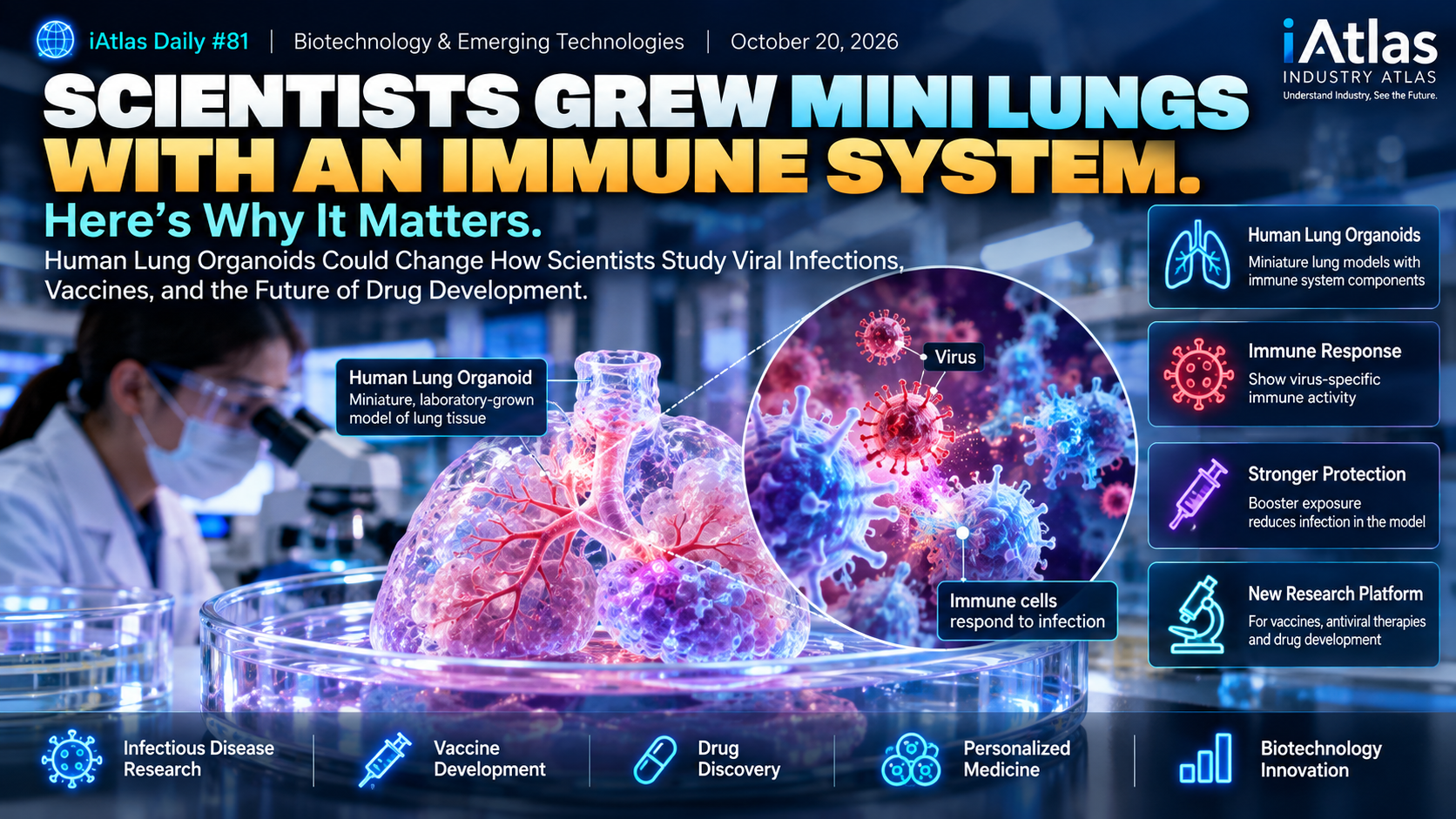
Scientists Grew Mini Lungs with an Immune System. Here’s Why It Matters.
Human Lung Organoids Could Change How Scientists Study Viral Infections, Vaccines, and the Future of Drug Development
iAtlas Daily #81 | Biotechnology & Emerging Technologies | October 20, 2026
The Big Story: Human Lung Organoids That Fight Back
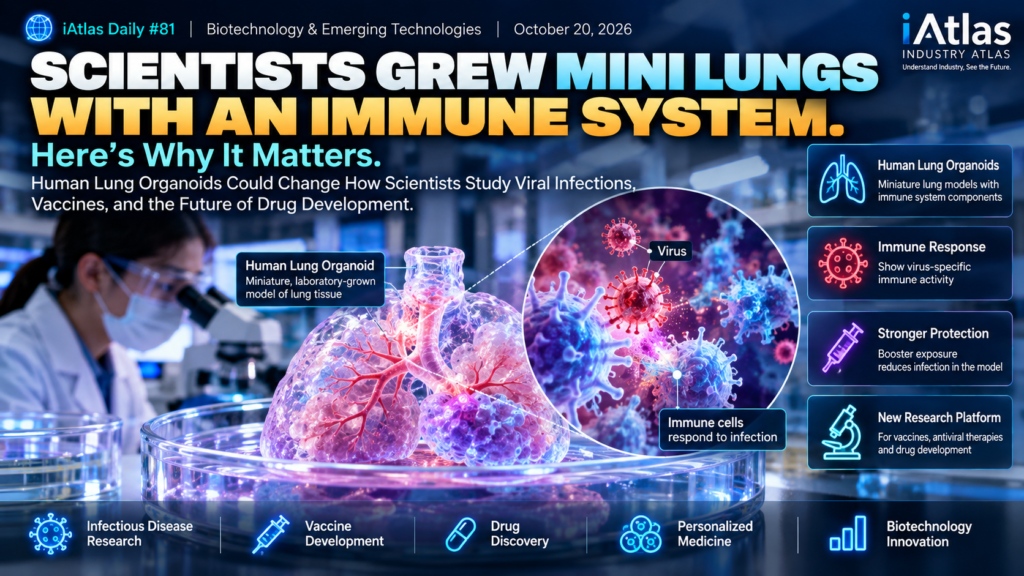
Human lung organoids are miniature, laboratory-grown models of lung tissue. They are not complete lungs, but they can reproduce some of the structures and biological functions that make human lungs work.
Now scientists have demonstrated something especially interesting.
A research team at Stanford University School of Medicine has developed human lung organoids that retain important components of the lung’s immune system.
When researchers exposed these models to a respiratory virus, the tissue mounted an immune response.
Even more remarkably, a subsequent booster exposure strengthened the response and reduced infection in the experimental model.
The findings were published in Nature and highlighted by the U.S. National Institutes of Health (NIH) on October 7, 2026.
The research could provide scientists with a new way to study how human lungs respond to infection, how immunity develops, and how future respiratory vaccines might work.
But the discovery also raises a much bigger question.
What happens when laboratory-grown human tissues become sophisticated enough to reproduce not just the structure of an organ, but some of its biological behavior?
The answer could influence biotechnology, pharmaceutical research, and the future of personalized medicine.
1. What Exactly Are Human Lung Organoids?
Imagine taking a small amount of human tissue and creating a miniature three-dimensional model that preserves some of the characteristics of the original organ.
That is the basic idea behind organoid technology.
Unlike conventional laboratory experiments that grow cells in a flat layer, organoids allow cells to exist in more complex three-dimensional arrangements.
Depending on the method used, researchers can create organoids from stem cells or directly from tissue samples.
These models can reproduce selected features of organs such as the brain, intestine, liver, kidney, and lung.
Human lung organoids are particularly valuable because respiratory diseases involve interactions among different cell types.
The lungs are not simply air-filled structures.
They contain specialized epithelial cells, supporting tissues, and immune cells that work together to protect the body.
When a virus enters the respiratory tract, those cells communicate through a complex series of signals.
Traditional cell cultures often cannot reproduce these interactions adequately.
Organoids offer researchers a way to study some of this complexity under controlled laboratory conditions.
However, they are simplified models.
They do not replace the complete structure or physiological functions of a human lung.
2. The Breakthrough: Mini Lungs with Immune Function
Many existing organoid systems reproduce important features of human tissue but lack the full range of immune cells found in the original organ.
That limits their ability to model infectious diseases.
The Stanford research addresses part of this problem.
The team developed lung organoids using human lung tissue fragments in a way that preserves tissue-resident immune components.
These immune cells are important because they can respond directly to threats encountered in the respiratory tract.
The researchers demonstrated that the organoids could support adaptive immune responses to viral infection.
Adaptive immunity is the part of the immune system that recognizes specific pathogens and can respond more effectively after previous exposure.
This is the principle behind many vaccines.
In the experiment, the organoid models showed virus-specific immune activity.
Following a booster exposure, the researchers observed a stronger protective response that reduced subsequent infection in the model.
The result suggests that important aspects of local respiratory immunity can be investigated using human tissue outside the body.
That is a meaningful advance for laboratory disease models.
The key achievement is not growing a complete lung. It is preserving enough biological complexity to study how human lung tissue responds to infection.
3. Why the Lung’s Local Immune System Matters
Most people think of immunity as something that circulates throughout the entire body.
But many immune defenses operate locally.
The respiratory tract is one of the body’s first points of contact with airborne pathogens.
Cells and immune components located in lung tissue can respond before an infection spreads more widely.
These local responses may influence whether a virus establishes an infection, how severely the disease develops, and how effectively the body responds to future exposure.
The new organoid research highlights the importance of these tissue-resident immune responses.
It also provides a potential experimental platform for studying them.
Researchers may be able to investigate questions such as:
- How do immune cells inside lung tissue recognize a virus?
- Which local immune responses help reduce infection?
- How does previous exposure change the response to a later infection?
- Could vaccines be designed to strengthen immunity directly in the respiratory tract?
These questions are important for respiratory infections and vaccine development.
However, a protective response in an organoid does not establish that the same intervention will protect people in clinical settings.
Human trials and additional validation remain necessary.
4. Could Human Lung Organoids Change Vaccine Development?
Traditional vaccine research relies on a combination of cell cultures, animal models, laboratory analysis, and clinical trials.
Each approach provides useful information.
But they also have limitations.
Animal models do not always reproduce human immune responses accurately.
Conventional cell cultures often lack the tissue complexity needed to understand local immunity.
Human lung organoids could provide an additional research tool.
Because the models contain human tissue and relevant immune components, scientists may be able to study certain vaccine responses more directly.
This is particularly interesting for vaccines designed to stimulate mucosal immunity.
Mucosal surfaces line areas such as the respiratory and gastrointestinal tracts.
A vaccine that strengthens immunity at the point where a pathogen enters the body could offer advantages for some infections.
The Stanford findings support further research into this possibility.
They do not demonstrate that organoid-tested vaccines are already more effective than existing vaccines.
Instead, the technology could help researchers investigate which immune responses are most relevant before moving to larger preclinical and clinical studies.
5. Why Organoids Are Attracting Pharmaceutical Interest
The significance of organoid technology extends far beyond respiratory viruses.
Drug developers face a fundamental challenge.
A compound that performs well in a laboratory experiment may not work as expected in humans.
One reason is that simplified experimental models cannot reproduce every important feature of human biology.
Organoids attempt to narrow part of this gap.
They can provide three-dimensional tissue models that capture more cellular diversity and biological behavior than some conventional cell-culture systems.
Potential applications include:
| Application | Potential Value |
|---|---|
| Infectious disease research | Study how pathogens interact with human tissues |
| Drug screening | Evaluate compound responses in human-derived models |
| Toxicity testing | Investigate harmful effects on specific tissues |
| Cancer research | Test how tumor-derived models respond to treatments |
| Personalized medicine | Explore patient-specific biological responses |
| Vaccine development | Investigate local immune mechanisms |
A June 2026 review in Stem Cell Reports described organoids as promising tools for drug discovery while emphasizing the need for reliable, scalable, and standardized testing methods.
The opportunity is substantial, but organoids are not yet a universal replacement for existing research methods.
Their usefulness depends on how accurately each model reproduces the biological processes being studied.
6. Could Scientists Eventually Grow Complete Human Organs?
This is one of the most common questions surrounding organoid research.
The short answer is that growing a miniature tissue model is very different from manufacturing a fully functional organ for transplantation.
A transplantable human lung would need an extraordinarily complex structure.
It would require a functional airway system, extensive blood vessels, mechanical properties suitable for breathing, and integration with the recipient’s body.
Human lung organoids do not currently provide those capabilities.
The Stanford research is focused on studying immune responses rather than producing transplantable lungs.
That distinction is essential.
Organoids may help scientists understand disease, test treatments, and potentially develop new regenerative approaches.
But the existence of a laboratory-grown lung model does not mean that fully functional replacement lungs are ready for clinical use.
The most immediate value lies in research.
And that value could be significant even without the ability to grow entire organs.
7. The Industrial Challenge: Can Organoids Be Manufactured Reliably?
For organoids to become widely used in pharmaceutical development, researchers must solve problems that resemble those found in other advanced manufacturing industries.
A successful laboratory demonstration is only the beginning.
The next challenge is reproducibility.
If two laboratories grow the same type of organoid, will the models behave similarly?
If a pharmaceutical company tests thousands of drug candidates, can it obtain consistent results across different production batches?
And can the process be scaled without losing the biological characteristics that make organoids valuable?
These questions connect organoid research directly to industrial technology.
Manufacturing Standardization
Researchers need protocols that produce consistent tissue models.
Differences in cell sources, culture conditions, and growth environments can affect experimental results.
Automation
Automated liquid handling, imaging, and analysis could make organoid production and testing more efficient.
Automation may also help reduce variation caused by manual laboratory procedures.
Quality Control
Organoids must be evaluated to confirm that they contain the expected cell types and perform the required biological functions.
For immune-enabled lung organoids, functional immune activity may be an important part of model qualification.
Scalability
Drug screening often requires large numbers of repeatable experiments.
Organoid platforms must therefore balance biological complexity with throughput, cost, and manufacturing consistency.
Data Analysis
Organoid experiments can generate complex imaging, molecular, and functional data.
Advanced analytics and AI may help researchers interpret those results.
The industrial opportunity lies not only in the biological models themselves, but also in the equipment, materials, software, and manufacturing processes needed to make them reliable.
8. Why This Could Create a New Biotechnology Supply Chain
As organoid technology advances, a broader ecosystem of specialized suppliers may emerge.
Potential participants include companies developing cell-culture media, extracellular matrices, bioreactors, automated liquid-handling systems, microscopy platforms, and laboratory data-analysis software.
Some companies may focus on producing standardized organoid models.
Others may provide contract research services that use those models to evaluate drug candidates.
Pharmaceutical companies may integrate organoid testing into selected stages of research and development.
However, the commercial opportunity will depend on more than technological sophistication.
Customers will need evidence that organoid-based testing provides reliable and useful information.
Cost and throughput will also matter.
A biologically sophisticated model may have limited commercial value if it is too expensive, inconsistent, or slow for practical drug-development workflows.
This is why manufacturing standardization and validation are so important.
The next phase of organoid development may be defined as much by industrial engineering as by cell biology.
9. What Are the Limitations?
The Stanford study represents an important research development, but several limitations should be understood.
First, organoids reproduce selected features of human tissue rather than the full complexity of a living person.
Second, the presence of immune cells does not mean that the model contains every component of the human immune system.
Third, experimental results may depend on the source and condition of the tissue samples.
Fourth, performance in a controlled laboratory environment does not guarantee equivalent results in patients.
Finally, scaling complex human tissue models into standardized commercial products remains technically challenging.
A separate study published online in October 2026 examined the fidelity of intestinal, liver, and kidney organoids for drug metabolism and toxicity assessment.
It identified important gaps between current organoid models and mature human tissues, including differences in cellular composition and functional characteristics.
Although that study evaluated different organs, it reinforces a broader point.
Organoids must be validated for the specific biological questions they are intended to answer.
More complexity is not automatically better unless it produces reliable and meaningful results.
Industry Impact
Biotechnology: More sophisticated organoids could expand the range of human biological processes that researchers can investigate.
Pharmaceutical R&D: Human-derived tissue models may provide additional evidence during drug discovery and preclinical evaluation.
Vaccine Development: Immune-enabled lung organoids could support research into respiratory and mucosal immunity.
Laboratory Automation: Standardized organoid production may increase demand for automated culture, handling, and imaging technologies.
Advanced Materials: Culture matrices and specialized biomaterials could become increasingly important to tissue-model performance.
AI and Data Analytics: Machine learning may help analyze complex organoid responses and improve experimental workflows.
Contract Research Services: Specialized organoid platforms could create opportunities for research service providers, subject to validation and customer adoption.
What to Watch Next
Reproducibility
Can independent laboratories reproduce the immune responses observed in the Stanford study?
Different Respiratory Pathogens
Will the model provide useful information for studying additional viruses and other respiratory infections?
Vaccine Research
Can the platform help identify local immune responses associated with meaningful protection?
Automated Production
Can complex lung organoids be manufactured consistently at a scale suitable for pharmaceutical research?
Regulatory Acceptance
Will validated organoid models gain wider acceptance for specific drug-development applications?
Commercial Adoption
Will pharmaceutical companies incorporate immune-enabled human lung organoids into routine research workflows?
iAtlas Insight
The development of immune-enabled human lung organoids illustrates a broader transformation in biotechnology.
For decades, researchers have relied on simplified experimental models to understand human biology.
Those models have enabled enormous scientific progress.
But many diseases involve interactions among different cell types, tissues, and immune mechanisms that are difficult to reproduce in conventional laboratory systems.
Organoid technology is helping researchers study some of those interactions in more realistic human-derived environments.
The Stanford study demonstrates how a miniature lung model can preserve important aspects of local immune behavior.
That could improve the tools available for investigating respiratory infections and developing future therapies.
Yet the next challenge is not simply to make organoids more biologically sophisticated.
It is to make them reproducible, scalable, and useful.
That is where biotechnology begins to intersect with industrial manufacturing.
The companies that develop reliable culture systems, automated production methods, and validated testing platforms may play important roles in the next stage of this industry.
The future of organoid technology may depend not only on what scientists can grow in a laboratory, but on how reliably those living models can be produced and used.
And that could change the way new medicines are discovered.
Related Articles
AI Data Center Infrastructure: The Next Industrial Investment Cycle
Explore how advanced technologies create demand for specialized equipment, infrastructure, and supporting industries.
References
1. National Institutes of Health — October 7, 2026
Human Lung Organoids with a Built-In Immune System Could Transform Respiratory Disease Research.
Human Lung Organoid Modelling of Tissue-Resident Antiviral T Cell Responses.
3. Stem Cell Reports — June 9, 2026
Human Organoids: Fit for Drug Discovery?
4. Drug Metabolism and Disposition — October 13, 2026
Systematic Evaluation of Organoid Fidelity for ADME and Toxicity Assessment.
5. Nature Biomedical Engineering — October 15, 2026
Towards Physiologically Relevant Human Tissue Models.
ℹ️ About iAtlas
iAtlas is an independent publication covering batteries, semiconductors, OLED, advanced materials, AI, and global industrial trends.
We transform complex industrial developments into clear, reliable, and easy-to-understand insights.
Whether you’re following today’s industry news or building long-term expertise, iAtlas helps you understand not only what happened, but why it matters.
Technology creates change.
Insight creates opportunity.
— iAtlas