Battery Safety Explained: Risks, Protection Systems & Best Practices
Category: Battery Technology
Content Type: Fundamentals
Related Industries: Electric Vehicles · Energy Storage Systems · Consumer Electronics
Last Updated: July 2026
Industry Snapshot
As lithium-ion batteries become larger and more energy-dense, battery safety has become one of the most important considerations in battery engineering. Modern batteries power everything from smartphones and laptops to electric vehicles (EVs) and large-scale energy storage systems (ESS). While these batteries deliver high performance, they also contain significant stored energy that must be carefully managed.
Battery safety involves preventing conditions that can lead to overheating, short circuits, fire, or thermal runaway. To achieve this, manufacturers combine advanced materials, intelligent monitoring systems, thermal management technologies, and rigorous testing standards throughout the battery lifecycle.
At a Glance
| Category | Description |
|---|---|
| Definition | Protection of batteries against electrical, thermal, and mechanical hazards |
| Main Purpose | Prevent failures, fire, and thermal runaway |
| Key Systems | BMS, BTMS, Protection Circuit, Fuse |
| Major Risks | Overcharge, Over-discharge, Short Circuit, Overheating |
| Main Applications | EVs, ESS, Consumer Electronics |
Overview
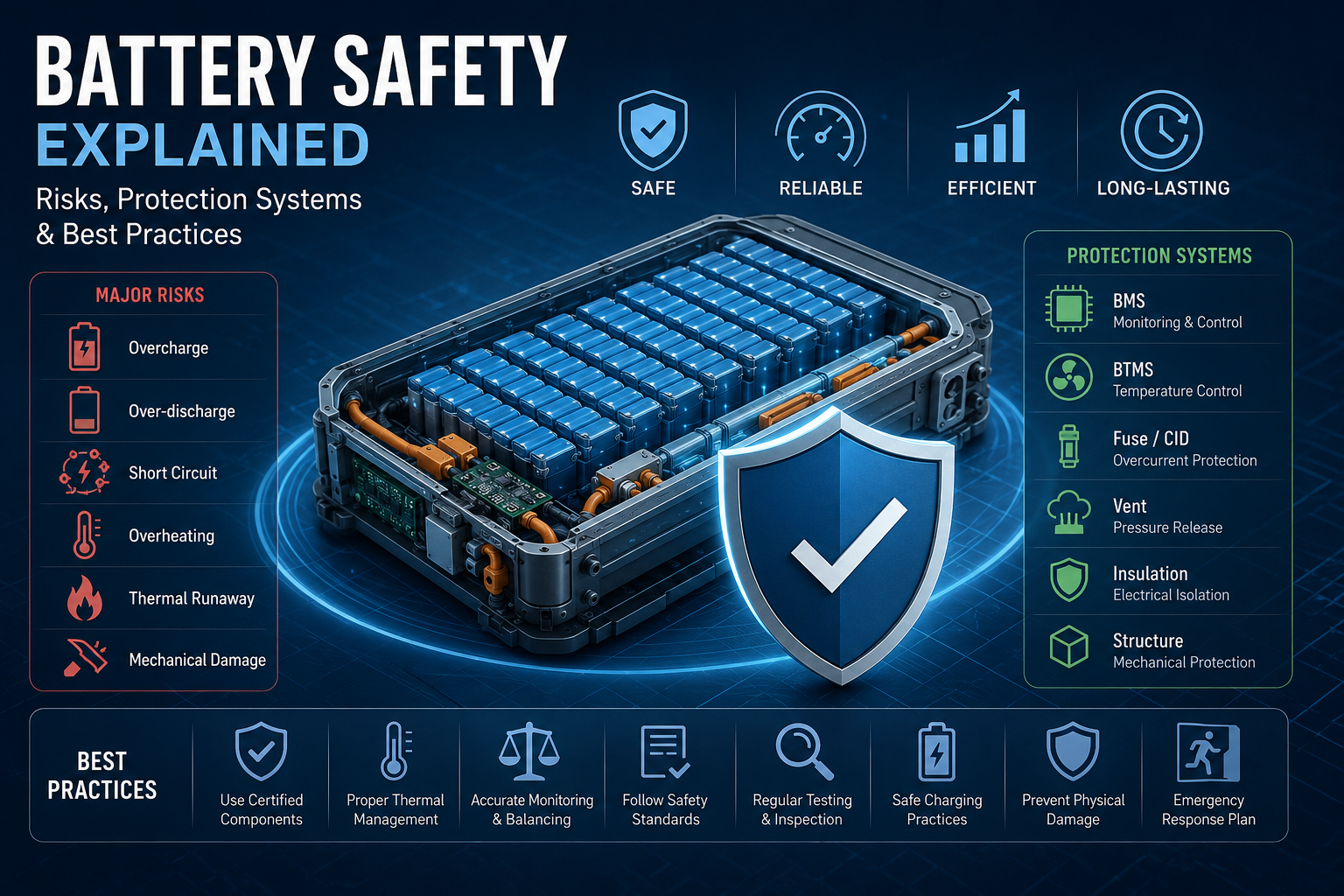
Battery safety is not achieved through a single component but through the integration of multiple protection systems.
Modern battery packs continuously monitor voltage, current, temperature, and charging conditions. If abnormal conditions are detected, the Battery Management System (BMS) limits battery operation or disconnects the pack to prevent damage.
At the same time, the Battery Thermal Management System (BTMS) keeps cell temperatures within the optimal operating range, reducing the likelihood of thermal runaway.
Mechanical protection, electrical isolation, cooling systems, and high-quality manufacturing processes all contribute to overall battery safety.
Major Battery Safety Risks
Lithium-ion batteries face several potential hazards.
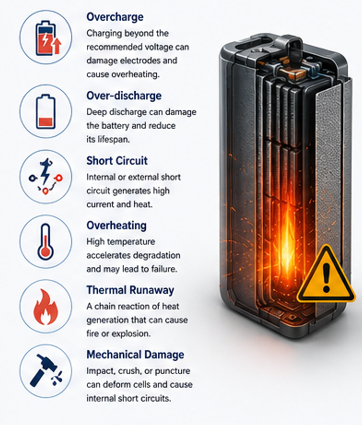
Overcharging
Charging beyond the recommended voltage can damage electrodes and generate excessive heat.
Over-discharging
Deep discharge may permanently reduce battery capacity and damage cell chemistry.
Short Circuit
Internal or external short circuits generate extremely high current, leading to rapid temperature rise.
Mechanical Damage
Impact, crushing, or puncture can deform internal structures and trigger internal short circuits.
Thermal Runaway
A chain reaction where increasing temperature accelerates heat generation, potentially leading to fire or explosion.
Battery Protection Systems
Modern batteries use multiple layers of protection.
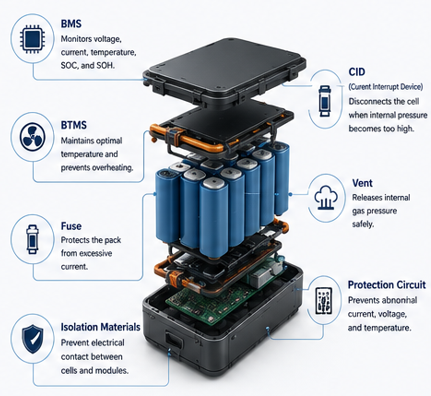
Battery Management System (BMS)
Monitors voltage, current, temperature, SOC, and SOH.
Battery Thermal Management System (BTMS)
Maintains safe operating temperatures.
Current Interrupt Device (CID)
Disconnects the cell under abnormal pressure.
Fuse
Protects against excessive current.
Vent
Releases internal gas pressure safely.
Isolation Materials
Prevent electrical contact between cells.
Battery Safety Testing
Before commercialization, batteries undergo extensive safety testing.
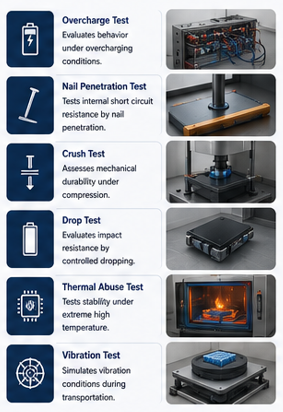
| Test | Purpose |
|---|---|
| Overcharge Test | Evaluate charging safety |
| Nail Penetration Test | Assess internal short circuit resistance |
| Crush Test | Verify mechanical durability |
| Drop Test | Evaluate impact resistance |
| Thermal Abuse Test | Test high-temperature stability |
| Vibration Test | Simulate transportation conditions |
International Safety Standards
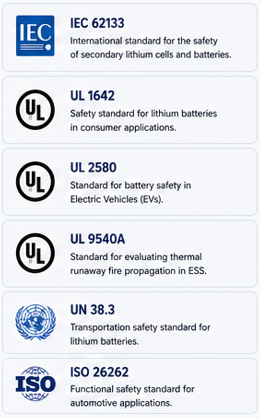
Several international standards define battery safety requirements.
- IEC 62133
- UL 1642
- UL 2580
- UL 9540A
- UN 38.3
- ISO 26262 (Automotive Functional Safety)
These standards help ensure batteries meet global safety expectations for transportation, consumer electronics, and electric vehicles.
Applications
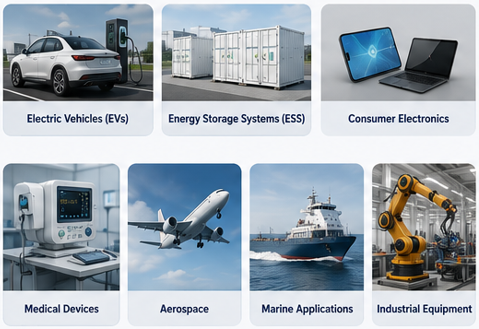
Battery safety technologies are essential in:
- Electric Vehicles (EVs)
- Energy Storage Systems (ESS)
- Consumer Electronics
- Medical Devices
- Aerospace
- Marine Applications
- Industrial Equipment
Industry Ecosystem
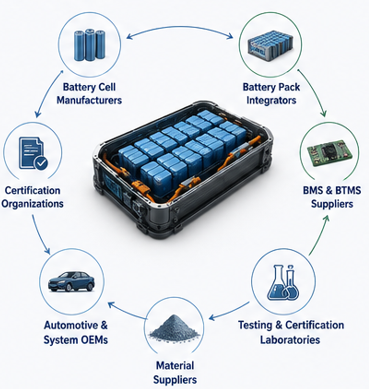
Battery safety involves collaboration across the supply chain.
- Battery Cell Manufacturers
- Battery Pack Integrators
- BMS Suppliers
- BTMS Suppliers
- Automotive OEMs
- Testing Laboratories
- Certification Organizations
- Material Suppliers
Atlas Insight
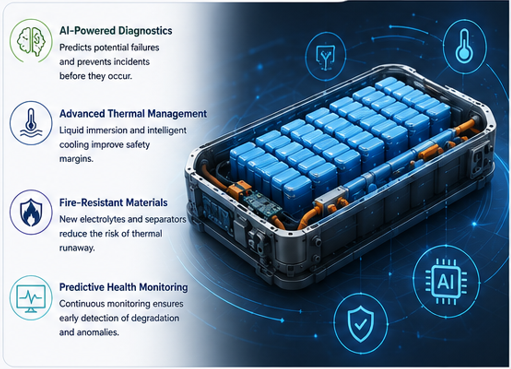
As battery energy density continues to increase, safety is becoming a key competitive advantage rather than simply a regulatory requirement.
Next-generation batteries combine AI-based diagnostics, advanced cooling technologies, fire-resistant materials, and predictive health monitoring to improve reliability. Future battery systems are expected to detect abnormal conditions earlier and respond automatically before failures occur.
Did You Know?
- Most EV battery fires originate from thermal runaway rather than external flames.
- Modern battery packs contain multiple layers of protection beyond the battery cells themselves.
- Battery safety testing often includes crush, vibration, and nail penetration tests.
- International standards such as UN 38.3 are required for transporting lithium batteries.
FAQ
What is battery safety?
Battery safety refers to technologies and practices that prevent electrical, thermal, and mechanical failures during battery operation.
What is thermal runaway?
Thermal runaway is a self-accelerating increase in battery temperature that can result in fire or explosion.
Why are BMS and BTMS important?
The BMS monitors battery conditions, while the BTMS controls battery temperature. Together they significantly improve battery safety.
Are lithium-ion batteries safe?
Yes. Modern lithium-ion batteries are designed with multiple protection systems and must pass strict international safety tests before commercial use.
Explore More
Fundamentals
- Battery
- Lithium-ion Battery
- Battery Cell
- Battery Module
- Battery Pack
- Battery Management System(BMS)
- Battery Thermal Management System(BTMS)
- Battery Safety
Materials
- Cathode
- Anode
- Electrolyte
- Separator
Manufacturing
- Cell Assembly
- Module Assembly
- Pack Assembly
Technologies
- Cell-to-Pack (CTP)
- Cell-to-Chassis (CTC)
- Wireless BMS
- Thermal Runaway
- Fast Charging
References
- International Energy Agency (IEA) – Global EV Outlook 2025
- U.S. Department of Energy – Vehicle Technologies Office
- UL Solutions – Battery Safety Standards
- IEC 62133
- Journal of Power Sources
About iAtlas
iAtlas is an independent publication covering batteries, semiconductors, OLED, advanced materials, AI, and global industrial trends.
We transform complex industrial developments into clear, reliable, and easy-to-understand insights.
Whether you’re following today’s industry news or building long-term expertise, iAtlas helps you understand not only what happened, but why it matters.
Technology creates change.
Insight creates opportunity.
— iAtlas