

Battery Management System (BMS) Explained: How Batteries Are Monitored, Protected, and Controlled
Understanding how battery management systems monitor voltage, current, and temperature, estimate battery health, balance cells, and protect modern energy storage systems.
🔋 iAtlas Library #05 | Battery · Fundamentals
Self-Test | Check Your Knowledge
How well do you understand battery management systems?
Before reading this article, answer three questions to evaluate your understanding of battery monitoring, protection, and control.
If you can confidently answer all three questions, you may already understand the fundamentals and be ready to explore more advanced BMS technologies.
Answers and explanations are provided near the end of this article.
Question 1. What is the primary purpose of a Battery Management System?
A. To increase the amount of lithium inside battery cells
B. To monitor, manage, and protect a battery system during operation
C. To manufacture battery electrodes
D. To convert alternating current into direct current
Question 2. What does State of Charge (SOC) represent?
A. The battery’s remaining charge relative to its defined capacity
B. The temperature of the battery enclosure
C. The number of battery cells connected in series
D. The maximum voltage of the battery pack
Question 3. Why is cell balancing important in a battery system?
A. It increases the physical size of battery cells.
B. It eliminates the need for temperature monitoring.
C. It helps manage differences in charge levels between series-connected cells or cell groups.
D. It converts electrical energy into chemical energy without charging.
Review your answers in the Self-Test Answers & Explanations section near the end of this article.
Industry Snapshot
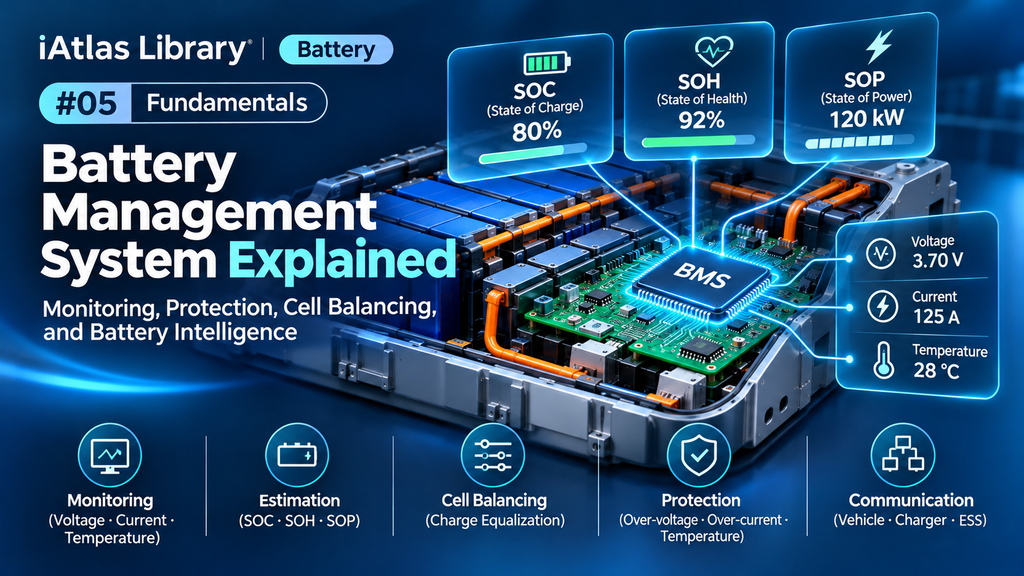
A Battery Management System (BMS) is the electronic monitoring and control system responsible for managing the operation of a rechargeable battery system.
Modern lithium-ion batteries require carefully controlled operating conditions.
Individual cells have defined voltage, current, and temperature limits. Exceeding these limits can accelerate degradation, reduce performance, or create safety risks.
A BMS monitors important battery parameters and uses this information to support safe and reliable operation.
Its main functions commonly include:
- Cell voltage monitoring
- Battery current monitoring
- Temperature monitoring
- State of Charge (SOC) estimation
- State of Health (SOH) estimation
- Cell balancing
- Fault detection
- Protection coordination
- Communication with external systems
BMS technology is particularly important in electric vehicles, energy storage systems, and industrial equipment.
As battery systems become larger and more complex, the BMS plays an increasingly important role in performance optimization, lifetime management, and system reliability.
At a Glance
| Category | Description |
|---|---|
| Technology | Battery Monitoring and Control |
| Main Function | Monitor, manage, and protect battery operation |
| Key Measurements | Voltage, Current, Temperature |
| Key Estimates | SOC, SOH, SOP |
| Core Functions | Monitoring, Balancing, Protection, Communication |
| Common Architectures | Centralized, Modular, Distributed |
| Communication | CAN, SPI, and other application-specific interfaces |
| Major Applications | EVs, ESS, Consumer Electronics, Industrial Batteries |
| Related Technology | Battery Thermal Management System (BTMS) |
1. What Is a Battery Management System?
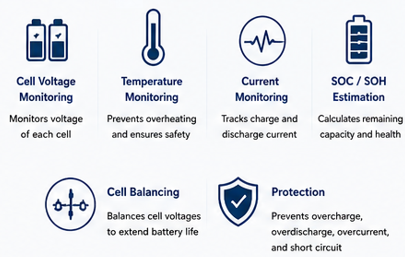
A Battery Management System is an electronic system that monitors battery conditions and manages selected operating and protection functions.
Lithium-ion cells must operate within specified limits.
For example, excessive charging voltage can cause unwanted electrochemical reactions, while excessive discharge can damage cell performance.
High temperatures can accelerate battery degradation and increase safety risks.
A BMS helps manage these conditions through measurement, estimation, control, and communication.
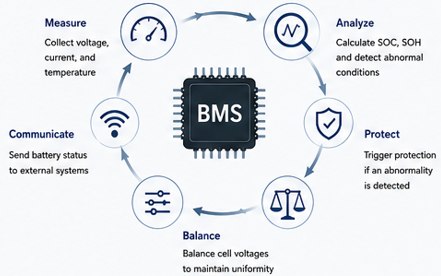
Its responsibilities can be grouped into four major areas.
Monitoring
Measuring battery voltage, current, temperature, and other relevant parameters.
Estimation
Calculating battery conditions that cannot be measured directly, such as SOC and SOH.
Protection
Detecting abnormal operating conditions and coordinating appropriate protective responses.
Control and Communication
Supporting cell balancing, charge and discharge limits, and communication with other equipment.
A BMS does not create additional energy.
Instead, it helps the battery operate within appropriate limits and makes its available energy more manageable and reliable.
2. Why Do Lithium-Ion Batteries Need a BMS?
Lithium-ion batteries offer high energy density and rechargeable operation, but they also have electrochemical and thermal limitations.
A battery system must therefore manage several important risks.
2.1 Overcharging
Charging beyond the specified upper voltage limit can accelerate degradation and create safety risks.
The BMS monitors voltage and can request or initiate protective action when necessary.
2.2 Overdischarging
Excessive discharge can damage battery cells and reduce their useful life.
The BMS helps prevent operation below specified voltage limits.
2.3 Excessive Current
High charge or discharge current can increase heat generation and place additional stress on battery components.
The BMS monitors current and helps enforce appropriate operating limits.
2.4 Temperature Extremes
Both high and low temperatures can affect battery performance.
High temperatures may accelerate degradation, while low temperatures can reduce power capability and create charging limitations.
The BMS uses temperature measurements to support operating restrictions and thermal-management decisions.
2.5 Cell-to-Cell Differences
Cells in the same battery system are not perfectly identical.
Differences can develop due to manufacturing variation, temperature distribution, aging, and operating history.
The BMS helps monitor these differences and may use cell balancing to manage charge imbalance.
3. Main Components of a BMS
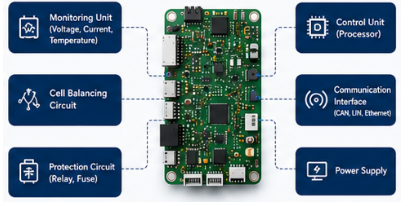
A BMS combines electronic hardware, sensors, software, and communication interfaces.
Its architecture varies depending on battery size, application, and manufacturer.
3.1 Battery Monitoring Integrated Circuits
Battery monitoring ICs measure cell voltages and may provide temperature measurement interfaces, diagnostic functions, and balancing control.
They are important components in multi-cell lithium-ion battery systems.
3.2 Current Sensors
Current sensors measure battery charging and discharging current.
Common sensing approaches include:
- Shunt resistors
- Hall-effect sensors
- Other magnetic or precision current sensing technologies
Current information supports protection, SOC estimation, and operating control.
3.3 Temperature Sensors
Temperature sensors measure selected battery temperatures.
Thermistors and other temperature-sensing devices are commonly used.
Sensor placement matters because temperatures may differ across the battery system.
3.4 BMS Controller
The BMS controller processes measurement data and executes monitoring, estimation, diagnostic, and control algorithms.
Depending on the architecture, this function may be performed by a microcontroller or other embedded processing hardware.
3.5 Cell Balancing Circuits
Balancing circuits help manage charge differences between series-connected cells or cell groups.
They may use passive or active balancing methods.
3.6 Communication Interfaces
Communication interfaces allow the BMS to exchange information with external controllers and supporting subsystems.
3.7 Protection Interfaces
The BMS may control or coordinate devices such as contactors, electronic switches, or other protective components.
The BMS does not necessarily contain all protective hardware itself.
Protection devices may be distributed throughout the battery pack.
4. What Does a BMS Measure?
Battery management begins with accurate measurements.
Three of the most important parameters are voltage, current, and temperature.
4.1 Cell Voltage
Cell voltage monitoring helps detect conditions such as:
- Overvoltage
- Undervoltage
- Cell imbalance
- Abnormal voltage behavior
Individual cell or cell-group voltage measurements are especially important in series-connected battery systems.
4.2 Battery Current
Current measurement supports:
- Charge and discharge monitoring
- Overcurrent detection
- Power calculations
- SOC estimation
- Operating-limit management
4.3 Battery Temperature
Temperature measurement helps the BMS evaluate whether the battery is operating within its specified thermal limits.
It also supports coordination with the thermal management system.
4.4 Additional Measurements
Depending on the application, a BMS may also use information related to:
- Pack voltage
- Insulation status
- Contactor state
- Coolant temperature
- Electrical faults
- System operating status
The exact measurement architecture depends on the battery design.
5. State of Charge (SOC) Explained
State of Charge estimates how much charge remains available relative to a defined battery capacity.
It is commonly expressed as a percentage.
For example:
SOC = 80%
This indicates that the battery is estimated to retain approximately 80% of its defined charge capacity under the estimation convention being used.
SOC is not directly measured by a single sensor.
Instead, it is estimated using measurements and battery models.
5.1 Coulomb Counting
Coulomb counting tracks the electrical charge entering and leaving a battery.
A simplified relationship is:
Change in Charge (Ah) = Current (A) × Time (h)
For example, if a battery delivers 10 A for one hour, approximately 10 Ah of charge has been removed.
In practice, accurate SOC estimation must consider measurement error, initial SOC uncertainty, and battery behavior.
5.2 Open-Circuit Voltage Method
Battery voltage can provide information about SOC under suitable conditions.
However, the relationship between voltage and SOC depends on chemistry, temperature, and battery history.
Some chemistries, including LFP, have relatively flat voltage regions that make voltage-only SOC estimation challenging.
5.3 Model-Based SOC Estimation
Advanced BMS designs may combine current, voltage, temperature, and mathematical battery models.
Algorithms such as Kalman-filter-based estimators can be used in appropriate implementations.
These methods help manage uncertainty and improve estimation under changing operating conditions.
Why SOC Matters
SOC information supports:
- Remaining range estimation
- Charging control
- Energy management
- Operating-limit decisions
- User-facing battery information
In electric vehicles, SOC is closely related to the driver’s understanding of remaining battery energy.
However, SOC and remaining driving range are not identical because energy consumption depends on driving conditions and other factors.
6. State of Health (SOH) Explained
State of Health describes the condition of a battery relative to a defined reference state.
Battery cells gradually change as they age.
These changes may include:
- Capacity loss
- Increased internal resistance
- Reduced power capability
- Changes in charging behavior
SOH estimation helps evaluate battery degradation and remaining performance.
6.1 Capacity-Based SOH
One common approach compares current capacity with reference capacity.
A simplified expression is:
SOH (%) = Current Measured Capacity ÷ Reference Capacity × 100
For example:
Reference Capacity = 100 Ah
Current Measured Capacity = 85 Ah
SOH = 85%
This indicates 85% capacity retention under the specified measurement conditions.
6.2 Resistance-Based Health Indicators
Battery internal resistance often changes with aging.
Resistance measurements can therefore provide useful information about battery condition.
However, resistance depends on temperature, SOC, measurement method, and other factors.
6.3 Why SOH Is Difficult to Estimate
Battery degradation is influenced by:
- Temperature
- Charge and discharge rates
- Depth of discharge
- Time spent at different SOC levels
- Battery chemistry
- Manufacturing variation
SOH is not a single universally standardized quantity.
Different BMS designs may use different definitions, models, and estimation methods.
Why SOH Matters
SOH information can support:
- Maintenance planning
- Warranty assessment
- Battery lifetime analysis
- Fleet management
- Second-life battery evaluation
7. State of Power (SOP) Explained
State of Power estimates the power a battery can safely deliver or accept under specified conditions.
SOP depends on factors such as:
- SOC
- Temperature
- Internal resistance
- Voltage limits
- Current limits
- Battery condition
A battery may have sufficient remaining energy but still be unable to deliver high power.
For example, low-temperature conditions can limit discharge power and charging capability.
The BMS may therefore calculate dynamic power limits and communicate them to other controllers.
In electric vehicles, these limits can influence acceleration, regenerative braking, and charging performance.
8. Cell Balancing Explained
Cells connected in series may develop differences in their states of charge.
Because series-connected cells share the same current, differences in available capacity or SOC can limit the usable operating range of the complete series string.
Cell balancing helps manage these differences.
8.1 Why Cell Imbalance Occurs
Cell imbalance can result from:
- Manufacturing variation
- Different self-discharge rates
- Temperature differences
- Aging differences
- Measurement uncertainty
8.2 Passive Cell Balancing
Passive balancing typically removes a small amount of energy from selected cells through resistive dissipation.
Advantages
- Relatively simple circuit design
- Established implementation methods
- Potentially lower component cost
Limitations
- Energy is dissipated as heat
- Balancing speed depends on circuit design
- Energy is not transferred to other cells
8.3 Active Cell Balancing
Active balancing transfers energy between cells or cell groups using suitable electronic circuits.
Potential Advantages
- Reduced energy dissipation in some applications
- Greater flexibility in energy redistribution
Engineering Challenges
- More complex circuitry
- Additional components
- Control complexity
- Cost and efficiency trade-offs
Passive vs. Active Balancing
| Characteristic | Passive Balancing | Active Balancing |
|---|---|---|
| Principle | Dissipates selected cell energy | Transfers energy |
| Circuit Complexity | Generally lower | Generally higher |
| Energy Handling | Mainly resistive dissipation | Energy redistribution |
| Cost | Often lower | Often higher |
| Applications | Common in many battery systems | Selected applications requiring advanced balancing |
The appropriate balancing strategy depends on system requirements and design trade-offs.
9. BMS Protection Functions
A BMS monitors battery conditions and coordinates protection when abnormal situations are detected.
9.1 Overvoltage Protection
Detects cell or pack voltage above specified limits.
9.2 Undervoltage Protection
Detects voltage below specified operating limits.
9.3 Overcurrent Protection
Detects current exceeding defined charging or discharging limits.
9.4 Temperature Protection
Monitors temperature conditions and supports operating restrictions or protective responses.
9.5 Short-Circuit Protection
Battery systems require appropriate short-circuit protection.
Depending on the design, this may involve electronic protection, fuses, contactors, and other dedicated hardware.
9.6 Insulation Fault Monitoring
Some high-voltage battery systems monitor electrical insulation conditions.
This is particularly important for applications requiring isolation between high-voltage circuits and accessible structures.
9.7 Fault Response
When a fault is detected, the BMS may:
- Generate an alarm
- Reduce allowable charging or discharging power
- Request thermal-management action
- Restrict operation
- Command protective switching devices
- Communicate fault information to an external controller
The actual response depends on the fault type, system architecture, and safety strategy.
Important: A BMS is one part of battery safety engineering. It cannot replace appropriate cell design, mechanical protection, thermal management, or independent protective devices.
10. BMS Architecture: Centralized, Modular, and Distributed
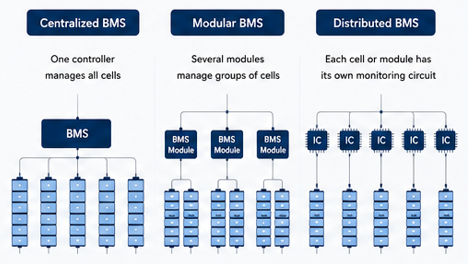
BMS architecture describes how monitoring and control functions are organized across the battery system.
10.1 Centralized BMS
In a centralized architecture, many measurement and control connections are routed toward a central electronic unit.
Potential Advantages
- Consolidated electronics
- Relatively straightforward architecture for suitable battery sizes
Engineering Considerations
- Extensive wiring in large systems
- Connector complexity
- Packaging constraints
10.2 Modular BMS
A modular architecture distributes monitoring functions across multiple units.
Module-level electronics communicate with a central controller.
Potential Advantages
- Scalable architecture
- Reduced long-distance sensing connections
- Flexible system integration
Engineering Considerations
- Communication reliability
- Synchronization
- Additional electronic units
10.3 Distributed BMS
Distributed architectures place monitoring electronics closer to individual cells or cell groups.
This can reduce certain wiring requirements.
However, it also introduces challenges involving packaging, communication, power consumption, and reliability.
Architecture Comparison
| Characteristic | Centralized | Modular | Distributed |
|---|---|---|---|
| Monitoring Electronics | Concentrated | Distributed across modules | Located closer to cells or groups |
| Wiring | Can be extensive | More localized | Potentially reduced sensing wiring |
| Scalability | Application-dependent | Often flexible | Potentially flexible |
| Complexity | Centralized wiring and control | Multiple monitoring units | Distributed electronics and communication |
| Common Design Priority | Integration simplicity | Scalability | Localized monitoring |
No architecture is universally superior.
The best choice depends on battery size, cost, manufacturing strategy, safety requirements, and application.
11. BMS Communication and System Integration
A BMS must exchange information with other systems.
In an electric vehicle, it may communicate with:
- Vehicle control units
- Charging systems
- Thermal management controllers
- Power electronics
- Diagnostic equipment
In stationary ESS applications, communication may involve:
- Energy Management Systems (EMS)
- Power Conversion Systems (PCS)
- Supervisory controllers
- Monitoring platforms
11.1 CAN Communication
Controller Area Network (CAN) is widely used in automotive and industrial control systems.
It enables electronic control units to exchange structured information.
11.2 SPI and Internal Interfaces
Serial Peripheral Interface (SPI) and specialized battery monitoring interfaces may be used between monitoring ICs and controllers.
11.3 Communication Data
A BMS may communicate information such as:
- SOC
- SOH
- Voltage
- Current
- Temperature
- Charge and discharge limits
- Fault status
- Contactor status
Reliable communication is essential for coordinated battery system operation.
12. BMS vs. BTMS: What’s the Difference?
BMS and BTMS are closely related but perform different functions.
Battery Management System
The BMS primarily handles battery monitoring, estimation, protection coordination, and operating control.
Battery Thermal Management System
The BTMS manages battery temperature through cooling, heating, and thermal-control equipment.
Comparison
| Function | BMS | BTMS |
|---|---|---|
| Cell Voltage Monitoring | Primary function | Not primary |
| SOC Estimation | Primary function | Not primary |
| SOH Estimation | Primary function | Not primary |
| Cell Balancing | Primary function | Not primary |
| Temperature Monitoring | Common function | Also uses temperature information |
| Cooling and Heating Hardware | May coordinate operation | Primary physical function |
| Thermal Protection | Monitors and coordinates | Executes thermal control |
| Communication | Central role | Application-dependent |
How They Work Together
Consider a battery operating at elevated temperature.
- Temperature sensors detect the condition.
- The BMS evaluates the measurements.
- The system may request increased cooling.
- The BTMS adjusts thermal-control operation.
- If temperatures exceed defined limits, the BMS may restrict battery power or initiate protective action.
This coordination helps manage battery performance and safety.
13. BMS Development and Validation
A reliable BMS requires both hardware and software engineering.
Development involves several important stages.
13.1 Requirements Definition
Engineers define:
- Battery operating limits
- Monitoring accuracy
- Protection requirements
- Communication requirements
- Environmental conditions
- Safety objectives
13.2 Hardware Development
Hardware design includes:
- Monitoring circuits
- Current sensing
- Temperature interfaces
- Controllers
- Power supplies
- Communication circuits
- Protection interfaces
13.3 Software Development
BMS software implements:
- Data acquisition
- SOC estimation
- SOH estimation
- Balancing algorithms
- Diagnostics
- Fault handling
- Communication
- Operating-limit management
13.4 Testing and Validation
BMS development may involve:
- Hardware-in-the-Loop (HIL) testing
- Software-in-the-Loop (SIL) testing
- Sensor fault simulation
- Communication testing
- Protection-function testing
- Environmental testing
- Battery system integration testing
Applicable safety standards and validation requirements depend on the product and market.
For automotive applications, functional safety engineering may involve ISO 26262.
For stationary battery systems, relevant safety and certification requirements depend on the installation, equipment, and jurisdiction.
14. Emerging Trends in BMS Technology
BMS technology continues to evolve as battery systems become more complex.
14.1 Wireless BMS
Wireless battery monitoring architectures aim to reduce certain communication wiring requirements.
Potential benefits include:
- Reduced wiring complexity
- Greater packaging flexibility
- Simplified assembly in some designs
However, wireless systems require careful consideration of communication reliability, cybersecurity, electromagnetic compatibility, and safety.
14.2 Advanced Battery State Estimation
More sophisticated algorithms are being developed to improve SOC, SOH, and power capability estimation.
These may use:
- Electrochemical models
- Equivalent circuit models
- Statistical estimation
- Data-driven methods
- Hybrid approaches
14.3 Cloud-Connected Battery Analytics
Battery operating data can support fleet-level analysis and maintenance planning.
Cloud-connected systems may help identify performance trends and evaluate battery degradation across large populations.
14.4 AI-Assisted Battery Diagnostics
Machine learning may support battery fault detection, health estimation, and predictive maintenance.
However, data quality, model validation, operating-condition coverage, and safety requirements remain important challenges.
14.5 Second-Life Battery Management
Battery systems reused in stationary applications may require updated monitoring, control, and operating strategies.
Differences in battery history and remaining performance create additional management challenges.
15. BMS Applications Across Industries
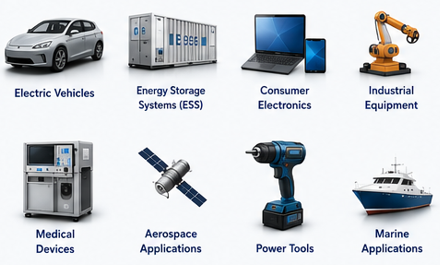
Electric Vehicles
EV BMS technology supports:
- Battery operating safety
- Remaining charge estimation
- Charging management
- Power-limit management
- Thermal-management coordination
- Battery lifetime monitoring
Energy Storage Systems
ESS applications emphasize:
- Long-term reliability
- Monitoring across large battery installations
- Communication with energy management systems
- Protection coordination
- Maintenance and diagnostics
Consumer Electronics
Portable electronics use battery management and protection functions adapted to smaller battery systems.
Important considerations include:
- Compact size
- Power consumption
- Charging safety
- Battery lifetime
- Cost
Industrial Equipment
Industrial batteries may operate under demanding conditions involving frequent cycling, high power, vibration, or varying temperatures.
BMS requirements depend on the equipment and operating environment.
16. iAtlas Insight — The BMS Is Becoming a Competitive Technology, Not Just a Safety Device
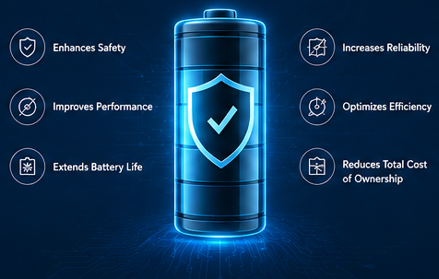
Battery performance is often discussed in terms of cathode materials, energy density, and manufacturing capacity.
However, the BMS has an important influence on how much of a battery’s potential performance can be used in practice.
Two battery systems using similar cells may deliver different user experiences because of differences in monitoring, estimation, thermal coordination, and operating strategies.
A well-engineered BMS can support:
Better Energy Utilization
More accurate estimates of available charge and operating limits.
Improved Charging Management
Appropriate charging restrictions based on battery conditions.
Longer Useful Life
Operating strategies that help reduce avoidable battery stress.
Enhanced Safety
Reliable detection and management of abnormal operating conditions.
Lower Operating Costs
Improved diagnostics, maintenance planning, and battery utilization.
Better System Integration
Coordinated operation with chargers, thermal systems, and external controllers.
As battery systems evolve, software and control technology are becoming increasingly important parts of battery competitiveness.
Battery chemistry determines much of a cell’s potential. Battery management helps determine how safely, reliably, and effectively that potential is used.
17. Did You Know?
- SOC is an estimate rather than a directly measured physical quantity.
- SOH can be defined using capacity, resistance, or other performance indicators.
- A battery can have a high SOC but limited power capability at low temperatures.
- Cell balancing helps manage charge differences between series-connected cells or cell groups.
- Passive balancing typically dissipates energy as heat.
- A BMS and BTMS perform different functions but must coordinate during operation.
- Wireless BMS technology is being developed to reduce certain wiring requirements.
- Advanced BMS algorithms can use mathematical battery models and measured operating data.
18. Frequently Asked Questions
What is a Battery Management System?
A BMS is an electronic system that monitors, manages, and protects a rechargeable battery system.
What are the main functions of a BMS?
Common functions include voltage, current, and temperature monitoring; SOC and SOH estimation; cell balancing; protection coordination; and communication.
What is the difference between SOC and SOH?
SOC estimates remaining charge, while SOH describes battery condition relative to a defined reference state.
Can a battery operate without a BMS?
Some simple battery configurations use basic protection circuits rather than a sophisticated BMS. However, lithium-ion battery systems require appropriate monitoring and protection for their intended application.
What is cell balancing?
Cell balancing helps manage differences in charge levels among series-connected cells or cell groups.
Does a BMS control battery temperature?
A BMS monitors temperature and may coordinate thermal-control requests. The BTMS performs the physical cooling and heating functions.
What is a wireless BMS?
A wireless BMS uses wireless communication for selected monitoring or control data instead of relying entirely on wired communication connections.
Can a BMS prevent every battery failure?
No. A BMS is an important protection layer, but battery safety also depends on cell design, manufacturing quality, electrical protection, thermal management, and mechanical engineering.
What should I learn after BMS?
Continue with Battery Thermal Management System (BTMS) to understand how batteries are cooled, heated, and maintained within appropriate temperature ranges.
19. Battery Fundamentals Learning Path
Continue through the iAtlas Battery Fundamentals series.
Understand lithium-ion battery principles and major components.
Explore individual cell structure, formats, and performance.
Learn how cells are connected and integrated into modules.
Understand complete battery system architecture and electrical integration.
05 — Battery Management System (BMS) — Current Article
Learn how batteries are monitored, protected, balanced, and controlled.
06 — Battery Thermal Management System (BTMS)
Understand battery cooling and temperature management.
Study battery safety risks and protection strategies.
Explore the broader foundations of battery technology, including battery types and applications.
Continue Learning
Previous Article: Battery Pack
Next Article: Battery Thermal Management System (BTMS)
20. Technology in the Real World — iAtlas Industry Insights
Battery management technology is closely connected to industrial competition in electric vehicles, energy storage, and battery manufacturing.
EV Fast Charging and Battery Management
Understand how battery operating limits, temperature, and cell conditions influence charging performance.
Technology Connection: BMS · SOC · Charging Limits · Thermal Management
Battery Lifetime and Warranty Economics
Explore why battery degradation, SOH estimation, and operating data matter for manufacturers and vehicle owners.
Technology Connection: SOH · Battery Aging · Warranty
AI and Battery Diagnostics
Examine how data analytics and advanced algorithms may improve battery health monitoring and predictive maintenance.
Technology Connection: Battery Data · AI · Predictive Diagnostics
Energy Storage System Monitoring and Safety
Understand how large ESS installations rely on battery monitoring, communication, and protection coordination.
Technology Connection: ESS · BMS · Energy Management · Safety
Connect these topics to matching published articles in iAtlas Industry — Battery after verifying their titles and URLs.
21. Self-Test Answers & Explanations
Review your answers to the three questions presented at the beginning of this article.
Question 1 — Correct Answer: B
To monitor, manage, and protect a battery system during operation.
A BMS monitors battery parameters, estimates battery conditions, supports operating control, and coordinates protection functions.
It does not create additional energy or manufacture battery materials.
Review: Section 1 — What Is a Battery Management System?
Question 2 — Correct Answer: A
The battery’s remaining charge relative to its defined capacity.
SOC estimates how much charge remains available in a battery.
It is commonly expressed as a percentage and estimated using measurements such as current, voltage, and temperature.
Review: Section 5 — State of Charge (SOC) Explained
Question 3 — Correct Answer: C
It helps manage differences in charge levels between series-connected cells or cell groups.
Cell balancing helps reduce charge imbalance that can limit usable battery capacity and affect system operation.
Balancing may be passive or active.
Review: Section 8 — Cell Balancing Explained
How Did You Do?
3/3 — Excellent Foundation
You understand the key functions of a BMS. Continue to Battery Thermal Management System or explore advanced BMS architectures.
2/3 — Almost There
Review the section related to the question you missed.
0–1/3 — Start Learning
Read the article from the beginning, focusing on BMS functions, SOC estimation, and cell balancing.
This short test is intended as a learning guide, not a comprehensive assessment of battery engineering expertise.
22. References
U.S. Department of Energy — Vehicle Technologies Office
Official research and development information covering electric vehicle technologies, batteries, and energy storage.
National Renewable Energy Laboratory (NREL)
Research on battery performance, degradation, modeling, and energy storage technologies.
Argonne National Laboratory
Research on battery materials, modeling, manufacturing, and energy storage systems.
Texas Instruments — Battery Management
Technical resources covering battery monitoring, protection, and management semiconductor technologies.
Analog Devices — Battery Management Systems
Technical information on battery monitoring, battery management, and related semiconductor solutions.
International Energy Agency — Global EV Outlook
Industry research on electric vehicles, batteries, and market development.
ℹ️ About iAtlas
iAtlas is an independent publication covering batteries, semiconductors, OLED, advanced materials, AI, and global industrial trends.
We transform complex industrial developments into clear, reliable, and easy-to-understand insights.
Whether you’re following today’s industry news or building long-term expertise, iAtlas helps you understand not only what happened, but why it matters.
Technology creates change.
Insight creates opportunity.
— iAtlas





2 Comments