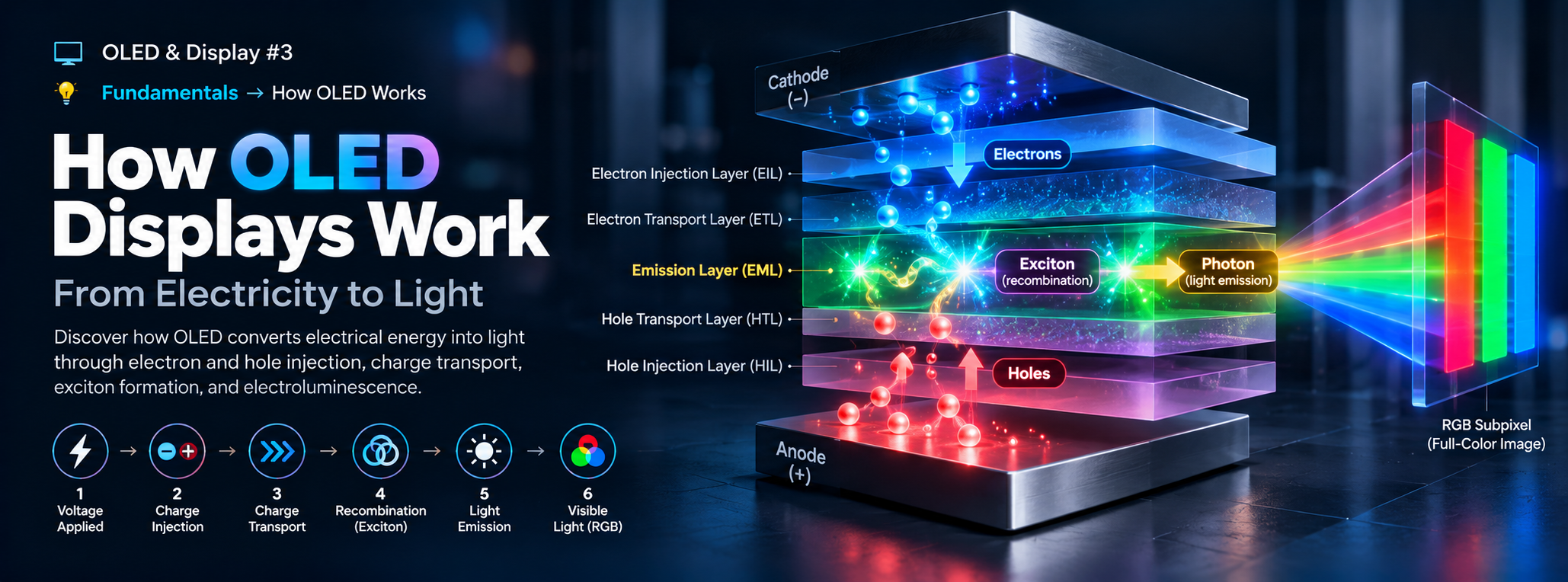
How OLED Displays Work: From Electricity to Light
🖥️ OLED & Display #3 | 💡 Fundamentals → How OLED Works
At a Glance
- OLED converts electrical energy directly into light through organic semiconductor layers.
- Electrons enter from the cathode, while holes enter from the anode.
- These charges move through dedicated transport layers toward the emission layer.
- When electrons and holes meet, they form an excited state known as an exciton.
- As the exciton releases energy, that energy can be emitted as a photon of light.
- OLED efficiency, color, brightness, and lifetime depend heavily on how well these processes are controlled.
Introduction
OLED is often described as a self-emissive display technology.
That means each OLED pixel can produce its own light without requiring a separate backlight.
But the phrase “self-emissive” does not fully explain what is actually happening inside the device.
How does electricity enter an OLED?
How do electrons and holes move through organic materials?
And how does their interaction ultimately create visible light?
The answer lies in a sequence of electrical and molecular processes occurring inside extremely thin organic semiconductor layers.
Understanding this process is one of the most important foundations for learning about OLED materials, device structures, efficiency, lifetime, and manufacturing technology.
The Basic OLED Light-Generation Process
At the most basic level, OLED converts:
Electrical Energy → Excited Molecular State → Light
A simplified sequence looks like this:
Voltage Applied
      ↓
Electron Injection
      +
Hole Injection
      ↓
Charge Transport
      ↓
Electron–Hole Recombination
      ↓
Exciton Formation
      ↓
Energy Release
      ↓
Light Emission
Every OLED pixel repeats this process whenever it needs to produce light.
The Basic Structure of an OLED Device
An OLED device contains multiple extremely thin layers positioned between two electrodes.
A simplified structure can be represented as:
Cathode
   ↓
Electron Injection Layer
   ↓
Electron Transport Layer
   ↓
Emission Layer
   ↓
Hole Transport Layer
   ↓
Hole Injection Layer
   ↓
Anode
Each layer has a different role.
The electrodes provide electrical charge, while the organic layers help inject, transport, and control electrons and holes.
The goal is to bring these charges together efficiently inside the Emission Layer, where light generation occurs.
Step 1: Voltage Is Applied
The OLED process begins when a voltage is applied across the two electrodes.
The OLED device has:
- Anode
- Cathode
These electrodes create the electrical conditions needed to inject charge carriers into the organic layers.
The two main charge carriers involved are:
Electrons
and
Holes
A hole can be understood as the absence of an electron within an electronic state, behaving effectively as a positive charge carrier.
The OLED device is designed so that electrons and holes enter from opposite sides.
Step 2: Electrons Are Injected from the Cathode
Electrons enter the OLED stack from the cathode side.
However, moving charge directly from an electrode into an organic semiconductor is not always efficient.
OLED structures therefore commonly use an:
Electron Injection Layer — EIL
The EIL helps electrons enter the organic semiconductor system more effectively.
After injection, the electrons move into the:
Electron Transport Layer — ETL
The ETL is designed to transport electrons toward the emission region.
The basic path is:
Cathode
   ↓
EIL
   ↓
ETL
   ↓
Emission Layer
Step 3: Holes Are Injected from the Anode
At the opposite side of the OLED device, holes are injected from the anode.
The structure commonly includes a:
Hole Injection Layer — HIL
The HIL helps holes enter the organic layers.
The holes then move through the:
Hole Transport Layer — HTL
toward the emission region.
The simplified path is:
Anode
   ↓
HIL
   ↓
HTL
   ↓
Emission Layer
Electrons and holes are therefore moving toward the same region from opposite directions.
Step 4: Electrons and Holes Meet
The OLED structure is designed to guide electrons and holes toward the Emission Layer — EML.
When they arrive in the same region, they can interact.
This process is commonly called:
Electron–Hole Recombination
But recombination does not simply mean that the charges disappear.
Their interaction creates an electronically excited state.
This excited state is known as an:
Exciton
Exciton formation is a critical step in OLED light generation.
What Is an Exciton?
An exciton is an excited state created through the interaction of an electron and a hole.
The OLED material temporarily stores energy in this excited state.
The exciton does not remain excited indefinitely.
Eventually, it returns to a lower-energy state.
When this happens, energy must be released.
In an OLED, that energy can be released as:
A photon of light
The simplified sequence is:
Electron + Hole
       ↓
     Exciton
       ↓
Energy Released
       ↓
     Photon
       ↓
      Light
This is the fundamental mechanism behind OLED emission.
What Is Electroluminescence?
The generation of light through electrical excitation is known as:
Electroluminescence
The term can be broken down into:
Electro
→ Electrical energy
Luminescence
→ Light emission
OLED is therefore an electroluminescent device.
Unlike technologies that depend on heating a material until it glows, OLED uses electronically excited molecular states to generate light.
This allows extremely thin organic layers to act as active light-emitting components.
Why Does the Emission Layer Matter?
The Emission Layer — EML is one of the most important parts of an OLED device.
It is the region where electrons and holes are intended to recombine and where light-emitting excited states are formed.
The EML strongly influences:
- Light color
- Efficiency
- Brightness
- Lifetime
- Operating voltage
- Overall OLED performance
OLED developers therefore spend significant effort designing and optimizing emission-layer materials.
How Does OLED Determine Light Color?
The color of OLED light is determined primarily by the properties of the emitting material.
Different organic molecules have different electronic energy structures.
When an excited state releases energy, the amount of energy determines the wavelength of the emitted photon.
Different wavelengths correspond to different colors.
In simplified terms:
Higher / Lower Energy Difference
          ↓
Different Photon Energy
          ↓
Different Wavelength
          ↓
Different Color
OLED devices can therefore be engineered to emit:
- Red
- Green
- Blue
- Other wavelengths
These emission characteristics form the basis of full-color OLED displays.
From Light to a Full-Color Pixel
A display requires much more than a single light-emitting device.
A full-color OLED panel must create millions of individually controlled pixels.
A simplified RGB pixel contains:
Pixel
├─ Red Subpixel
├─ Green Subpixel
└─ Blue Subpixel
Each subpixel controls its own light output.
By adjusting the brightness of red, green, and blue independently, the display can produce a wide range of colors.
For example:
Red + Green → Yellow

Green + Blue → Cyan

Red + Blue → Magenta

Red + Green + Blue → White
Actual commercial OLED architectures can be considerably more complex, but RGB control remains a fundamental concept in display color generation.
How Does an OLED Control Brightness?
OLED brightness is controlled by changing the amount of light emitted by the pixel.
That depends on the electrical conditions applied to the OLED device.
More precisely controlled current can change the rate at which charge carriers participate in light-generation processes.
A display therefore uses electronic circuits to precisely control individual pixels.
This is where the TFT backplane becomes important.
The Role of the TFT Backplane
OLED materials generate light, but another system must decide:
- Which pixel turns on
- How bright it should be
- What color should appear
- When the pixel should change
This control is provided by the Thin-Film Transistor — TFT backplane.
A simplified relationship is:
Display Signal
      ↓
TFT Backplane
      ↓
Electrical Current
      ↓
OLED Subpixel
      ↓
Light
The TFT backplane acts as the electronic control system behind the OLED pixels.
This is why technologies such as:
- LTPS
- LTPO
- Oxide TFT
are important in modern OLED displays.
They will be covered separately later in the OLED & Display series.
Why Charge Balance Matters
Generating light is not simply about injecting as many electrons and holes as possible.
The charges must arrive at the right place and in the right balance.
If electron and hole transport is poorly balanced:
- Recombination may occur in the wrong region.
- Energy may be lost without producing useful light.
- Operating voltage may increase.
- Efficiency may decrease.
- Material degradation may accelerate.
OLED material design therefore aims to carefully control:
Injection → Transport → Recombination → Emission
This is one reason OLED stacks contain multiple specialized functional layers rather than a single organic material.
Where Does Energy Get Lost?
Not all electrical energy entering an OLED becomes visible light.
Energy can be lost through several mechanisms.
Examples include:
- Inefficient charge injection
- Poor electron–hole balance
- Non-radiative energy loss
- Light trapped inside the device
- Material degradation
- Electrical resistance
OLED development therefore involves improving both:
Internal Efficiency
How efficiently electrical energy becomes light inside the OLED.
and
Optical Extraction
How much of that generated light actually escapes the device and reaches the viewer.
Improving both is important for higher display efficiency.
Why OLED Materials Matter So Much
OLED performance depends heavily on the molecular properties of its organic materials.
Different materials are optimized for different functions.
For example:
Injection Materials
Help charges enter the organic stack.
Transport Materials
Move electrons or holes through the device.
Emission Materials
Generate light.
Host Materials
Provide an environment in which emitting molecules operate effectively.
Dopant Materials
Can determine or improve emission characteristics.
This is why the OLED industry includes an important ecosystem of specialized chemical and advanced-material suppliers.
Why Is Blue OLED Particularly Challenging?
Red, green, and blue are all required for full-color OLED displays.
However, achieving a strong combination of:
- High efficiency
- Long lifetime
- High color purity
has historically been particularly challenging for blue OLED materials.
Blue light corresponds to relatively high-energy photons.
This places demanding requirements on material stability and device design.
As a result, improvements in blue OLED technology can have significant implications for:
- Display efficiency
- Device lifetime
- Material demand
- OLED stack design
Blue emission remains one of the important areas of OLED materials research.
From One OLED Device to Millions of Pixels
A single OLED device can generate light, but a modern display may contain millions of pixels.
For example, every pixel must be:
- Fabricated accurately
- Electrically controlled
- Uniform in performance
- Protected from contamination
- Consistent in color and brightness
This introduces major manufacturing challenges.
Producing OLED displays therefore requires precise control across:
Materials
   ↓
Deposition
   ↓
Patterning
   ↓
TFT Control
   ↓
Encapsulation
   ↓
Inspection
   ↓
Pixel Compensation
The physics of light generation and the realities of mass production are closely connected.
From Electricity to the Image You See
The entire OLED process can now be summarized as:
Image Signal
     ↓
TFT Backplane
     ↓
Electrical Current
     ↓
Electron + Hole Injection
     ↓
Charge Transport
     ↓
Recombination
     ↓
Exciton Formation
     ↓
Photon Emission
     ↓
RGB Subpixel Control
     ↓
Visible Image
A colorful OLED screen therefore begins with extremely small electrical and molecular interactions occurring inside ultra-thin layers.
iAtlas Insight
The most important point about OLED light generation is that device performance depends on an entire chain of processes rather than on the emitting material alone.
A high-performance OLED requires efficient:
Charge Injection
↓
Charge Transport
↓
Charge Balance
↓
Exciton Formation
↓
Light Emission
↓
Light Extraction
A weakness in any one of these steps can affect efficiency, brightness, lifetime, or manufacturing performance.
Materials Are Designed as a System
This explains why OLED development is not simply a search for a better red, green, or blue emitter.
Injection layers, transport layers, host materials, dopants, electrodes, and device architecture must work together.
The value of OLED materials should therefore be understood at the device-system level.
Efficiency and Lifetime Are Closely Connected
Driving an OLED harder may increase brightness, but electrical and molecular stress can also affect degradation.
Manufacturers therefore need to optimize:
- Brightness
- Efficiency
- Lifetime
- Operating voltage
simultaneously.
A material that performs well in one metric may not necessarily produce the best overall device.
Blue OLED Has Strategic Importance
Because blue emission remains technically demanding, improvements in blue OLED materials can influence the performance of the entire display.
A significant breakthrough in blue efficiency or lifetime could affect:
- Panel power consumption
- OLED stack structure
- Material usage
- Tandem OLED architecture
- Product lifetime
This makes blue OLED technology important not only scientifically, but also commercially.
Device Physics Connects Directly to Manufacturing
Even an excellent OLED material cannot deliver its potential if deposition thickness, contamination control, pixel patterning, or process uniformity are poor.
For industry analysis, OLED should therefore be viewed as a combination of:
Materials Science + Device Physics + Precision Manufacturing
Understanding how electricity becomes light is the bridge connecting all three.
FAQ
Why does OLED produce light without a backlight?
OLED contains organic semiconductor materials that emit light when electrons and holes interact under electrical excitation.
The pixel itself therefore acts as the light source.
What are electrons and holes in OLED?
Electrons are negatively charged carriers.
A hole represents the absence of an electron in an electronic state and behaves effectively as a positive charge carrier.
OLED devices transport both toward the emission region.
Where is light actually generated inside an OLED?
Light is primarily generated in the Emission Layer, where electrons and holes recombine and form excited states.
What is an exciton?
An exciton is an electronically excited state formed through the interaction of an electron and a hole.
When it returns to a lower-energy state, energy can be released as light.
What is electroluminescence?
Electroluminescence is the generation of light through electrical excitation.
OLED is an electroluminescent technology.
Why are there so many layers in an OLED?
Different layers are optimized for charge injection, electron transport, hole transport, emission, and other functions.
Separating these roles helps improve efficiency and device performance.
Key Takeaways
- OLED converts electrical energy directly into light.
- Electrons enter from the cathode, while holes enter from the anode.
- Transport layers guide both charge carriers toward the emission region.
- Electron–hole interaction creates an excited state known as an exciton.
- Exciton energy can be released as a photon through electroluminescence.
- The emission material determines important characteristics such as color and efficiency.
- The TFT backplane controls when and how strongly each OLED subpixel emits light.
- Efficient OLED operation requires careful control of injection, transport, recombination, and emission.
- OLED performance depends on the entire material stack rather than on the emitter alone.
- OLED light-generation physics directly influences materials development, equipment requirements, efficiency, and lifetime.
OLED & Display Learning Path
Previous Article
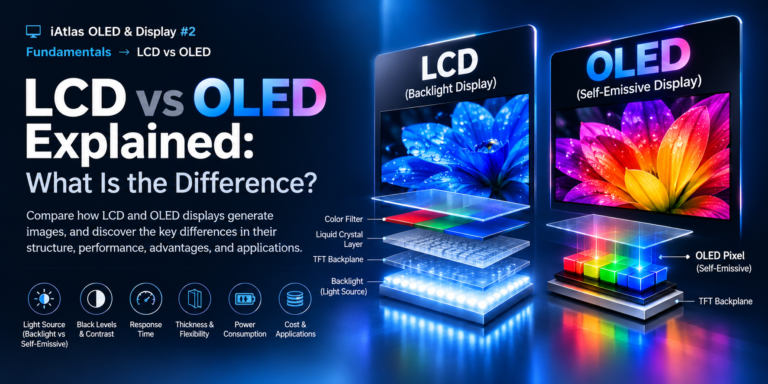
OLED & Display #2 — LCD vs OLED Explained: What Is the Difference?
Current Article
OLED & Display #3 — How OLED Displays Work: From Electricity to Light
Next Article
OLED & Display #4 — OLED Display Structure Explained: Inside the Layers of an OLED
The next article will examine the OLED stack layer by layer and explain how electrodes, injection layers, transport layers, the emission layer, and the TFT backplane work together inside a modern OLED display.
References & Further Reading
For this article, references should cover:
- Universal Display Corporation (UDC) — Organic Light Emitting Diodes (OLEDs)
- Samsung Display — Organic Layers (HIL, HTL, EML, ETL, EIL)
- Universal Display Corporation — UniversalPHOLED Materials
- Samsung Display — Backplane
ℹ️ About iAtlas
iAtlas is an independent publication covering batteries, semiconductors, OLED, advanced materials, AI, and global industrial trends.
We transform complex industrial developments into clear, reliable, and easy-to-understand insights.
Whether you’re following today’s industry news or building long-term expertise, iAtlas helps you understand not only what happened, but why it matters.
Technology creates change.
Insight creates opportunity.
— iAtlas