
Battery Manufacturing Process Explained: From Raw Materials to Battery Pack
🔋 iAtlas Battery #1 | 📘 Fundamentals → 🚀 Getting Started
Lithium-ion batteries have become the backbone of modern technology. They power smartphones, laptops, electric vehicles (EVs), energy storage systems (ESS), drones, and countless industrial applications. As global demand for clean energy and electrification continues to grow, understanding how these batteries are manufactured has become increasingly important.
Unlike many manufactured products, lithium-ion batteries require an exceptionally controlled production process. Every stage—from material preparation to final testing—directly affects battery performance, safety, cycle life, and reliability.
This article provides an overview of the complete battery manufacturing process and serves as a starting point for understanding the technologies explored throughout the Battery section of iAtlas.
The Battery Manufacturing Process Flow
Raw Materials → Electrode Manufacturing → Cell Assembly → Electrolyte Filling → Formation & Aging → Inspection → Module & Pack Assembly
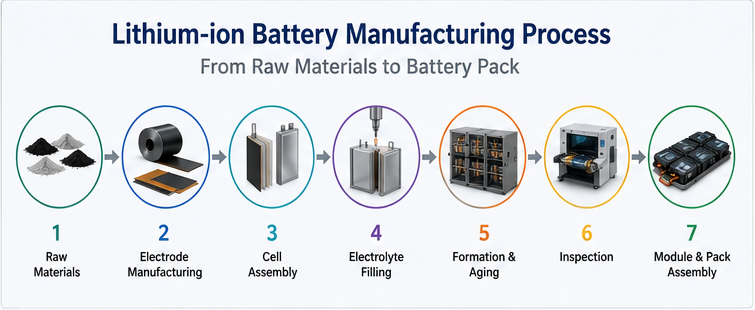
1. Raw Materials
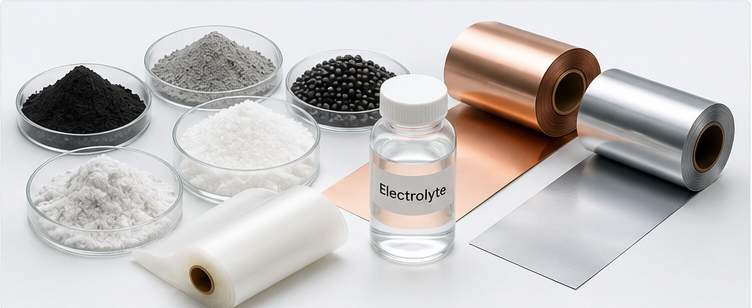
Battery production begins with high-purity raw materials.
The main components include:
- Cathode active materials
- Anode active materials
- Electrolytes
- Separators
- Copper foil
- Aluminum foil
- Conductive additives
- Binders
The quality and purity of these materials significantly influence energy density, charging speed, cycle life, and overall battery safety.
Different battery chemistries—such as NCM, LFP, and LMFP—require different material compositions, resulting in varying performance characteristics.
2. Electrode Manufacturing
The electrode manufacturing process transforms raw materials into functional battery electrodes.
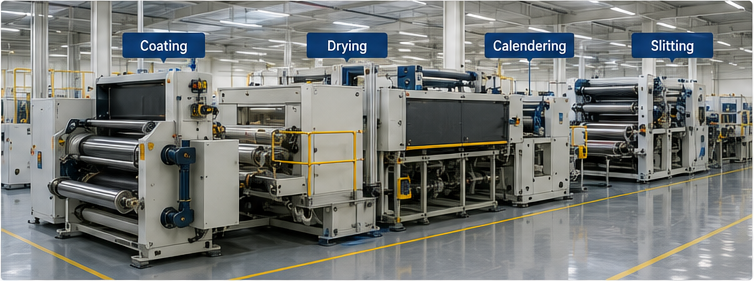
Typical steps include:
- Mixing
- Coating
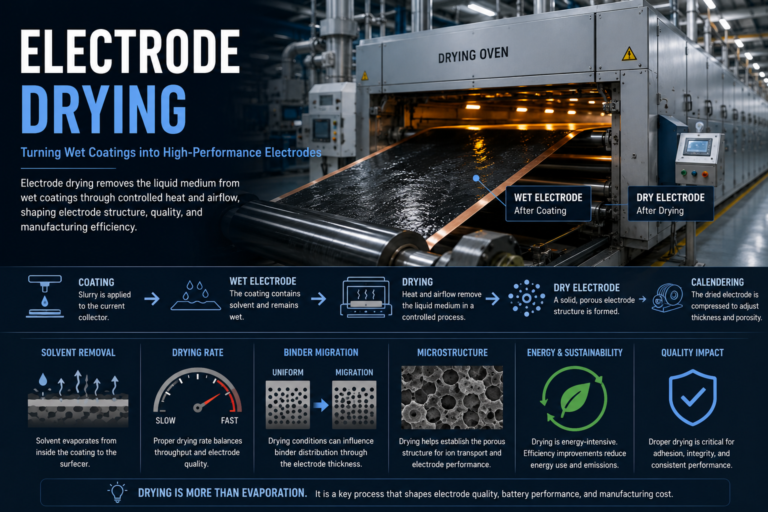
- Drying
- Calendering
- Slitting
The slurry must be mixed uniformly before being coated onto current collectors. After drying, the electrodes are compressed to improve density and conductivity before being cut into the required dimensions.
Even microscopic variations in coating thickness can affect battery performance.
3. Cell Assembly
Once the electrodes are prepared, they are assembled into battery cells.
Depending on the product, manufacturers use:
- Cylindrical cells
- Prismatic cells
- Pouch cells
The electrodes and separators are stacked or wound together with extremely high precision.
At this stage, particle contamination becomes a major concern because even tiny contaminants can reduce battery reliability or cause internal short circuits.
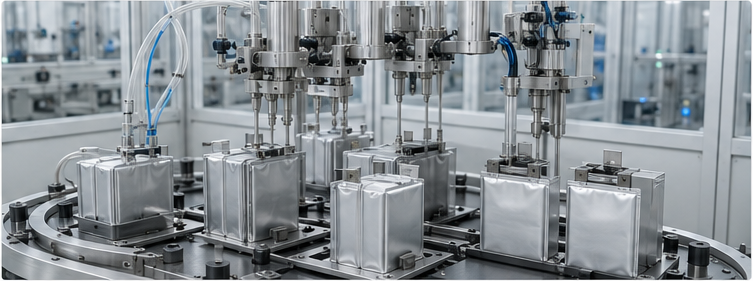
4. Electrolyte Filling
Electrolyte filling is one of the most critical manufacturing steps.
Electrolytes react readily with moisture, producing unwanted compounds such as hydrofluoric acid (HF), which can damage battery components and reduce long-term performance.
For this reason, electrolyte filling is typically performed under extremely dry conditions.
Manufacturers often rely on dry rooms and controlled-atmosphere environments to maintain consistent quality.
5. Formation and Aging
Formation is the first charging process after the battery cell has been assembled.
During this stage:
- The Solid Electrolyte Interphase (SEI) layer is formed.
- Initial battery characteristics are stabilized.
- Cell performance is evaluated.
Although formation is one of the longest production stages, it is essential for achieving stable long-term battery performance.
6. Inspection and Quality Control
Before shipment, every battery cell undergoes rigorous inspection.
Typical quality checks include:
- Capacity testing
- Internal resistance measurement
- Leakage testing
- Voltage inspection
- X-ray inspection
- Safety testing
Only cells that satisfy strict quality requirements proceed to module assembly.
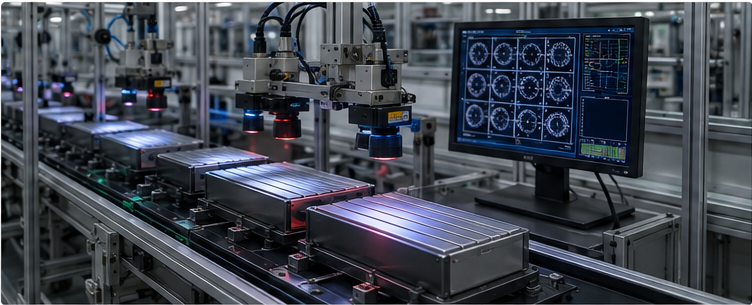
7. Module and Pack Assembly
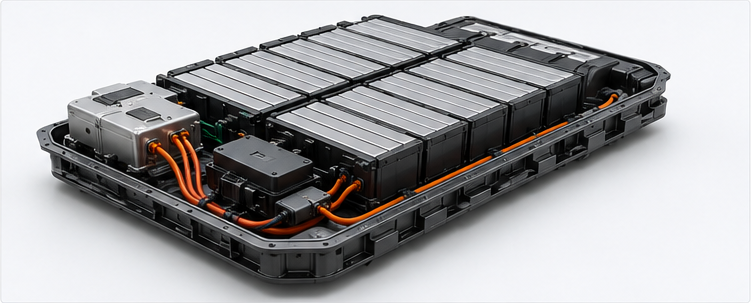
Qualified battery cells are assembled into modules and battery packs.
Additional components include:
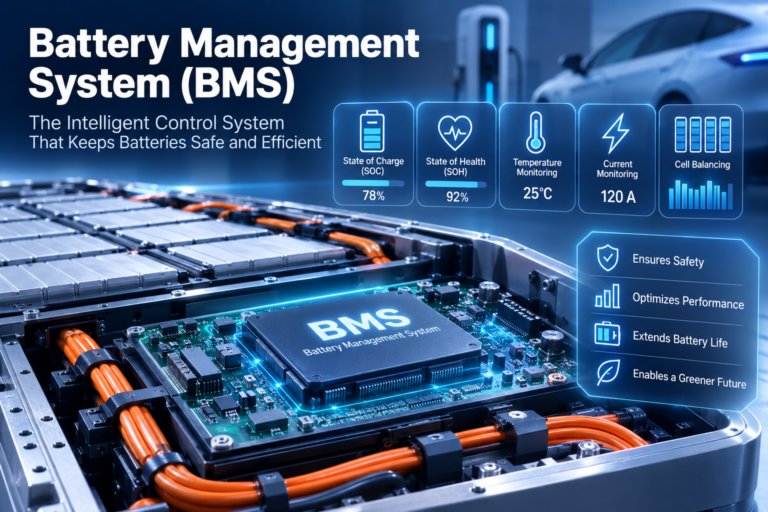
- Battery Management System (BMS)
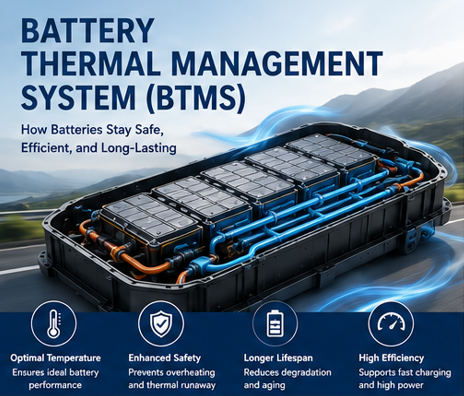
- Cooling systems
- Busbars
- Structural frames
- Electrical connectors
This stage converts individual cells into complete battery systems suitable for electric vehicles and energy storage applications.
Why Manufacturing Environment Matters
Battery manufacturing is not only about machinery—it is also about environmental control.
Processes such as electrolyte filling and cell assembly require strict control of:
- Moisture
- Oxygen
- Dust particles
- Temperature
Maintaining stable manufacturing conditions helps improve product consistency, reduce defects, and extend battery life.
This is one of the reasons advanced battery manufacturers invest heavily in dry rooms and controlled production environments.
Key Takeaways
- Lithium-ion battery manufacturing consists of multiple precision-controlled processes.
- Material quality directly affects battery performance and safety.
- Moisture control is essential during electrolyte filling and cell assembly.
- Formation is a critical step in developing stable battery performance.
- Quality inspection ensures only qualified cells proceed to final assembly.
🎓 Battery Learning Path
📘 Fundamentals
📍🔋 iAtlas Battery #1 — Manufacturing Process (Current)
▶ 🔋 iAtlas Battery #2 — How Batteries Work
▶ 🔋 iAtlas Battery #3 — Materials Overview
Next Learning Path: 🧪 Materials
📖 Continue Reading
➡ Next Article
🔋 iAtlas Battery #2
How Lithium-ion Batteries Work: Charging, Discharging, and Energy Storage
Understand how lithium ions move between the cathode and anode during charging and discharging, and discover the fundamental principles behind lithium-ion batteries.
References
- International Energy Agency (IEA)
- U.S. Department of Energy – Vehicle Technologies Office
- Battery University
- Nature Energy (Battery Manufacturing Research)
About iAtlas
iAtlas is an independent publication covering batteries, semiconductors, OLED, advanced materials, AI, and global industrial trends.
We transform complex industrial developments into clear, reliable, and easy-to-understand insights.
Whether you’re following today’s industry news or building long-term expertise, iAtlas helps you understand not only what happened, but why it matters.
Technology creates change.
Insight creates opportunity.
— iAtlas


Super