Sodium-Ion Battery: From the Lab to Mass Production
CATL’s GWh-Scale Production, 60 GWh Storage Deal and Commercial Deployment Show How Sodium-Ion Is Entering Its Industrialization Phase
🔋 iAtlas Daily #67 | Sodium-Ion Battery & Energy Storage | September 2026
For years, sodium-ion batteries occupied an interesting position in battery research.
The basic idea was attractive.
Sodium is abundant.
It is widely available.
And sodium-ion batteries could reduce dependence on lithium.
But one fundamental question remained:
Can sodium-ion batteries actually be manufactured at scale?
In 2026, that question is beginning to receive a much clearer answer.
China’s CATL has moved sodium-ion technology through several critical stages:
Laboratory Development
↓
Product Engineering
↓
Manufacturing Scale-Up
↓
Commercial Contracts
↓
GWh-Scale Deployment
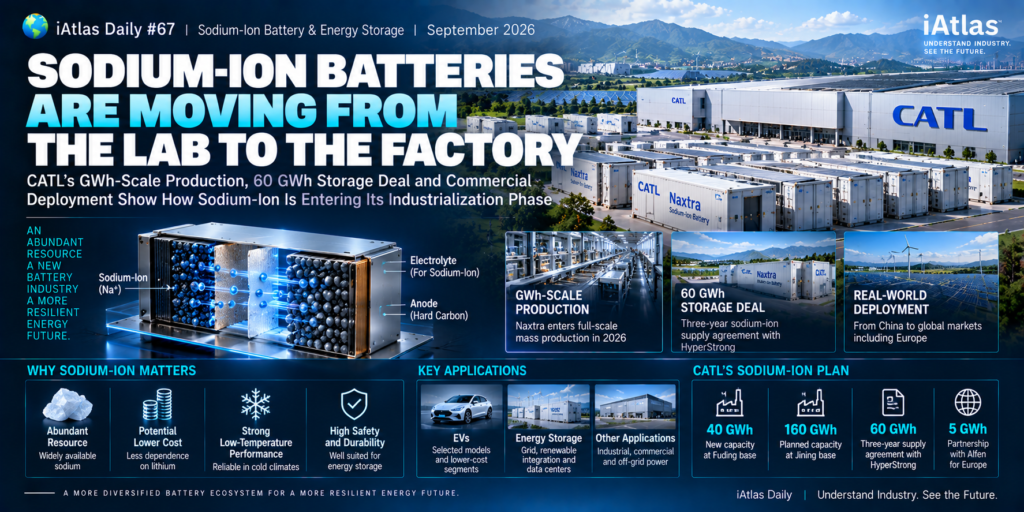
CATL says its Naxtra sodium-ion battery will enter full-scale mass production by the end of 2026 after overcoming key manufacturing challenges.
For stationary storage, the transition is already further advanced.
CATL has commissioned sodium-ion production lines, plans substantial additional capacity, and signed a three-year:
60 GWh
sodium-ion energy-storage agreement with HyperStrong.
This changes the sodium-ion story.
The question is no longer simply:
Can sodium-ion batteries work?
It is becoming:
Where can sodium-ion batteries compete economically with lithium-ion batteries?
And that is the question that could turn sodium-ion from an alternative chemistry into a significant battery industry.
🌍 The Big Story
Lithium-ion dominates modern battery manufacturing.
It powers:
Electric Vehicles
Smartphones
Energy Storage Systems
Laptops
Power Tools
and countless other products.
Its ecosystem is enormous.
Decades of investment have created:
Materials Suppliers
Cell Factories
Equipment
Engineering Expertise
Recycling
and:
Global Supply Chains
That makes lithium-ion extremely difficult to displace.
Sodium-ion does not need to replace it.
That distinction is essential.
The emerging battery industry may increasingly look like:
NCM
→ High energy density
LFP
→ Cost + durability
Sodium-Ion
→ Resource diversification + low-temperature applications + stationary storage
Instead of one chemistry winning everything, the market could become:
Multi-Chemistry
CATL itself is increasingly describing battery development in those terms.
1. What Is a Sodium-Ion Battery?
A sodium-ion battery works according to a principle broadly similar to lithium-ion.
During charging and discharging, ions move between:
Cathode
and:
Anode
through an electrolyte.
The fundamental difference is the charge carrier.
Lithium-ion uses:
Li⁺
Sodium-ion uses:
Na⁺
At first glance, this appears to be a relatively small change.
Industrially, it is not.
Changing the ion changes:
Electrode Materials
Energy Density
Electrolyte Requirements
Manufacturing Conditions
Supply Chain
and:
Battery Performance
2. Why Sodium?
The attraction begins with resources.
Lithium resources are geographically concentrated and require mining, refining and chemical conversion before reaching battery production.
Sodium is far more abundant.
It is available across many regions of the world.
That creates a potential strategic advantage:
Resource Diversification
The battery industry would no longer depend exclusively on lithium-based chemistry for every application.
CATL explicitly positions sodium-ion as a way to reduce reliance on a single critical resource base.
This is particularly important as battery demand expands beyond EVs into enormous stationary-storage markets.
3. But Abundant Sodium Does Not Automatically Mean a Cheap Battery
This is an important distinction.
People often hear:
Sodium is abundant
and conclude:
Sodium batteries must be cheap.
The reality is more complicated.
Battery cost includes:
Cathode
Anode
Electrolyte
Separator
Current Collectors
Cell Manufacturing
Formation
Pack Integration
and:
Factory Utilization
Raw-material abundance is only one part of the equation.
A mature lithium-ion factory producing millions of cells efficiently may still outperform an immature sodium-ion line economically.
The key variable is therefore:
Industrial Scale
4. Sodium-Ion Has Historically Faced an Energy-Density Problem
Sodium ions are larger and heavier than lithium ions.
That makes achieving very high energy density more difficult.
The IEA notes that sodium-ion technology still generally has lower energy density than lithium-ion alternatives, which limits its competitiveness with LFP in some applications.
This matters enormously for vehicles.
A vehicle battery must carry itself.
More battery mass can mean:
More Weight
↓
More Energy Consumption
↓
Lower Efficiency
For a long-range premium EV, energy density remains extremely important.
This is why sodium-ion is unlikely to simply replace high-performance lithium-ion batteries across the market.
5. But an ESS Does Not Need to Carry Its Own Weight
Now consider a stationary battery.
An ESS sits:
Beside a Solar Farm
Inside a Data Center
At a Substation
or:
Near a Factory
It does not need to move.
That changes the optimization problem.
Instead of maximizing:
Wh/kg
the system may prioritize:
Cost
Cycle Life
Safety
Temperature Performance
Resource Availability
and:
Long-Term Reliability
Suddenly, sodium-ion’s lower energy density becomes less damaging.
This is why stationary energy storage may become one of its most important early markets.
6. Low-Temperature Performance Is Another Advantage
Cold temperatures are difficult for batteries.
CATL says its Naxtra passenger battery can operate from:
−40°C to +70°C
and retain more than:
90% usable capacity at −40°C. CATL
The IEA similarly identifies strong low-temperature performance as one of sodium-ion’s important advantages relative to lithium-ion chemistries, particularly LFP.
That could make sodium-ion particularly attractive in:
Northern China
Northern Europe
Canada
and other cold regions.
Again, chemistry selection becomes application-specific.
7. The Important Breakthrough Was Not Only Chemistry
CATL’s April 2026 announcement revealed something particularly important.
The company said it had overcome four major manufacturing bottlenecks:
Extreme Moisture Control
Gas Generation in Hard Carbon
Aluminum-Foil Adhesion
and:
Self-Forming Anode Scale-Up.
This is the industrial side of battery technology that is often overlooked.
A chemistry can perform well in a laboratory cell.
That does not mean it can be produced:
Millions of Times
with:
High Yield
Consistent Quality
and:
Competitive Cost
The transition from science to manufacturing is where many battery technologies fail.
8. Moisture Control Is Particularly Important
Battery materials can be highly sensitive to water.
Moisture can influence:
Material Stability
Electrolyte Reactions
Gas Formation
Cell Performance
and:
Lifetime
At laboratory scale, researchers can carefully control small batches.
At factory scale, the challenge becomes:
Can the same environment be maintained continuously across thousands or millions of cells?
This requires:
Dry Rooms
Process Control
Material Handling
Environmental Monitoring
and:
Manufacturing Discipline
CATL identifying extreme moisture control as one of the sodium-ion mass-production bottlenecks shows how industrialization depends on much more than electrochemistry.
9. Hard Carbon Is Another Key Piece
Lithium-ion batteries commonly use graphite anodes.
Sodium-ion often relies on:
Hard Carbon
because conventional graphite is less suitable for storing larger sodium ions.
But hard carbon introduces its own challenges.
CATL specifically identified gas generation in hard carbon as one of the issues that had to be solved for mass production.
This illustrates a broader principle:
Changing battery chemistry changes the entire materials ecosystem.
New chemistry can create demand for:
New Cathode Materials
New Anodes
New Electrolytes
and potentially:
New Manufacturing Equipment
10. Aluminum Could Simplify Part of the Supply Chain
Sodium-ion can potentially use aluminum current collectors more broadly than conventional lithium-ion architectures.
That matters because lithium-ion anodes typically rely on:
Copper Foil
Copper is heavier and generally more expensive than aluminum.
The ability to use aluminum can therefore provide potential advantages in:
Material Cost
Weight
and:
Supply Chain
But CATL’s disclosure also shows that aluminum itself creates manufacturing challenges—the company specifically cited foil adhesion as one of the barriers it needed to overcome.
Again:
Material advantage
does not automatically equal:
Manufacturing advantage.
Engineering connects the two.
11. 2026 Is Becoming the Industrialization Year
CATL introduced its first-generation sodium-ion technology in 2021.
But the story has changed substantially since then.
The current sequence looks roughly like:
2021
First-generation sodium-ion technology
↓
2025
Naxtra product introduction
↓
2026
Vehicle deployment + manufacturing scale-up + ESS commercialization
↓
Mass Production
CATL says full-scale Naxtra production is scheduled for the end of 2026.
That means sodium-ion is moving out of the technology-demonstration phase.
12. The EV Market Is Beginning to Open
In February, CATL and Changan announced what they described as the world’s first mass-production sodium-ion passenger vehicle.
This is important because passenger vehicles impose demanding requirements around:
Energy Density
Safety
Fast Charging
Low-Temperature Operation
Cycle Life
and:
Cost
If sodium-ion can enter even selected vehicle segments, its addressable market becomes much larger.
But the most logical first markets may not be premium long-range EVs.
13. Sodium-Ion Does Not Need to Power Every EV
Imagine the EV market as several segments.
Premium Long-Range EV
Priority:
Maximum Energy Density
Mainstream EV
Priority:
Balanced Cost + Range
Urban EV
Priority:
Low Cost + Durability
Cold-Climate Vehicle
Priority:
Low-Temperature Performance
Sodium-ion may be more competitive in some segments than others.
The correct question therefore is not:
Can sodium-ion beat lithium-ion?
It is:
Where does sodium-ion’s performance profile create the best economics?
That is a much more useful industrial question.
14. ESS May Reach Scale Faster
For stationary storage, CATL has already moved aggressively.
Its TENER Sodium Energy Storage System is scheduled for initial Chinese customer deliveries in September 2026.
CATL expects cumulative shipments to reach:
1 GWh by the end of 2026
with international deliveries beginning in June 2027.
This is an important milestone.
A battery technology becomes industrially meaningful when it moves from:
Pilot Cells
to:
Commercial GWh Deployment
Sodium-ion is beginning that transition.
15. The 60 GWh Contract Changes the Scale of the Discussion
In April, CATL and Chinese energy-storage integrator HyperStrong signed a three-year sodium-ion supply agreement covering:
60 GWh
CATL describes it as the world’s largest sodium-ion energy-storage cooperation agreement.
The importance is not simply the headline number.
A large long-term order gives manufacturers something critical:
Demand Visibility
Factories require enormous investment.
Suppliers also need confidence before expanding.
A 60 GWh commitment can help support:
Production Investment
↓
Supplier Investment
↓
Higher Utilization
↓
Lower Cost
↓
More Customers
This is how a technology begins to develop industrial momentum.
16. CATL Is Building Production Capacity Around That Demand
CATL says it has invested:
RMB 5 billion
to expand sodium-ion production lines at its Fuding base, adding:
40 GWh/year
of capacity.
Its Jining base in Shandong has a planned:
160 GWh
of sodium-ion capacity.
Those figures should be treated carefully—planned capacity is not the same thing as actual production.
But they show the direction.
China is not treating sodium-ion purely as a research project.
It is building manufacturing infrastructure around it.
17. This Is Where China’s Advantage Becomes Important
Battery competition is often described as a technology race.
But China’s advantage extends beyond battery chemistry.
China already has an enormous ecosystem of:
Battery Manufacturers
Cathode Producers
Anode Producers
Electrolyte Suppliers
Separator Suppliers
Equipment Makers
Automation Companies
Energy-Storage Integrators
and:
EV Manufacturers
That ecosystem can accelerate commercialization.
A new battery chemistry does not need to build every industrial capability from zero.
It can leverage parts of the existing battery-manufacturing base.
18. Scale Creates Learning
Imagine two companies.
Company A
Produces:
10 MWh
of sodium-ion cells.
Company B
Produces:
10 GWh
At larger scale, Company B encounters far more real-world manufacturing problems.
It learns about:
Yield
Defects
Equipment Reliability
Material Variation
Process Stability
Customer Performance
and:
Field Failures
This creates:
Manufacturing Learning
And manufacturing learning can become as important as the underlying patent portfolio.
19. China’s Lead Is Therefore More Than Capacity
The Financial Times reported this month that Western companies are falling behind China’s sodium-ion industry as Chinese manufacturers move toward much larger-scale production and commercialization.
The important point is not simply:
China has more factories.
It is the combination of:
R&D
Materials
Manufacturing
Customers
Deployment
The full loop looks like:
Technology
↓
Factory
↓
Customer
↓
Field Data
↓
Process Improvement
↓
Better Technology
That feedback loop can compound quickly.
20. Europe Is Already Becoming a Customer
CATL’s sodium-ion strategy is not limited to China.
In July, CATL and European energy-solutions company Alfen announced a:
5 GWh
sodium-ion energy-storage partnership for Europe.
This is strategically interesting.
Europe wants:
Energy Security
Battery Supply Diversification
and:
Domestic Industrial Capability
Yet emerging battery technologies may still depend heavily on Chinese suppliers.
That creates the same question seen elsewhere in the battery industry:
Can a region deploy new battery technologies without also building the manufacturing ecosystem behind them?
21. BYD Is Developing Sodium-Ion Too
CATL is not alone.
BYD has also developed sodium-ion technology and is working on demonstration applications.
Its 2026 interim report says the company is actively pursuing R&D and demonstration applications for sodium-ion energy storage.
BYD has separately said it has developed sodium-ion batteries with cycle life up to 10,000 cycles, although mass-production timing will depend on market demand.
This is important because competition between major manufacturers can accelerate:
Technology Improvement
Supply-Chain Development
and:
Cost Reduction
22. But Lithium-Ion Is Not Standing Still
Sodium-ion is entering a moving market.
LFP batteries continue improving.
Manufacturing scale continues increasing.
Lithium prices can fall.
Fast-charging technology is improving.
Cell-to-pack architectures are becoming more efficient.
This creates a difficult competitive environment.
The IEA notes that sodium-ion remains challenged by lower energy density and that its competitiveness depends partly on lithium-market conditions.
Sodium-ion therefore needs to create its own value proposition rather than rely solely on lithium scarcity.
23. Sodium-Ion’s Best Role May Be Complementary
The future battery market may therefore look like:
High-Nickel NCM
→ Maximum energy density
LFP
→ Mainstream EV + ESS
Sodium-Ion
→ ESS + cold climates + selected lower-cost mobility
Solid-State
→ Future high-performance applications
Different chemistries can coexist.
CATL itself argues for multiple chemistry systems serving different use cases.
This is an important shift from the idea that one chemistry must replace another.
24. Resource Diversification May Be the Strategic Advantage
The most important sodium-ion benefit may ultimately be neither energy density nor headline cell cost.
It may be:
Optionality
If lithium prices rise sharply:
→ Sodium provides another pathway.
If lithium supply becomes constrained:
→ Sodium provides another pathway.
If stationary storage demand expands faster than lithium supply:
→ Sodium provides another pathway.
A diversified battery ecosystem becomes more resilient.
The logic is similar to an investment portfolio.
Dependence on one resource creates concentration risk.
Multiple chemistries reduce that concentration.
25. The Factory Is the Real Test
Battery history contains many promising chemistries.
Far fewer reach mass production.
The industrialization sequence remains unforgiving:
Material Discovery
↓
Laboratory Cell
↓
Prototype
↓
Pilot Line
↓
Qualification
↓
Mass Production
↓
Competitive Cost
↓
Reliable Field Operation
Sodium-ion has progressed further down that path than ever before.
But it still needs to prove itself across millions of cells and years of operation.
That is why 2026 matters.
The sodium-ion story is moving from:
Chemistry
to:
Manufacturing
🧩 Why This Matters
Sodium-ion has crossed an important industrial threshold.
CATL is moving from laboratory development toward GWh-scale manufacturing and commercial delivery.
ESS could become the first major market.
Stationary applications reduce the penalty associated with lower energy density.
China’s advantage is ecosystem depth.
Materials, equipment, battery factories, system integrators and customers already exist at scale.
The 60 GWh HyperStrong agreement provides real demand visibility.
This is no longer merely a pilot project.
Lithium-ion does not need to lose for sodium-ion to win.
Sodium-ion can become significant by occupying specific applications where its characteristics make economic sense.
Battery competition is becoming multi-chemistry.
The future may be NCM + LFP + sodium-ion rather than a single dominant chemistry.
🔭 What to Watch
CATL Mass Production — Naxtra is scheduled to enter full-scale mass production by the end of 2026.
TENER Sodium Deliveries — Initial Chinese ESS deliveries are scheduled for this September, with CATL targeting 1 GWh of cumulative shipments by year-end.
60 GWh HyperStrong Contract — Actual project deployment will show how quickly contracted volume translates into installed capacity.
Changan Vehicles — Passenger-vehicle deployment will test sodium-ion outside stationary storage.
BYD — Watch whether BYD moves from demonstration projects into a firm mass-production schedule.
Europe — CATL’s 5 GWh Alfen partnership will be an important test of sodium-ion commercialization outside China.
Cost — Sodium-ion ultimately needs to demonstrate competitive total system economics against continually improving LFP.
🧭 iAtlas Insight
For years, sodium-ion was discussed as:
A possible alternative to lithium-ion.
That framing may now be outdated.
A more useful question is:
What role should sodium-ion play inside a diversified battery system?
Lithium-ion already has extraordinary scale.
LFP is inexpensive, durable and mature.
High-nickel batteries provide high energy density.
Sodium-ion does not need to defeat all of them.
It needs to find applications where its combination of:
Resource Availability
Low-Temperature Performance
Safety
Cycle Life
and:
Potential Cost
creates the best system-level economics.
Stationary storage may provide exactly that opportunity.
But the most important development in 2026 is not a laboratory performance record.
It is that China is building:
Factories
Supply Chains
Customers
and:
Commercial Projects
around the chemistry.
That is the point where a battery technology begins becoming an industry.
The sodium-ion race may ultimately be won not by the company with the best laboratory cell, but by the ecosystem that learns how to manufacture it at scale first.
📚 Related Articles
📰 iAtlas Daily #65: LG Energy Solution Is Building an ESS Manufacturing Network Across North America
📚 iAtlas Library | Battery Manufacturing: Lithium-Ion Battery
📰 iAtlas Weekly #12: The Global Manufacturing Map Is Being Redrawn
🔗 References
- CATL — Naxtra Sodium-Ion Battery and 2026 Mass Production
- CATL — TENER Sodium Energy Storage System
- CATL — 60 GWh HyperStrong Sodium-Ion Agreement
- CATL — Alfen 5 GWh European Sodium-Ion Partnership
- IEA — Global EV Outlook 2026: EV Batteries
- Financial Times — Western Companies Lag China in Sodium Battery Race
ℹ️ About iAtlas
iAtlas is an independent publication covering batteries, semiconductors, OLED, advanced materials, AI, and global industrial trends.
We transform complex industrial developments into clear, reliable, and easy-to-understand insights.
Whether you’re following today’s industry news or building long-term expertise, iAtlas helps you understand not only what happened, but why it matters.
Technology creates change.
Insight creates opportunity.
— iAtlas