Why Is the Display Industry Moving Beyond Smartphones?
How Automotive Displays, IT OLED, and Micro-OLED Are Creating New Opportunities for Display Manufacturers
iAtlas Daily #87 | OLED & Display Technology | October 28, 2026
The Next Big Opportunity for OLED May Not Be a Smartphone
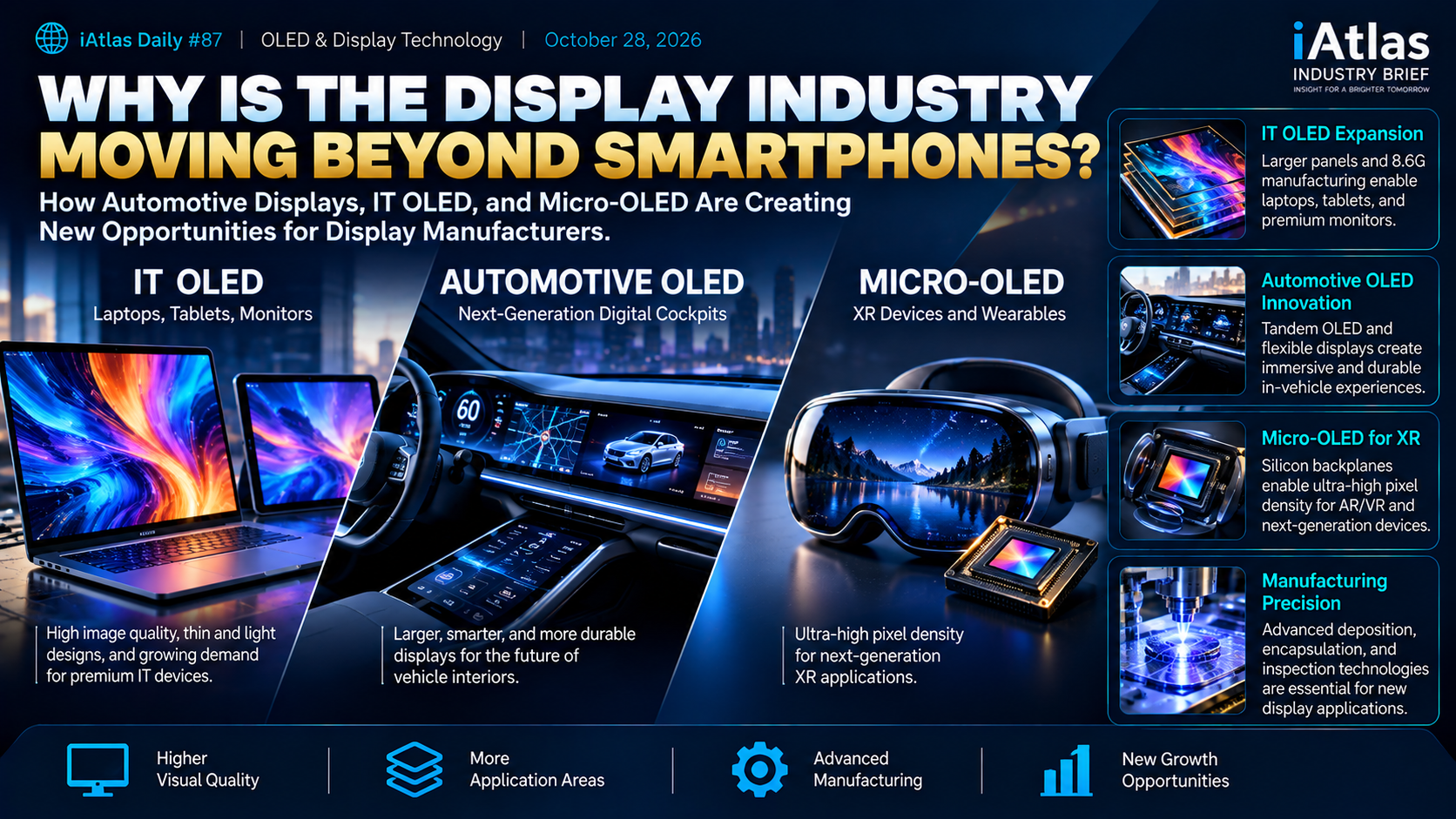
The OLED display industry is entering a new phase as manufacturers expand beyond smartphones into laptops, tablets, automobiles, and next-generation wearable devices.
For years, smartphones have been one of the most important markets for OLED technology.
Their demand for thin panels, high contrast, vibrant colors, and energy-efficient displays helped establish OLED as a premium display technology.
But the industry is changing.
Laptop manufacturers are introducing more OLED models. Automakers are transforming dashboards into sophisticated digital interfaces. Extended reality devices require extremely small displays with exceptionally high pixel density.
These applications have something in common.
They need more than a conventional smartphone screen.
Each market demands different combinations of brightness, durability, size, resolution, manufacturing precision, and cost.
For display manufacturers, this creates an opportunity to expand into new product categories.
It also introduces a new challenge.
The next stage of OLED competition will depend not only on display quality, but also on the ability to manufacture specialized panels efficiently at scale.
1. Why the Smartphone Market Is No Longer Enough
Smartphones remain a major application for OLED technology.
However, depending too heavily on one product category creates risks for display manufacturers.
Smartphone replacement cycles, customer purchasing decisions, and competition among panel suppliers can influence demand and profitability.
At the same time, OLED manufacturing requires substantial capital investment.
Production lines must operate at competitive utilization and yield levels to support attractive manufacturing economics.
This encourages display companies to pursue additional markets.
The opportunities include:
- Laptops and tablets: Larger premium screens with high image quality and low power consumption.
- Automotive displays: Durable, flexible screens integrated into increasingly digital vehicle interiors.
- XR and wearable devices: Extremely compact displays with high pixel density.
- Gaming monitors: Fast response times, strong contrast, and high refresh rates.
These markets will not develop at identical speeds.
But together, they offer display manufacturers a broader foundation for long-term growth.
2. IT OLED: Why Laptops and Tablets Matter
OLED is increasingly competing with LCD in laptops, tablets, and other IT devices.
The technology offers several potential advantages.
Better Contrast
OLED pixels generate their own light.
Unlike conventional LCDs, they do not require a separate backlight.
This allows individual pixels to turn off, producing deep blacks and strong contrast.
Thin and Flexible Designs
OLED technology can support thin panel structures and new device designs.
Depending on the panel architecture, this can help manufacturers develop lighter or more compact products.
Display Performance
OLED can offer fast pixel response times and high-quality image reproduction.
However, OLED panels must also address challenges involving lifespan, brightness, power consumption, and image retention.
These factors become especially important in laptops and tablets, where users may display static interface elements for extended periods.
Why Larger Manufacturing Substrates Matter
Smartphone OLED production has traditionally relied heavily on sixth-generation manufacturing lines.
As demand for larger IT panels increases, manufacturers are investing in higher-generation production equipment.
Larger glass substrates can improve the economics of producing larger panels, provided manufacturing yields and equipment productivity are sufficiently high.
This is why eighth-generation OLED manufacturing has become strategically important.
3. Samsung Display: Investing in 8.6-Generation IT OLED
Samsung Display is one of the companies leading the transition toward larger IT OLED manufacturing.
Its A6 production line in Asan, South Korea, was designed around 8.6-generation glass substrates measuring approximately 2,290 × 2,620 mm.
The company announced an investment of KRW 4.1 trillion in the project.
The objective is to support large-scale production of OLED panels for IT devices, including laptops.
In its second-quarter 2026 business update, Samsung Display identified the 8.6-generation IT OLED line as an important element of its strategy for expanding into tablet, gaming, and automotive applications.
Why This Investment Matters
Manufacturing a smartphone-sized panel and manufacturing a laptop-sized panel involve different production economics.
A larger substrate can allow manufacturers to arrange multiple larger panels more efficiently.
However, the benefit depends on several factors:
- Panel dimensions and substrate utilization
- Deposition equipment performance
- Defect density and manufacturing yield
- Material consumption
- Production throughput
Larger substrates do not automatically guarantee lower costs.
Manufacturers must achieve stable yields and efficient equipment operation.
The A6 investment therefore represents more than a capacity expansion.
It reflects the growing importance of production efficiency in the competition for larger OLED applications.
4. Automotive OLED: The Car Is Becoming a Digital Display Platform
Modern vehicles are increasingly defined by digital interfaces.
Traditional instrument clusters are being replaced or supplemented by large displays.
Navigation, entertainment, vehicle controls, and driver information are becoming more integrated.
This creates opportunities for OLED technology.
However, automotive displays face requirements that differ substantially from consumer electronics.
Long Operating Lifetimes
Vehicles may remain in service for many years.
Automotive displays must maintain acceptable performance over extended operating periods.
Temperature Resistance
A vehicle interior can experience extreme heat or cold.
Display materials and structures must tolerate demanding environmental conditions.
Visibility and Safety
Displays must remain readable under changing lighting conditions.
They must also support safe interaction between drivers, passengers, and vehicle systems.
Design Flexibility
Curved, thin, and unusually shaped panels can help automotive designers integrate displays into dashboards and other interior surfaces.
These requirements explain why automotive OLED technology often uses specialized panel architectures.
5. LG Display: Tandem OLED for Automotive Applications
LG Display has developed Tandem OLED technology to improve display performance and durability.
A conventional OLED panel generally uses one emissive unit.
Tandem OLED stacks multiple emissive units within the device structure.
LG Display’s two-stack Tandem OLED architecture is designed to improve brightness and operational lifetime compared with a comparable single-stack approach.
These characteristics are valuable in automotive environments.
Why Tandem OLED Matters
Higher brightness can improve visibility under strong ambient lighting.
Longer operational life is important for displays expected to function reliably over many years.
Improved efficiency can also help manage power consumption and thermal performance.
LG Display has introduced automotive technologies including:
P-OLED: OLED structures using flexible plastic substrates to support curved and lightweight display designs.
Advanced Thin OLED (ATO): A thinner OLED architecture intended to reduce display thickness while maintaining image quality.
Smart Dual View: A technology that allows drivers and passengers to see different content from the same display area.
Embedded Camera Display: A design that integrates camera functionality beneath the display surface.
At CES 2026 and SID Display Week 2026, LG Display highlighted automotive and IT OLED applications as important areas for continued development.
These innovations demonstrate how display technology is becoming increasingly integrated with vehicle design, user experience, and safety.
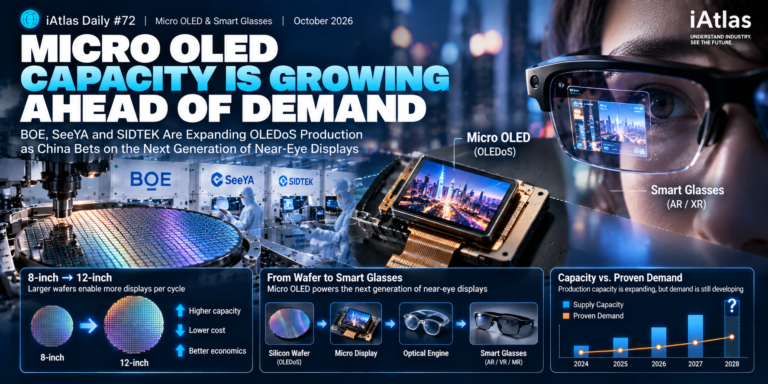
6. Micro-OLED: A Different Approach for XR Devices
Another important area of display development is Micro-OLED.
Micro-OLED is particularly relevant to virtual reality, augmented reality, electronic viewfinders, and other compact optical systems.
Unlike conventional OLED panels manufactured on glass or flexible substrates, many Micro-OLED displays are built on silicon backplanes.
This approach is often called OLED-on-Silicon, or OLEDoS.
Why Silicon Matters
A silicon backplane enables very small pixel structures and dense electronic integration.
This allows manufacturers to achieve extremely high pixel densities within a compact display.
Sony Semiconductor Solutions describes OLED microdisplays with pixel densities of approximately 4,000 pixels per inch in its product portfolio.
Such densities are useful when a small screen is viewed through optical lenses.
The Manufacturing Challenge
Micro-OLED production involves a different set of constraints from large-area OLED manufacturing.
Important requirements include:
- Extremely fine pixel patterning
- Precise organic material deposition
- High-quality silicon backplanes
- Brightness and optical efficiency
- Effective heat management
- Reliable encapsulation and contamination control
Micro-OLED also faces challenges involving cost and production capacity.
Its commercial potential depends partly on whether XR devices can achieve broader consumer and enterprise adoption.
Micro-OLED Is Not MicroLED
The names are similar, but the technologies are different.
Micro-OLED uses organic light-emitting materials.
MicroLED generally uses microscopic inorganic LED emitters.
They involve different materials, fabrication approaches, and manufacturing challenges.
7. China Is Reshaping the Competitive Environment
The OLED industry’s expansion is also influencing competition among display manufacturers.
South Korean companies have established strong capabilities in premium OLED technology.
At the same time, Chinese manufacturers such as BOE, TCL CSOT, and Visionox are developing OLED technologies and expanding their production capabilities.
Their strategies include smartphone panels, larger IT displays, and new display architectures.
Why Competition Is Intensifying
Display manufacturers compete across several dimensions.
Manufacturing Cost: Producing panels efficiently is critical in markets where pricing pressure is strong.
Yield: Defect control becomes increasingly important as panel dimensions and manufacturing complexity increase.
Technology Differentiation: Brightness, power efficiency, durability, resolution, and form factor influence customer selection.
Customer Relationships: Display suppliers must meet demanding qualification, reliability, and delivery requirements.
Capital Investment: Advanced production lines require substantial financial resources and long-term planning.
Chinese manufacturers’ expansion may increase competitive pressure, but production announcements alone do not establish equivalent yields, product quality, or profitability.
Actual competitiveness must be evaluated through commercial production results.
8. Manufacturing Technology Is Becoming a Competitive Advantage
OLED technology depends on highly controlled manufacturing processes.
Organic materials must be deposited accurately, thin-film structures must remain consistent, and completed panels must be protected from environmental degradation.
As the industry expands into IT, automotive, and microdisplay applications, these requirements become more demanding.
Organic Material Deposition
OLED panels require precisely controlled organic functional layers.
Depending on the architecture, manufacturers may use vacuum thermal evaporation or other deposition methods.
Larger substrates and high-resolution structures create challenges involving deposition uniformity, pattern accuracy, and material utilization.
Encapsulation
OLED materials can be sensitive to oxygen and moisture.
Encapsulation protects the device from environmental exposure that could degrade its performance.
The appropriate encapsulation technology depends on the panel design and intended application.
Contamination Control
Particles and unwanted contamination can create defects.
Controlled manufacturing environments are therefore important for achieving high product yields.
Inspection and Metrology
Manufacturers must monitor film thickness, pattern alignment, defects, and electrical performance.
As display architectures become more sophisticated, inspection and process-control capabilities become increasingly valuable.
Equipment Integration
New OLED applications may require changes to deposition equipment, substrate handling, encapsulation systems, and testing processes.
This creates opportunities for equipment and materials suppliers capable of supporting specialized manufacturing requirements.
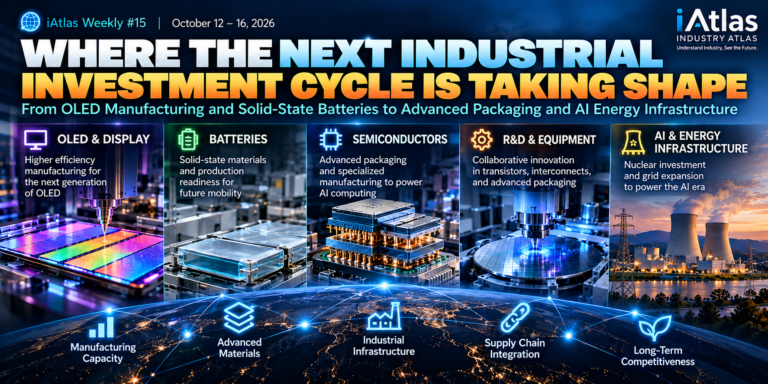
9. Industry Implications: Where the Opportunities Are Emerging
The expansion of OLED beyond smartphones has implications throughout the industrial supply chain.
| Industry Segment | Emerging Opportunity | Key Challenge |
|---|---|---|
| IT OLED | Laptops, tablets, premium monitors | Larger substrates, yield, cost |
| Automotive OLED | Digital cockpits, flexible displays | Reliability, lifetime, temperature |
| Micro-OLED | XR devices, viewfinders, optical systems | Pixel density, brightness, scale |
| OLED Materials | Advanced emitters and functional layers | Efficiency, stability, consistency |
| Manufacturing Equipment | Deposition, encapsulation, inspection | Precision, throughput, integration |
For panel manufacturers, diversification can reduce dependence on individual product categories.
For materials suppliers, new applications can create demand for improved emissive materials and functional layers.
For equipment manufacturers, more demanding panel structures can increase the importance of manufacturing precision and process stability.
For device makers, OLED technology provides additional design flexibility.
However, the pace of adoption will ultimately depend on whether OLED delivers sufficient value relative to competing display technologies.
iAtlas Insight | The Next OLED Competition Will Be About Manufacturing Specialization
The expansion of OLED beyond smartphones is often described as a market-growth story.
But it is also a manufacturing transformation.
A smartphone OLED panel, an automotive dashboard display, and a Micro-OLED panel for XR devices have fundamentally different requirements.
A successful manufacturing process for one application cannot necessarily be transferred directly to another.
This creates three important competitive factors.
1. Application-Specific Technology
Manufacturers must optimize brightness, resolution, durability, and form factor for each target market.
2. Production Economics
Large investments in advanced manufacturing lines must translate into competitive yields, throughput, and costs.
3. Supply Chain Integration
Display performance depends on the coordinated development of materials, equipment, panel manufacturing, and device integration.
The companies that succeed may not simply be those producing the greatest number of OLED panels.
They may be those capable of manufacturing the right type of OLED panel for each application at the right cost.
The next phase of display competition is not only about making better screens. It is about making specialized screens economically and reliably.
Related Articles
Semiconductor Manufacturing
How Thin Film Deposition Builds Semiconductor Devices Layer by Layer
Learn how thin-film deposition enables the precise material structures used in advanced electronic devices, including semiconductor and display technologies.
Industrial Supply Chains
Industrial Competition Is Moving Deeper into the Supply Chain
Explore why equipment, materials, and manufacturing capabilities are becoming increasingly important in global technology competition.
Manufacturing Strategy
The Next Industrial Advantage Is Flexibility
Understand how manufacturing flexibility can help industrial companies adapt to new technologies, product requirements, and changing demand.
References
1. Samsung Display — 8.6-Generation IT OLED Production Line
Official announcement of Samsung Display’s A6 manufacturing investment, larger OLED substrate strategy, and expansion into the IT display market.
2. Samsung Electronics — Second Quarter 2026 Results
Corporate update discussing Samsung Display’s 8.6-generation IT OLED manufacturing plans and its strategy for tablet, gaming, and automotive display applications.
3. LG Display — Automotive OLED
Official technical overview of Tandem OLED, flexible automotive displays, and advanced in-vehicle display applications.
4. LG Display — Tandem OLED Technology
Explanation of stacked emissive structures, brightness, lifetime, and application-specific OLED performance.
5. LG Display — SID Display Week 2026
Company announcement covering OLED developments for IT, automotive, and other emerging display applications.
6. Sony Semiconductor Solutions — OLED Microdisplay
Technical information on OLED microdisplays, silicon backplanes, pixel density, and XR-related applications.
7. LG Display — K-Display 2026
Company announcement covering OLED applications across monitors, IT devices, automotive displays, and emerging product categories.
ℹ️ About iAtlas
iAtlas is an independent publication covering batteries, semiconductors, OLED, advanced materials, AI, and global industrial trends.
We transform complex industrial developments into clear, reliable, and easy-to-understand insights.
Whether you’re following today’s industry news or building long-term expertise, iAtlas helps you understand not only what happened, but why it matters.
Technology creates change.
Insight creates opportunity.
— iAtlas