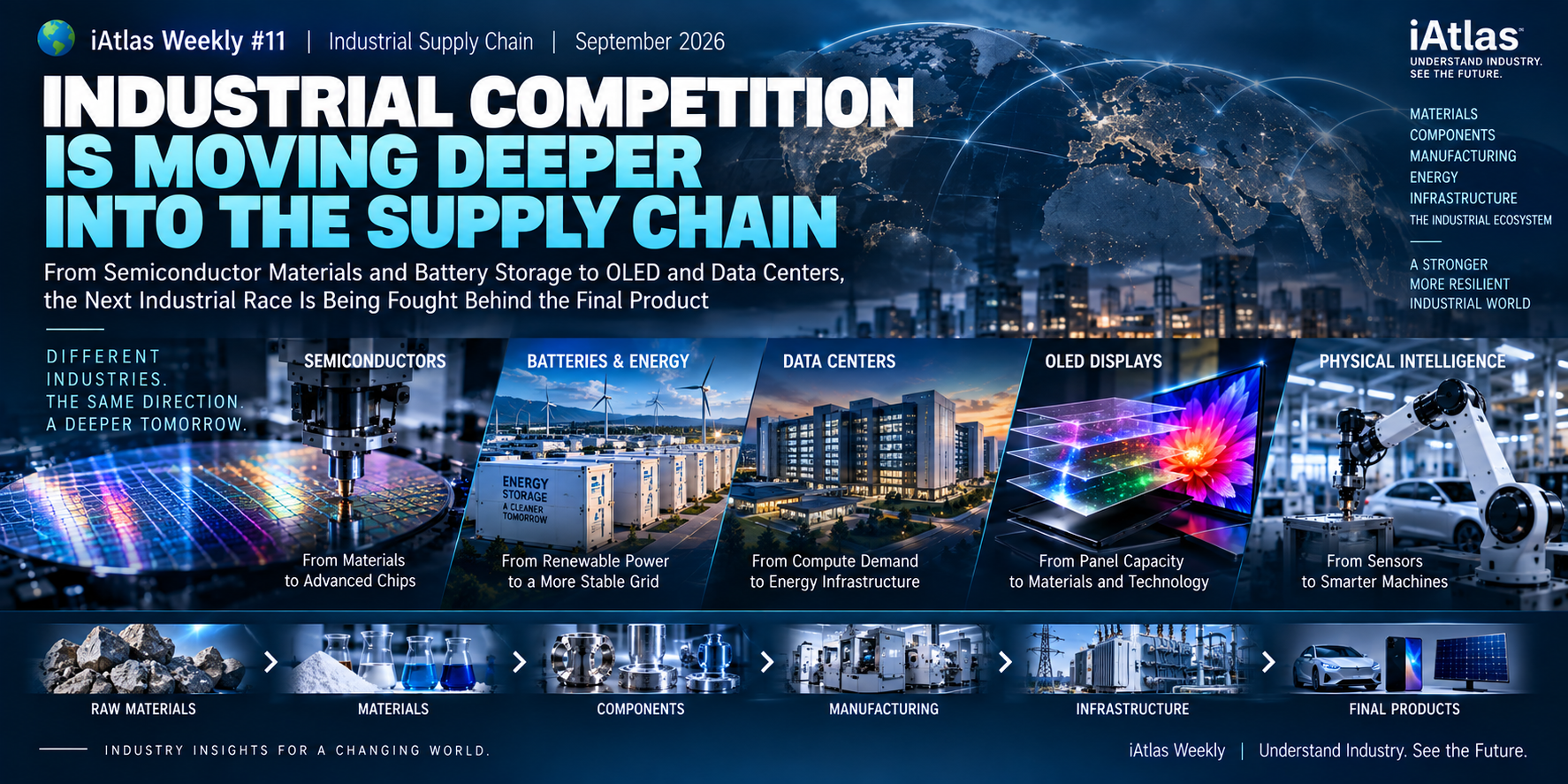
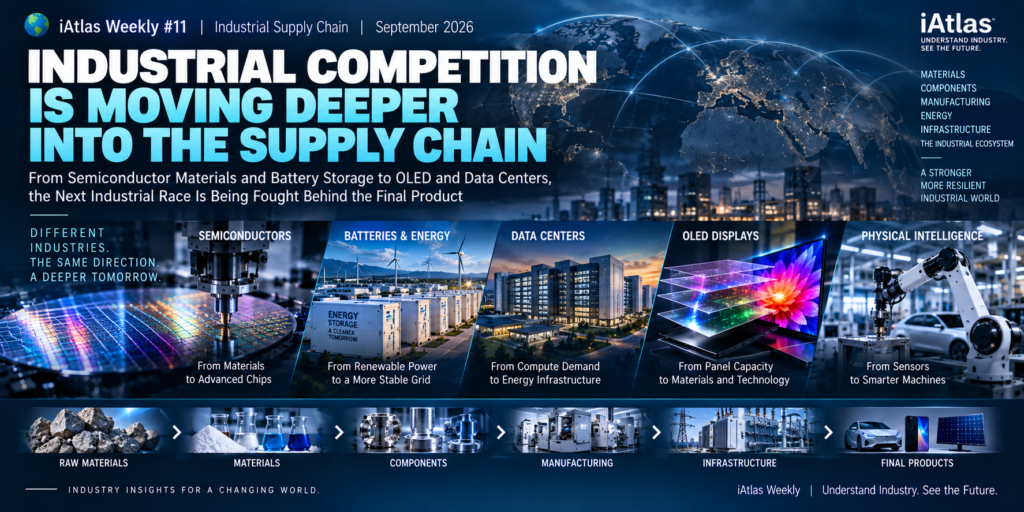
Industrial Competition Is Moving Deeper into the Supply Chain
From Semiconductor Materials and Battery Storage to OLED and Data Centers, the Next Industrial Race Is Being Fought Behind the Final Product
🌍 iAtlas Weekly #11 | Weekly Briefing | September 2026
For years, industrial competition was easiest to see at the final product.
- Who makes the most chips?
- Who sells the most batteries?
- Who produces the most OLED panels?
- Who builds the largest data centers?
Those questions still matter.
But this week’s developments point to a deeper transformation.
The competition is increasingly moving behind the final product.
Into:
- Materials
- Components
- Manufacturing Equipment
- Energy
- Infrastructure
- Sensors
- Processing Technology
and ultimately:
Industrial Ecosystems
A semiconductor fab cannot operate without specialized materials and equipment.
A renewable-energy system becomes increasingly dependent on storage.
An OLED factory needs a sophisticated materials and equipment network.
A data center requires enormous electrical and thermal infrastructure.
An intelligent machine needs sensors, signal processing, power and local computing.
Different industries are beginning to reveal the same pattern:
Final Product
↓
Manufacturing
↓
Equipment & Components
↓
Materials & Energy
↓
Industrial Ecosystem
The next industrial race is not simply about who makes the final product. It is about who controls the system required to make it.
🌍 The Big Picture
This week’s stories appeared to come from very different industries.
Semiconductors.
Battery storage.
Data centers.
OLED displays.
Edge computing.
But underneath them sits the same structural change.
Industrial value chains are becoming deeper.
Companies and countries increasingly recognize that controlling final assembly alone does not guarantee industrial strength.
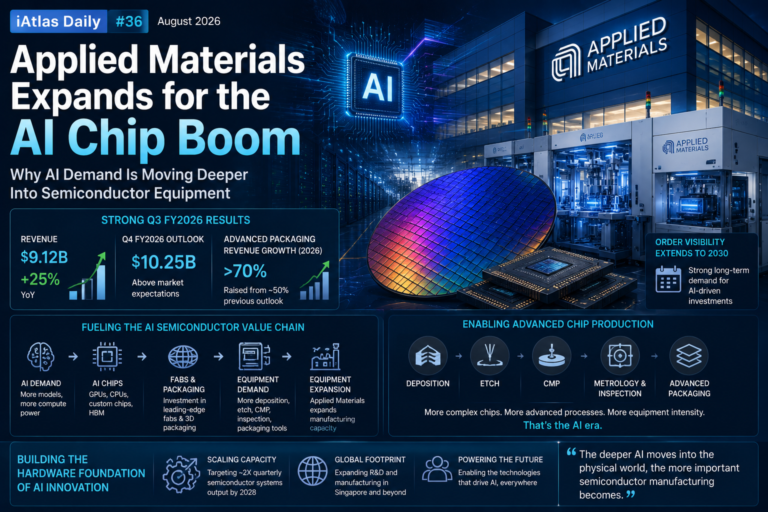
Consider semiconductors.
A chip requires:
Silicon Wafer
↓
Materials
↓
Manufacturing Equipment
↓
Precision Components
↓
Fab
↓
Packaging
↓
Chip
Or batteries:
Critical Minerals
↓
Battery Materials
↓
Cells
↓
Packs
↓
Energy Storage Systems
↓
Grid
The same logic extends across advanced manufacturing.
And as geopolitical competition increases, each layer becomes more strategic.
⛏️ 1. Semiconductor Competition Is Moving into Materials
Semiconductor industrial policy initially focused heavily on fabs.
Countries wanted:
Domestic Chip Manufacturing
But fabs themselves depend on a much larger ecosystem.
A semiconductor production line requires:
- lithography equipment
- deposition equipment
- etch systems
- process gases
- specialty chemicals
- silicon wafers
- quartz components
- precision ceramics
- vacuum systems
This creates another layer of dependency.
The supply chain can be visualized as:
Chip
↓
Fab
↓
Equipment
↓
Component
↓
Material
Daily #54 examined this through high-purity quartz.
Quartz components may appear far removed from the final semiconductor.
But high-purity materials can become strategically important because they sit inside critical manufacturing equipment.
This is an important lesson:
Localization does not stop when the factory is built.
It moves upstream.
Recent developments across other critical semiconductor materials reinforce this problem. China still has dominant positions in several niche minerals used across semiconductors, energy and defense, while efforts to develop alternative production capacity remain slow and expensive.
The semiconductor race is therefore increasingly becoming:
Fab Localization
↓
Equipment Localization
↓
Component Localization
↓
Material Localization
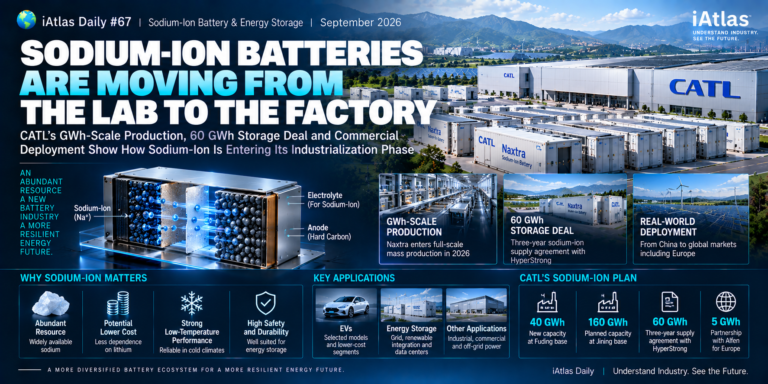
🔋 2. India’s Solar Industry Is Creating a Battery Industry
A similar transition is occurring in energy.
India spent years rapidly expanding solar capacity and developing domestic solar manufacturing.
But renewable generation creates another industrial requirement:
Energy Storage
Solar produces electricity when sunlight is available.
The grid needs electricity when demand exists.
Storage connects the two.
This creates a new industrial chain:
Solar Manufacturing
↓
Renewable Deployment
↓
Variable Electricity
↓
Storage Demand
↓
BESS Manufacturing
↓
Battery Supply Chain
Premier Energies and RCT Energy India recently agreed on a proposed 12 GWh BESS manufacturing facility in Telangana, with the first 6 GWh phase expected to begin operations in FY2027–28.
The importance of the project goes beyond 12 GWh.
Premier Energies comes from solar manufacturing.
Its move into storage shows how one industrial ecosystem can create another.
☀️ 3. Manufacturing Ecosystems Expand Sideways — Then Upstream
Industrial development does not always move in a straight line.
Sometimes one established industry creates an adjacent industry.
India provides a useful example.
First:
Solar
Then:
Renewable Power
Then:
Energy Storage
Then potentially:
Battery Components
Cells
Materials
Recycling
This is an important pattern.
Industrial ecosystems can expand in two directions.
Horizontally
Into adjacent markets.
Solar → Storage
Vertically
Deeper into the supply chain.
BESS → Cells → Materials
Once both happen simultaneously, a much broader industrial cluster can emerge.
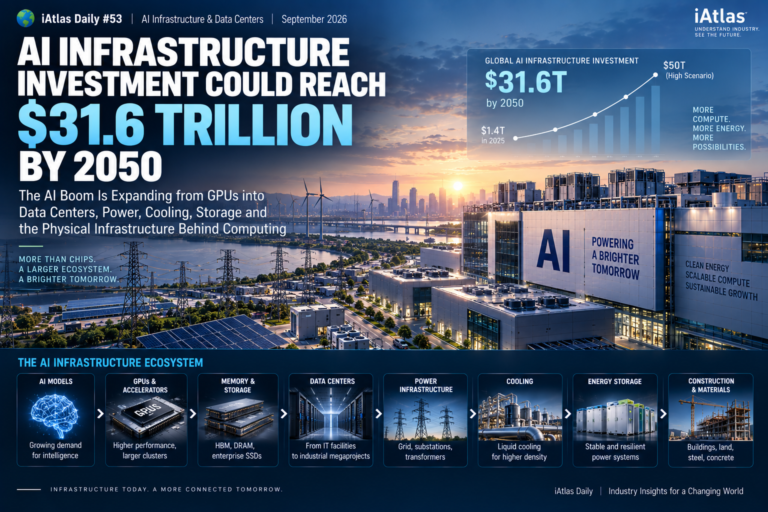
⚡ 4. Data Centers Are Becoming Energy Infrastructure
Microsoft’s reported data-center expansion provides another version of the same story.
Microsoft is reportedly targeting more than 38 GW of global data-center capacity by 2032, up from approximately 12 GW today.
At first glance, this is a cloud-computing story.
But at 38 GW, it becomes something else.
A data center needs:
Servers
↓
Memory & Storage
↓
Networking
↓
Power Distribution
↓
Transformers
↓
Cooling
↓
Grid Connection
↓
Electricity Generation
The deeper we move through the chain, the less the industry resembles software.
And the more it resembles:
Heavy Infrastructure
🔌 5. The Technology Supply Chain Now Includes Transformers
This is one of the biggest changes in the current technology cycle.
A decade ago, few investors would have described transformers, switchgear or cooling equipment as central parts of the digital technology supply chain.
Today they increasingly are.
Large computing infrastructure requires:
- substations
- transformers
- switchgear
- UPS systems
- backup power
- cooling systems
- pumps
- heat exchangers
- transmission infrastructure
That means digital growth increasingly creates demand in traditional industrial markets.
The technology stack now extends much further than the semiconductor.
Software
↓
Compute
↓
Server
↓
Data Center
↓
Electrical Equipment
↓
Grid
↓
Energy
The boundary between technology and infrastructure is disappearing.
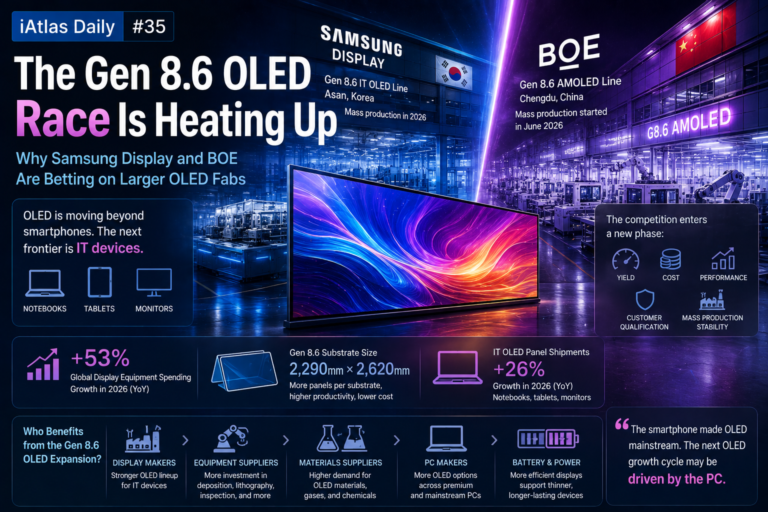
🖥️ 6. OLED Competition Is Moving Beyond Panel Capacity
Displays show the same upstream movement.
The visible competition is between companies such as:
Samsung Display
LG Display
BOE
Visionox
TCL CSOT
But an OLED panel is the output of a much deeper manufacturing chain.
High-Purity Chemicals
↓
OLED Materials
↓
Deposition
↓
Masks & Components
↓
Process Equipment
↓
Panel
China’s first major OLED challenge was building competitive panel-manufacturing capacity.
As that capacity expands, the next question becomes:
Who supplies the factory?
This is where competition increasingly moves into:
Materials
Equipment
Components
Process Technology
and Intellectual Property.
🧪 7. Advanced Materials Create Hidden Industrial Moats
Materials are particularly interesting because they are often invisible in the final product.
Consumers do not buy:
OLED Host Material
or
High-Purity Quartz
They buy:
Smartphones
Displays
Computers
But upstream materials can determine:
- performance
- yield
- reliability
- efficiency
- lifetime
- manufacturing cost
And replacing them is often difficult.
A new supplier may need to complete:
Development
↓
Purification
↓
Testing
↓
Process Integration
↓
Qualification
↓
Mass Production
That process can take considerable time.
So seemingly small material suppliers can occupy strategically important positions in enormous industries.
🏭 8. Building a Factory Is Easier Than Building an Ecosystem
This may be the most important lesson from this week’s stories.
A factory can be financed.
A building can be constructed.
Equipment can be installed.
But an industrial ecosystem requires much more:
Suppliers
Engineers
Materials
Process Knowledge
Infrastructure
Logistics
Customers
Service Networks
Intellectual Property
Workforce
These capabilities accumulate over years or decades.
That helps explain why moving production away from established manufacturing clusters can be more difficult than expected. Recent reporting on companies that shifted production out of China found some were reconsidering those moves because replicating China’s supplier networks, skilled labor and infrastructure proved difficult.
Industrial competitiveness is therefore not just factory capacity.
It is ecosystem density.
🇨🇳 9. This Is Why China’s Manufacturing Position Is Difficult to Replicate
China’s industrial advantage is frequently discussed through low costs or manufacturing scale.
Those matter.
But the ecosystem itself may be even more important.
A mature manufacturing cluster can provide:
Supplier A
next to
Supplier B
next to
Component Manufacturer
next to
Assembly Plant
supported by:
Logistics
Power
Engineering Talent
Tooling
Maintenance
Customers
Once that ecosystem exists, each company reinforces the others.
This creates a powerful industrial network effect.
Recent attempts to diversify production away from China demonstrate that recreating these interconnected capabilities elsewhere can be difficult even when labor costs appear attractive.
🌎 10. Localization Is Becoming a Global Industrial Strategy
This explains why so many countries now use similar language:
Reshoring
Friend-shoring
Localization
Domestic Manufacturing
Supply-Chain Resilience
The objective is no longer simply:
Attract a factory.
It is increasingly:
Build the ecosystem around the factory.
That means governments are targeting:
Materials
↓
Components
↓
Equipment
↓
Manufacturing
↓
Infrastructure
The United States, for example, continues investing in alternative critical-mineral supply chains, yet China still controls large portions of refining capacity for several strategically important minerals.
The gap between having a factory and controlling a supply chain remains enormous.
🤖 11. Physical Intelligence Adds Another Layer
The Analog Devices–Alif Semiconductor deal provides a slightly different example.
ADI agreed to acquire Alif for $1.35 billion in cash, with up to $200 million of additional contingent consideration. Alif adds AI-native microcontrollers and fusion processors to ADI’s existing sensing, signal-processing, power and connectivity portfolio.
The important industrial chain here is:
Physical World
↓
Sensor
↓
Signal Processing
↓
Local Computing
↓
Connectivity
↓
Control
↓
Machine
AI processing is only one piece.
To make a machine intelligent, an entire physical semiconductor system is required.
📡 12. Sensors Could Become the Gateway to the Physical Economy
A data center processes digital information.
A machine must first understand the physical world.
That requires sensors.
Temperature.
Pressure.
Motion.
Sound.
Vibration.
Position.
Electrical signals.
These inputs then pass through:
Sensing
↓
Analog Processing
↓
Data Conversion
↓
AI Processing
↓
Decision
↓
Actuation
ADI describes the resulting capability as Physical Intelligence — systems capable of sensing, reasoning and acting locally in real time.
This broadens the semiconductor opportunity beyond GPUs and memory.
🔄 13. Different Industries, Same Pattern
Put this week’s five stories together.
Semiconductor
Chip → Equipment → Quartz → Material
Battery / Energy
Solar → ESS → Battery → Materials
Data Center
Compute → Facility → Electrical Equipment → Grid
OLED
Panel → Equipment → Materials → Chemicals
Physical Intelligence
Machine → Processor → Sensor → Physical Signal
At first, these look unrelated.
But they all move in the same direction:
Deeper into the industrial stack.
That is the structural theme of the week.
🧱 14. The Real Strategic Asset Is the Stack
Industrial leadership increasingly comes from controlling multiple layers simultaneously.
A company controlling only final assembly may remain vulnerable to upstream suppliers.
A country controlling raw materials but lacking manufacturing may capture only part of the value.
The strongest industrial positions emerge when multiple layers reinforce one another.
For example:
Materials
Equipment
Manufacturing
Engineering
Infrastructure
Customers
=
Industrial Ecosystem
The stack becomes the strategic asset.
💰 15. Capital Expenditure Spreads Through the Entire Chain
This also changes how we should think about industrial investment.
A $10 billion factory does not create only $10 billion of economic activity.
It can trigger investment in:
Supplier Factories
Utilities
Logistics
Equipment
Materials
Engineering
Maintenance
Training
Similarly, Microsoft’s data-center expansion does not benefit only semiconductor suppliers.
It can create demand for:
Construction
Transformers
Cooling
Power Generation
Grid Infrastructure
Industrial capex propagates through the ecosystem.
🔬 16. Small Components Can Become Big Bottlenecks
The deeper supply chains become, the more vulnerable they can be to overlooked components.
A billion-dollar production line can potentially depend on a relatively small number of specialized suppliers.
Examples include:
High-Purity Quartz
Specialty Chemicals
Precision Bearings
Rare Metals
Masks
Vacuum Components
Transformers
The economic value of the component itself may be small compared with the final product.
But its strategic value can be enormous.
This creates an important distinction:
Economic Size ≠ Strategic Importance
A small market can still become a major bottleneck.
🛡️ 17. Supply-Chain Resilience Is Becoming a Cost
For decades, industrial optimization focused heavily on:
Efficiency
Lowest cost.
Highest utilization.
Global specialization.
Minimal inventory.
The new environment adds another variable:
Resilience
Multiple suppliers.
Local production.
Inventory buffers.
Alternative materials.
Redundant capacity.
That can increase costs.
But governments and companies increasingly view some redundancy as strategic insurance.
The industrial objective is changing from:
Maximum Efficiency
toward:
Efficiency + Resilience
♻️ 18. Recycling Becomes Part of the Ecosystem
The supply chain does not end when a product is manufactured.
Batteries provide the clearest example.
Material
↓
Cell
↓
Battery
↓
ESS / EV
↓
End of Life
↓
Recycling
↓
Recovered Material
↓
New Battery
The same circular logic is increasingly relevant to electronics and critical materials.
As localization strategies mature, recycling can become another way to reduce dependence on imported raw materials.
The industrial stack therefore eventually becomes a loop.
🌐 19. Industrial Policy Is Becoming Ecosystem Policy
This has major implications for governments.
Subsidizing a single factory may not be enough.
Long-term competitiveness may require coordinated investment across:
Energy
Transport
Education
R&D
Materials
Suppliers
Manufacturing
Infrastructure
The policy objective therefore changes.
From:
Build more factories.
To:
Create an environment where entire industries can operate.
That is a much harder challenge.
But it is also where sustainable industrial advantage is created.
🧭 20. The Next Industrial Map Will Be Drawn by Ecosystems
The global industrial map is being redrawn.
Not because every supply chain will become fully domestic.
That is unrealistic.
Instead, countries and companies are deciding which layers they cannot afford to depend on entirely.
The result will likely be a more complex system:
Global Supply Chains
Regional Manufacturing
Strategic Localization
Supplier Diversification
Different industries will choose different combinations.
But the direction is clear.
The question is moving from:
Where is the product made?
toward:
Where does the ecosystem behind the product exist?
🧩 Why This Matters
This week’s developments reveal five major structural changes.
1. Competition is moving upstream.
Materials, components and equipment are becoming more strategic.
2. Industrial ecosystems matter more than individual factories.
Factories depend on dense networks of suppliers and infrastructure.
3. Technology and traditional industry are converging.
Data centers increasingly depend on energy and electrical infrastructure.
4. Localization is becoming deeper.
Countries increasingly want not only final manufacturing but also upstream capabilities.
5. Hidden suppliers can become strategic bottlenecks.
Small components and specialized materials can determine whether enormous factories can operate.
🔭 What to Watch Next
Critical Materials
Watch high-purity quartz, rare metals, battery materials and specialty chemicals.
BESS Localization
India’s 12 GWh project will show how far storage manufacturing can move upstream into cells and materials.
Data Center Power
Microsoft’s reported 38 GW target makes grid capacity, transformers and cooling increasingly important industrial indicators.
China’s OLED Supply Chain
Watch whether domestic material and equipment suppliers gain qualification at major Chinese OLED fabs.
Physical Intelligence
Watch whether edge AI accelerates demand for sensors, analog chips, MCUs and power-management devices.
Semiconductor Localization
The latest developments already show the trend continuing: SK hynix is reportedly exploring U.S. memory manufacturing options, while China’s CXMT is looking to expand from DRAM into NAND. Neither plan is final, but both point toward increasingly strategic memory supply chains.
🧭 iAtlas Insight
The visible product gets the attention.
The invisible ecosystem creates the advantage.
A semiconductor chip is valuable.
But behind it sit materials, equipment, chemicals and engineering.
A battery is valuable.
But behind it sit minerals, cathodes, anodes, manufacturing equipment and energy infrastructure.
An OLED panel is valuable.
But behind it sit specialized organic materials, deposition systems and process knowledge.
A data center is valuable.
But behind it sit transformers, cooling systems and power grids.
An intelligent robot is valuable.
But behind it sit sensors, analog semiconductors, processors and actuators.
The deeper we look, the more industrial competition changes.
It becomes less about a single product.
And more about:
Who controls the stack?
That may be one of the defining industrial questions of the next decade.
The strongest industrial economies will not necessarily be those that assemble the most final products. They will be those that build the deepest, hardest-to-replace ecosystems behind them.
📚 This Week on iAtlas
⛏️ Daily #54 — Semiconductor Materials
The Semiconductor Supply Chain Is Moving Upstream to High-Purity Quartz
A look at why seemingly obscure materials can become strategic semiconductor bottlenecks.
🔋 Daily #55 — Battery & Energy Storage
India’s Solar Industry Is Moving into Battery Storage
Premier Energies and RCT’s planned 12 GWh BESS project shows how renewable deployment can create new manufacturing ecosystems.
🌐 Daily #56 — Digital Infrastructure
Microsoft Targets 38 GW of Data Center Capacity by 2032
Computing growth is increasingly becoming a physical infrastructure challenge involving electricity, cooling and grid capacity.
🖥️ Daily #57 — OLED
OLED Competition Is Moving from Panels to Materials
China’s expanding OLED capacity is shifting competition deeper into materials, equipment and process technology.
🤖 Daily #58 — Semiconductors & Physical Intelligence
Analog Devices Bets $1.35 Billion on Physical Intelligence
ADI’s Alif acquisition illustrates how intelligence is moving into sensors, machines and real-world systems.
🔗 References
Analog Devices — Alif Semiconductor Acquisition
Reuters — Microsoft Plans 38 GW of Data Center Capacity
BESS News — Premier Energies & RCT 12 GWh BESS Project
ℹ️ About iAtlas
iAtlas is an independent publication covering batteries, semiconductors, OLED, advanced materials, AI, and global industrial trends.
We transform complex industrial developments into clear, reliable, and easy-to-understand insights.
Whether you’re following today’s industry news or building long-term expertise, iAtlas helps you understand not only what happened, but why it matters.
Technology creates change.
Insight creates opportunity.
— iAtlas