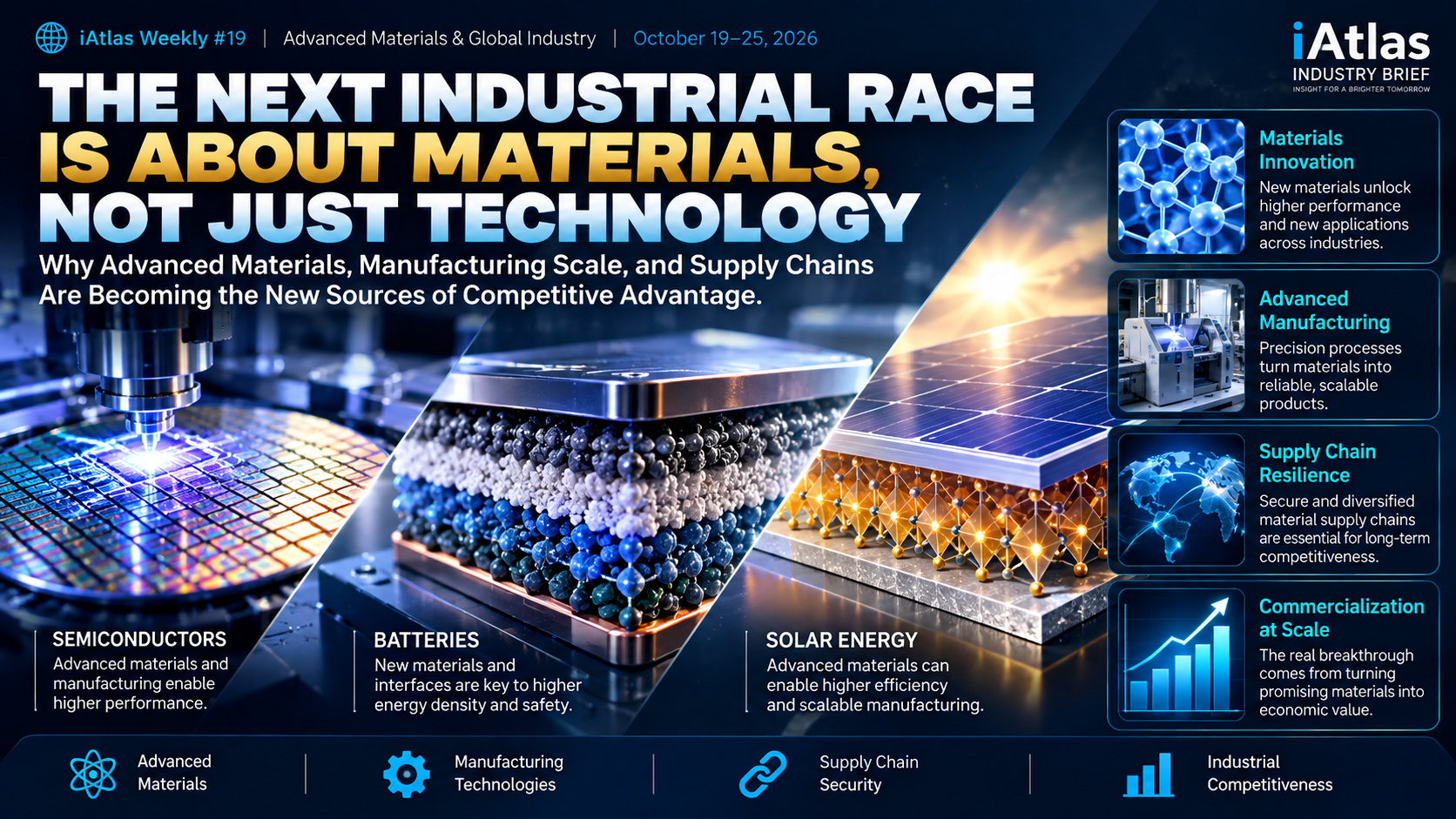
The Next Industrial Race Is About Materials, Not Just Technology
Why Advanced Materials, Manufacturing Scale, and Supply Chains Are Becoming the New Sources of Competitive Advantage
iAtlas Weekly #19 | Advanced Materials & Global Industry | October 25, 2026
The Next Industrial Breakthrough May Be Hiding Inside the Materials
For decades, technology competition has been defined by visible achievements.
Faster computers. More powerful batteries. More efficient solar panels. Smaller semiconductor chips.
But behind these improvements lies a less visible industrial transformation.
Advanced materials are becoming one of the most important foundations of technological competitiveness.
The performance of a semiconductor depends on the materials used to build its microscopic structures. The future of batteries depends partly on electrolytes, electrodes, and the interfaces between them. The commercial potential of next-generation solar panels depends on materials that can convert more sunlight into electricity without sacrificing durability.
And developing a promising material is only the beginning.
Companies must also learn how to manufacture it consistently, secure reliable supplies, and integrate it into existing production systems.
Several developments during the week of October 19–25, 2026, illustrate this shift.
From semiconductor investment to advanced solar manufacturing, the emerging pattern is increasingly clear.
The next industrial advantage may belong to companies that can turn difficult materials into reliable, scalable products.
1. Semiconductors: The Competition Is Moving Deeper into Materials and Manufacturing
The semiconductor industry is often described as a competition over smaller transistors and more powerful processors.
Yet each generation of semiconductor technology requires increasingly sophisticated materials and manufacturing processes.
As device structures become more complex, manufacturers must control thin films, interfaces, contamination, and microscopic defects with extraordinary precision.
This makes materials science central to semiconductor performance.
A New U.S. Investment in Power Semiconductors and Critical Materials
On October 22, the U.S. Commerce Department announced plans for approximately $389 million in research and development awards involving power semiconductor technologies and critical materials.
The funding targets technologies relevant to advanced energy systems, including fusion-related applications.
The proposed support highlights a broader industrial priority: developing strategic manufacturing capabilities rather than relying exclusively on imported technologies or materials.
Power semiconductors are especially important because they control how electricity is converted, distributed, and used.
Technologies based on gallium nitride (GaN) and silicon carbide (SiC) can offer advantages in selected high-voltage, high-frequency, or high-efficiency applications.
But commercial performance depends on much more than the underlying semiconductor material.
Crystal quality, epitaxial growth, wafer processing, packaging, thermal management, and manufacturing yield all influence the final device.
Advanced Memory Requires Advanced Processes
During the same week, reports indicated that Samsung Electronics and SK Hynix were preparing upgrades to their NAND manufacturing operations in China.
The reported plans involve moving toward more advanced, higher-layer-count memory products.
For NAND manufacturers, adding more layers creates increasingly difficult manufacturing challenges.
Deep structures must be formed with high precision. Thin films must remain uniform. Etching, deposition, inspection, and defect control become increasingly important.
These developments illustrate why semiconductor competitiveness cannot be measured solely by the specifications of finished chips.
It also depends on the materials, equipment, and manufacturing expertise required to produce them.
2. Batteries: Better Materials Must Become Better Manufacturing Processes
Battery technology provides another example of how materials are reshaping industrial competition.
Lithium-ion batteries have improved substantially through changes in cathode chemistry, anode materials, electrolyte formulations, and cell design.
Yet manufacturers continue to face difficult trade-offs involving energy density, safety, charging speed, durability, and cost.
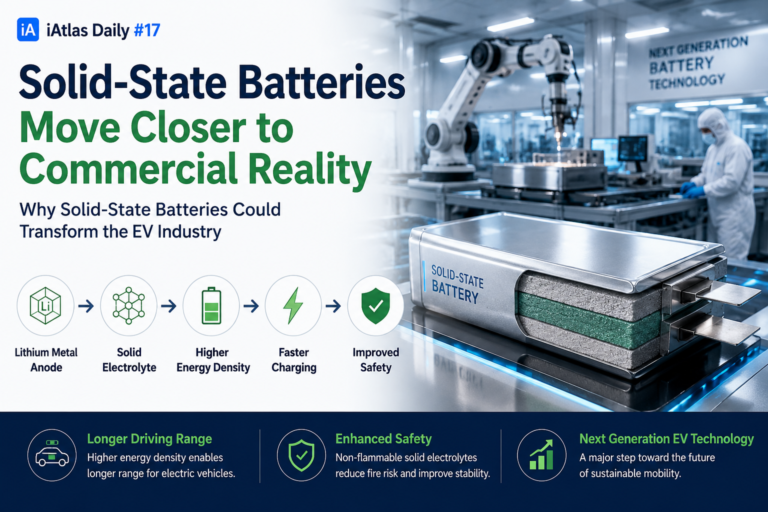
Solid-state batteries represent one possible direction for future development.
Instead of relying on conventional liquid electrolytes, these designs use solid ion-conducting materials.
Some architectures could enable lithium-metal anodes or other high-energy-density designs.
However, laboratory performance does not automatically translate into commercial success.
The Challenge of Material Interfaces
In a solid-state battery, the contact between electrodes and electrolytes becomes particularly important.
Microscopic gaps, chemical reactions, or mechanical stress can increase resistance and reduce performance.
Some sulfide-based solid electrolytes also react with moisture, creating additional handling and processing requirements.
Manufacturers must therefore manage both the materials themselves and the environment in which they are processed.
This creates opportunities for advanced powder processing, protective coatings, precision assembly, dry-room technologies, and controlled-atmosphere manufacturing.
Manufacturing Compatibility May Determine Adoption
One of the most important commercial questions is whether new battery materials can be integrated into practical production lines.
A material that delivers exceptional performance but requires expensive, low-throughput processing may struggle to compete.
Conversely, a slightly less advanced material could prove commercially attractive if it offers stable performance, high manufacturing yield, and lower production costs.
This distinction is becoming increasingly important as companies attempt to move solid-state battery technologies from laboratories toward industrial production.
The next generation of batteries will be shaped by the combination of materials performance and manufacturing economics.
3. Solar Energy: Efficiency Records Are No Longer Enough
Solar technology is experiencing a similar transition.
Conventional silicon solar cells have benefited from decades of manufacturing improvements and cost reductions.
But silicon has physical limits on how efficiently a single-junction cell can convert sunlight into electricity.
Perovskite-silicon tandem solar cells offer a potential pathway beyond those limits.
By combining materials that absorb different portions of the solar spectrum, tandem devices can convert sunlight more efficiently.
Laboratory results have already demonstrated the potential of this approach.
The remaining challenge is commercialization.
Moving from Laboratory Cells to Industrial Production
In October 2026, the European PEPPERONI project highlighted progress toward industrial manufacturing of perovskite-silicon tandem modules.
The project brought together partners working to advance tandem photovoltaics from research toward scalable production.
Its activities underscore the importance of manufacturing methods, equipment integration, and long-term reliability.
A separate study published in Nature Sustainability in August 2026 reported perovskite solar cells fabricated using scalable blade-coating methods under ambient-air conditions.
The researchers reported a certified efficiency of 26.5% for a single-junction device and 33.0% for a perovskite-silicon tandem cell.
The study also presented encouraging laboratory stability results.
These findings are significant because industrial solar manufacturing requires more than high conversion efficiency.
It requires uniform coatings, repeatable production, acceptable yields, long-term outdoor durability, and competitive costs.
A highly efficient laboratory cell does not necessarily become a commercially successful solar module.
The same principle applies across advanced technology industries.
Manufacturing performance determines whether scientific progress can create economic value.
4. Critical Materials Are Becoming a Strategic Supply Chain Issue
Advanced materials are not only a scientific challenge.
They are also becoming a geopolitical and economic issue.
On October 23, the United States designated helium as a critical material, reflecting concerns about its importance to semiconductor manufacturing and other strategic technologies.
Helium is used in applications including leak detection, cooling, and specialized scientific equipment.
Its availability can therefore affect industries far beyond conventional energy markets.
The designation highlights an important distinction.
A material does not need to be expensive or widely recognized to become strategically important.
Its importance may arise because it performs a function that is difficult to replace.
Why Supply Security Matters
Modern industrial supply chains often depend on highly specialized materials produced or refined by a limited number of suppliers.
Even when a material represents a relatively small share of a finished product’s cost, a shortage can interrupt an entire manufacturing process.
This creates several priorities for industrial companies:
- Diversifying sources of critical materials.
- Improving recycling and recovery technologies.
- Developing alternative materials where technically feasible.
- Expanding domestic or regional processing capabilities.
- Strengthening relationships with qualified suppliers.
These priorities are becoming relevant across semiconductors, batteries, renewable energy, and advanced manufacturing.
The strategic value of a material increasingly depends on both its technical properties and the reliability of its supply chain.
5. Why Manufacturing Equipment Is Becoming More Important
The rise of advanced materials creates opportunities throughout the industrial equipment market.
New materials frequently require new manufacturing conditions.
Some must be processed under controlled humidity or oxygen concentrations. Others require precise temperatures, specialized deposition methods, or extremely clean environments.
The challenge is to preserve material performance while producing large quantities consistently.
Precision Processing
Semiconductor and advanced-energy manufacturing increasingly depend on highly controlled deposition, coating, etching, and thermal processes.
Even small deviations can affect device performance or yield.
Environmental Control
Certain materials are sensitive to moisture, oxygen, or chemical contamination.
Controlled-atmosphere equipment, dry rooms, purification systems, and contamination-monitoring technologies may therefore become important components of the manufacturing process.
However, environmental requirements differ by chemistry and application.
Not every advanced material requires an inert atmosphere, and processing conditions must be established through material-specific validation.
Inspection and Quality Control
Advanced materials often require detailed inspection of composition, film thickness, surface characteristics, and defects.
As production volumes increase, manufacturers must identify problems before they lead to significant yield losses.
These requirements mean that equipment suppliers are becoming important participants in materials innovation.
The companies capable of translating laboratory processes into reliable industrial systems may capture increasing value.
6. Industry Implications: Where the Opportunities Are Emerging
The growing importance of advanced materials could reshape competition across several parts of the industrial economy.
Materials Developers
Companies producing high-purity chemicals, specialty polymers, ceramics, coatings, and advanced semiconductor materials may benefit from increasingly demanding performance requirements.
Equipment Manufacturers
Suppliers of deposition, coating, precision processing, environmental control, and inspection equipment could see new opportunities as advanced materials enter commercial production.
Component and Device Manufacturers
Companies that successfully integrate new materials into reliable products may gain advantages in efficiency, durability, performance, or cost.
Supply Chain Companies
Materials processing, purification, recycling, and logistics capabilities could become strategically important as manufacturers seek greater supply security.
Investors and Policymakers
Investment decisions may increasingly focus on the full commercialization pathway rather than laboratory performance alone.
The most promising technologies will need to demonstrate not only scientific progress but also practical manufacturing and market competitiveness.
iAtlas Insight | The Real Breakthrough Is Turning Materials into Industry
The next phase of industrial competition may be less about discovering entirely new technologies and more about making difficult technologies commercially practical.
Across semiconductors, batteries, and solar energy, a common pattern is emerging.
First, researchers develop a material with promising properties.
Next, engineers identify the conditions required to preserve those properties.
Then manufacturers must build production systems that can deliver consistent performance at scale.
The final stage is often the most difficult.
A material can perform exceptionally well in a laboratory and still fail commercially because of low manufacturing yield, poor durability, expensive processing, or supply chain limitations.
This suggests three questions that industrial companies and investors should ask when evaluating emerging technologies.
1. Can the material deliver meaningful performance advantages?
A new material must solve a problem that matters to customers.
2. Can the manufacturing process preserve those advantages at scale?
Repeatability, reliability, and cost determine whether the technology can become a viable product.
3. Can the supply chain support long-term commercialization?
Even a technically successful product may struggle without secure access to materials, equipment, and production expertise.
These questions apply to many emerging technologies, from solid-state batteries and tandem solar cells to next-generation semiconductors and advanced electronic devices.
The central lesson is straightforward.
The next industrial winners may not be the companies that discover the most impressive materials, but those that learn how to manufacture them reliably, economically, and at scale.
Related Articles
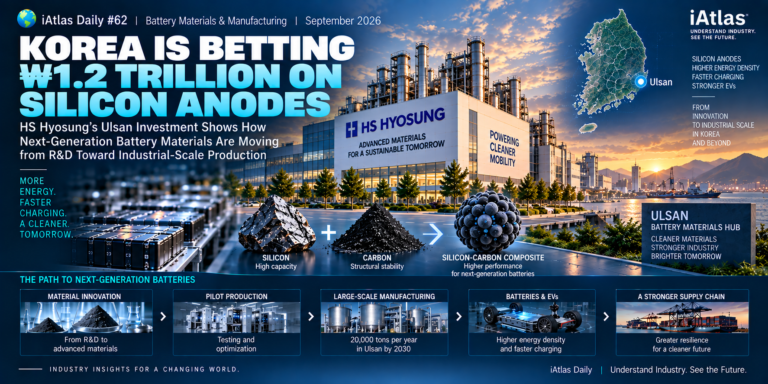
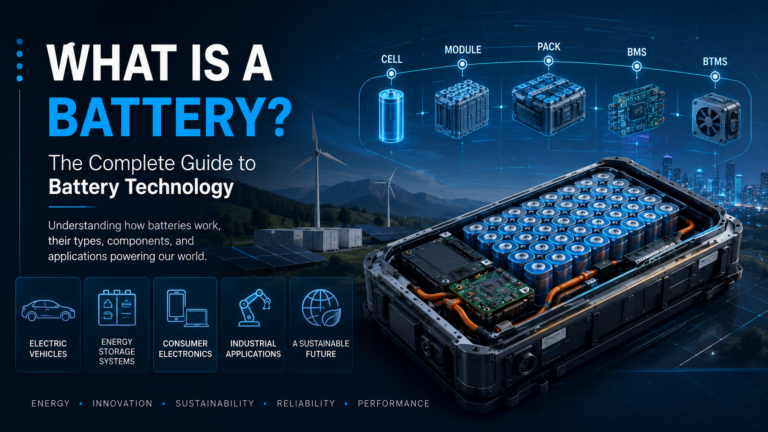
Advanced Battery Materials
Understand the fundamental structure of lithium-ion batteries and why changes in materials and electrolytes are important for next-generation energy storage.
Semiconductor Manufacturing
How Thin Film Deposition Builds Semiconductor Devices Layer by Layer
Explore how precision deposition and thin-film engineering enable increasingly complex semiconductor structures.
Industrial Competitiveness
Industrial Competition Is Moving Deeper into the Supply Chain
Discover why materials suppliers, equipment manufacturers, and upstream production capabilities are becoming central to global industrial competition.
References
Reporting on proposed U.S. research funding for advanced power semiconductors and strategically important materials.
2. Reuters — Samsung, SK Hynix Upgrading China Plants to Make More Advanced Chips (October 21, 2026)
Reporting on plans to advance NAND memory manufacturing technology and the regulatory challenges facing semiconductor production in China.
An EU-funded research initiative addressing industrial-scale production of perovskite-silicon tandem photovoltaic technology.
Research demonstrating scalable perovskite fabrication methods and high-efficiency tandem solar-cell performance.
5. Nature Reviews Clean Technology — Taking Perovskite Photovoltaics from Promise to Product (2026)
Analysis of the manufacturing, reliability, commercialization, and economic challenges facing perovskite photovoltaics.
6. Associated Press — U.S. Designates Helium as a Critical Material (October 2026)
Reporting on helium supply security and its strategic importance to semiconductor manufacturing and other technologies.
ℹ️ About iAtlas
iAtlas is an independent publication covering batteries, semiconductors, OLED, advanced materials, AI, and global industrial trends.
We transform complex industrial developments into clear, reliable, and easy-to-understand insights.
Whether you’re following today’s industry news or building long-term expertise, iAtlas helps you understand not only what happened, but why it matters.
Technology creates change.
Insight creates opportunity.
— iAtlas